
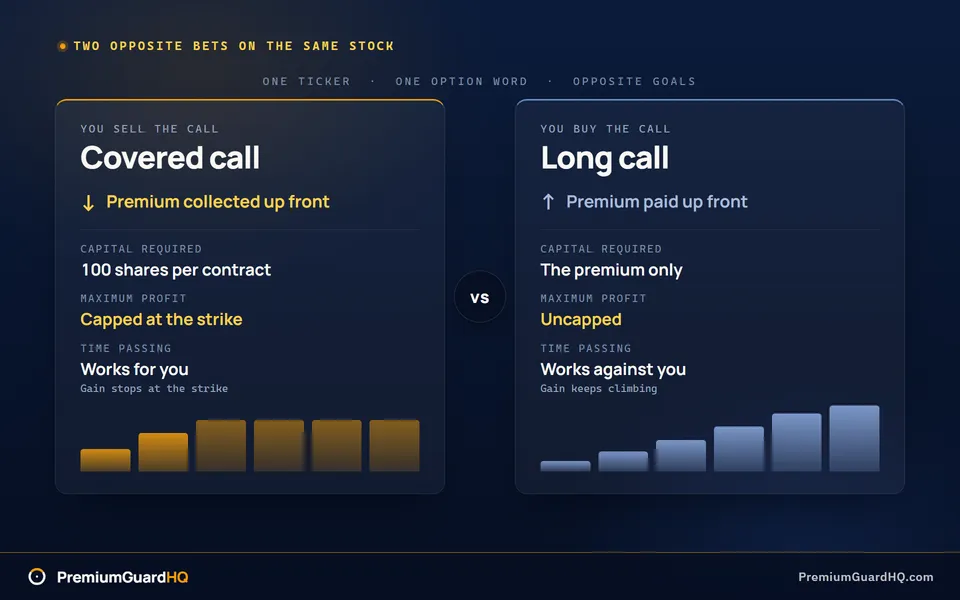
The same stock can carry two very different trades. A covered call means you sell someone the right to buy shares you already own and collect cash up front. That cash is called a premium. A long call means you pay a premium instead, buying the right to profit if the stock jumps.
Same ticker, same option word, opposite goals.
This guide comes from the PremiumGuardHQ team. We keep the payoff arithmetic plain, explain time and volatility in ordinary terms, and step through rolling, assignment, dividends, and taxes. We also point out where long calls win outright. By the time you finish, you will know whether you are chasing income or chasing upside, and which trade fits that goal.
Verdict: covered call is the operator default, long call is the big-move tool
A covered call generally fits better when you want steady income from stock you already hold. You get paid up front, and time works in your favor if the stock goes nowhere. A long call fits better when you expect a fast, sharp rally. Your potential gain is not capped, and your risk is limited to the premium you paid.
Treat a covered call like rent on shares you own. You receive cash now, but your gain stops at the strike price, the preset price where you agreed to sell. A long call is closer to buying optionality. You spend a known fee today for the chance at an outsized move later, and your total loss is capped at that fee.
If your thesis is a quick, event-driven breakout, speed matters more than income. In that case, a long call can beat a covered call, which gets run over by a sharp rally and caps your gain at the strike.
Covered call vs long call at a glance
Same stock, opposite positioning. Here are the basic payoffs and cash mechanics for each trade before time decay, implied volatility, and trade management come into play.
| Dimension | Covered call | Long call |
|---|---|---|
| Capital required up front | Cost of 100 shares per contract. A covered call means selling a call against stock you already own, so you need the shares first. | Just the option premium. That’s the cash you pay upfront to open the trade. |
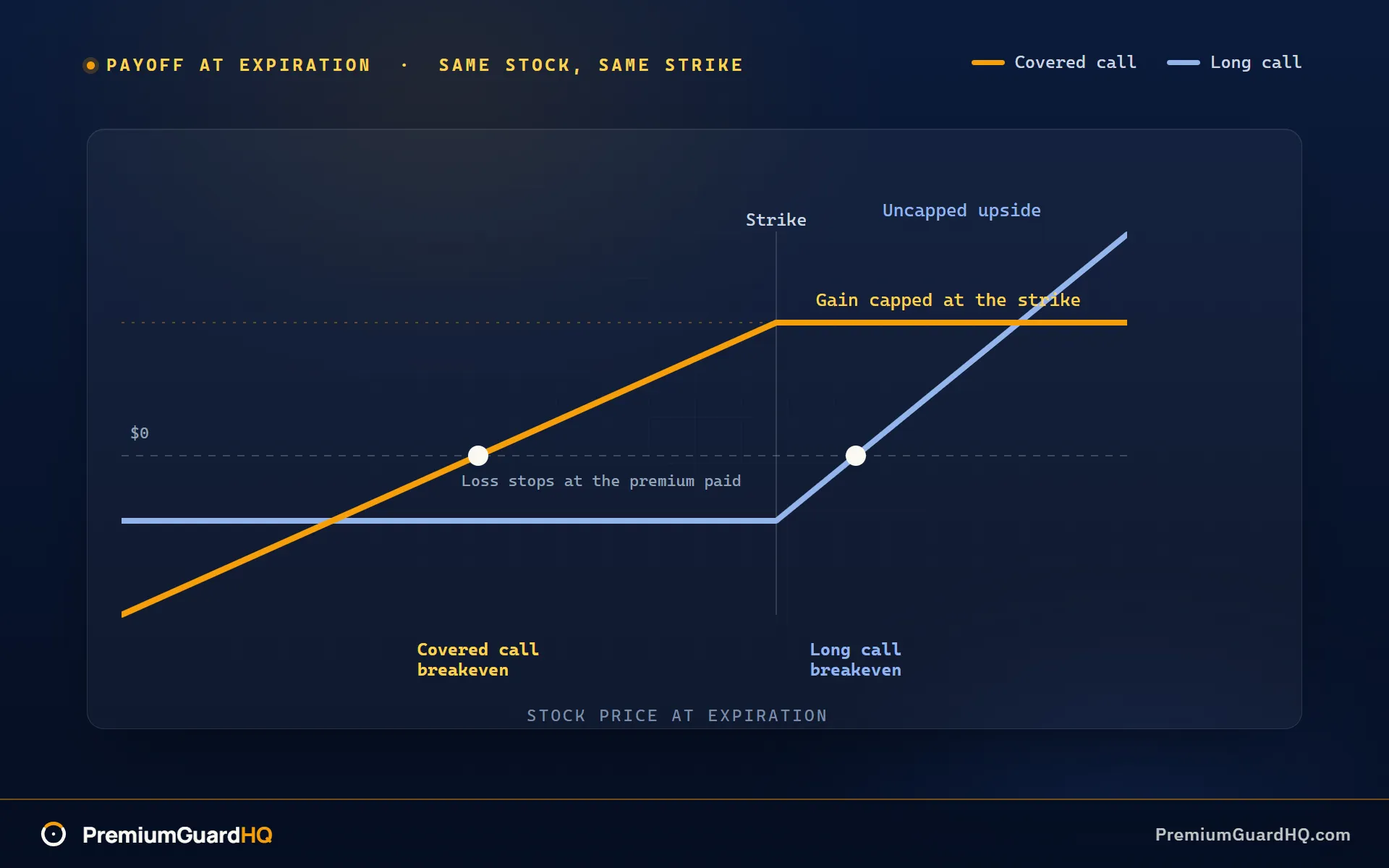
| Maximum profit | Capped. You keep the stock’s gain up to the strike price, plus the premium you collected. | No cap in theory. The more the stock rises, the more you make. |
| Maximum loss | Large if the stock falls hard, close to the loss you’d take just owning the stock outright. The premium you collected softens the blow a little. | Limited to the premium you paid. That’s the most you can ever lose. |
| Breakeven at expiration | Your stock purchase price minus the premium you collected. | The strike price plus the premium you paid. |
| If the stock does nothing | You likely keep the full premium since the call probably expires worthless. That lowers your effective cost on the stock. | The option loses value every day that passes. This is called time decay. The option can expire worthless, and you lose the whole premium. |
| What you’re really getting paid for | Time passing while the stock stays flat to mildly up. Traders call this selling theta, the daily value an option loses as it ages. | A real, fast move in the stock’s price, often paired with a jump in implied volatility, which is the market’s guess at how much the stock will move. |
Payoffs above depend on the exact strike and premium you pick, and on how assignment plays out. Assignment is when the option buyer exercises their right and you’re forced to deliver the shares. This table explains the concepts. It is not trade advice.
Payoff math and capital reality
What can you lose? What can you make? And how much of your money gets tied up along the way?
A long call is a paid right to buy a stock at a set price before a set date. If the stock climbs far above that price in time, you can earn a large gain. The most you can lose is the premium you paid, and your upside has no upper limit.
The catch is timing. If the stock does not climb high enough before the option expires, it becomes worthless. You lose the full premium, even if the stock rises later. You needed to be right on direction and on timing at the same time. Buying more runway is why some traders reach for long-dated call options instead of near-term contracts.
A covered call starts from the opposite side. You own the stock, or you buy it, and you sell someone else the right to buy those shares from you at a set price called the strike. You collect a premium right away. You need 100 shares for each contract you sell, so real money sits in the stock, not just in a small option premium.
The premium you collect adds to your return and lowers your breakeven. Your gain stops at the strike though. If the stock runs far past it, you will usually have to sell at the strike and miss the rest of the move. The part many traders overlook is that you still carry the stock’s full downside risk. The premium cushions a drop only slightly; it does not protect you from a sharp decline.
So start with where you already stand. If you own the shares, a covered call adds income and puts a ceiling on gains. If you do not want that much money tied up in stock, a long call gives exposure for the premium alone, but you are racing the clock the whole time. Note too that the two breakevens in the table are not the same kind of number: the buyer’s is set once, while the seller’s moves with every premium collected.
Winner: covered call wins for income operators who already want to hold shares. It can pay you even when the stock does nothing, because the premium keeps coming in. A long call needs the stock to move quickly just to overcome the value that time decay strips away each day.
But keep the other side honest. Long call wins when you expect a large, fast move up. A covered call caps your gain at the exact moment the stock does what you wanted. A long call lets you ride the full move with only the premium at risk.
If you run this over and over as an income process, sometimes called the Wheel, the hardest work shows up in bookkeeping. You need to know which cycles closed, what your true cost basis is after all the premiums, and how much you can pay yourself without shrinking the account. PremiumGuardHQ auto-detects each cycle across your brokers, fixes the cost-basis numbers your broker gets wrong, and runs a Safe Withdrawal Engine that shows the exact amount you can withdraw from closed cycles without eating into your capital.
Greeks and probability: time and volatility are the real opponent
Why do long calls lose money even when you get the direction right? Why does a covered call keep paying while the stock goes flat? The answer sits in a set of numbers called the Greeks. They measure how an option’s price responds to passing time and price movement.
A long call leans on three of these inputs, and all three need to line up. Delta tracks how much the option’s price moves for each move in the stock. When the stock and strike are roughly level, the call is at the money, and delta usually sits near +0.50. Theta tracks daily value loss from time passing. For a long call, theta is negative, so time works against you every day, whether the stock moves or not. Vega tracks how the option’s price responds to implied volatility, which is the market’s guess at how much the stock might swing. A long call has positive vega, so it gains when that volatility guess expands and loses when it contracts. You need the stock to move your way before time and a calm market eat the premium. You can be right on direction and still lose if the move comes too late or too slowly.
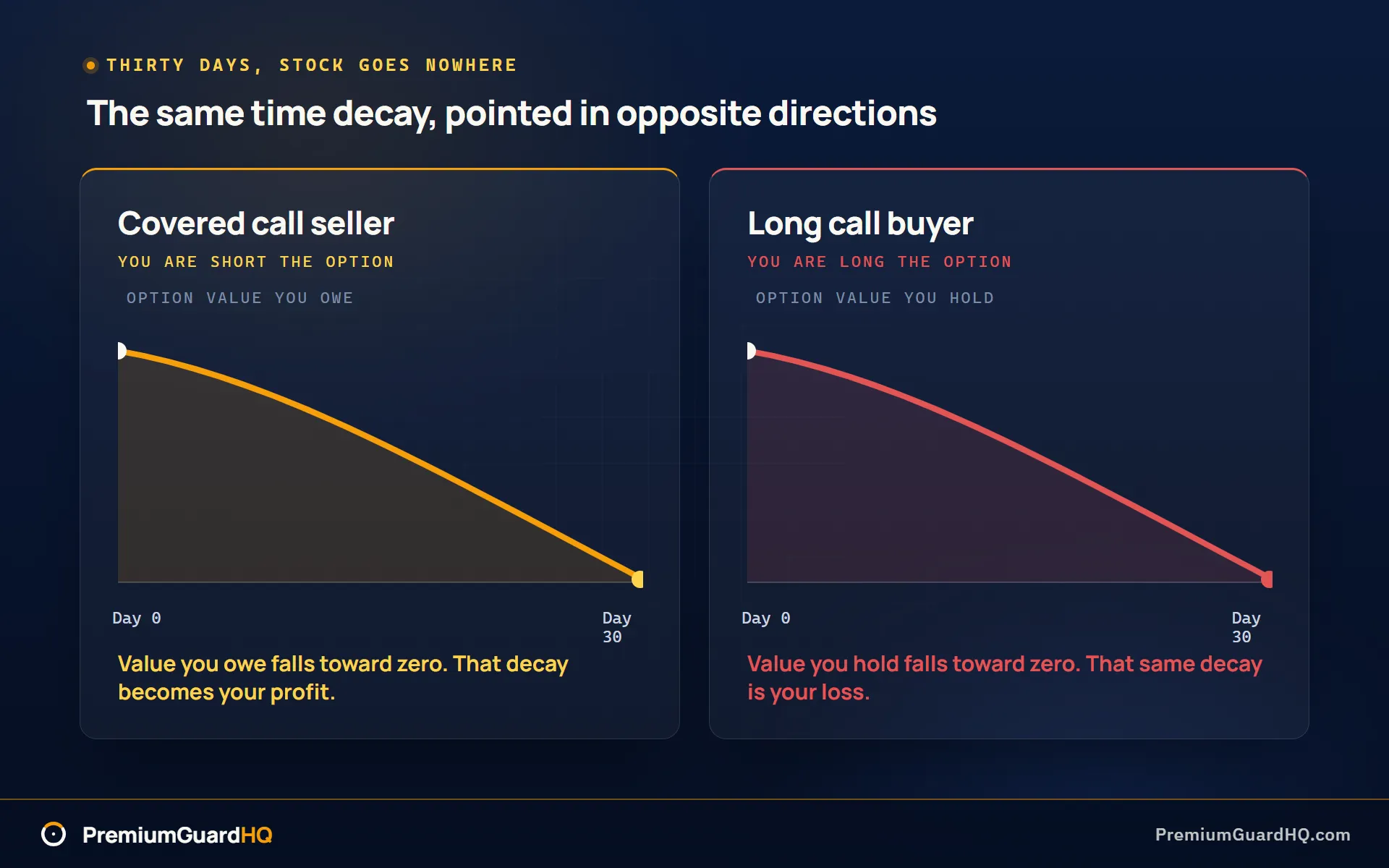
A covered call flips two of those values into your favor. You own 100 shares and you are short one call, so you sold it and owe the buyer if it is exercised. Your net delta is 1.00 minus the call’s delta. Theta turns positive. Each day the stock stays below your strike, the call you sold loses value, and that decay becomes your profit. Vega turns negative, so you prefer a quieter market. A muted stock keeps the option you sold from getting expensive again. In plain terms, a long call buys time and buys volatility. A covered call sells both, for cash today.
Imagine a stock that chops sideways for a month. That flat tape quietly helps the covered call seller and quietly punishes the long call buyer. The premium you sold keeps shrinking in your favor. The premium you bought keeps shrinking against you.
Now reverse the setup. Suppose you genuinely expect a large, fast move higher, perhaps around an earnings report or another catalyst. The long call is built for that job. Your potential gain has no ceiling, and as the stock climbs, delta expands, so the position picks up speed right when you need it. A covered call in that same rally can force you to sell shares at the strike and hand the rest of the move to someone else.
Covered call wins when your edge is patience, not prediction, because theta works in your favor every single day. Long call wins when your edge is correctly timing one big move.
The most common mistake is using the wrong tool. Buying calls in pursuit of steady income rarely works because time decay fights you the whole way. Selling covered calls when you want full, uncapped upside simply caps the gain you were trying to catch.
Management and real-world frictions: rolling, assignment, dividends and taxes
Once the trade is open, management begins. What happens after entry, and what can you do when the position moves against you?
A long call is simple to manage. You do not have to hold until expiration and exercise it. Most traders sell the option back to the market, or sell to close, and keep whatever value remains. If the stock never climbs above your strike plus the premium you paid, the option can expire worthless. Your loss stops at that premium. The main force working against you is time decay, the steady loss in value as each day passes.
A covered call becomes more hands-on once the stock rallies past your strike. The buyer of your call can exercise it, which forces you to sell your shares at the strike. This is called assignment. You keep the premium you collected, but you give up any gain above that strike.
If you want to avoid giving up the shares, you can roll. Rolling up and out is the typical move. First, buy to close the existing short call, which means buying back the option you sold. Then sell to open a new call with a later expiration and a higher strike. That gives the stock more room to run before you have to sell, and it often collects more premium along the way.
Dividends deserve attention as well. A call buyer may exercise early, before expiration, just to capture an upcoming dividend payment. This is more likely when the option has little time value left and the dividend is worth more than the remaining time value the buyer would forfeit. If you sell covered calls on dividend-paying stocks, watch the ex-dividend date. That cutoff day decides who receives the next payment.
Taxes add another layer. Covered call premium and long call gains can be taxed differently depending on holding period and the specifics of the trade. This article is not the place to nail down your exact tax bill. Confirm the details with a tax professional before you file.
Long calls win on simplicity of worst-case risk, because your loss is capped at a known premium from the start. Covered calls win on manageability for income operations, if you accept the assignment mechanics that come with the strategy. The seller can roll the position forward and keep collecting time decay, but has to stay alert to dividend dates and tax treatment along the way.
Run covered calls repeatedly across several tickers and accounts, and placing the trade is the easy part. The hard part is keeping the numbers straight through each roll, each assignment, and each withdrawal. PremiumGuardHQ is built for that job. It finds each cycle automatically, reconciles your adjusted cost basis to match what actually happened, and runs a Safe Withdrawal Engine that separates premium profit, stock profit, and real net income.
Choose the strategy that matches your job
The math shows how each trade behaves. Your job tells you which one to run.
Choose a covered call if you already own shares and want to get paid while you hold them.
- You collect the premium up front. Premium is the cash you receive for selling the option. If the stock stays flat or drifts up a little, the call expires worthless and you keep every dollar of that premium.
- Time works in your favor here. Each day that passes without the stock jumping past your strike, the option loses value, and that loss is your gain. The strike is the set price at which the buyer can buy the stock from you. In exchange for this steady edge, you accept a capped gain. Your profit stops growing once the stock moves past the strike.
Choose a long call if you expect a big, fast move up and want uncapped upside with a known worst case.
- Your gain has no ceiling. The most you can ever lose is the premium you paid, nothing more.
- This is the one honest spot where a long call beats a covered call. If your whole thesis is that the stock is about to run, a capped trade works against that thesis.
Choose a covered call if your real goal is to get paid for waiting, without selling the stock you hold.
- This trade is for getting paid to wait. You turn shares you already planned to hold into a small, steady stream of cash, one expiration at a time.
Choose a long call if you do not have, or do not want to tie up, the cash for 100 shares per contract.
- A covered call requires owning 100 real shares before you can sell a single contract against them. A long call only asks for the premium. That is a much smaller check to write.
Both strategies can be misused. The right pick is the one whose payoff matches your goal and time horizon, not the one that sounds more exciting. There is also a third door, which is to buy a fund that writes the calls for you; the case for and against paying a fund to run the covered call is its own comparison.
Frequently asked questions
What is a strike price in a call option?
The strike price is the contract’s fixed price at which the call buyer can purchase the stock before expiration. For a long call, it is the price you have the right to pay. For a covered call seller, it is the price where you may be forced to sell if the buyer exercises. Every payoff comparison above starts from this single number.
What happens if the stock does nothing in a covered call vs a long call?
The covered call seller comes out ahead. If the stock stays below the strike, the call usually expires worthless and the seller keeps the full premium as income. The long call buyer loses instead. Time decay chips away at the option’s value every day, and the option can expire worthless if the stock never climbs above the strike plus the premium paid.
Can I lose more than the premium on a long call?
No. A standard long call’s risk stops at the premium you paid. That limit applies to the option position itself, not to any stock you may separately choose to buy or hold. It is one of the cleanest and most predictable risk profiles in options, which is part of why long calls appeal to traders who want a known worst case.
Can I be assigned early on a covered call, especially around dividends?
Yes. Early exercise can make sense for the buyer when the option’s remaining time value is worth less than the upcoming dividend payment. The Management and real-world frictions section above covers this in more detail. Dividend-paying stocks add a calendar risk that dividend-free stocks do not carry, so covered call sellers should track ex-dividend dates.
What does it mean to roll a covered call?
Rolling means closing your current short call and opening a new one, usually with a later expiration, a higher strike, or both. The typical move, known as rolling up and out, buys back the existing call and sells a new one further out in time. It can give the stock more room to run and often brings in additional premium, but it never removes the core tradeoff between the premium you collect and the capped upside plus assignment risk you accept.
For repeatable covered call income, the real edge usually comes from tracking and discipline, not from locating the one perfect strike.