
You can click a LEAPS call into your brokerage ticket in about ten seconds. That’s the easy part. The hard part is knowing what moves its price after you own it.
LEAPS options stands for Long-Term Equity Anticipation Securities. That’s just a fancy name for an option that doesn’t expire for a year or more.
Many traders treat a LEAPS call like a slower, cheaper weekly option. It isn’t. The stock price is just one piece of the puzzle. Time left, implied volatility (a measure of how much the market expects the stock to move), and interest rates all push and pull on the price too, sometimes in opposite directions.
Maybe you want long-term exposure to a stock without paying full price for 100 shares. That’s a reasonable goal. But you don’t want a lottery ticket either.
By the end of this, you’ll know what a LEAPS call is, what drives its price day to day, and how to run one through a call option calculator before you risk a dollar. Serious operators run the numbers first instead of guessing.
What are LEAPS options
LEAPS are options with long expiration dates. They usually expire one to three years from now, which is much longer than regular options. A LEAPS call gives you the right to buy 100 shares of stock at a set price before it expires. This gives you long-term exposure to a stock’s price for a lot less cash than buying the shares outright. But it comes with a cost: time decay and swings in implied volatility work against you the whole time you hold it. Time decay means the option loses value simply as days pass. Implied volatility is the market’s guess about how much the stock might move.
LEAPS can be calls or puts. A call is a bet that the stock will go up. A put is a bet that the stock will go down. Most people who talk about “a LEAPS strategy” mean calls used as a long-term stand-in for owning shares.
Here’s a simple way to think about it. LEAPS give you long-term option exposure, but the option’s built-in risk factors decide whether you actually make money, not just which way the stock moves.
How LEAPS options work: what actually moves the price
A LEAPS call is an option with a long time left before it expires, often a year or more. One contract equals 100 shares. At the end, a LEAPS call pays out max(0, stock price minus strike price) times 100. The strike price is the set price you have the right to buy the stock at. If you hold a $50 strike call and the stock ends up at $70, your payoff is $20 times 100, or $2,000. If the stock ends up at $40 or lower, the payoff is $0.
That formula only applies on the very last day. Every day before that, the price on your screen is made of two separate pieces. Mixing them up is why traders get confused when their option doesn’t move the way they expected.
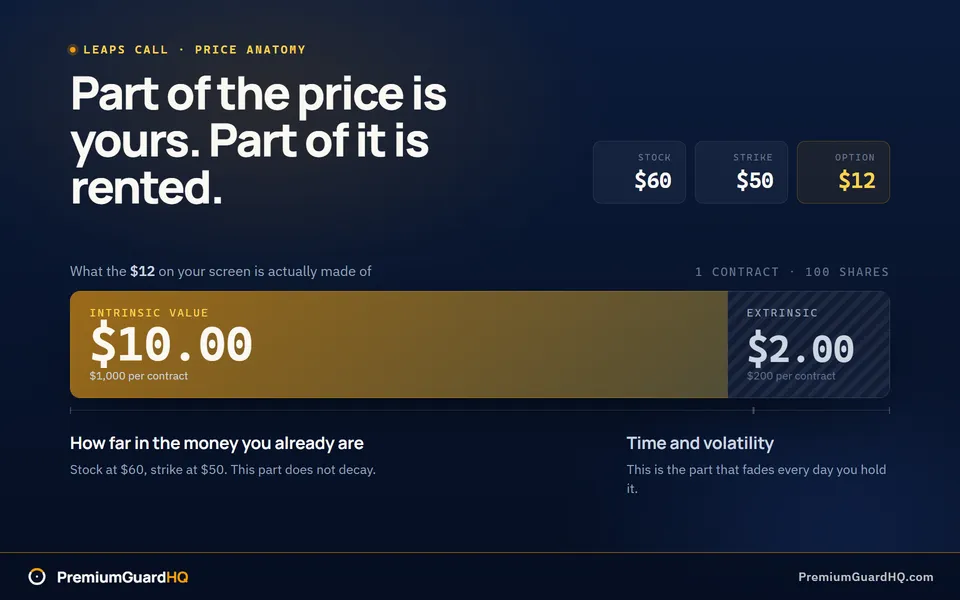
Intrinsic value is how far in the money the option already is. If the stock is at $60 and your strike is $50, you have $10 of intrinsic value, or $1,000 per contract. Extrinsic value is everything else you’re paying for. That includes the time left before expiration and the market’s guess about how much the stock might move. A $12 option on that same $50 strike has $10 of intrinsic value and $2 of extrinsic value.
The Greeks that actually drive LEAPS pricing
You need to know what the option Greeks do to your position, not memorize the formulas behind them.
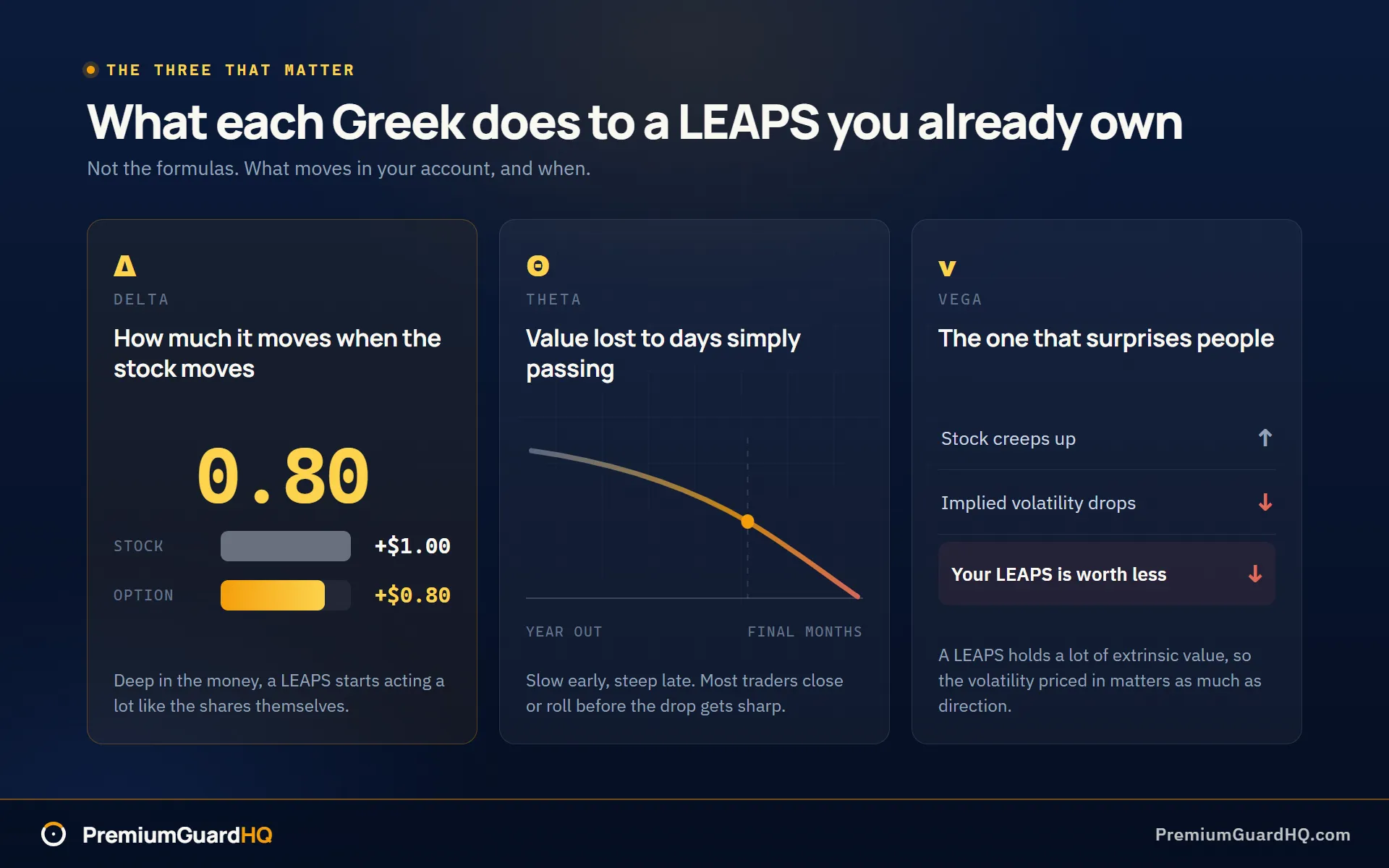
- Delta shows how much the option price tends to move for every $1 move in the stock. A delta of 0.80 means the option gains roughly 80 cents when the stock gains a dollar. Deep in-the-money LEAPS carry high delta and start acting a lot like owning the stock itself.
- Theta measures time decay, how much value the option loses just from days passing. Theta moves slowly early in a LEAPS’ life and speeds up as expiration gets closer. This is why many traders close or roll a LEAPS well before the final few months, instead of riding it into the steep part of the decay curve.
- Vega measures how much the option price moves when implied volatility changes. Implied volatility is the market’s guess about how much the stock will swing in the future. LEAPS carry a lot of extrinsic value, so they are often more sensitive to volatility than short-term options. This is the part that surprises people most. If implied volatility drops after you buy, your LEAPS can lose value even if the stock crept up a little. The stock going up isn’t enough. The volatility priced into the option matters just as much.
Why the strike you pick changes everything
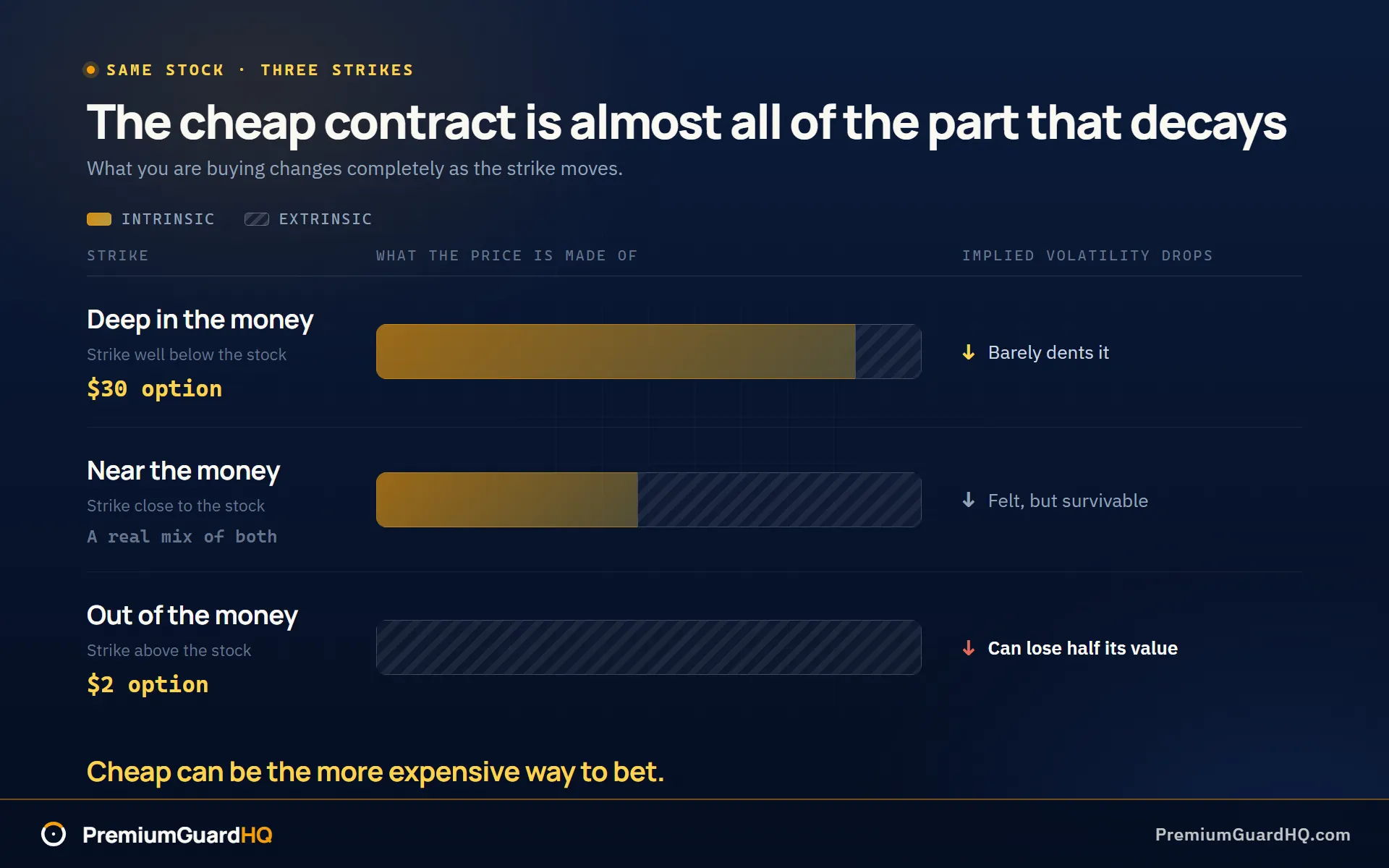
A deep in-the-money LEAPS has a strike well below the current stock price. It is mostly intrinsic value, so it behaves more like stock, with less time decay dragging on it day to day. An out-of-the-money LEAPS has a strike above the current price. It is almost entirely extrinsic value, which is why it looks cheap.
Cheap options carry the highest percentage sensitivity to time decay and to swings in implied volatility. A $2 option can lose half its value from a volatility drop that barely dents a $30 option. That’s why “cheap” can end up being the more expensive way to bet.
Liquidity and what you actually pay to trade
The bid-ask spread is the gap between what buyers offer and what sellers ask. It’s a real cost you pay the moment you open the trade. Open interest and volume, the number of open contracts and the number traded that day, are rough gauges of how easily you can get in and out.
Thinly traded LEAPS often fill well away from the mid price, the midpoint between the bid and ask. A limit order, an order that only fills at your chosen price or better, protects you from a bad fill, and that’s not optional here.
What a LEAPS call cannot do
A LEAPS call is a decaying asset. If the stock goes nowhere long enough, the option can lose money even without a crash. The most you can typically lose is the premium, the price you paid for the option. That sounds small, but it isn’t a small risk. It just means you paid all of that risk upfront, on day one, instead of over time. It is the mirror image of collecting premium instead of paying it, where the cash lands first and the obligation shows up later.
How to buy LEAPS call options: a checklist and calculator workflow
Buying a LEAPS call is not one decision. LEAPS stands for Long-Term Equity Anticipation Securities, which just means an option with more than a year until it expires. Buying one is really a chain of smaller decisions, each one shaping the next. Here is the order that keeps you from skipping a step that matters.
Step 1: Decide the job of the LEAPS call. Are you using it as a stand-in for owning 100 shares of stock? Then your goal is to move like the stock, not to swing for a huge win. Or are you making a straight bet that the stock goes up? That second path accepts more sensitivity to time and to implied volatility, which is the market’s guess about how much the stock will move. In exchange, you get bigger gains or losses from a smaller amount of money. Name the job first. Your strike price, your delta target, and how much implied volatility risk you can stomach all follow from that one answer.
Step 2: Pick an expiration date that matches your thesis. Most LEAPS buyers pick dates far out, often 9 to 18 months or more, so the trade has time to work out. Theta is the daily cost of time decay, the value an option loses just from time passing. Theta grows into a bigger headwind the closer you get to expiration. Set a date to check on and manage your trade well before it expires. Do not just hold and hope.
Step 3: Choose your strike using delta, not a gut feeling. Delta measures how much an option’s price moves when the stock moves one dollar. A common range for stock-replacement trades is roughly 0.70 to 0.80 delta. Some traders go deeper, to 0.80 or 0.90, to shrink the part of the price that is pure time value, called extrinsic value. A lower delta option costs less and moves more per dollar risked, but it leans harder on time and implied volatility to make the trade work. Quick filter: skip contracts where most of the price is extrinsic value, unless you are deliberately betting on a sharp, fast move.
Step 4: Check implied volatility before you pay for it. Buying when implied volatility is high means paying up for uncertainty that may not stick around. Look at IV rank, which compares today’s implied volatility to its own recent history. If implied volatility drops after you buy, a factor called vega can drag your option’s value down even while the stock price inches higher. If your trade only works because implied volatility stays this high, that is a fragile trade.
Step 5: Treat the fill as part of the trade. A fill is the price you actually get when your order executes. Look for tight bid-ask spreads, real open interest, and steady daily volume. These tell you other people are actively trading this contract, so you can get in and out at a fair price. Use a limit order, which lets you set the exact price you are willing to pay. Expect some slippage, the small gap between the price you wanted and the price you got. That spread cost gets paid once on entry and often again on exit.
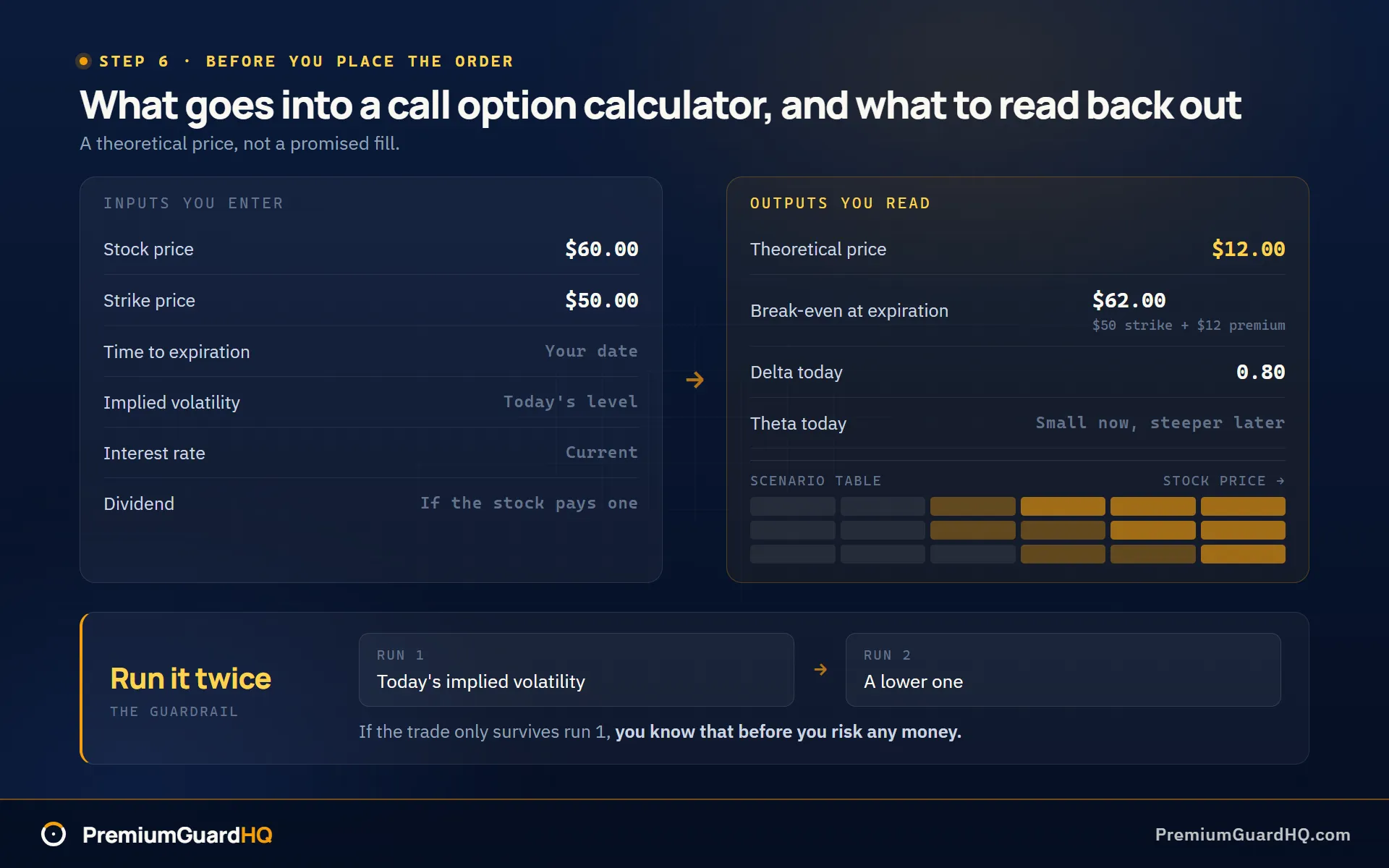
Step 6: Model it in a call option calculator before you place the order. A call option calculator estimates a theoretical price for the option based on the numbers you enter. It does not promise you will get that exact fill.
- Enter these inputs: the stock’s current price, the strike price, time left until expiration, implied volatility, the interest rate, and dividends if the stock pays one.
- Read the outputs like an operator: the theoretical price, the break-even price at expiration (strike plus premium paid, per share), today’s delta and theta, and a scenario table. The scenario table shows what the option would be worth on a future date across several possible stock prices. Use that table to test time and price movement together, not price movement alone.
- Guardrail: run the model once using today’s implied volatility, then run it again using a lower one. If the trade only survives at today’s high level, you now know that before you risk any money.
- Then check the shape at expiry: a theoretical price tells you what the contract is worth now, not what the position does if you hold it. Drop the same strike and premium into the options profit calculator and it draws the payoff at expiration, marks the breakeven, and shows the most you can lose, which is the premium and nothing more.
Step 7: Set your monitoring rules before you enter, not after. Plan an exit or roll date before the steep, late-life decay window covered earlier in this guide. As delta climbs toward 1.0, the option starts behaving almost exactly like owning the stock. Some traders roll into a new contract at that point to use their capital more efficiently. Decide your maximum tolerated loss in premium, the dollar amount you are willing to lose, and your time-based exit point now, while you are calm and not staring at a losing position. A LEAPS can lose a large chunk of its value with months still left on the clock. That isn’t a malfunction: it’s extrinsic value doing exactly what it does as time passes.
Where this fits in a broader plan: Some traders pair a long LEAPS call with selling shorter-dated calls against it, collecting extra premium along the way. That combination is a separate topic worth its own explanation. What matters here is simpler: however you run this trade, your cost basis, the credits you have collected, and your real gain or loss can quietly drift from what your broker’s screen shows over time. Your real gain or loss only settles when the position closes, and keeping those numbers straight matters just as much as picking the right strike.
Frequently asked questions
Are LEAPS only calls?
No. LEAPS just means a long-dated option, one with a year or more until it expires. It can be a call, which is a bet the stock goes up, or a put, which is a bet the stock goes down. Most “LEAPS strategy” talk you’ll see online focuses on calls. That’s because a call is a simple way to get long-term upside in a stock while risking less cash than buying 100 shares outright.
Why not just buy far out-of-the-money LEAPS since they’re cheaper?
Cheap usually means low delta, which is explained above as how much the option moves per dollar of stock movement. It also means most of what you paid is extrinsic value, the time and volatility premium covered earlier. That combination cuts two ways against you. Time decay eats a bigger share of the price, and swings in implied volatility hit harder. The stock also has to move further just to get you to break even.
What delta do traders usually target for LEAPS calls?
For a stock-replacement style trade, meaning you want the option to act like owning the shares, many traders aim for roughly 0.70 to 0.80 delta. That’s a middle ground between stock-like price movement and not tying up too much cash. Going deeper, to 0.80 or 0.90 delta, shrinks the extrinsic value even further. But it also means more cash tied up per contract and a smaller payoff per dollar risked, so weigh that trade-off against your actual goal from Step 1 above.
When does theta become a real problem on LEAPS?
Theta, the daily cost of time decay, isn’t constant. It stays fairly small early in a LEAPS’ life and speeds up as expiration gets closer. Most experienced traders don’t wait for expiration day to deal with this. They set a date to manage, roll, or close the position well before the final few months, when decay steepens the most. Treating expiration as a deadline rather than a finish line is the difference between managing theta and getting run over by it.