
Your short call is in the money. That means the stock price has passed your strike price, so you’re on track to lose your shares or take a loss. Your finger is hovering over the “Roll” button. Stop.
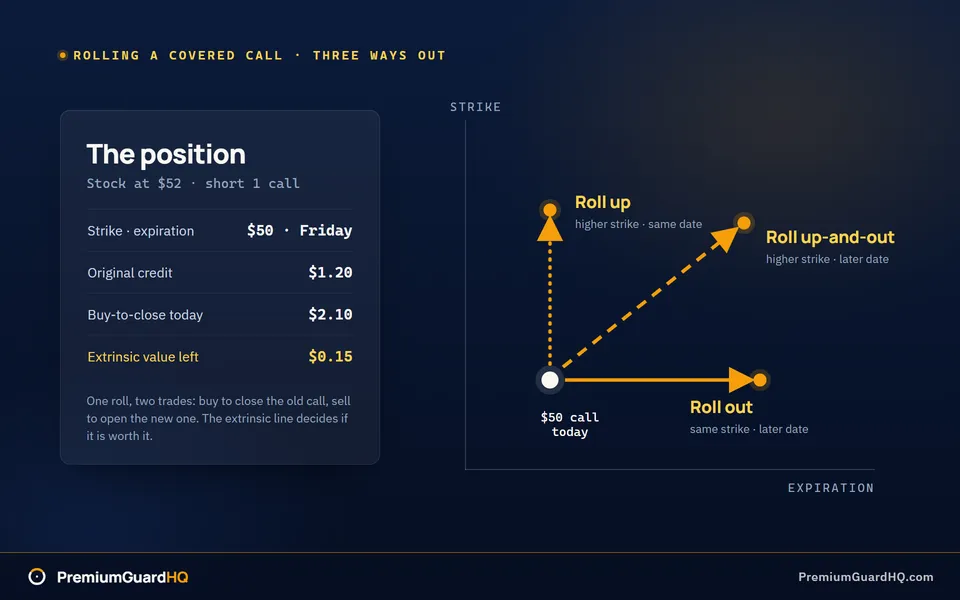
Rolling covered calls means closing your current contract and opening a new one. You pick a new date, a new strike price, or both. This happens in one move with two parts: you buy to close (BTC) the old contract, then sell to open (STO) the new one. Done right, this is a controlled adjustment you choose on purpose. Done on emotion, it just delays a loss and calls it a plan.
This guide gives you a repeatable process. First, pick your goal. Next, price the roll with a clean net credit or debit test, so you know if you get paid to make the trade or pay out of pocket. Then place the order. Finally, handle assignment and any tax costs that come with it. Assignment simply means you’re forced to buy or sell the stock.
Rolling changes the contract. It does not change the risk in the stock itself. That choice always stays yours.
Before you click Roll, get your numbers and dates in front of you.
Before you start: the numbers and dates you need to roll a covered call
Rolling means closing your current call option and opening a new one, usually at a later date or different strike price. It’s a math problem, not a gut call. Gather these numbers first so step 1 is just plugging them in, not hunting for them.
Position inputs. Write down: ticker, shares owned (100 per option contract), current stock price, your short call’s strike price and expiration date, the credit you got when you sold it, and today’s cost to buy to close. That last figure is what it costs right now to buy back that same contract and cancel your obligation.
Option quality inputs. Check the extrinsic value left, meaning the time value still in the option’s price. Also check the bid/ask spread, the gap between buy and sell prices. A wide spread means the option is hard to trade at a fair price.
Three dates. Note the next ex-dividend date if the stock pays one. Miss this and you risk early assignment, meaning your shares get bought away from you before expiration. Also note your option’s expiration date and your own decision deadline, like “review at 21 days to expiration (DTE).”
Account readiness. Confirm your broker allows multi-leg orders, so you can place the buy-to-close and the new sell-to-open as one order, or as two linked orders.
A place to log it. Keep a spreadsheet or tracker ready to record the net credit or debit from the roll and your new cap, the price where your shares get called away if the stock rises above it.
With these in hand, step 1 is just filling in the blanks.
Step 1: snapshot the position and define your roll objective
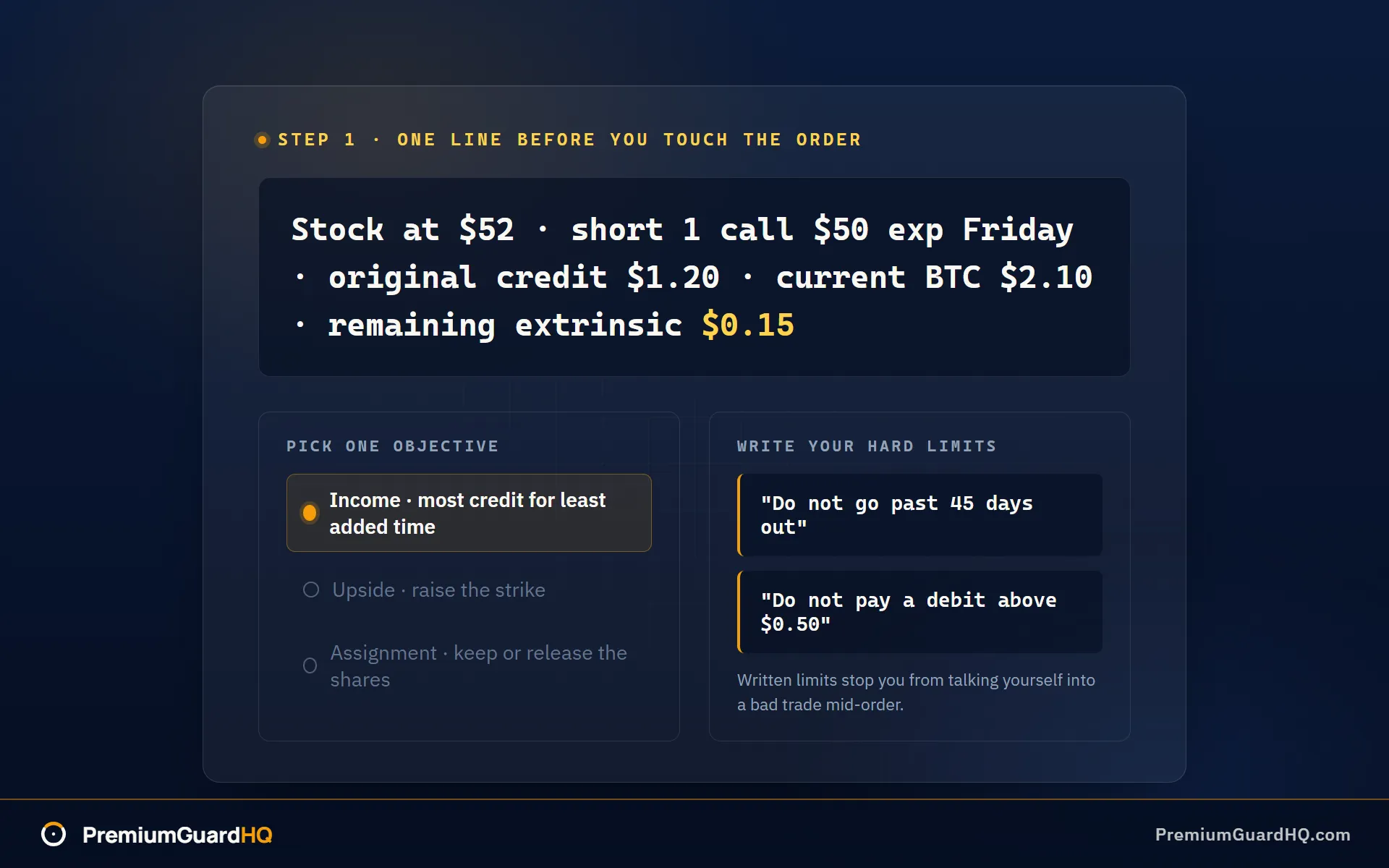
Grab the numbers you gathered above and write one line. Use this format: Stock at $52; short 1 call $50 exp Friday; original credit $1.20; current BTC $2.10; remaining extrinsic $0.15.
The last number matters most. Extrinsic value is the time value left in the option’s price, the part that isn’t just the option’s built-in loss. When extrinsic value is close to zero, most of what you’d pay to buy back the option is just covering that loss, not real time value. That tells you a roll buys you very little.
Next, say the mechanics plainly. Rolling a covered call means selling a new call option against stock you own, after closing your old one. It’s really two trades:
- Buy-to-close (BTC): you buy back the short call you have now.
- Sell-to-open (STO): you sell a new short call with a new strike price, a new expiration date, or both.
Nothing else happens. You are not “saving” a position. You are closing one contract and opening a different one.
Now pick one objective for this roll. Don’t mix them:
- Income objective: collect the most net credit, meaning the cash you keep, for the least added time.
- Upside objective: raise the strike price so you get more if your shares get called away, meaning sold at the strike price.
- Assignment objective: decide, honestly, if you want to keep these shares or let them go.
Finally, write your hard limits. For example: “Do not go past 45 days out” or “Do not pay a debit above $0.50.” Written limits stop you from talking yourself into a bad trade mid-order.
You should now have a one-line snapshot, one named objective, and one written limit sitting in front of you.
Step 2: price the roll: build up, out, and up-and-out candidates and compute net credit or debit
Open your broker’s option chain, the list of every strike price and expiration date for your stock. Build three roll candidates. Use the same number of contracts you hold now for all three.
- Roll out: Same strike price, later expiration date.
- Roll up: Higher strike price, same expiration date. This usually costs you money, called a debit.
- Roll up-and-out: Higher strike price and later expiration date. This can sometimes pay you money, called a credit.
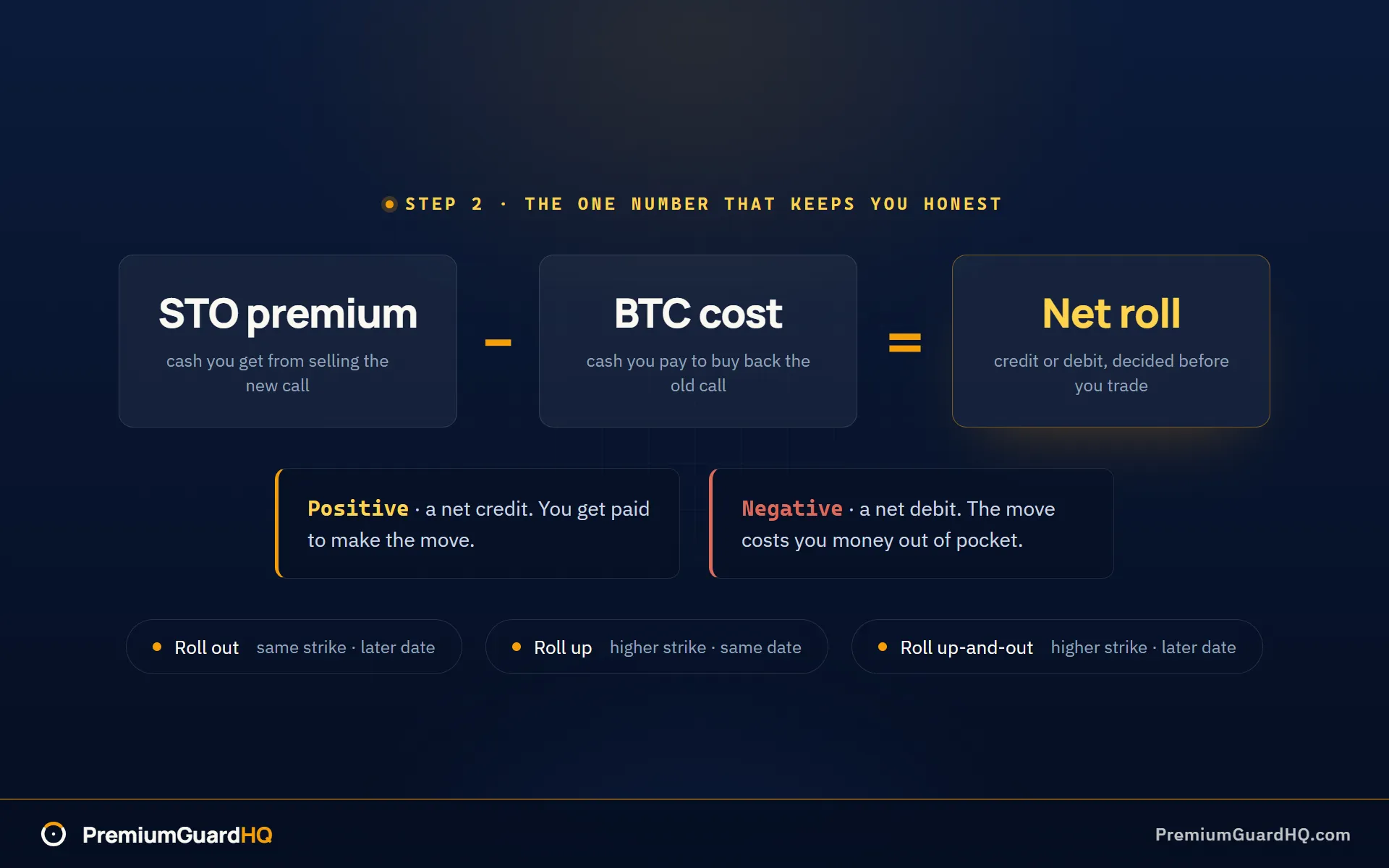
For each candidate, compute one number. This number keeps you honest about what the roll really costs or pays:
Net roll = STO premium (cash you get from selling the new call) − BTC cost (cash you pay to buy back the old call)
A positive number means you get paid to make the move. A negative number means the move costs you money out of pocket. You can sanity-check the new leg’s income and return math with the covered call calculator before you commit.
Next, run two quick checks on each candidate:
- New sale cap: Compare the new strike price to today’s stock price. This tells you how much room is left before your shares get called away, meaning sold at the strike price.
- Time extension cost: Count the extra days you’re tying up your shares and your cash in this trade.
Pick the candidate that matches the goal you wrote down in Step 1. Don’t pick based on how a trade feels in the moment.
You should now have at least one roll candidate with a known net credit or debit. You’ll also know exactly what you’re gaining, whether that’s more time, a higher strike price, or more income, and what you’re giving up, whether that’s a debit paid, upside still capped, or cash tied up longer.
Step 3: execute the roll as one order (and verify you actually closed the old call)
Every broker builds this trade the same way. It doesn’t matter if you use Schwab, Fidelity, or Interactive Brokers. The roll is always a two-leg order, meaning an order with two parts that fill together:
- Leg 1: Buy-to-close (BTC). This closes the call you currently hold.
- Leg 2: Sell-to-open (STO). This opens the new call from the candidate you picked in Step 2.
Enter both legs as one limit order, an order that only fills at the price you set or better, for the net credit or debit you calculated. Do not use a market order. On a wide bid/ask spread, meaning the gap between the buy price and the sell price, a market order can fill at a much worse price than you planned.
If your broker has a one-click “Roll” button, you can use it. Still, check the order ticket before you submit it. Confirm both legs show the right strike price, the right expiration date, and the right number of contracts. These buttons sometimes default to the wrong month or the wrong size.
Submit the order. If it does not fill within a few minutes, move your limit price a small step closer to the mid-price, the midpoint between the bid and the ask. Then try again. Keep adjusting in small steps until it fills.
Once the order fills, open your positions tab. Check two things:
- Your old call shows a quantity of zero. This means it is fully closed.
- A new short call appears with the strike price and expiration date you picked.
You should now have your old covered call closed and a new short call open, with the exact strike, expiration, and net credit or debit you planned for.
Step 4: roll out for income: the clean adjustment when the call is OTM or near the money
Use this move when your short call is out of the money (OTM). That means the stock price is still below your strike price, the price you agreed to sell your shares at. It also works if the price is sitting close to your strike. Your only goal here is to keep collecting cash.
Build the new trade the same way you did in Step 2: same strike price, later expiration date. Most income traders push out to 30-45 days to expiration. Match whatever cadence you already run from your covered call income workflow.
Check the math before you touch anything:
- Prefer a net credit. This means you get paid to extend the trade, instead of paying out of pocket.
- Compare credit per day. Divide the net credit by the extra days you’re adding. A roll that pays $30 for 10 extra days beats one that pays $40 for 30 extra days.
Roll sooner rather than later. Earlier rolls usually have more time value left in the option. That’s the extrinsic value, the part of the option’s price tied to time and uncertainty, not just the stock price. More time value left means you’ll often collect a better credit per day than if you wait until the option is almost out of time.
Before you submit, confirm the new strike still fits your plan. Ask yourself: if the stock reaches that strike price and your shares get sold, are you still happy selling at that price? If not, pick a different strike.
Execute the trade. Log three things: the new expiration date, the net credit you collected, and your running total premium for this cycle.
You should now hold the same covered call, pushed to a later date, at the same strike, for a net credit. Write down your new expiration date and your updated income total.

Step 5: roll up or up-and-out to regain upside after a rally
Use this move when a stock has jumped up fast and your short call is now blocking profits you’d rather keep. That short call is simply the contract you sold that caps your gain. Build two options side by side before you choose.
- Roll up (same expiration date): Move to a higher strike price, same date. A strike price is the set price you agree to sell your shares at. This usually costs you cash out of pocket, called a net debit.
- Roll up-and-out (higher strike, later date): This sometimes pays you cash instead, called a net credit.
Run both choices through the net roll formula from Step 2. Then use one simple rule before you place the order: if the trade costs you cash, write down two things. First, what you’re buying: extra upside room between your old strike and your new one. Second, what you’re giving up: cash today, and often more time with your shares locked into the trade.
Pick the net credit version whenever one is available. If you must pay cash, never pay more than the limit you set for yourself back in Step 1. Don’t talk yourself into a bigger number in the moment.
Place the roll. As soon as it fills, write down your new cap number, meaning the new strike, which is the price you’ll sell at if your shares get called away. Called away simply means the buyer exercises their right to buy your shares at the strike price.
You should now hold a higher strike price, a later expiration date if you rolled out, and a clear answer to one question: did you get paid, or did you pay, to hold onto more upside?
Step 6: roll ITM and deep ITM covered calls: decide between assignment, time extension, and dividend-driven early assignment risk
Now for the hard case. Your call is in the money (ITM), or even deep in the money. This means the stock price is above your strike price, the price you agreed to sell at, sometimes far above it.
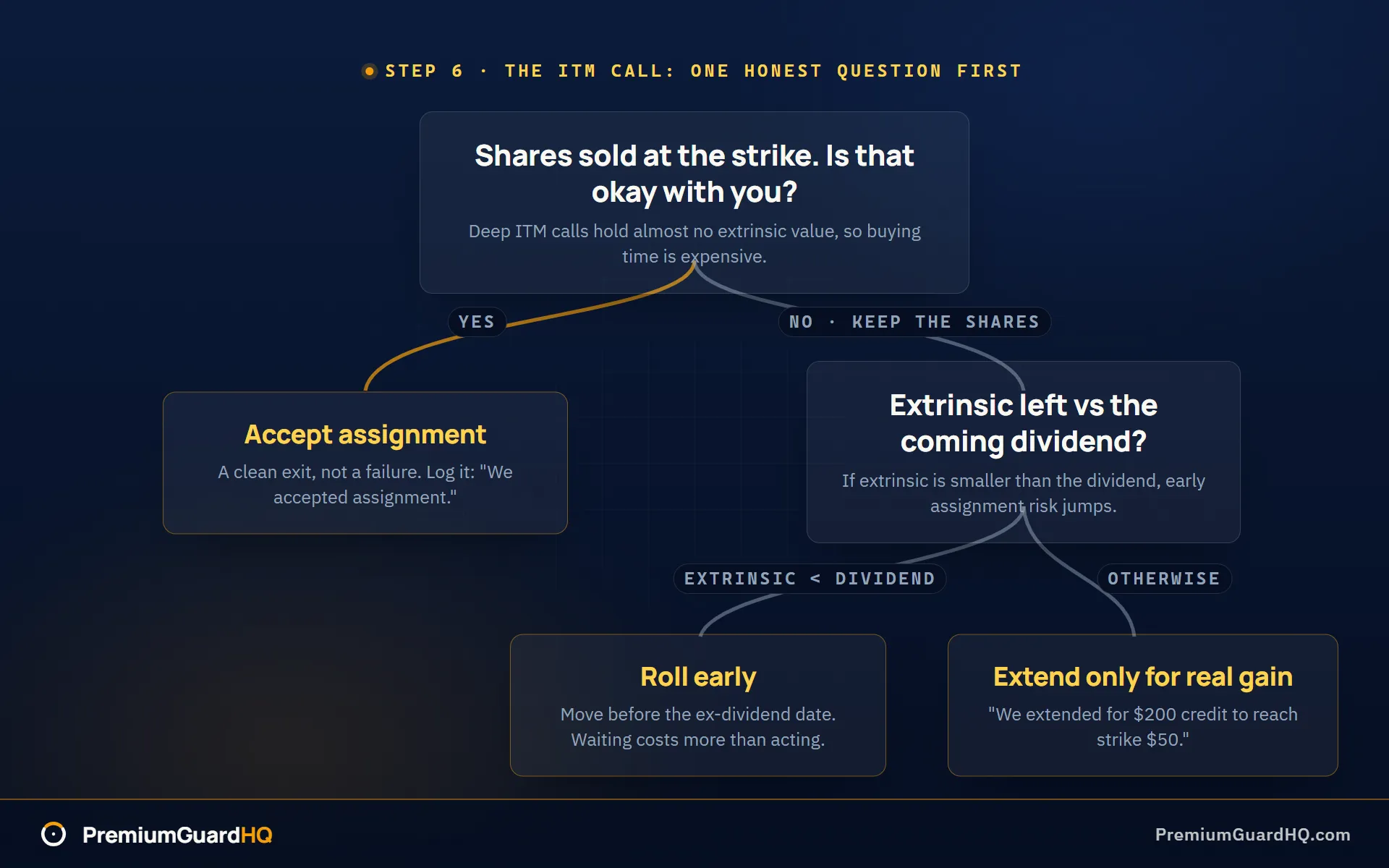
Before you look at rolling, ask one honest question: if your shares get sold at the strike price, is that okay with you? If yes, stop here. Letting your shares go, called assignment, is a clean exit. It is not a failure.
Want to keep the shares instead? Check the math first. Deep ITM calls usually have very little extrinsic value left, meaning the time value part of the option’s price, separate from its built-in profit. That makes it hard to roll for any real gain. You will often pay a steep fee just to buy more time, without improving your position.
Next, check for dividends. Does the stock pay one? If the extrinsic value left is smaller than the upcoming dividend payment, your risk of early assignment jumps before the ex-dividend date, the cutoff date for earning that dividend. Inside that window, roll early. Waiting costs you more than acting sooner.
If you do decide to roll, pick a new strike that either:
- Raises your strike price by a meaningful amount, so you can still profit if the stock rises further, or
- Pays you a credit big enough to justify tying up your money for longer.
Write the decision down like a business choice, not a guess. For example: “We accepted assignment” or “We extended for $200 credit to reach strike $50.”
You should now have a documented plan for ITM and deep ITM calls. This plan covers whether you will accept assignment or roll, and it accounts for early assignment risk around dividend dates and the real cost of extending time.
Step 7: roll down after a drop (or pause calls)
Use this move when the stock has dropped hard. Your short call, the option you sold, is now far out of the money, or OTM. That means the stock price sits well below your strike price, the price you agreed to sell at. The call now pays you almost nothing to keep it open.
You have two choices. Don’t pick the first one just because it feels like “doing something.”
Choice 1: Roll down. Buy back the old call. This is called buy-to-close, or BTC. Then sell a new call at a lower strike price and a later date. This is sell-to-open, or STO. Use the same net roll math from Step 2. You want a net credit, which means you collect more cash than you spend.
Choice 2: Pause the calls. Close the call, or just let it expire. Don’t sell a new one yet. Use this choice when every lower strike would force you to sell your shares at a price you’d regret later.
If you roll down, write this one line before you place the order:
“We collected $___ more premium, but lowered the potential sale price from $___ to $___.”
That sentence is the whole decision. If it makes you wince, don’t place the trade.
Follow two rules. Only pick lower strikes you would still accept as a real exit price. Never turn a temporary drop into a locked-in bad sale just to collect a small credit.
Place your order. Then write down what you did:
- If you rolled down, log the new strike as your new cap, the highest price you’ll accept.
- If you paused, log the exact condition that brings you back. For example: “Resume calls once the stock reclaims $45.”
You’ll now have one of two things. Either a new lower-strike covered call is open, with a clear net credit and an exit price you’ve accepted. Or you’ve paused the calls on purpose, with a clear rule for when you’ll start again.
What success looks like after you roll a covered call
You should be able to check your roll in under a minute. Here’s the list:
Position check. One short call open, matching your 100 shares (or 200 for two contracts). No leftover old contract sitting in your account.
Contract check. The strike price and expiration date match the candidate you picked earlier. Not close. Exact.
Economics check. State the whole roll in one number: “I collected a $40 net credit” or “I paid a $15 net debit.” If you can’t say it in one sentence, go back and check your fills.
Cap check. You know your new sale price if assigned, meaning the stock gets called away from you. State it plainly: “My shares sell at $52 if the stock is above that price at expiration.”
Calendar check. Two reminders are set: any ex-dividend date risk, and your next review date, like 21 DTE, meaning 21 days before the contract ends.
Ledger check. The closed leg’s profit or loss is logged. The new short call is tracked as its own fresh position, separate from the old one.
If any check fails, fix it now. A wrong strike or a missing reminder is a small problem today. It becomes a real risk the longer it sits unnoticed.
Tips and troubleshooting
Rolling is a new trade, not a fix. If the roll doesn’t get you a better cap, more time, or a real net credit, meaning cash into your pocket, not out of it, it isn’t helping. Accept assignment, letting your shares get sold at the strike price, and put that cash into a fresh position instead. From cash, the next trade is usually a put, and selling a put is a different promise than selling a call.
Don’t wait until the last day. Extrinsic value, the time-value part of the option’s price, shrinks fast near expiration. Wait too long and rolling up often costs you money instead of paying you. Decide early. You keep more choices open that way.
Check for dividend risk. If the extrinsic value left is smaller than the next dividend payment, assignment risk rises before the ex-dividend date, the cutoff for earning that dividend. Manage the position earlier, or accept assignment as your planned outcome, as step 6 covered.
Watch your holding period and tax status. Each new call you sell can be “qualified” or not. That’s a tax rule affecting your stock’s holding period, meaning how long you’ve owned the stock, which decides your tax rate. Deep ITM calls, where the strike price sits well below the stock price, can reset or pause that clock. If you’re managing for long-term capital gains tax rates, check this every time you roll.
Don’t assume your broker catches every wash sale. A wash sale happens when you sell stock at a loss and buy it, or something “substantially identical,” back within 30 days. The IRS uses that broad “substantially identical” standard, but brokers often only flag identical contracts on the same account. So this risk can slip through even when you sell at a loss and rebuy within 30 days, including across different accounts. When you’re not sure, bring your full trade ledger to a CPA.
Frequently asked questions
What does it mean to roll an option?
Rolling is really two trades placed together. First, you buy to close (BTC), meaning you buy back the contract you already sold, ending your obligation on it. Second, you sell to open (STO) a brand new contract, usually with a different strike price, a different expiration date, or both. The old contract’s profit or loss becomes final the moment you close it. The new contract is a fresh position with its own risk, its own strike, and its own cap, the price your shares get sold at if you’re assigned. Treat it that way in your tracking, not as one continuous trade.
When should you roll a covered call instead of letting assignment happen?
Roll when the new contract clearly improves your position: you collect a net credit, meaning more cash in than out, you get a better cap or sale price, or the extra time is worth the trade. Let assignment happen, meaning your shares get sold at the strike, when rolling keeps costing you cash out of pocket, or when it locks your shares up for months without paying you fairly for it. See Step 6 above for the full ITM and deep ITM breakdown.
How do you roll a covered call up and out?
Pick a higher strike price and a later expiration date where the net roll still works for you. That’s the cash you get minus the cash you pay. Price it using the same formula from Step 2: new premium collected minus the cost to buy back your old call. Before placing the trade, check that the new strike is a price you’d genuinely be happy selling your shares at if the stock reaches it. If the number feels wrong, don’t force the trade just to “do something.”
Is rolling covered calls forever a real strategy?
It’s possible to do it mechanically, closing and reopening a call again and again with no planned end point. The question is whether each roll still pays you fairly. Repeated rolls that cost a small debit each time quietly stack up, tying up cash and capping your upside without much to show for it. Judge every single roll on its own net credit or debit and its own added time, never on habit.
Will rolling covered calls trigger a wash sale, and what about taxes?
A wash sale applies when you sell stock at a loss and buy back the same or a “substantially identical” position within 30 days. This mostly comes up if you’re selling shares at a loss, not simply rolling a call for a credit. Separately, whether a covered call counts as “qualified” can affect how long you must hold the stock for lower long-term tax rates, and deep ITM calls can disrupt that holding period. Bring your actual trade ledger to a CPA if this affects your tax planning.