
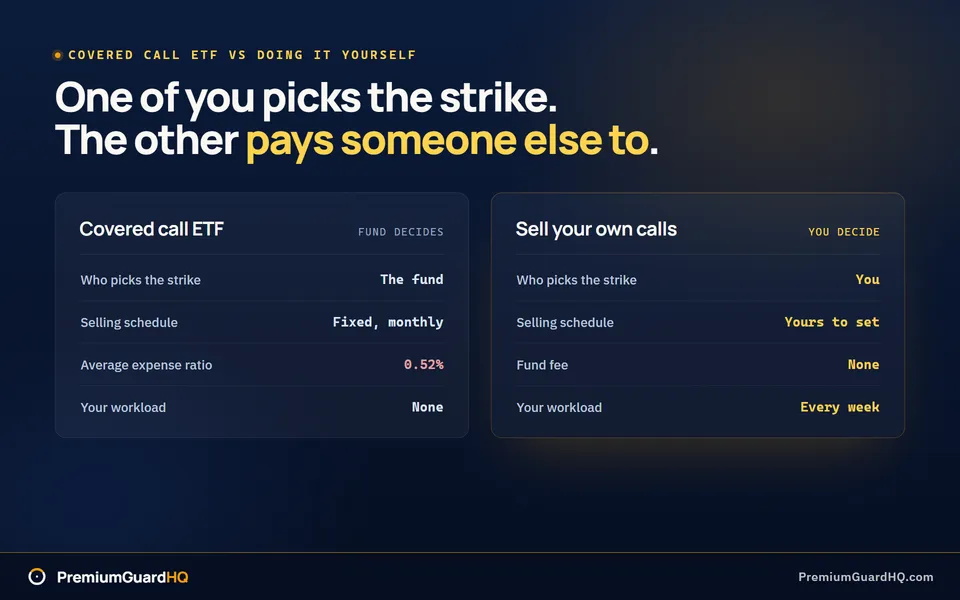
You want the cash that covered calls can produce, but one decision still blocks you. Do you buy a covered call ETF and let a fund manager trade the options, or do you sell the calls from your own account?
A covered call ETF is a fund that trades on an exchange like a stock and sells call options against stocks or an index, handing you the option premium every month. A call option is a contract that lets someone buy a stock at a fixed price. When a fund sells that contract against shares it already owns, the position is covered. If you do this yourself, you choose the stock and the strike price and you keep the premium. That gives you control, but it also gives you the work.
The PremiumGuardHQ team wrote this comparison. We prefer the DIY route, but we judge both paths on the same four standards: how the yield works, how much control you keep, how the two choices are taxed, and how much work each one requires. We use sourced facts, and we say plainly where the ETF wins. This is not a fund roundup. By the end, you will know which path matches the way you actually trade.
Verdict: which one pays you more
If you know how to run covered calls and value control over your own money, writing the calls yourself usually lets you keep more of what you earn. You pick the stocks, the strikes, and the timing of any locked-in gains. A covered call ETF can still be the better choice if you want monthly cash without the work.
A covered call is a promise to sell shares you own at a set price by a set date. Covered call ETFs make that promise across a full basket of stocks. The tradeoff is a ceiling on how much the fund can gain when the market jumps, which is the same ceiling you accept on your own shares and the reason what you actually give up when you sell a call is worth understanding before you buy either one. Schwab notes that covered-call funds “typically underperform” when markets climb quickly, because gains above the strike get capped and shares get called away. If you trade yourself, you decide when to accept that cap or avoid it.
The ETF beats DIY for one kind of reader. If you don’t want to get approved for options, monitor your own positions, or handle the paperwork and taxes tied to assignment, the fund is the cleaner route. Assignment happens when the option buyer exercises the contract and you must sell your shares. Some traders do not want that bookkeeping, and the fund is a fair answer.
Covered call ETF vs DIY covered calls at a glance
This is the shortest honest comparison. It lays out what a covered call ETF takes off your plate and what stays under your control when you sell calls yourself. A covered call is a promise to sell stock you own at a set price, in exchange for cash paid to you now. That upfront cash is the premium.
| What it comes down to | Covered call ETF | Sell your own covered calls |
|---|---|---|
| Income source | Option premium plus any dividends from the fund’s holdings | Option premium you sell, plus dividends on shares you personally hold |
| Upside cap | Yes. Selling calls caps your gains, so the fund tends to fall behind when the market rises fast | You decide the cap. You pick the strike price, the price at which you agree to sell, and choose whether to sell a call at all |
| Typical market fit | Works best when the market is flat or rising slowly. Premium can soften losses, but you can still lose money | Same mechanics, but your results depend on your own strike picks and how much of your stock you cover |
| Fees and expense drag | Fund fees apply. Schwab cites a 0.52% average expense ratio for this fund category | No fund fee, but you still pay trading costs like the gap between buy and sell prices, plus any costs from having your shares called away |
| Tax character | A portion of the income is usually taxed at ordinary income rates. Schwab flags this as a tax drag risk in taxable accounts | More control over timing and which shares you sell, but still complex. Gains can count as short-term depending on how long you held |
| Operational workload | Low. The fund handles every trade and decision for you | Higher. You need your broker’s approval to trade options, and you handle monitoring, rolling, assignment, and recordkeeping yourself |
| Diversification | The fund can hold many stocks and run the call-selling strategy across all of them | Depends on your account size and how many stocks you can realistically manage yourself |
| Transparency of what you own | Varies by fund. Some funds use other instruments instead of holding the stock directly | Direct. You own the shares and the specific calls you sold, nothing else |
Sources: Schwab’s covered-call ETF education article, dated Feb. 11, 2026, including expense ratio figures it cites from Morningstar. Where this table says “varies,” we could not verify a single current yield figure from our sources without turning this into a fund-by-fund roundup.
Yield and cash flow: what actually counts as income
A phrase like “pays more” can hide two separate ideas. It could mean more cash appears in your account this month. It could also mean more income you truly earned, the kind that does not quietly shrink the capital producing it. Those are not the same, and confusing them is how traders get surprised later.
Schwab says covered call funds “often report higher-than-average yields.” A covered call ETF pays you both the option premium and any dividends from the stocks it holds, bundled into one payment. A yield is simply the income paid out, expressed as a percent of what you invested.
Schwab also flags the tradeoff. Higher income usually comes with less growth in the fund’s price. The fund’s gains get capped when the market rises quickly. A bigger check now can leave you with a smaller pool of growing money later.
We are not printing a table of current fund yields. Yields change every month, and we do not have issuer yield pages tied to a specific date. Any number we wrote today would be stale by the time you read it.
Doing it yourself gives you something a fund cannot: a clean line between money you earned and money that only moved between accounts. At PremiumGuardHQ, we see it this way. Premium is unearned income. It becomes earned only after the full trade cycle closes, meaning you bought back the option or your shares got called away. Until then, it is a number sitting on paper.
This matters because your broker’s screen can be slightly wrong. Wash-sale rules and adjustments for premium you already collected can change the cost basis your broker displays. Cost basis is what you originally paid. You need it to calculate your real gain or loss. If that number is wrong, your view of “income” is wrong too.
PremiumGuardHQ was built to fix exactly that. It automatically finds every options cycle across your brokers and corrects the cost-basis math. Then it shows you three numbers for every closed cycle: Premium P/L, Equity P/L, and Net Income. P/L means profit or loss. You can finally see what you truly earned rather than what you merely withdrew.
The Safe Withdrawal Engine goes one step further. It calculates how much you can take out without shrinking the equity base below a target you set, drawing only on realized, closed-cycle profits. The goal is to stop silent equity erosion, the pattern where you keep withdrawing “income” during a rough stretch without noticing that you are spending your own capital.
Winner: DIY for anyone who wants to see what they truly earned. The ETF wins only for investors who are content to treat the distribution amount itself as the finish line.
If you lean DIY, do not try to track all of this by hand in a spreadsheet. Real tracking tools catch what manual work misses, and PremiumGuardHQ’s free tier is free forever with no card required.
Control: strike selection, upside capture and when you get called away
You have to choose one setup. Do you want a fixed set of rules that someone else runs for you? Or do you want to decide trade by trade how much upside you are willing to give up and when?
A covered call ETF sells call options against its holdings on a fixed schedule. A call option is a contract that gives someone else the right to buy the stock from you at a set price. The fund runs the same playbook every cycle, no matter what the market does that week. Schwab points out the cost of that. When stocks rise fast, covered call funds “typically underperform” plain stock holdings. That happens because the calls the fund sold are more likely to get exercised. The fund’s shares get bought away at the price it agreed to sell, or the fund has to buy back the call at a loss to close the trade. Either way, the gains get capped at exactly the moment you would least want them capped.
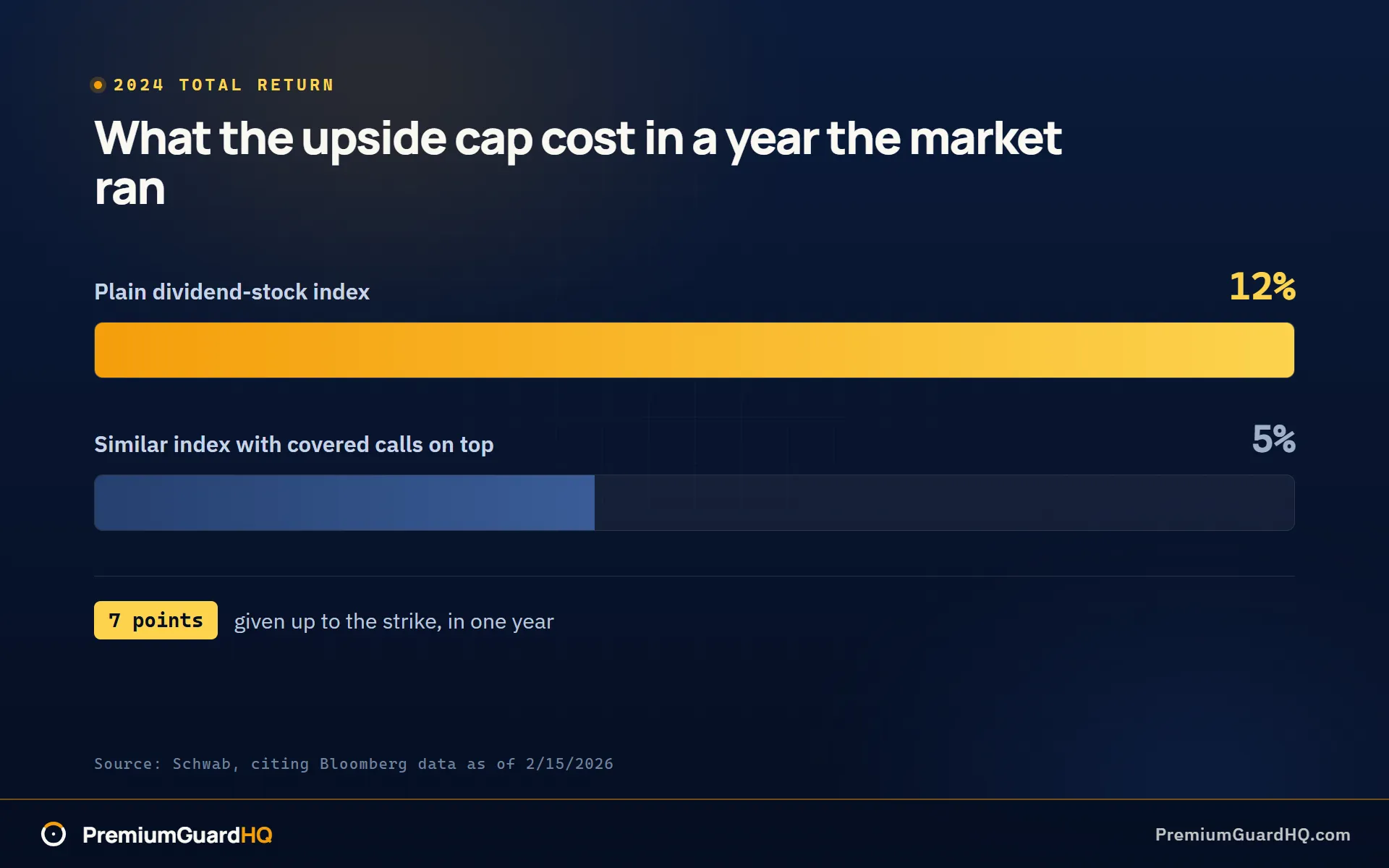
Schwab gives a real number to show how wide that gap can get. In 2024, a plain dividend-stock index returned about 12%. A similar index with covered calls layered on top returned about 5%. Schwab credits Bloomberg data for that figure, as of February 15, 2026. That gap erases most of the gain, because the fund’s rules could not bend for the year you actually lived through.
DIY works the same way under the hood. You own the shares, you sell the call, and if the stock settles above your strike, your shares get called away just like the fund’s. That piece of the trade never changes. What changes is who decides. You pick the strike price, the expiration date, and whether to sell a call against your shares that month at all. A calculator that can put the premium and the called-away price on one screen makes that decision concrete instead of theoretical. Some months you might skip it because you think the stock is about to run.
That freedom has a catch. You now have to impose on yourself the same discipline a fund enforces automatically. Most serious sellers settle on a strike range, a preferred expiration window, and a cap on how much money sits in any one stock. The problem is that those rules quietly drift. You sell one call closer to the stock’s price than usual because the payment looked good. You let one stock grow past your cap because it has been winning. Nobody flags it, so nobody notices, until it costs you.
PremiumGuardHQ fits into the DIY side here without becoming a signal service that tells you what to trade. You set your strategy once: your return target, your concentration cap, your strike range, your expiration window. From there, PremiumGuardHQ flags fills that drift from what you declared. For Pro users, it reads your accounts overnight. It flags items such as earnings landing inside an expiration week or one position creeping past the cap you set. It never tells you what to do next. You see what changed. The call stays yours.
Winner: DIY, because it gives you more levers to pull and more say over when your upside gets capped. The ETF wins only if you would genuinely rather hand that decision to someone else in exchange for a steady, hands-off process. Neither path promises that DIY earns more money. It gives you more control and more responsibility, not a guaranteed bigger return.
Tax treatment: ordinary income risk, account placement and recordkeeping
Tax treatment mostly comes down to two things: how much of the cash you actually keep, and how much extra work you will accept to keep more of it.
The tax code puts investment income into two buckets. Schwab explains this clearly as of February 11, 2026. One bucket is ordinary income, taxed at your regular wage rate, which runs from 10% to 37%. The other bucket is tax-advantaged income, such as qualified dividends, taxed at lower long-term capital gains rates: 0%, 15%, or 20%. Schwab also flags a 3.8% tax called the NIIT that can apply on top of this if your income is higher. NIIT stands for Net Investment Income Tax.
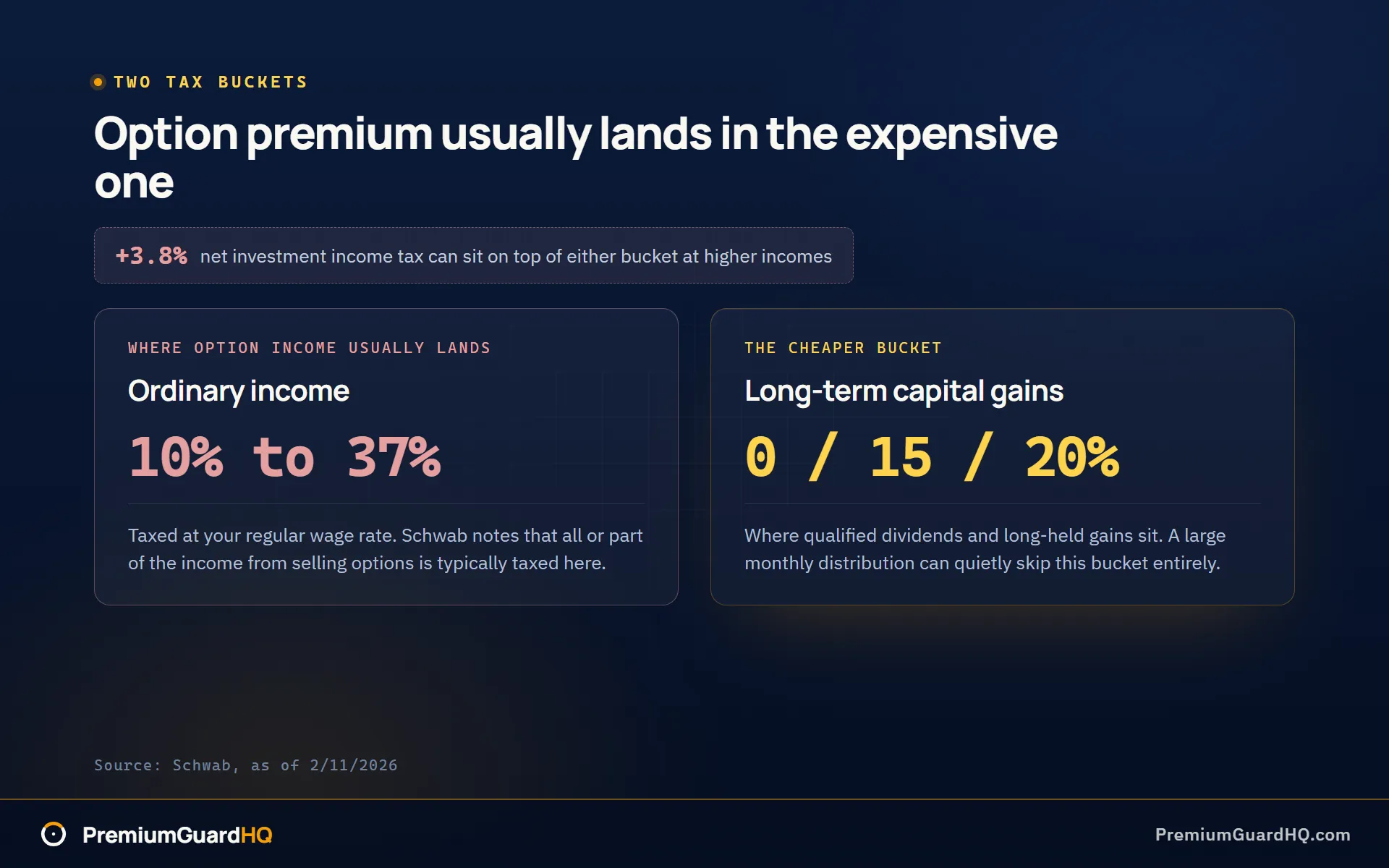
The problem shows up with a covered call ETF. Schwab states plainly that “all or a portion of the income generated by selling options is typically taxed at the higher ordinary income tax rates.” A fund that pays you a large monthly check may be quietly handing you the more expensive tax bucket instead of the cheaper one. Schwab notes this matters less inside a tax-advantaged account like an IRA or 401(k), where you don’t pay tax until you withdraw money. Withdrawals from those accounts still get taxed as ordinary income, but you have deferred the bill and you control when it lands.
Running the trades yourself can give you more control here too. You decide when to close a position, when to roll it forward, and which shares to sell. That gives you more say over when your tax bill lands. The price of that control is recordkeeping. That is the trade a lot of people make when they pick the fund instead: they would rather skip the tax and trade bookkeeping than hold on to the extra control.
PremiumGuardHQ closes exactly that gap. It keeps a trade ledger for every cycle, so each number traces back to a real fill. It also reconciles your adjusted cost basis, aware of wash-sale rules and premiums you already collected. Tax season should start from a clean, reconciled record of every closed cycle, not from rebuilding a year of trades out of broker statements. That is operational clarity, not tax advice. Talk to a tax professional about your own situation.
Winner: it depends on the account. In a taxable account, the ETF’s ordinary-income mix can create real tax drag, according to Schwab, while DIY offers more control but more bookkeeping. In a tax-advantaged account, the ETF becomes more attractive because that ordinary-income drag gets deferred, according to Schwab.
Effort and execution risk: passive cash flow vs running the operation
Effort decides this section. Do you want monthly cash with almost no work, or are you willing to run covered calls like a small business?
A covered call ETF wins here without much argument. Schwab describes these funds as holding a basket of stocks or an index, plus an options overlay on top. The overlay sells the calls and collects the payment, called premium, for you. These funds usually reset the calls every month. There is no strike to pick, no expiration date to watch, and no work to do. For anyone building retirement income who does not want the bookkeeping that comes with running the wheel strategy themselves, that is a fair trade.
Running it yourself means you are now the fund manager. You choose the strike price and the expiration date, and you live with the result. How a covered call works against shares you own is not complicated. If the stock stays below your strike, you keep the premium and sell another call. If it rises above your strike, your shares get called away, which means you must sell them at the price you agreed to. Neither outcome is bad, but both require you to show up and do the work week after week.
Most DIY losses trace back to the person running the trades, not the market. Do you check your positions every week? Do you follow your own strike rules when a stock gets exciting, or do you drift? Most DIY sellers don’t lose money because the strategy failed. They lose ground because they stopped running the process the way they said they would.
Better tools narrow that gap, but they never make DIY passive. PremiumGuardHQ automatically finds every cycle across your brokers and backfills your full history, so your track record does not depend on remembering to update a spreadsheet. Pro users get their accounts read overnight, so they start the day already knowing what changed: earnings landing inside an expiration week, a put drifting close to the money, one stock creeping past the cap they set. If you withdraw premium as income, the Safe Withdrawal Engine tells you the exact amount you can take out from realized, closed-cycle profits without quietly shrinking your equity.
Winner: the covered call ETF for effort and simplicity. DIY only wins if you are actually willing to run the process and put real tracking behind it. If you want hands-off income, take the ETF win and move on.
Choose the ETF or choose DIY: the profile test
Choose a covered call ETF if you want hands-off monthly cash and no part of options approvals, rolling decisions, assignment, or trade and tax bookkeeping. A covered call is a promise to sell stock at a set price. Rolling means closing one options contract and opening a new one to push the deadline out. Assignment is when the option buyer exercises the contract and you must deliver the stock. Schwab describes how the fund handles that overlay work from start to finish. If the bookkeeping is the part you do not want, the ETF is the cleanest fit. Our roundup of six covered call ETFs sorted by overlay structure is the shortlist to start from.
Choose DIY covered calls if control matters more to you than convenience. You pick the stocks. You pick how much upside you give up. You decide when gains get locked in. You are trading extra work for a say in how the machine runs.
Choose DIY plus PremiumGuardHQ if your real blocker is not skill but operations. Maybe you run several brokers and hold many positions, and the bookkeeping has become the hard part. PremiumGuardHQ auto-detects your cycles, fixes your cost basis, and splits every closed cycle into three numbers: Premium P/L, Equity P/L, and Net Income. The Safe Withdrawal Engine tells you the exact amount you can safely take out.
Choose the ETF inside a tax-advantaged account if ordinary-income tax drag is your main concern in a taxable account. Ordinary income is money taxed at your regular income tax rate, which is usually higher than the rate on long-term investment gains. Schwab notes that this concern matters less once taxes are deferred inside an IRA or 401(k).
If you are running this yourself, start on PremiumGuardHQ’s free-forever tier. No card required. Or test Pro at $49 a month or $470 a year, with a 14-day free trial and one-click cancel.
Frequently asked questions
What is a covered call ETF?
A covered call ETF is a fund that holds stocks and sells call options against them to collect extra cash for you. A call option is a promise to sell a stock at a set price by a set date. The cash the fund collects for that promise is called premium, and the fund pays it out to you. Schwab notes the tradeoff plainly as of February 11, 2026: you can get higher monthly payments, but your gains are capped compared with simply holding the stocks outright.
Are covered call ETFs safe?
Not in the usual sense of “safe.” These funds don’t guarantee your money back. Schwab points out that the premium the fund collects can soften some losses, but the fund can still lose money in a falling market. It is not hedged, meaning it is not protected, against a real market drop. Before buying, ask yourself whether you can handle your account value swinging around, plus a monthly payment that is not fixed either.
Do covered call ETFs underperform in bull markets?
Usually, yes, according to Schwab. A bull market is one where prices are rising quickly. In that environment, the calls the fund sold cap its gains, and shares often get bought away or bought back at a loss. Schwab cites Bloomberg data showing a 2024 example: a plain dividend-stock index returned about 12% that year, while a similar index with covered calls layered on top returned about 5%. That gap illustrates the cap. It is not a promise that the same gap repeats every year.
If I can sell covered calls myself, why buy a covered call ETF instead?
Buying the ETF means you skip the work entirely. Schwab describes the fund running the whole options process for you: picking strikes, selling calls, and collecting the premium on a schedule. Doing it yourself gives you more control over strike prices, timing, and what actually counts as income. If you go the DIY route, the real risk is losing track of your own numbers. That is exactly what PremiumGuardHQ handles: automatic cycle detection, cost basis reconciliation, three clean numbers for every cycle (Premium P/L, Equity P/L, Net Income), and a Safe Withdrawal Engine so you never quietly withdraw the capital that generates your income.