
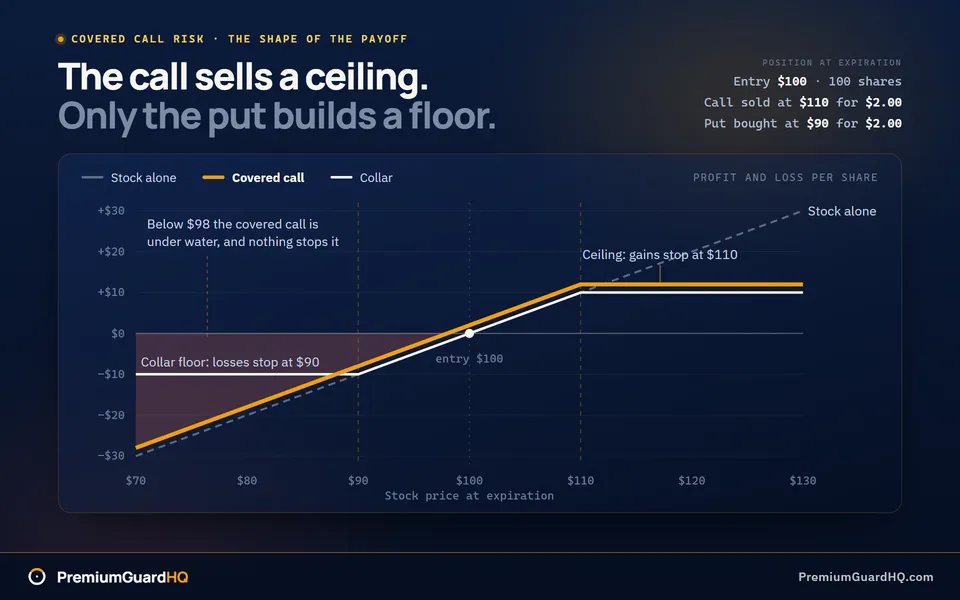
You sell a covered call. The premium lands in your account and feels like free money. Premium is just the cash you get paid for selling the option.
Then the stock gaps down 15% overnight. Or it rips past your strike price and keeps climbing without you. Suddenly the “income” trade feels like it robbed you.
Neither outcome is unfair. Both are covered call risk working exactly as designed. Nobody showed you the full shape of the payoff.
By the end, you’ll be able to sketch that payoff in plain English. You’ll put real numbers on your max gain and max loss. And you’ll see exactly what a protective put or a collar changes. A protective put is insurance you buy on your stock. A collar pairs that insurance with a covered call to help pay for it.
At PremiumGuardHQ, we split every position into two numbers: Premium P/L and Equity P/L. That way the risk shows up in numbers, not a bad feeling after the fact.
Here is what a covered call actually risks.
What is covered call risk
Covered call risk is the tradeoff you accept when you own stock and sell a call option against it. A call option is a contract that lets someone else buy your stock at a set price, called the strike price. You collect cash up front for selling it, called the premium. In exchange, your gains stop once the stock rises above the strike price, and you still absorb nearly the entire loss if the stock falls. The premium only softens that fall a little.
A covered call means you own at least 100 shares of stock, and you sell one call option for every 100 shares you hold. The stock you already own is what “covers” the trade. It acts as collateral, so you can hand over shares if the option buyer decides to exercise their right to buy. The word “covered” describes how the trade is built. It says nothing about how much money you could lose. It does not mean you are protected from a falling stock price.
Here is the one-line version worth remembering. A covered call is an income tool layered on top of stock you already own. It is not insurance against a drop in price. If you want real protection against a falling stock, that comes from a different tool entirely, such as a protective put or a collar, not from the call option itself.
How covered calls, protective puts, and collars work at expiration
Here is the plain payoff map. This shows what happens to your money on expiration day, the day an option contract ends.
Three building blocks:
- Covered call: You own 100 shares. You sell 1 call option and collect cash up front. That cash is called a premium.
- Protective put: You own 100 shares. You buy 1 put option, which pays you if the stock falls below a set price. This costs you cash up front.
- Collar: You own 100 shares, sell 1 call, and buy 1 put at the same time. Traders often size the call premium to cover most or all of the put’s cost.
Now the outcomes. Everything depends on where the stock price lands at expiration compared to your strike prices. A strike price is the set price written into the option contract.
Stock finishes above the call strike. The person who bought your call will almost certainly use their right to buy your shares. This is called assignment. You are required to sell your 100 shares at the strike price. Your profit stops right there, no matter how high the stock climbs afterward.
Stock finishes between the put strike and the call strike. Both options expire worthless. You keep the cash you collected and you keep your shares. This is the quiet outcome, and it happens most often.
Stock finishes below the put strike. This only applies if you own a put. The put pays you the difference between the strike and the stock price. It offsets your losses below that line. Without a put, there is no floor. Your loss keeps growing as the stock falls.
Here is the minimum math worth memorizing. It ignores dividends and broker fees.
| Metric | Formula |
|---|---|
| Covered call max profit | (Call strike − stock entry price) + call premium |
| Covered call breakeven | Stock entry price − call premium |
| Covered call max loss | Stock entry price − call premium (if stock falls to $0) |
| Collar max loss | Stock entry price − call premium + put premium − put strike |
The collar formula looks messy. It just means your loss is capped once the stock drops below the put strike. Losses past that point are absorbed by the put.
One more fact worth knowing. Assignment does not have to wait for expiration day. It can happen early, because the buyer controls when the contract gets exercised. Early assignment clusters around two situations: a dividend payment is coming up, or your short call is deep in-the-money, meaning the stock price is well above the strike.
Now that the payoff is mapped step by step, the next question is why it feels unfair in practice, even though every outcome above was set from the start.
The covered call risk asymmetry: capped upside, uncapped downside
Here is the mental model to hold onto. A covered call is long stock risk, plus a contract that sells away a slice of your future upside. “Long stock risk” just means you carry the same risk as anyone who simply owns the shares. The call you sold does not remove that risk. It only trims what you can earn on the way up.
That trade-off is not symmetric. It shows up differently depending on which direction the stock moves.
When the stock rallies hard. Say you bought a stock at $100 and sold a call with a strike price of $105. The strike price is the price you agreed to sell your shares at. If the stock rockets to $130, you still only sell at $105. Your best case was locked in on day one: the gain up to the strike, plus the premium you collected. Premium is the cash you get paid for selling the call. Everything above $105 belongs to whoever bought your call.
This matters even if you plan to keep doing this trade repeatedly. If you sell calls month after month on a stock that keeps grinding higher, your shares get sold each time the stock clears the strike. This is called being “called away.” Each time, you miss the next leg of the rally. One capped gain feels fine. A string of them during a strong bull run quietly drags your returns far below just holding the stock. Some of that is decided before you ever pick a strike, which is why which stocks make that ceiling easier to accept is worth settling first.
When the stock sells off. This is where the premium cushion turns out thinner than it feels. Say you collected $2 in premium on that same $100 stock. Here is what your position actually looks like as the stock falls:
| Stock price | Loss on shares | Premium collected | Net result |
|---|---|---|---|
| $98 | -$2 | +$2 | Roughly flat |
| $90 | -$10 | +$2 | Down about $8 |
| $80 | -$20 | +$2 | Down about $18 |
| $60 | -$40 | +$2 | Down about $38 |
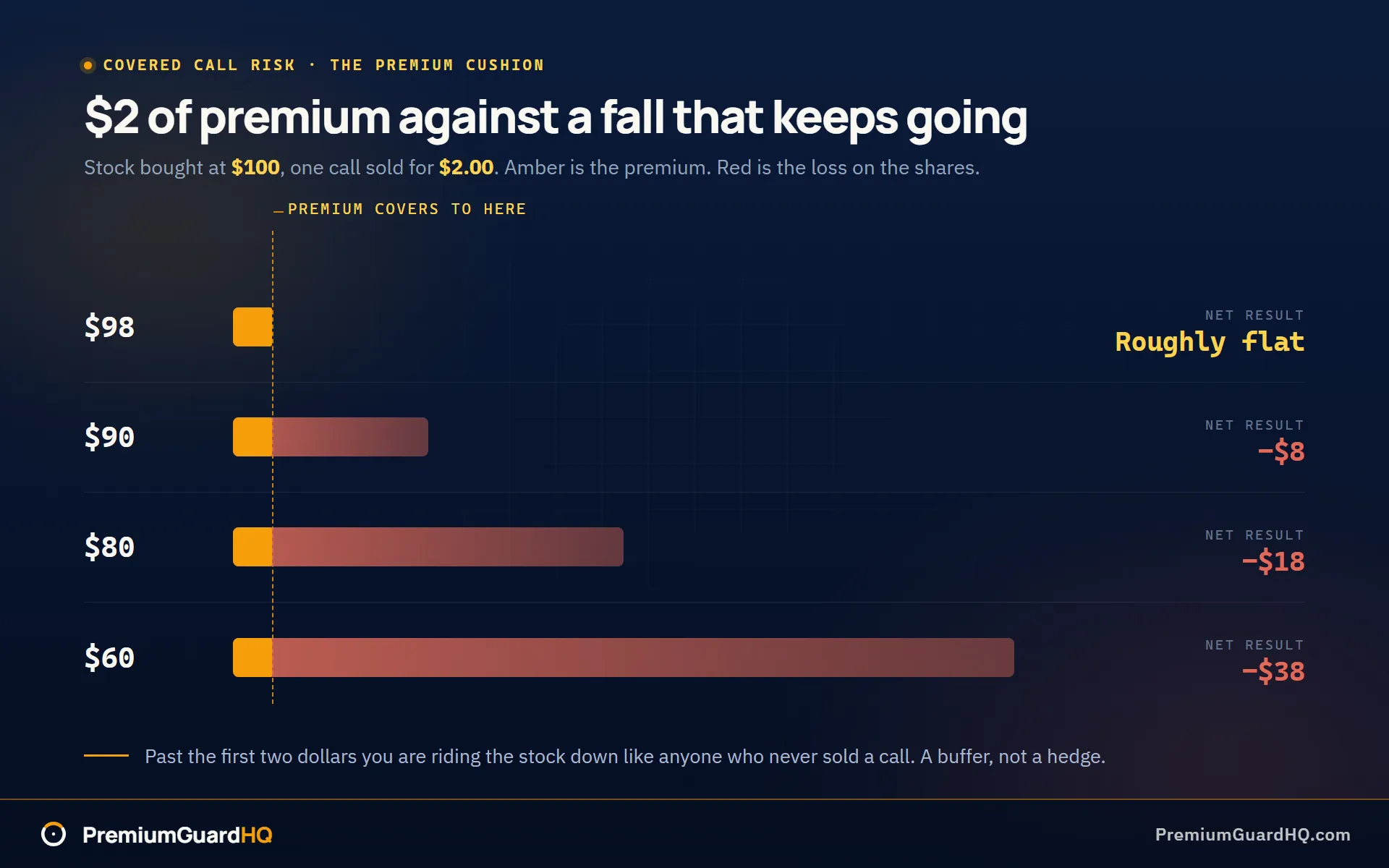
The premium only offsets the first two dollars of loss. Past that, you are riding the stock down just like anyone who never sold a call. You just started $2 better off. That is the entire effect: a small buffer, not a hedge, and not insurance.
It helps to be precise about what a covered call does not change. It does not create unlimited risk the way a naked call does. A naked call means selling a call option without owning the shares to back it up. That can produce open-ended losses if the stock keeps climbing. Your shares cover that risk completely.
But covered calls do nothing about a few other risks. Gap risk is the danger of the stock jumping or dropping sharply overnight on news. Sector risk is your stock falling just because its whole industry sells off. Earnings risk is the chance that a single earnings report tanks the price. All of that risk sits inside the stock itself, untouched by the option you sold.
So if your real fear is a large drop in price, the covered call was never the tool for that job. A protective put is what actually changes that picture, because it puts a floor under your losses. If your fear is really the cost of buying that put, a collar is the structure that helps pay for it, by selling a call to fund the put. A collar caps your upside even further than a plain covered call does.
One practical habit worth building, especially if you rely on premium as income: track your Premium P/L separately from your Equity P/L. Premium P/L is the cash you have collected from selling options. Equity P/L is what your shares are actually worth right now, gains or losses included. During a drawdown, it is easy to look at steady premium checks and feel like you are doing fine, while the shares underneath are quietly losing far more than the premium ever brought in. That is what makes counting premium as income too early so expensive.
The next section looks at how adding a protective put, or building a full collar, redraws this payoff chart, and what that protection costs you in return.
Protective puts and collars: how they change covered call risk and what they cost
Now add two more pieces to the payoff picture: the protective put and the collar.
A protective put puts a floor under your stock. A put option pays you if the stock falls below a set price, called the strike price. Buy one against shares you already own, and your losses stop at that floor, no matter how far the stock keeps falling. You pay cash up front for that protection. That cash is called the premium.
A collar pays for that floor by selling a call. Selling a call caps how high your gains can go, in exchange for cash today. How a collar is constructed is simple enough: it sets a floor and a ceiling on your stock at the same time.
Here’s what changes compared to a plain covered call. A covered call only touches the top of your payoff. It sets a ceiling through the call you sold, and it nudges your breakeven price down slightly because of the premium you collected. A protective put only touches the bottom. It sets a floor through the put you bought, but it lowers your net returns, because you paid a premium for the put instead of collecting one.
Put those two pieces together and you get the collar. You own the stock, you buy a put, and you sell a call, all at the same time. That’s the full recipe: long stock, plus a long put, plus a short call. Once it’s on, your outcome is mostly locked into a band between the put strike and the call strike. Above the call strike, your gains stop. Below the put strike, your losses stop. In between, you ride the stock, minus or plus whatever the two premiums cost you net.
Here’s the part that gets glossed over constantly: a collar is never free. It can look “zero cost” on your trade ticket when the cash you collect from the call roughly matches the cash you pay for the put. But even a perfectly balanced collar still costs you something real. That cost is the upside you gave away by selling the call. You’re trading away your best-case outcomes to buy protection against your worst-case outcomes.
There’s also a practical wrinkle. In real markets, the call premium and the put premium rarely match exactly. Bid-ask spreads are the small gaps between buying and selling prices. Add in timing differences between placing each leg, and you usually end up paying or collecting a little net cash. “Zero-cost collar” is a common phrase, but “near-zero-cost” is closer to the truth most of the time.
Choosing your two strike prices means choosing how much pain and how much upside you’ll accept. The put strike sets the worst drawdown you’ll tolerate below today’s price. The call strike sets how much upside you’ll give up while the hedge is on. Most traders use the same expiration date for both legs, so the hedge stays simple and you’re never left holding one leg after the other expired.
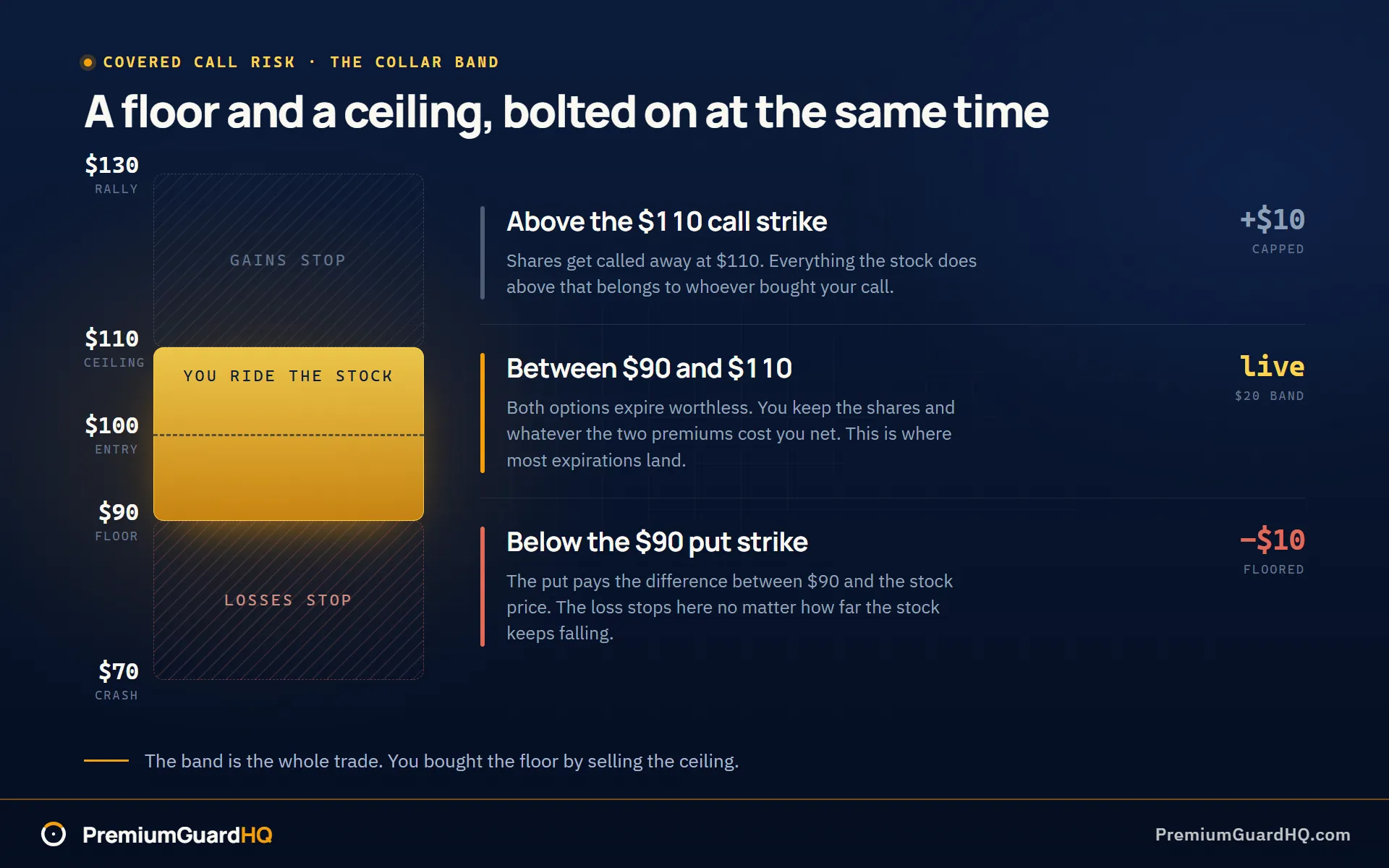
On execution: placing both legs together as a single combo order, instead of entering the put and the call as two separate trades, cuts down on legging risk. Legging risk is the danger that the stock price moves between your first order and your second, leaving you with a worse price than planned. Even with the collar on, you still own the stock underneath. The stock’s price still drives most of what happens to you day to day, as long as it stays inside the band between your two strikes.
Tying this back to covered call risk: a protective put deals with the catastrophic tail, the sharp, ugly drop that a plain covered call never protected against. A collar deals with that same tail, but it does so by putting a second cap on your income, on top of the cap the call overlay already placed on your gains.
The next section puts real numbers on the same position, once with no put and once with a put attached, so you can see the hedge’s cost in dollars instead of a slogan.
Worked example: covered call alone vs. covered call with a protective put
Here’s the same starting position run two ways, using plain, rounded numbers. These numbers are illustrative only, not a real trade.
Covered call: You buy 100 shares at $100. You sell 1 call with a strike price of $110 and collect a $2.00 premium. The strike price is what you agree to sell your shares for. The premium is cash you get paid upfront, just for making that promise.
Collar: Same shares, same call. Now you also buy 1 put with a strike price of $90 for $2.00. A put pays you if the stock falls below its strike price. The $2.00 you collected from the call roughly covers the $2.00 you paid for the put, so the options cost about $0.00 net. In real markets this exact match rarely happens. Small gaps between buying and selling prices usually leave you paying or collecting a little cash either way.
Here’s how each version plays out at three stock prices on expiration day, the day the options end. You can model both legs before you place them with the same inputs.
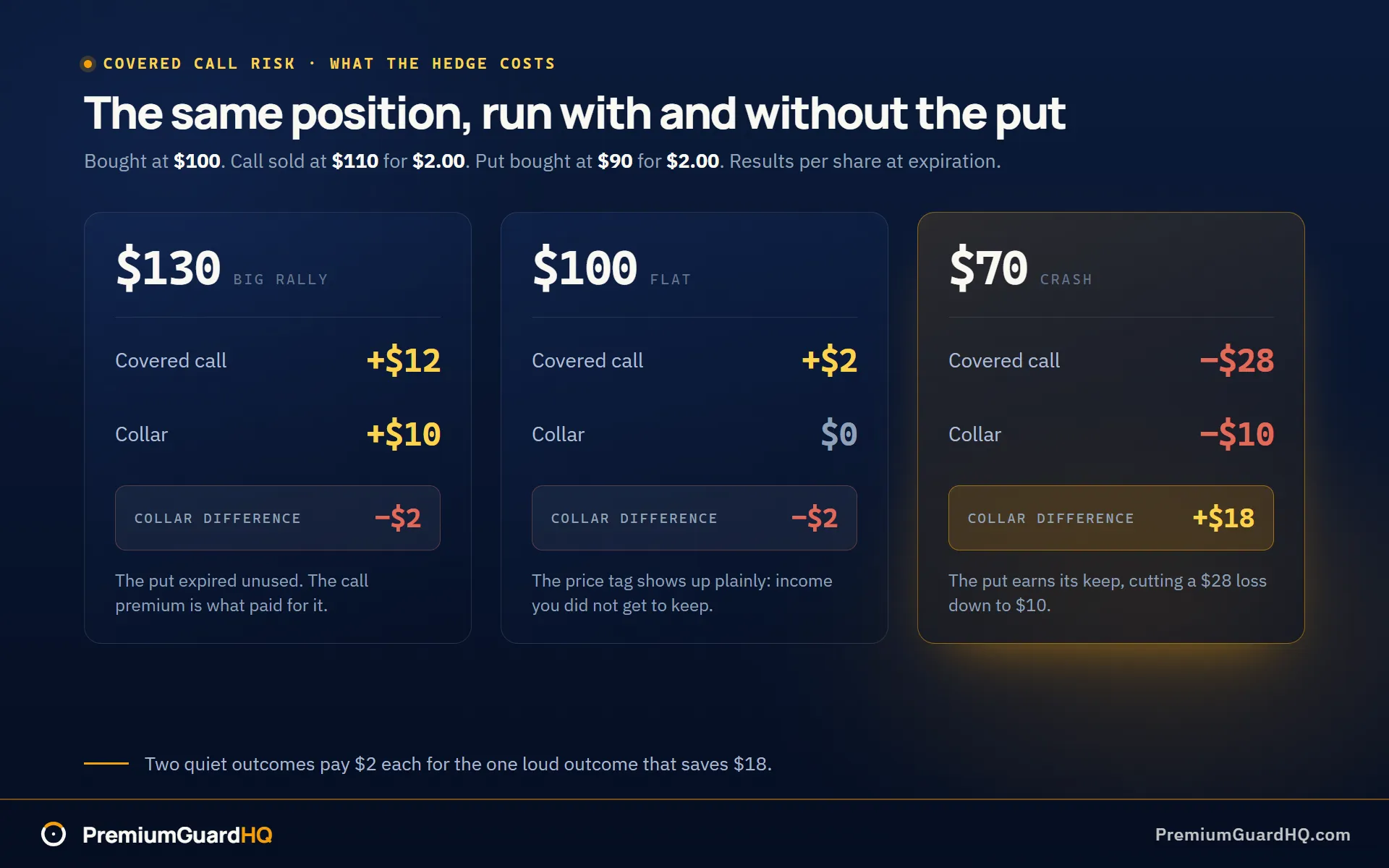
| Stock price | Covered call result | Collar result | What it shows |
|---|---|---|---|
| $130 (big rally) | Shares sold at $110. Profit = $10 + $2 = $12/share | Shares sold at $110. Profit = $10 + $0 = $10/share | Same ceiling either way. The put went unused, and the call premium is what paid for it. |
| $100 (flat) | Profit = $2/share | Roughly $0/share | You paid for protection with income you gave up. |
| $70 (crash) | Loss = -$30 + $2 = -$28/share | Put lets you sell at $90. Loss = -$10 + $0 = -$10/share | The put is what actually stopped the bleeding. |
Three things stand out. At $130, the put expired worthless, and the $2 it cost you was the same $2 the call brought in, which is why the collar finishes $2 behind. At $100, that price tag is easier to see: $2 per share of income you did not get to keep. At $70, the put earns its keep, cutting a $28 loss down to $10.
That’s the whole tradeoff in one table. The collar turns an open-ended drawdown into a defined floor. But it can also shrink or erase the covered call’s income during the exact stretch when the stock just sits still. That is the line between a hedge and an options strategy built to pay you.
Frequently asked questions about covered call risk
Can you lose money with covered calls?
Yes. Premium is a small buffer, not a shield. The most you collect softens the fall by a few dollars, but a stock can drop far more than that. If your $100 stock falls to $60, no realistic covered call premium was ever going to cover that gap. Covered calls lower your cost basis a little each time you sell one. Cost basis is what you effectively paid for the shares. Lowering it is not the same as putting a floor under your losses. There is no floor unless you add a put. See “The covered call risk asymmetry” section above for the full breakdown with numbers.
Covered call vs protective put: which one reduces risk more?
They protect against different things. A covered call slightly improves your breakeven price because you collect premium up front, but it caps your upside and leaves nearly all of your downside exposed. A protective put costs you cash instead of paying you, but it sets a real floor below the put’s strike price. Strike price is the price written into the option contract. If your biggest fear is a sharp drop, the put does the actual protecting. The call was never built for that job.
What is an options collar, and is it the same as a covered call with a protective put?
Yes, a collar and “a covered call with a protective put” describe the same trade. You own the stock, sell a call, and buy a put, all at the same time. The call brings in cash that helps pay for the put. That’s the appeal. But the call also sets a ceiling on how much you can make. You are trading away your best-case outcome to help fund protection against your worst-case outcome. See the collar walkthrough above for the exact math.
Why can a covered call get assigned early, especially around dividends?
Assignment means the option buyer uses their right to buy your shares before expiration day, the day the contract normally ends. This can happen any time your call is in-the-money, meaning the stock price sits above your strike price. It gets more likely when two things line up: there is very little time value left in the option, and a dividend payment is coming up soon. The option buyer may exercise early specifically to collect that dividend. The practical takeaway is simple: treat assignment as something that can happen on any day the call is in-the-money, not just on expiration day.
What are qualified vs unqualified covered calls, and why do weekly calls matter for taxes?
A qualified covered call gets a specific tax treatment under IRS rules, but only if it meets the qualified covered call requirements around how much time is left until expiration and how far the strike price sits from the stock price. Very short-dated calls, the kind used for weekly income, and certain deep in-the-money calls often fail those requirements. That can turn the trade into an unqualified covered call, which changes how your gains get taxed and can also affect the holding period on your stock. Adding a put to build a collar introduces its own tax wrinkles on top of that. Keep detailed records of every trade, and talk to a tax professional about your specific pattern of trades. Tax rules here are strict and unforgiving of guesswork.