
Your P/L chart displays one breakeven number. Your broker displays another, and your wheel spreadsheet gives you a third. The issue is not your math.
Most breakeven formulas online are written for option buyers, and that is where the mismatch starts. A buyer pays a premium and hopes the stock moves far enough to pay off. Premium is simply the price you pay or collect for an option contract. But what does breakeven mean in options when you are the seller instead of the buyer? If you run the wheel, selling cash-secured puts and covered calls for income, you are on the opposite side of that trade. Your real breakeven is a cost basis line that shifts every time you collect premium or roll a position. Rolling means closing your current option and opening a new one, usually at a different strike price or expiration date.
This article covers two things: the buyer breakeven formulas every page teaches, and the seller breakeven you actually track in a wheel, including why it shifts after every roll. PremiumGuard tracks wheel cycles and reconciles cost basis, so these formulas connect directly to your real trade fills rather than a rough estimate.
One sentence covers the whole idea: breakeven is the exact price where you stop losing money and start making it. What changes is how you get there.
What breakeven means in options
Breakeven in options is the stock price where your profit and loss reaches exactly zero at expiration. It includes the option premium plus any stock cost tied to the position. At expiration, breakeven typically equals the strike price plus or minus the premium paid or collected.
That formula holds only if you carry the trade to expiration. Premium is the price you pay or collect for the option. Expiration is the date the option contract ends. Before that date, your account may show a different profit or loss figure because the option’s current price reflects remaining time and market swings, not just the final outcome at expiration. Unless stated otherwise, breakeven on this page means breakeven at expiration.
The direction is easy to remember. Paying a premium pushes your breakeven farther from the current stock price. Collecting a premium pulls it closer, which helps you. For sellers, breakeven works like a cost basis. Cost basis is the true cost of a trade after every dollar paid or collected gets counted. For a seller, breakeven is the price where everything collected and everything owed balances to zero.
How breakeven works in options: the buyer math the internet stops at
One detail matters before the formulas. Premium, the price of an option, is always quoted per share. One contract, however, controls 100 shares. A $2.00 premium means $200 total for one contract. The formulas below use the per-share figure, not the contract total.
Almost every page teaches this buyer math.
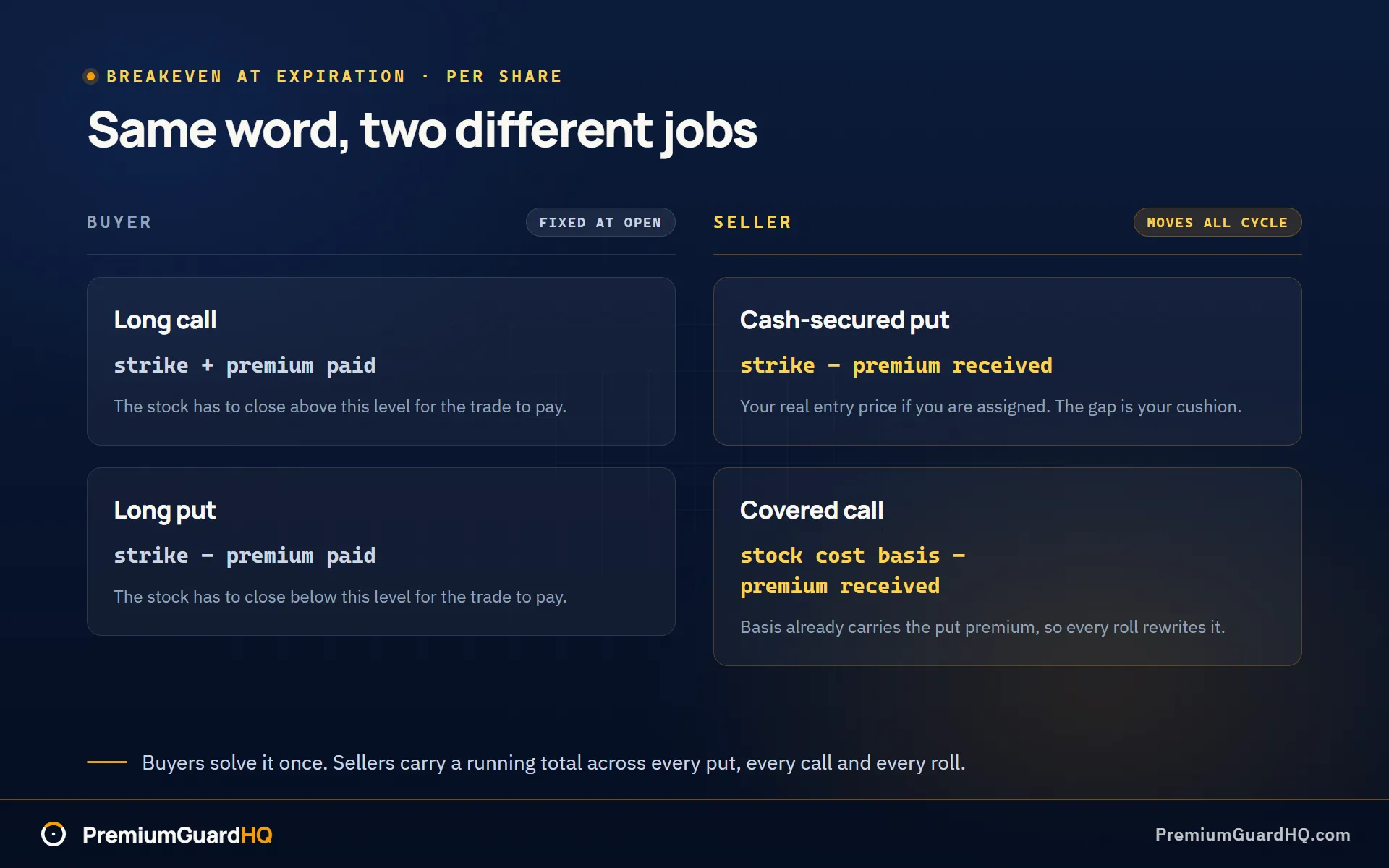
Long call buyer: breakeven = strike price + premium paid. A call gives the buyer the right to buy 100 shares at the strike price, the set price written into the contract. Test it with our options profit calculator. At expiration, the stock must close above this level for the call buyer to come out ahead.
Long put buyer: breakeven = strike price − premium paid. A put gives the buyer the right to sell 100 shares at the strike price. The stock must close below this level at expiration for the put buyer to finish net profitable.
Quick gut check. “In the money,” or ITM, means the option has real value right now. It does not mean the trade is profitable. A call can be ITM and still lose money if the stock has not cleared strike plus premium. A put can be ITM and still lose money if the stock has not dropped below strike minus premium. ITM tells you the option has value. Breakeven tells you whether the trade is actually a winner. How many dollars it actually made is the calculation that comes after that one.
There is one more reason your charts disagree before expiration. The option’s price before expiration includes extra value tied to remaining time and potential stock movement. That extra value is called extrinsic value, and it sits on top of the option’s final payout. A “current” breakeven line on a live chart therefore depends on the option’s current price, not the simple strike plus or minus premium formula.
Most pages skip the next part entirely. Seller breakeven is cost basis math, and it moves.
Seller breakeven is cost basis math: cash-secured puts, covered calls, and the moving line when you roll
Everything above applies to buyers. Sellers need a different frame.
For a seller, breakeven is the stock price where the whole position nets to zero. Add up every dollar of premium collected and every dollar tied up in the stock you own. The operator rule is simple: premium is a cushion. Every credit, money coming into your account, pushes your breakeven in your favor. Every debit, money leaving your account, pushes it against you.
Cash-secured put seller breakeven at expiration:
CSP breakeven per share = put strike minus premium received
A cash-secured put is a promise to buy 100 shares at a set price called the strike. You back that promise with cash held ready in your account. Try the cash-secured put calculator with your own numbers.
If you get assigned, you are forced to buy the shares. Your real entry price is the strike minus the premium you already collected. That is lower than the strike itself, and that gap is your cushion. It is worth knowing what actually happens to your account when you are assigned before you rely on that cushion.
Rolling changes this number directly. A roll closes your current option and opens a new one, usually at a different strike or expiration date. Roll for a net credit, and you collect more than you pay out, so your total premium rises and your breakeven moves lower. Roll for a net debit, and you pay out more than you collect, so your total premium falls and your breakeven moves higher. That trade-off is the whole of what a roll actually costs you.
Covered call seller breakeven at expiration:
Covered call breakeven per share = stock cost basis minus premium received
A covered call is a promise to sell 100 shares you already own at a set strike price in exchange for premium. Test this with the covered call calculator.
That formula is clean for one cycle. In a wheel strategy, though, your stock usually did not come from a regular purchase. It came from a cash-secured put assignment, so your starting cost basis already includes put premium.
Once you are deep in a wheel, the accurate version looks like this:
- Net stock cost basis = assigned strike minus total put premiums collected
- Covered call breakeven = net stock cost basis minus total call premiums collected
That is why seller breakeven moves. It is a running total that changes every time you collect a credit or pay a debit.
The moving breakeven across a full wheel cycle:
Track two numbers for every 100-share cycle. The first is your gross share entry price. That is usually the strike price where you were assigned, or your original purchase price if you bought the stock outright. The second is your cumulative premium: every credit minus every debit, added up across every put and every call, including all rolls.
One master equation ties it together:
Moving breakeven = gross share entry price minus cumulative premium per share
One catch is worth knowing. Brokers often show cost basis inconsistently after you have collected several rounds of premium and been assigned stock along the way, partly because the rules for how brokers must report cost basis do not track premium the way a wheel seller does. That is why serious sellers keep their own running net basis instead of trusting the broker screen.
Next, we will walk through one full wheel-style sequence, credit by credit and roll by roll, and show exactly where breakeven sits after each step.
Worked example: the wheel breakeven moves after every premium and every roll
The numbers below are made up to show the math clearly.
You sell one cash-secured put on XYZ. A cash-secured put means you promise to buy 100 shares at a set price, with cash held in your account. That set price is called the strike. The strike here is $50.00, and you collect $1.20 in premium, the fee you get paid for selling the option.
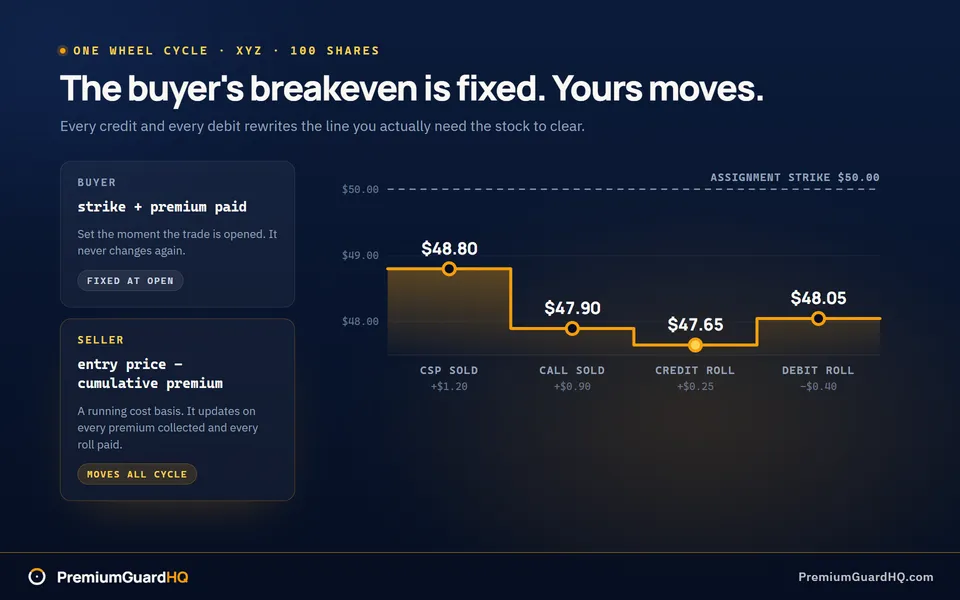
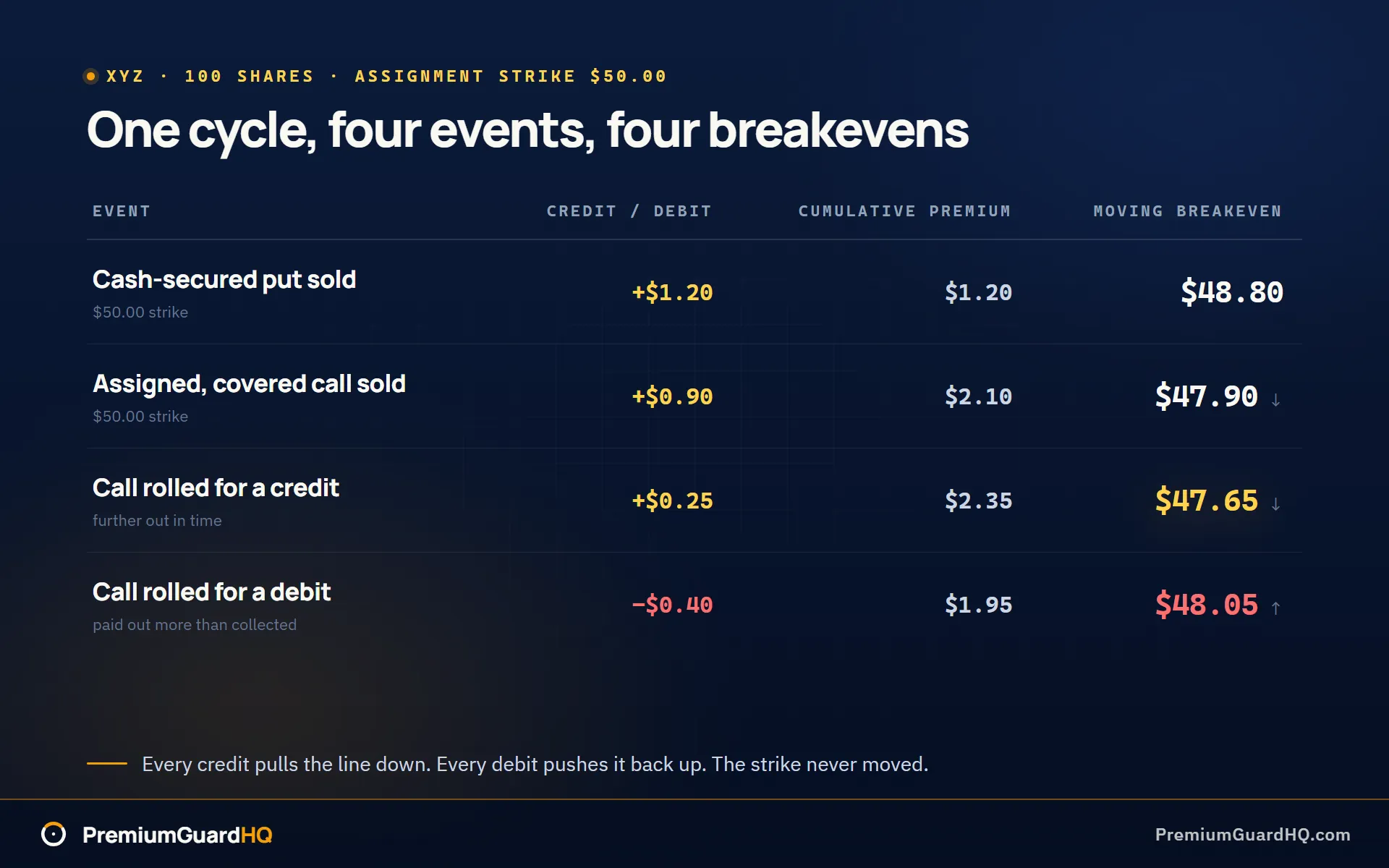
Step 1: your first breakeven. Breakeven = 50.00 minus 1.20 = $48.80. If XYZ falls below $50 and you get assigned, meaning you are forced to buy the shares, your real starting cost is $48.80 a share, not $50.
Step 2: assignment happens. You now own 100 shares at a $50 assignment price. But your true cost, called your net basis, is still $48.80. You sell a covered call at the $50 strike and collect $0.90. A covered call is a promise to sell your shares at a set price if the stock reaches it. New breakeven = 48.80 minus 0.90 = $47.90.
Step 3: you roll the call. Rolling means closing the current call and opening a new one further out in time. This roll brings in a net credit of $0.25, so you collected more money than you paid. Breakeven drops again: 47.90 minus 0.25 = $47.65.
Step 4: later, you roll again. This time the roll costs a net debit of $0.40, so you paid out more than you collected. Breakeven rises: 47.65 plus 0.40 = $48.05.
| Event | Cumulative premium per share | Moving breakeven |
|---|---|---|
| After CSP sold | $1.20 | $48.80 |
| After covered call sold | $2.10 | $47.90 |
| After credit roll | $2.35 | $47.65 |
| After debit roll | $1.95 | $48.05 |
Notice what happened. Each roll credit or debit did not stand alone as a separate win or loss. It moved your breakeven up or down because it changed your true cost.
The breakeven line was never a formula you solve once and forget. It is your net cost basis, and it updates after every credit you collect and every debit you pay. Holding that line current by hand is the part that breaks first, and it is what separates the tools built to hold it from a spreadsheet.
Frequently asked questions about wheel breakeven
Is breakeven the same as the strike price?
No. The strike is only the set price written into the contract. Breakeven is a different number because it also counts premium, the money you paid or collected for the option. For a long call, breakeven equals strike plus premium paid. For a long put, breakeven equals strike minus premium paid. For covered calls and wheel cycles, breakeven is your net cost basis after every premium collected along the way, not just the strike price.
What does in the money mean, and does ITM mean I’m profitable?
In the money, or ITM, means the option has real value built in right now. A call is ITM when the stock trades above the strike. A put is ITM when the stock trades below the strike. ITM does not mean you are profitable. Profit requires the stock to clear your actual breakeven, which includes premium. An option can be ITM and still lose money if the stock has not moved far enough past breakeven yet. See “How breakeven works in options” above for the full breakdown.
Why does my broker show a different breakeven or cost basis than my math?
Brokers apply premium, assignments, and reporting rules differently across platforms, so the number on your screen often will not match your own math. That is normal. To get an accurate wheel breakeven, calculate it from your actual fills. Take your starting share entry price and subtract your cumulative net premium per share, counting every credit and debit across every put, call, and roll. Keep your own running number instead of trusting the broker display.
Do commissions, fees, slippage, or dividends change breakeven?
Fees and slippage do, because they change how much premium you actually keep. Slippage is the gap between the price you expected and the price you actually got filled at. Every dollar lost to fees or slippage lowers your real net premium and shifts your true breakeven against you. Dividends do not change the basic covered call breakeven formula, but they raise the odds of early assignment on in the money calls near the ex-dividend date, which can change your timing and outcome.