
You own shares. Maybe they went up a lot. Now you’re looking at the options chain, wondering if you should sell a covered call. That means you agree to sell your shares at a set price if the stock gets there. This set price is the strike. In exchange, you get cash today. That cash is the premium.
Something feels off about giving up your upside for a few hundred bucks. You can’t quite say why.
Here’s the truth most guides skip: covered calls are not free money. They are a trade-off. Sometimes the right answer is no trade at all.
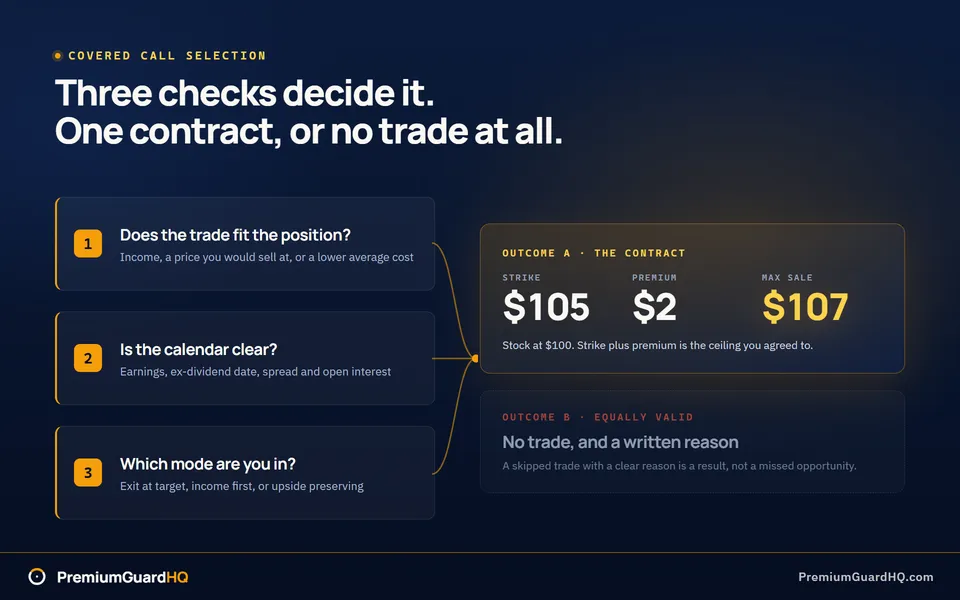
This guide walks you through a simple 3-step process. You’ll end up in one of two places. Either you get a clear reason to skip the trade, or you get a specific plan: a strike price, a delta, an expiration date, and what to do if your shares get called away. Delta is just a rough measure of how likely the option ends up in the money by expiration.
This guide covers the decision itself, not the income mechanics or rolling tactics. Those live in other guides.
Let’s start with the checklist that comes before you open the options chain.
Before you start: get these facts on one screen
Grab these facts before you touch the options chain. A covered call means you sell someone the right to buy your stock at a set price, the strike price, by a set date. You collect cash upfront for this, the premium. Missing even one fact below can turn a good trade into a bad surprise.
Position facts
- Shares owned, counted in lots of 100. Options only trade in 100-share blocks. Note if any shares can’t be sold, like shares tied up in a company plan.
- Your true cost basis. This is the real price you paid for your shares, after fees and past trades. Your broker’s number may be wrong. Wash sale rules and old premium payments can quietly change what your broker shows. A wash sale happens when you sell a losing stock and rebuy it too soon, which changes your basis. Check your own trade records too.
Calendar risks
- Your stock’s next earnings date, when the company reports how it did. Write down whether it falls during the week your option expires.
- The next ex-dividend date, if your stock pays one. This is the cutoff day to still get the payment. Miss it and you lose the dividend.
Option-chain reality check
- The nearest monthly expiration dates you can pick from. This is when your option contract ends.
- The bid-ask spread and open interest on strikes you’d actually use. Bid-ask spread is the gap between buy and sell prices. Open interest is how many contracts are currently open. A wide spread or thin open interest means you may lose money just getting in and out of the trade.
Decision inputs
- Your regret test: if the stock jumps next month, would losing your shares to the option buyer sting?
- Your time horizon for owning this stock. Weeks? Months? Years?
Tools
- An options chain showing delta, a number that estimates how likely your option is to get exercised. Also grab a notebook or simple template to log your reasoning.
- Optional: PremiumGuardHQ, which splits your premium profit from your stock profit so your decision rests on real numbers, not a guess.
With these on one screen, you’re ready for step 1.
Step 1: Decide if a covered call is the right trade for this position
Before you look at a single strike price, answer one question. What outcome do you want, even though your gains get capped? A covered call is a promise to sell your stock at a set price if the buyer wants it, in exchange for cash paid to you now. There are only three good reasons to make that promise.
- You want income while you hold a stock that isn’t moving much.
- You want to sell your shares at a price you’d already be happy with.
- You want to lower your average cost a little while still holding on.
If none of these fit, stop here. You’re not ready to sell a covered call yet.
Run the regret test. Assignment is when the option buyer makes you sell your shares at the strike price, the price you both agreed on. Ask yourself: if that happened next month, would it sting? If losing the shares would make you angry or regretful, a covered call is probably a bad fit. The only exception is picking a strike so far above the current price that assignment becomes unlikely. But if selling at a certain price already sounds fine to you, think of this trade a different way. You’re just getting paid to place a limit sell order, a standing order that sells your stock once it hits your target price.
Check for landmines before you even look at the premium. Premium is the cash you collect for selling the option.
- Earnings. If your stock reports earnings while the option is still open, the premium might look bigger than usual. Don’t let that fool you. Earnings reports can cause the stock to jump or crash overnight, and no premium fully covers that risk. Decide now: are you holding through earnings no matter what happens?
- Dividends. If your stock pays a dividend, check the ex-dividend date you noted earlier. That’s the cutoff date for who gets the next payment. As that date gets closer, calls that are deep in the money carry a higher chance of early exercise, meaning the buyer grabs your shares early just to collect the dividend for themselves.
- Liquidity. Wide bid-ask spreads and low open interest turn a clean plan into a messy one. You could enter at a bad price and struggle to exit later. Open interest just means how many contracts are currently open on that option. If you are still deciding which shares to buy in the first place, chain quality is one of the criteria for choosing a stock to sell calls against.
Do a quick tax gut-check. This isn’t a tax guide, so here’s the short version. In a taxable account, some covered calls can mess with your holding period, the length of time you’ve owned a stock, which decides whether a gain counts as long-term or short-term for taxes. Special rules called “qualified covered call” rules govern this, and the IRS spells out how a short call can affect your holding period. If your shares are close to hitting the one-year mark for long-term gains, or close to a dividend holding deadline, treat the tax angle as a real constraint, not an afterthought. When in doubt, ask a tax professional. This guide won’t cover every edge case.
Now make the call. Sort yourself into one of three buckets.
- Green light: You’re neutral to mildly bullish in the near term, meaning you expect the stock to stay flat or rise a little. You’re fine selling at a known price. Nothing on the calendar worries you.
- Yellow light: You want the premium, but you also want to keep your shares. Only move forward here if you pick a setup that makes assignment less likely, such as a strike further above the current price.
- Red light: You’re strongly bullish, you can’t stomach losing the shares, or the calendar, like earnings or a merger, makes this trade too risky right now.
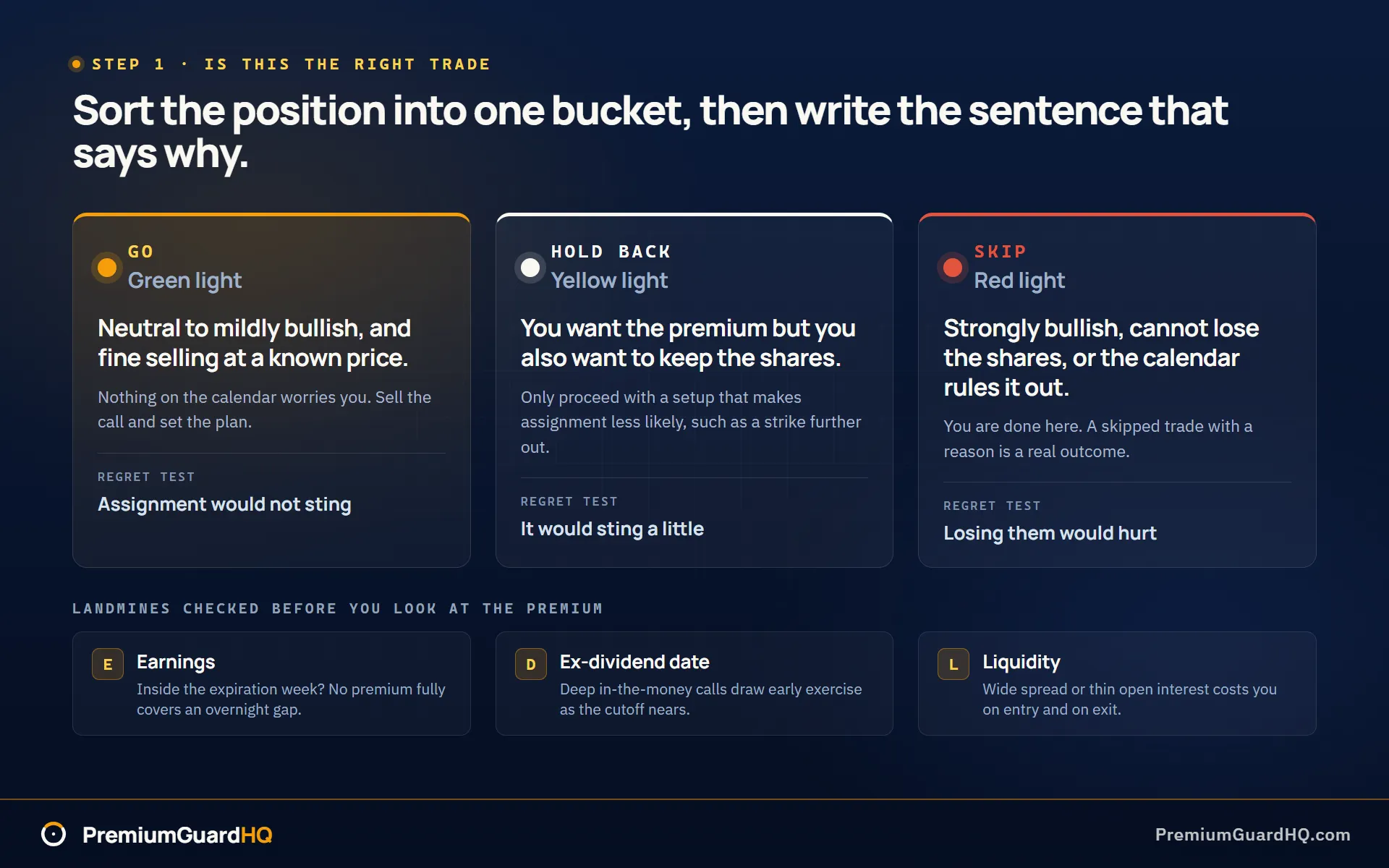
You now have a documented decision. Write one sentence explaining your color and why. If you landed on green or yellow, move to the next step, where you’ll pick the actual strike price and delta, a number that shows how likely the option is to finish in the money. If you landed on red, you’re done here. Skipping the trade is still a real outcome, not a failure.
Step 2: Choose your expiry and strike using a delta-based outcome map
You now have a green or yellow light. Time to pick the actual contract. That means the expiration date and the strike price. A strike price is the set price at which you agree to sell your stock if the option gets used against you.
Start with time, not price. Pick your expiration date first. This date decides what kind of bet you’re making. A good default is a monthly expiration, roughly 30 to 45 days out. People often call this window the DTE. DTE just means “days to expiration,” or how many days are left before the contract ends.
Shorter DTE has a trade-off. You’ll make this decision more often, and the option’s price will react faster to small stock moves. Longer DTE has a different trade-off. You collect more premium up front. Premium is the cash payment you get for selling the option. But your shares stay tied up longer, and the odds of a big move happening before expiration go up. Neither choice is “correct.” Pick the window that matches how often you actually want to check on this position.
Use delta to set your assignment odds. Delta is a number between 0 and 1. You’ll find it listed on the options chain, which is the table of available contracts your broker shows you. Think of delta as a rough guess, not a promise. It estimates how likely the option finishes “in the money” by expiration. In the money means the stock price has passed the strike price, so the option would get exercised. A 0.20 delta call has roughly a 20% chance of ending in the money. A 0.50 delta call is roughly a coin flip.
Assignment means the option gets exercised and you’re required to sell your shares at the strike price. Once you know your goal from step 1, delta becomes the dial you turn to control how likely that is.
- Exit-at-target mode. You’re fine selling your shares. Pick the strike price you’d actually be happy selling at, then check what delta that strike lands on. The delta is just a side effect here, not the goal.
- Income-first mode. You want the biggest premium check you can get while still holding your shares most of the time. Higher delta strikes sit closer to the current stock price, and they pay more premium. They also get assigned more often. You’re trading a higher assignment chance for more cash today.
- Upside-preserving mode. You want to keep the stock working for you. Lower delta strikes sit further from the current price. They pay less premium but leave more room for the stock to rise before you’d lose your shares.
Pick one mode. Write it down next to your strike and expiration.
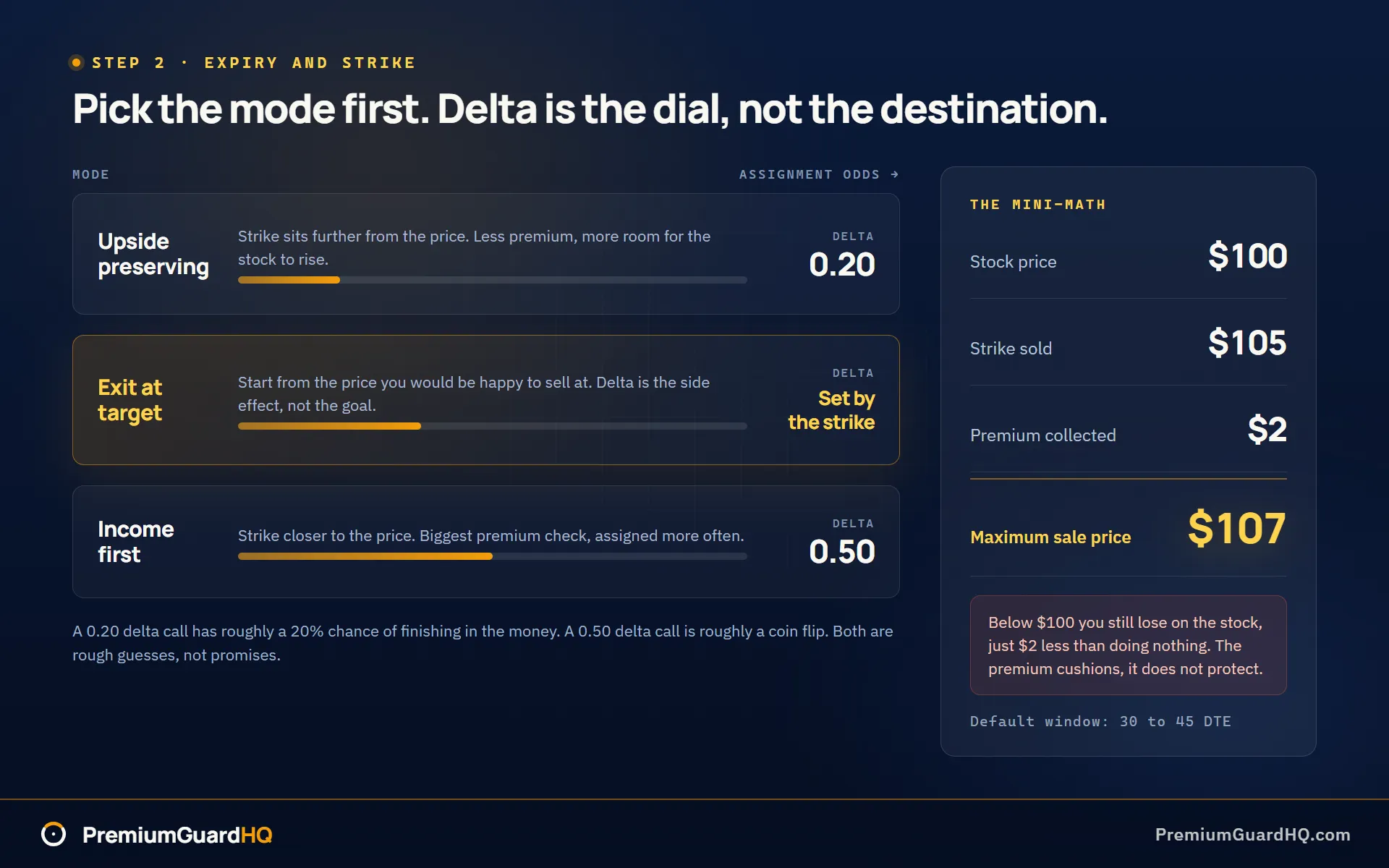
Do the mini-math before you commit. Three numbers matter here: the premium you’ll collect, the strike price, and the current stock price. Together they show you the bounded outcome of this trade.
- Your maximum sale price, if assigned, is strike plus premium.
- Your downside is still real stock downside. The premium only cushions it slightly.
For example, say the stock trades at $100. You sell a $105 strike call and collect $2 in premium. Your best-case sale price is $107. Below $100, you still lose money on the stock, just $2 less than if you’d done nothing. This guide keeps that math conceptual on purpose. To see the bounded outcome drawn for your own position, run the strike and premium through a covered call calculator. For the order entry itself, credit included, use the repeatable monthly workflow for selling calls.
Run these sanity checks before you lock in a strike.
- Liquidity. Check the bid-ask spread on the strike you want. A wide spread means the premium you see quoted isn’t the premium you’ll actually get when your order fills.
- Earnings inside the window. If an earnings report lands before your expiration date, part of that premium is really payment for the risk of a big overnight jump. It’s not just normal time decay.
- Big embedded gains. If the stock has already climbed far above what you paid for it, the covered call is doing a different job than income. It’s mostly an exit tool now. Consider the opportunity cost: are you comfortable capping the upside on a winner?
Calibrate against a benchmark. Some indexes track a systematic version of this same trade. They sell a monthly call against a stock index every cycle, and traders call these buy-write benchmark indexes. They consistently show the same pattern: smoother returns and steady premium income, but noticeably weaker results during strong bull runs. That weaker result is the mechanical cost of the trade you’re choosing to make.
One more fork in the road. Maybe what you actually want is passive income, without managing strikes, expirations, or assignment yourself. If so, a covered call ETF is worth a look. A fund handles the mechanics for you, charges a fee, and hands you a distribution. Running it yourself gives you control over strike, timing, and which stock. The choice is which job you want: managing the calls, or owning a packaged result.
You should now have a specific expiration date and strike price picked, with the delta noted and your mode written down: exit-at-target, income-first, or upside-preserving.
Step 3: Place the trade and write the management plan before the market moves
You have a strike price, an expiration date, and a delta. The strike price is what you agree to sell your shares at. The expiration date is when the contract ends. Delta is a number that hints at how likely the option is to finish in the money. Now it’s time to place the order.
Sell one call contract for every 100 shares you’re willing to sell. If you own 300 shares, sell three contracts. No more.
Use a limit order, not a market order, especially on stocks with normal trading volume. A limit order lets you set the lowest price you’ll accept. A market order takes whatever price is offered right now, which can be a bad deal if the gap between the buy price and sell price is wide. You already checked that gap in Step 2, so put it to use here. This guide keeps the clicking-and-typing part short on purpose.
Write your assignment statement first
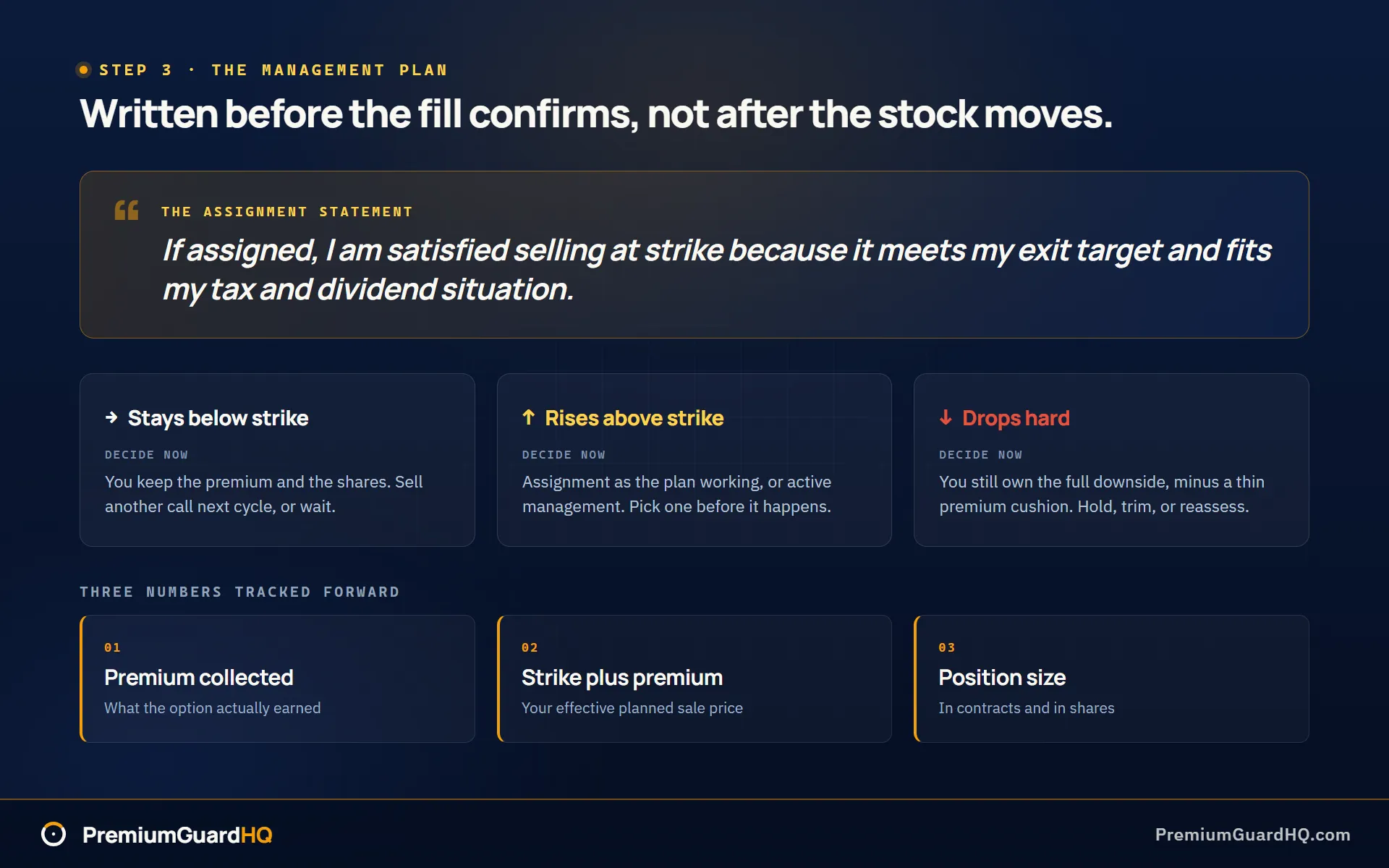
Before the fill even confirms, write one sentence. This is your assignment statement. Assignment happens when the option buyer exercises their right, and you’re required to sell your shares at the strike price. Your sentence should say whether you’re okay with that. Try something like this:
“If assigned, I am satisfied selling at strike because it meets my exit target and fits my tax and dividend situation.”
Write that sentence right now, honestly. If you can’t say it and mean it, that tells you something important. It means you either should have skipped this trade back in Step 1, or you picked the wrong strike in Step 2. Fix the mismatch before you place the order, not after you get assigned.
Decide your three outcomes now
Write your answers down. Don’t leave them to memory once the position is live.
- Stock stays below your strike. Success just means you keep the premium, the money you were paid for selling the call. Decide now whether you’ll sell another call once this one expires, or wait.
- Stock rises above your strike. Decide now whether assignment counts as a win, since it was your plan all along, or whether you’ll consider active management instead. Active management, like rolling the option to a new strike or date, is a separate skill covered elsewhere.
- Stock drops hard. A covered call does not protect you from a real decline. You still own all the downside risk in the stock, minus the small cushion the premium gave you. Decide now: do you hold the shares, sell some, or look at other options?
Watch for two early assignment triggers
Early assignment means the option buyer exercises the contract before expiration day, instead of waiting until the end. The timing is never yours to control, because early exercise sits entirely with the buyer.
- Deep in-the-money calls near the ex-dividend date. This happens when your strike price is far below the stock’s current price. If a dividend payment is coming up too, the option buyer has a real reason to exercise early and collect that dividend for themselves.
- Corporate actions. Mergers, spinoffs, and special dividends can all change the math for the option buyer and trigger early exercise. Watch your stock’s news, not just the calendar.
Save rolling for a separate decision
If the stock moves against your plan and you’re thinking about rolling, stop here and take the rolling decision on its own terms instead. Rolling means closing your current option and opening a new one at a different strike or date. This guide covers picking the trade, not repairing one that’s gone sideways.
Track three numbers going forward
Track your position like an operator, not a spectator. Write down these three numbers and keep them updated:
- Premium collected
- Your effective planned sale price, which is strike plus premium
- Your position size, in contracts and shares
These three numbers stay true no matter what the stock does day to day. A tool like PremiumGuardHQ can help here too. It separates what the option actually earned in premium from what the stock itself did to your equity value. That split matters. It’s the clearest way to judge whether this covered call strategy is working for you over time, instead of eyeballing one number that blends both together.
You now have an open covered call position, a written assignment statement, and a decided plan for all three outcomes. That’s the job done for this step.
What success looks like after you run the 3-step selection process
You’re done when one of two things is true.
Outcome A. You have an open covered call. A covered call means you sold someone the right to buy your shares at a set price. Your notes list the expiration date, strike price, delta range, and the assignment statement from step 3. Assignment means the option buyer can force you to sell your shares at that price.
Outcome B. You skipped the trade. You can say why in one sentence: the regret test from step 1 failed, earnings land inside your expiration week, or your holding period, dividend timing, or thin liquidity ruled it out. A skipped trade with a clear reason is a good result. It is not a missed opportunity.
Run three checks before you move on.
- Your contract count matches the 100-share lots you’re actually willing to sell.
- Your strike matches the mode you picked in step 2: exit-at-target, income-first, or upside-preserving.
- Earnings and ex-dividend dates for this cycle are marked on your calendar.
Last, confirm you avoided the two traps this guide warned about. You did not mistake premium for total return. And you did not let a generic rule replace your own numbers.
Frequently asked questions
Does selling a covered call affect my holding period for long-term capital gains?
It can, depending on IRS “qualified covered call” rules and how far your strike sits from the stock price. Some calls can pause or even reset the clock on your holding period, the length of time you’ve owned a stock, which decides whether a gain is long-term or short-term for tax purposes. If your shares are close to the one-year mark, treat this as a real constraint back in Step 1, not something to check after the fact. Confirm the details for your specific position before you place the trade.
What delta is “best” for a covered call?
There’s no single best delta. Think of it as a dial, not a magic number. Higher delta strikes sit closer to the stock price, so they pay more premium but get assigned more often. Lower delta strikes sit further away, so they pay less but leave more room for the stock to rise. Which one is right depends on the mode you picked in Step 2: exit-at-target, income-first, or upside-preserving.
Should expiration be weekly or monthly?
This is about your workflow, not a rule. Weekly expirations mean more decisions and more frequent monitoring. Monthly expirations mean fewer decisions, but your shares stay tied up longer and more can happen before the contract ends. Pick the window that matches how often you actually want to check on this position, not what worked for someone else.
Can I lose my dividend because of early assignment?
Yes, this can happen, especially when your short call is deep in the money near the ex-dividend date. Deep in the money means the strike price sits well below the current stock price. When that happens near the payment cutoff, the option buyer has a real reason to exercise early and collect the dividend instead of you. Always note your ex-dividend date during prep, and treat it as a real constraint when picking your strike.
Is a covered call ETF better than doing it myself?
It depends on what job you want done. A covered call ETF handles the strikes, expirations, and assignment for you, but it charges a fee and follows a fixed mandate you can’t adjust. Doing it yourself costs more time but gives you full control over strike, timing, and which stock you’re using. If you just want packaged income without managing the mechanics, the ETF can be simpler. If you want precision on a stock you already own, DIY gives you that control.