
Every January, someone posts a “top 10 covered call stocks” list. By March, half those tickers have already fallen 30% after an earnings surprise nobody saw coming.
You may already hold 100 shares of a stock, or you may be about to buy them. Either way, the goal is to sell covered calls against that stock and collect income. A covered call obligates you to sell your shares at a set price later, and the premium is the cash the buyer pays now for that commitment.
The trouble with “best stocks for covered calls” lists is that they go stale. Fundamentals change. Implied volatility resets. The best ticker from last quarter becomes this quarter’s trap.
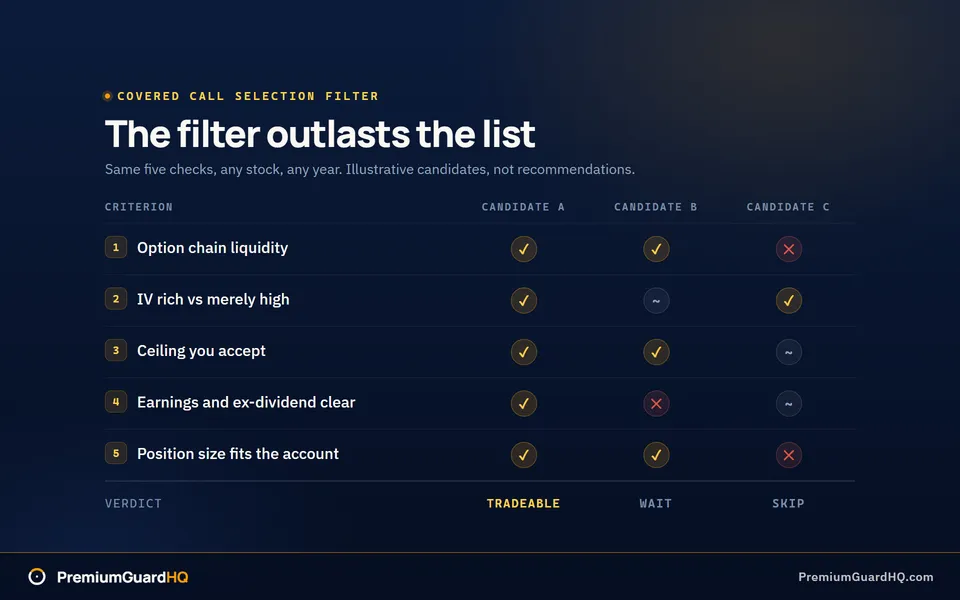
What lasts is a filter. This guide gives you five criteria you can apply to any stock in any year before you sell your first call.
This is education only, not a recommendation. Any tickers mentioned are illustrations as of the writing date, not picks.
Start with execution quality. Bad liquidity turns premium into slippage, the hidden cost of a weak fill.
1. Check options liquidity before you even think about strikes
Shares can trade millions of times a day while the options market stays thin. Share volume and option volume are separate. A familiar name can look safe because the stock chart prints heavy volume, and then you get a poor fill the moment you try to sell a call.
For covered calls, good liquidity means the exact strikes and expiration dates you will actually use have real trading activity, not just the stock itself. DTE stands for “days to expiration,” the number of days left before the option expires. Start with the option chain at your target DTE, usually 30 to 45 days out, and look at the strikes near your planned delta.
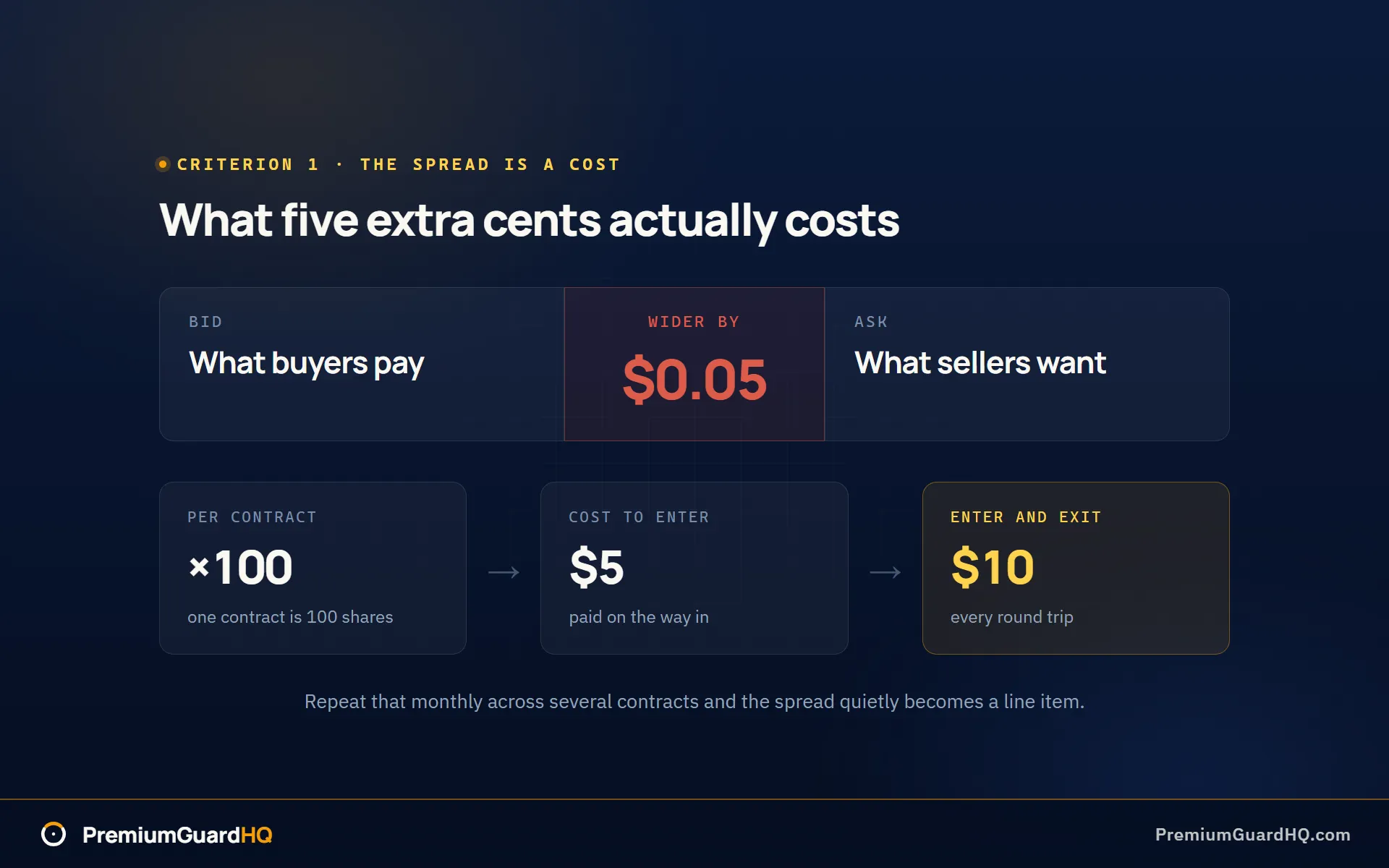
Delta runs from 0 to 1 and estimates the probability an option expires in the money. At those strikes, confirm two things. First, volume and open interest should be consistent: contracts already open, with new ones trading regularly. If you are unsure which number to trust, open interest and volume answer different questions. Second, bid-ask spreads should be tight. The bid is what buyers will pay, the ask is what sellers want, and the gap between them is a cost on every trade.
That gap adds up fast. A spread that is $0.05 wider costs about $5 per contract every time you enter and exit. Do that every month for a year across several contracts, and you have quietly handed income back to market makers.
Watch for two red flags: spreads wider than the premium itself, and thin weekly strike listings that leave you with poor roll choices later. As of August 27, 2026, heavily traded names like AAPL or SPY show tight spreads at nearly every strike. A thin single-name chain may show gaps wide enough to eat half your premium. That is not a buy signal, just a contrast worth noticing.
2. Separate high premium from rich premium
A fat premium can still be a bad trade. Before you sell a call, ask one question: is this option overpriced for what the stock actually does, or just priced for how scary it looks?
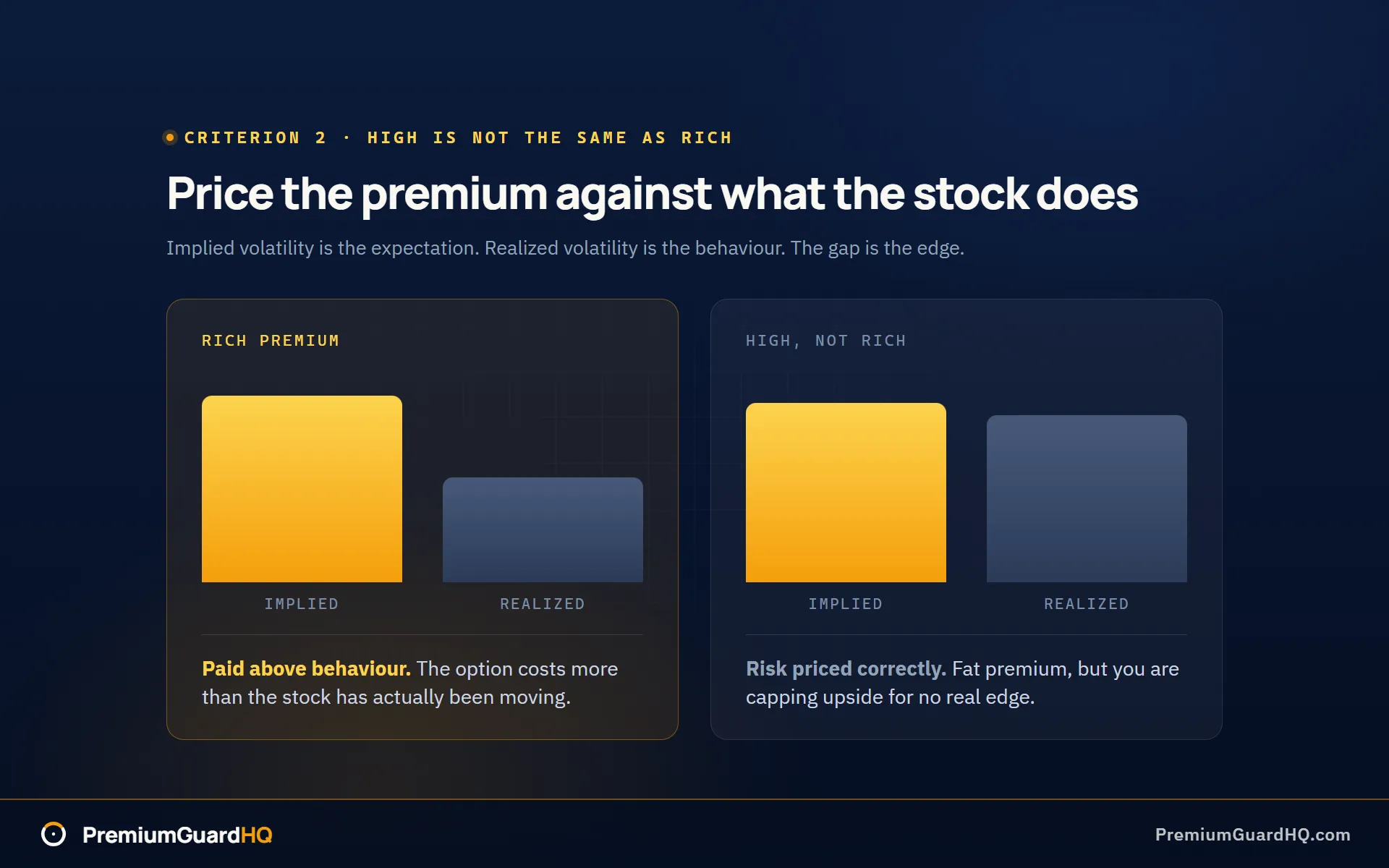
Two numbers matter. Implied volatility, or IV, is what the options market expects the stock to do. It is baked into the option price, so higher IV means fatter premiums. Realized volatility is what the stock actually did, based on its real price history. High premium only means IV is high. Rich premium means IV is high compared with what the stock has actually been doing. Mixing the two up is how traders end up selling calls on stocks that are risky for good reason.
Start by checking IV rank versus IV percentile. That shows where current IV sits against the stock’s own one-year history. Then compare current IV with recent realized volatility. If IV sits well above realized volatility, the call is priced rich. You are getting paid more than recent behavior justifies. If the two numbers are close, you are not collecting a real edge. You are just capping your upside for thin pay.
Check the calendar too. IV often inflates right before a known event, such as an earnings report, then collapses once the event passes. Premium can look attractive at the exact moment risk is highest. That premium reflects fear, not richness. It often deflates fast once the news hits, sometimes taking your gain with it.
Red flag: IV is elevated and realized volatility is elevated too, for a real reason. News-driven gaps or shaky fundamentals mean the market is pricing risk correctly, not mispricing an option. Knowing when a fat premium is compensation and when it is a warning is most of this criterion.
NVDA around a big event week might show high IV alongside genuinely large realized moves. That pricing is deserved, not rich. A steady dividend stock like KO usually shows low IV because it simply does not move much. Premium size alone tells you nothing. The ratio between IV and realized volatility is what matters.
3. Know your ceiling before you sell the call
Selling a covered call can feel like free money until the stock runs without you and you remember the trade you made. You receive cash today, called premium. In exchange, you agree to sell your shares at a set price if the stock reaches it. That price is the strike. The premium is payment for accepting that obligation, and the trade includes a ceiling built in.
Run one test before you sell anything. What price would make you genuinely happy to sell these shares? Not “fine with it.” Happy. That number should guide your strike. If you cannot name a number, you are not ready to pick one.
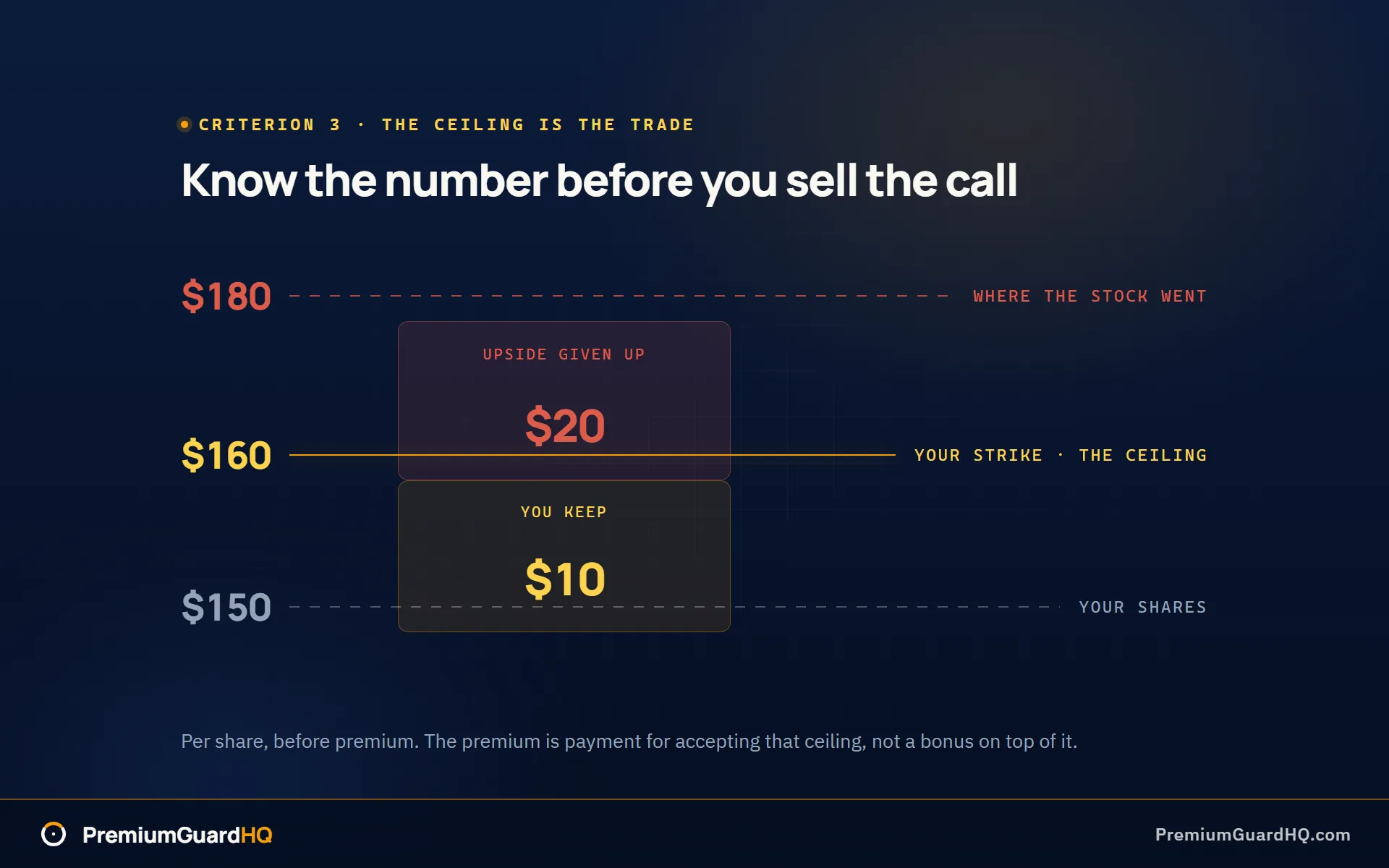
Now run the second half of the test. If the stock rockets past your strike, what does that cost you? Do the math instead of settling for a vague feeling of regret. Say you own shares at $150 and sell a call at $160. The stock then jumps to $180. Your shares get called away, meaning the buyer exercises the right to buy them from you at $160. This is assignment. You keep the premium and the gain up to $160, but you miss the $20 per share between $160 and $180. That is the real cost of assignment. Know that number before you sell the call, not after.
Strike distance is where you express what you actually want. A strike farther from the current stock price pays less premium but leaves more room for the stock to run before you are capped. A strike closer to the current price pays more premium but gets your shares called away more often. Neither choice is automatically right or wrong. Each one says something different about what you are trying to do. It helps to price a strike against your own cost basis before you commit to one.
Watch for a common trap. Rolling means buying back your current call and selling a new one, usually at a later date or different strike, to avoid assignment. Rolling occasionally is a normal adjustment. Rolling every cycle because you cannot stand letting the shares go is a different problem. That habit turns a clean, planned exit into a repeated cost, paid over and over just to delay a decision you will eventually have to make anyway.
One more thing to flag. If you care about long-term capital gains treatment, assignment timing and the IRS qualified covered call rules can affect your holding period. That gets specific fast, so the details are covered in the FAQ below.
Imagine holding MSFT or AAPL shares and selling a call two strikes out. If the stock grinds 15% higher past your strike, the gap between your strike and the new price is upside you traded away for premium. That is the deal. Know the number before you agree to it.
4. Check the calendar before you sell a single call
You can pick a great stock and get the strike right, and still get burned. Not because your analysis was wrong. Because you forgot to check a date.
Two dates matter most, and both take under a minute to check. Before you sell any call, ask two things. Does an earnings report fall inside the option’s life? Does an ex-dividend date fall inside it too? The same two questions close out the filters when you are screening cash-secured puts on the other side of the wheel.
Earnings risk. If your call’s expiration extends past the next earnings report, you are not selling the same trade anymore. The stock could gap 10% or more overnight on news nobody can predict. Premium runs higher heading into earnings because that risk is real, not because it is free money. Choose that trade deliberately.
Ex-dividend risk. The ex-dividend date is the first day a stock trades without its upcoming dividend attached. If your call is deep in the money going into that date, you can face early exercise. That means the buyer takes your shares early instead of waiting for expiration.
This happens for a simple reason. Early exercise is smart for the buyer when the extrinsic value left in the option is smaller than the dividend they would collect by owning the stock instead. Extrinsic value is the part of an option’s price tied to time and uncertainty, not built-in profit. Say a stock pays a $0.50 dividend, and your call has only $0.20 of extrinsic value left. The buyer profits by taking the stock, collecting the $0.50, and giving up the small remaining time value.
Track both dates per position on a real calendar, not in your head. As of August 27, 2026, names like JPM and KO pay regular quarterly dividends. Traders holding covered calls on stocks like these need to know exactly when the ex-dividend date lands against their strike and expiration.
PremiumGuard is built to catch exactly that. It reads your open positions and flags when an earnings date or ex-dividend date falls inside your short call’s window, with the numbers behind the flag. You still decide what to do. But you decide with the date in front of you, not after assignment has already happened.
5. Match the position size to the account you actually have
You found a stock with tight option spreads. Its premium looks rich, not just high. You know your ceiling and checked for earnings dates. One filter remains, and it has nothing to do with the stock. It is about your account.
Covered calls need 100 shares per contract. A contract is the standard options unit, and it always covers 100 shares. A $400 stock requires $40,000 in shares before you can sell one call against it. A $20 stock requires $2,000. Same strategy, very different entry costs. This is why “best stocks for covered calls” lists mean little without knowing your account size. The best stock for a $500,000 account can be a bad fit for a $15,000 one.
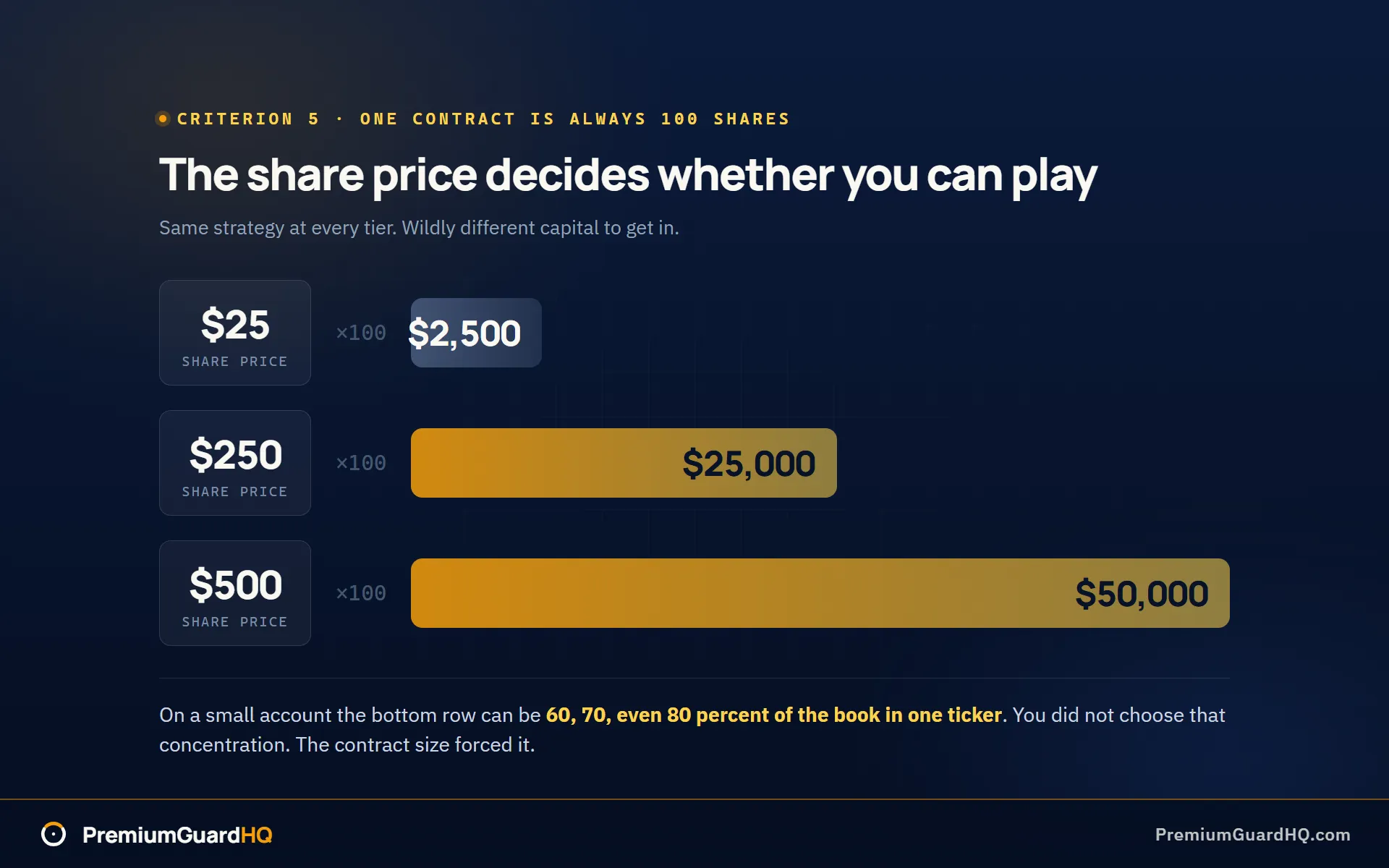
The trap: a trader with a small account sees a high-premium mega-cap stock and wants in. To afford 100 shares, that one position can eat 60, 70, even 80 percent of the whole account. Your capital now rides on one company’s stock price. If it drops hard, there is no other position to soften the blow. You did not choose that concentration. The math forced it on you.
Run the math before you fall for a ticker. Take the share price, multiply by 100, and see what percent of your account it consumes. Many disciplined traders cap any single position at 10 to 15 percent of total capital. Use that cap as a starting point. This is where lower-priced, liquid stocks earn their place. They let you build five, eight, or ten positions instead of one. More positions means one bad earnings report only dents the account instead of sinking it.
There is a trade-off to weigh as well, and it points straight back at the first criterion. Some of the most liquid, easiest-to-trade stocks cost a lot per contract. Some cheaper stocks trade with worse bid-ask spreads and more event risk, because smaller companies can gap harder on bad news. Cheap and liquid do not always arrive together.
So use two filters before you commit capital. First, check that the premium you would collect after spread costs is actually worth the cash tied up in the position. Second, make sure you could survive an assignment or a drawdown on that stock without it swallowing your whole account.
A stock like F trading in the teens lets a small account hold several positions across different sectors. A stock like NVDA in the hundreds might force a small account into one concentrated bet just to participate. Neither stock is better for covered calls. The fit depends on what is in your account before you ever look at a strike price. If picking the names is the part you would rather skip altogether, that is the honest case for letting a fund sell the calls instead.
Frequently asked questions
Does selling a covered call affect my long-term capital gains holding period?
It can. The IRS has rules about “straddles” that can pause your stock’s holding period clock when you write certain calls against it. This mostly targets calls sold deep in the money or far out in time. The IRS created a safe zone called a qualified covered call. If your call meets those tests, your holding period keeps running normally. The catch is that your broker’s screen will not tell you whether your trade qualifies. If tax treatment matters to you, talk to a tax professional about your actual position, not a general rule of thumb.
How do I estimate early assignment risk before an ex-dividend date?
Check the extrinsic value on your call the day before the ex-dividend date. If your call is in the money and its extrinsic value is smaller than the dividend, you are at risk of early exercise. Extrinsic value is the part of an option’s price that is not built-in profit. Section 4 covers this in detail, but the short version is simple: small time value plus a real dividend equals a real chance your shares get called away early.
What’s a reasonable bid-ask spread and open interest for a covered call trade?
Look for tight spreads, visible size on both sides, and steady open interest at the strikes you actually plan to use. No single magic number exists because it varies by stock and by strike. But there is a useful gut check. If the spread eats up a big chunk of the premium you would collect, the trade is no longer really income. It is friction. You are paying market makers instead of getting paid by them.
Covered call ETFs versus writing calls yourself: what’s the real trade-off?
A covered call ETF handles everything for you. It sells calls on a set schedule across a basket of stocks. That convenience comes with a management fee, less control over which strike or expiration gets used, and no say in tax timing. Writing calls yourself gives you full control over strike price, days to expiration, and when gains get realized. It also demands real execution discipline, since nobody rolls or picks your dates for you. Neither path is better. The question is how much control you want versus how much simplicity you are after.
PremiumGuard exists to make this math visible across every position you hold, not just one ticker at a time. Spreads, extrinsic value, dividend dates, and concentration all appear with the numbers behind them, so the decision stays yours.