
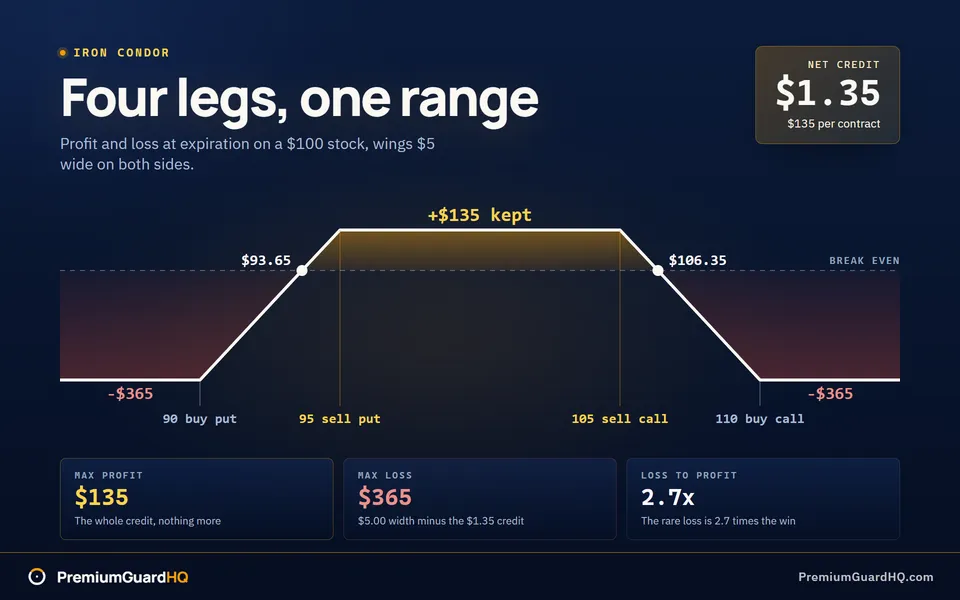
You keep hearing an iron condor called easy money. Sell options, collect cash, done. But the real payoff stays hidden.
By the end, you will be able to read any iron condor on your own. You will know its four legs, max profit, max loss, and breakeven prices.
An iron condor is a neutral trade, not an income machine. It bets a stock stays inside a range. If that bet fails, losses can be several times the credit collected.
Here’s the definition.
What is an iron condor?
An iron condor is a four-leg options trade made from two credit spreads: a bull put spread and a bear call spread, both on the same stock and the same expiration date. You open it for a net credit, and you keep that credit if the stock price stays between the two short strikes.
A credit spread means selling one option and buying another for upfront cash. The bull put spread sits below the stock price, and the bear call spread sits above it. Together they set your profit range. Your loss is also capped, since you buy two further-out options, called wings, limiting how far losses can run. That stacking of one spread on each side of the chain is how spread strategies are constructed to shape risk rather than simply reduce it.
An iron condor is a bet that the stock stays range-bound, trading sideways without a big move. You profit from calm, not direction.
How a short iron condor works
A short iron condor has two parts. You sell an out of the money put spread for a credit, and you sell an out of the money call spread for a credit. Out of the money means the strike price sits away from where the stock trades right now, so that option has no built-in value yet. Both spreads share the same expiration date, the day the options stop trading and settle. You collect two credits up front. That combined cash is the most you can make on the trade.
The trade has four legs. A leg is just one single option inside the spread.
- Sell 1 put at strike A. This is the inner put, closer to the stock price.
- Buy 1 put at strike B, a lower strike. This is the outer put.
- Sell 1 call at strike C. This is the inner call, closer to the stock price.
- Buy 1 call at strike D, a higher strike. This is the outer call.
The two options you buy, B and D, are called the wings. They sit furthest from the stock price. Their only job is to cap how much you can lose if the stock makes a big move. The two options you sell, A and C, are called the short strikes. They sit closer to the stock price and mark out the range where you keep your money.
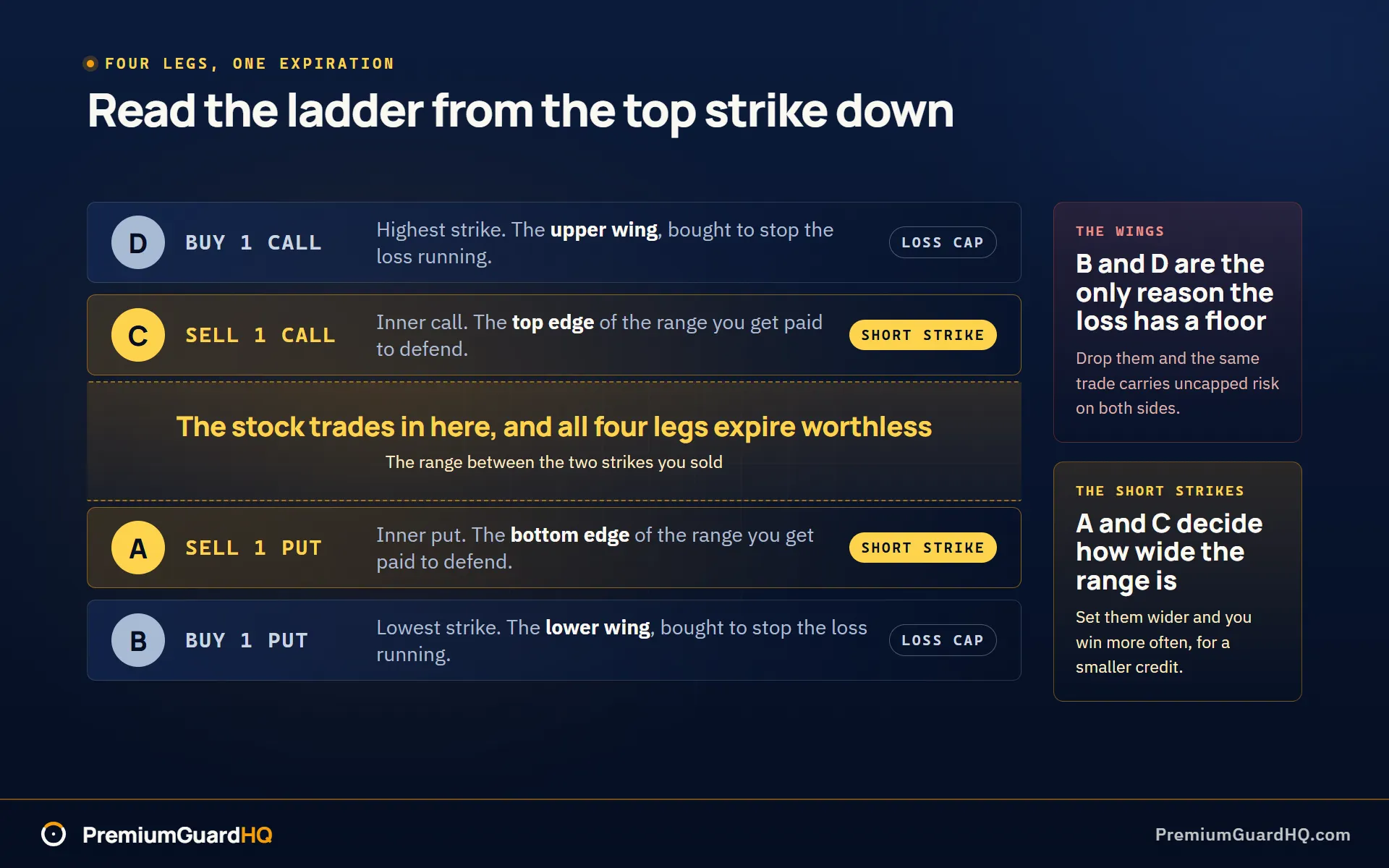
At expiration, only two things can happen. If the stock finishes between strike A and strike C, all four options expire worthless and you keep the full credit. That is the best case.
If the stock finishes beyond either wing, past strike B or past strike D, one of the two spreads hits its max loss. The other spread expires worthless and adds nothing.
Strike prices change the math on every trade. Before placing one, run your own numbers through the calculator to see both breakevens and the max loss for your own strikes.
Build it from four legs and read the payoff
Picture the stock price on a number line. Between your two short strikes, you win. Outside that range, one side of the trade can lose money. That is the whole shape of an iron condor.
To read the real numbers, you need three things.
Net credit. This is the cash you collect from both spreads added together, per share. Call it CR. It is the premium buyers pay you for the options you sold, minus what you paid for the long options that protect you. Those protective options are called the wings.
Wing width. This is the gap between a short strike and its matching long strike. Call it W. The put side and the call side can have different widths, and the wider one decides your worst case. For example, a $5 put wing paired with a $10 call wing means the $10 side sets your max loss, because it can lose more money before the long option caps it.
Now the formulas, in plain words:
- Max profit = CR. The most you can make is the credit you collected. Nothing more.
- Max loss = W - CR, using the wider wing.
If your wider wing is $10 and you collected $2 of credit, your max loss is $8 per share. Your max profit is $2 per share.
Next come your two breakeven prices. A breakeven is the exact stock price where you stop making money and start losing it.
- Lower breakeven = short put strike - CR.
- Upper breakeven = short call strike + CR.
Options prices are quoted per share, but a standard contract settles over 100 shares. So a $2 credit per share is $200 per contract in real cash. An $8 max loss per share is $800 per contract.
Here is the part most traders skip. You can make an iron condor look like a high win rate trade just by placing the short strikes far apart. A wide trade might win often, but the rare loss can run several times bigger than the credit you collected. The worked example below puts real numbers on this trade-off.
What an iron condor is a bet on: movement and implied volatility
Here is the bet in one sentence. A short iron condor bets that the stock will not move much before expiration, and that implied volatility will stay flat or fall. Implied volatility is the market’s guess at how much a stock will swing in the future. That guess is baked into the price of every option.
Two kinds of movement matter here. Realized movement is what the stock price actually does, day by day. Implied volatility is what option prices expect it to do. You can be right about one and wrong about the other, and that gap is where iron condors win or lose.
This trade also leans on two traits called greeks. Positive theta means the position gains a little value each day the stock sits still, all else equal. Theta measures how much an option loses value just from time passing. Negative vega means that if implied volatility jumps, the position tends to lose value even if the stock has not moved. Vega measures how much an option’s price shifts when implied volatility changes.
Now the part that confuses almost everyone. At expiration, the stock can only land in one place. It cannot finish below your put spread and above your call spread at the same time. So only one of your two spreads can ever be the losing side once the clock runs out.
Before expiration, though, both spreads can show a paper loss at once. This usually happens during a spike in implied volatility, when fear in the market rises fast. Higher implied volatility raises the price of options on both sides, puts and calls, even if the stock barely moved. Your account can show red on both legs for a while, even though only one side can actually lose at expiration. For more on what counts as high implied volatility and why it moves pricing on both sides, see our guide to volatile names.
The honest summary: an iron condor is neutral by design. It gets paid for a quiet stock and passing time. In exchange, it stays exposed to a big surprise move, or a sudden jump in implied volatility, before expiration ever arrives.
Worked example: one iron condor, every dollar spelled out
Illustrative example only. Not a live quote.
Picture a stock at $100. You build an iron condor with wings $5 wide on both sides, so the math stays clean. An iron condor is four options traded together: two spreads that bet the stock stays in a range.
Here are the four legs, with the premium (the price paid or received) per share:
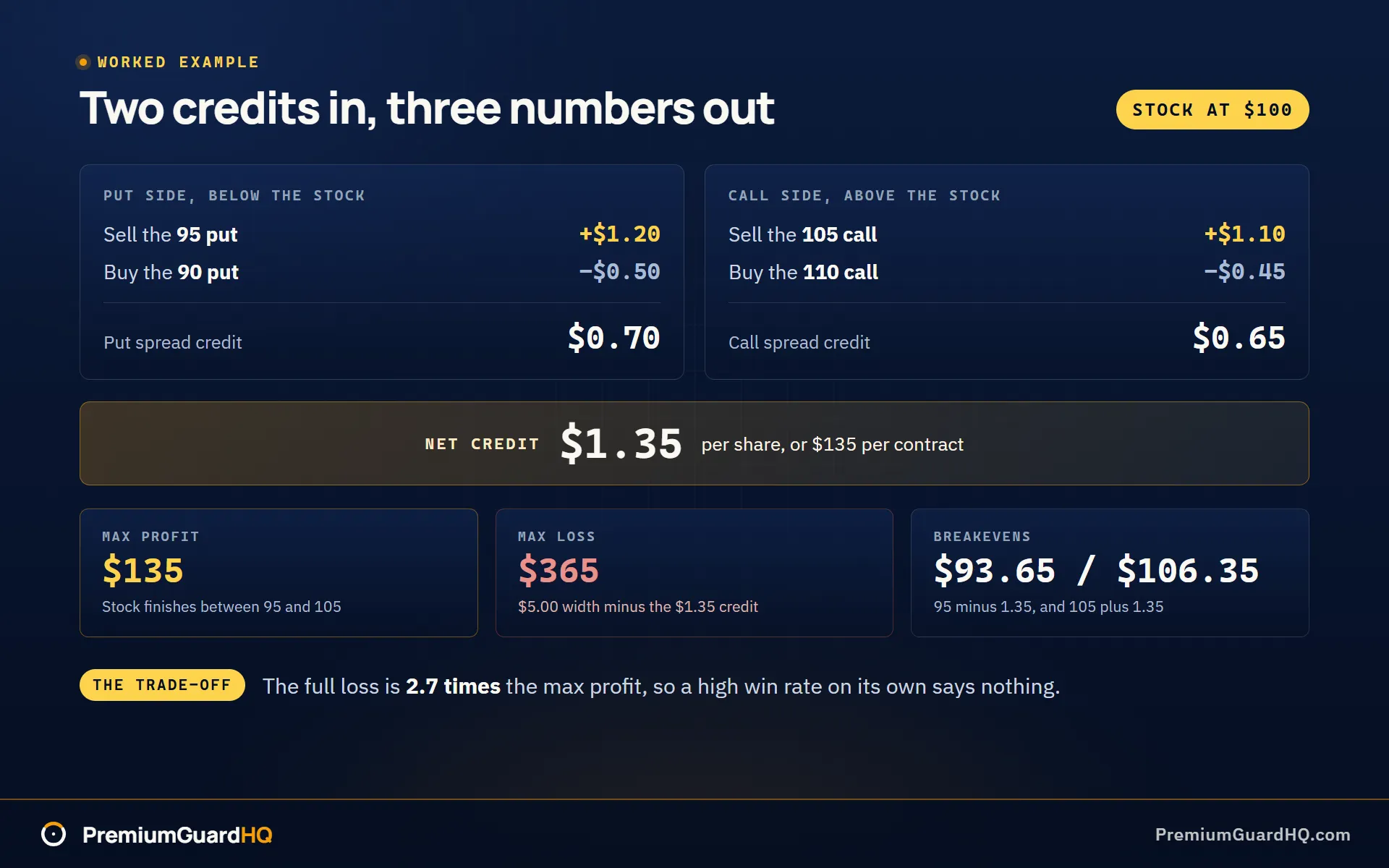
- Sell the 95 put for $1.20
- Buy the 90 put for $0.50
- Sell the 105 call for $1.10
- Buy the 110 call for $0.45
The put side brings in $1.20 minus $0.50, or $0.70. The call side brings in $1.10 minus $0.45, or $0.65. Add those: your net credit is $1.35 per share, or $135 per contract, since one contract covers 100 shares.
Now the payoff numbers, using the wing width (W) of $5:
- Max profit = $135.
- Max loss = $5.00 - $1.35 = $3.65 per share, or $365 per contract.
- Lower breakeven = 95 - 1.35 = $93.65.
- Upper breakeven = 105 + 1.35 = $106.35.
Check three prices at expiration, the day the options settle:
- Stock at $100: both spreads expire worthless. You keep +$135.
- Stock at $93.65: the put side’s loss exactly matches your credit. You roughly break even.
- Stock at $90 or below: the put side hits its full loss of $5.00 per share minus the $1.35 credit, for -$365.
This is why the win rate can look high. The full loss, $365, is about 2.7 times the max profit of $135.
Four legs, one trade. Most platforms let you place and watch all four legs as one position instead of four separate tickets.
Frequently asked questions
Is an iron condor bullish or bearish?
Neither. An iron condor is neutral by design. It does best when the stock barely moves at all, not when it goes up or down. You make your full profit if the stock price lands between your two short strikes at expiration. Those are the options you sold, one put and one call. A big move in either direction hurts the trade.
Why does an iron condor have two breakevens?
Because it has two spreads working at the same time. One breakeven sits below the stock price, on the put side. One sits above it, on the call side. To find them, use two simple rules. The lower breakeven is the short put strike minus the credit you collected. The upper breakeven is the short call strike plus that same credit.
How is an iron condor different from an iron butterfly?
An iron condor sells its put and call at two different strike prices, which creates a wider profit zone but a smaller credit. An iron butterfly sells the put and call at the same strike price. That narrows the profit zone a lot, but it pays a bigger credit upfront. Same four-leg shape, different width and different payoff.
Is an iron condor an income strategy?
It collects cash upfront, called a credit, but it is not a steady income machine. One bad move can cost several times what you collected, as shown in the worked example above. See where premium trades like this sit among income strategies for the wider comparison. If you want your multi-leg premium trades tracked cleanly across a connected broker, PremiumGuardHQ tracks your trades so the math stays visible.