

You know how selling puts for income works: you pick a stock you like, sell a put below its current price, and collect premium while you wait. A bull put credit spread starts from that same idea, with one more trade added to cap the downside.
In this setup, you sell a put. Then you buy a cheaper put at a lower strike, same expiration, and keep the cash difference. That is the whole structure.
This article stays narrow on purpose. The goal is to set this spread next to a plain cash-secured put so the tradeoff shows up in real dollars, not theory.
First, the exact definition and payoff math.
What is a bull put credit spread
A bull put credit spread is an options trade where you sell one put and buy another put at a lower strike on the same stock, with the same expiration. The cash you collect up front is your maximum profit. Your maximum loss is the gap between the two strikes minus that cash.
It is the bullish half of the credit spread family: sell the nearer option, buy the farther one, keep the difference.
The trade is bullish. It reaches full profit when the stock closes above the short strike at expiration. Even a modest dip can still leave a profit as long as the stock finishes above breakeven.
- Short put strike: the put you sold.
- Long put strike: the lower put you bought, which caps your risk.
- Spread width: the gap between the two strikes.
- Net credit: the cash you collect up front.
- Breakeven: the short strike minus the net credit, the point where losses begin.
How a bull put credit spread works at entry and at expiration
Opening the trade is one order with two legs. You sell a put at the higher strike and buy a put at the lower strike, same stock and expiration. The cash arrives right away. That payment is the net credit: the short put premium minus the cost of the long put. Both legs can go into one ticket. PremiumGuardHQ’s multi-leg order entry is built for exactly this.
Three numbers define the trade:
- Max profit: the net credit you collected, times 100 per contract.
- Max loss: the gap between strikes, minus the net credit.
- Breakeven: short strike minus the net credit.
At expiration, three things can happen:
- The stock closes at or above your short strike. Both puts expire worthless, so you keep the full credit.
- The stock closes between the two strikes. Your short put is in the money, meaning it has value against you. Assignment is possible. Your result lands between max profit and max loss.
- The stock closes below your long strike. Both puts are in the money, but the long put stops additional losses. The result stays capped at max loss.
That shape is the point of the structure, and it follows how spread positions are built from two legs rather than one.
These are standard equity options, so a short put can be assigned before expiration at the holder’s discretion. If that happens, the long put is already in place as the hedge.
Bull put spread vs cash-secured put at the same short strike
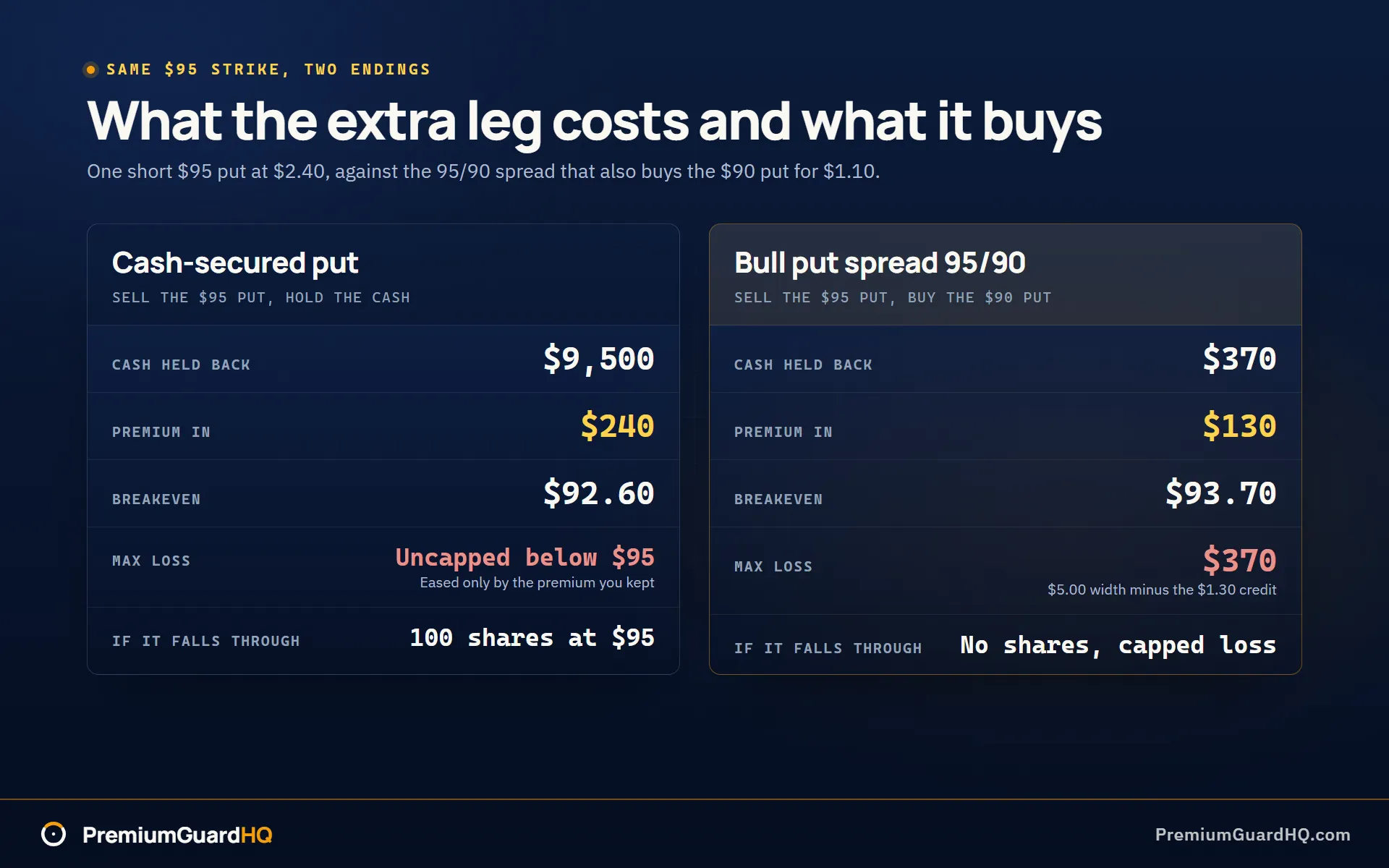
If you already sell cash-secured puts, a bull put spread is that same short put with one extra leg. A cash-secured put means you set aside enough cash to buy 100 shares if assigned. A bull put spread also buys a cheaper put at a lower strike, and that added put caps your loss.
The table below compares the same short strike side by side.
| Cash-secured put | Bull put spread | |
|---|---|---|
| Premium collected | Full premium from the short put | Smaller: short put premium minus the cost of the long put |
| Cash held back | Enough to buy 100 shares at the short strike | Just the strike width minus your net credit, times 100 |
| Max loss | Large if the stock keeps falling after assignment, eased by the premium you kept | Capped at (width minus credit) times 100 |
| Breakeven price | Short strike minus premium | Short strike minus the smaller net credit |
| If stock finishes below both strikes | You get assigned shares and keep them | You take a capped loss and get no shares |
The last row is the entire reason for this comparison.
A drop below your strike hands you shares in a cash-secured put. That is step one of the wheel strategy: sell puts, get stock, then sell covered calls on that stock for more income.
A bull put spread changes that. The long put cancels assignment. You take a loss whose size you knew from the start, but you walk away with no shares. With no shares left to sell covered calls against, the wheel never starts.
That is the trade. A bull put spread gives up the clean path to owning stock in exchange for a hard loss ceiling. If owning stock was ever part of the plan, the spread closes that door. If you only wanted income and never wanted shares, that closed door may be exactly what you want.
For the full mechanics of the plain version, including how assignment works, read our guide on the cash-secured put. To run your own strikes and account size on the CSP side, use the cash-secured put calculator.
A worked example with checkable math
Illustrative example. Not a live quote. The numbers below are made up to keep the math clear and do not point to any real stock.
Assume a stock trades at $100.00. You open the 95/90 bull put spread from the previous section: sell the $95 put for $2.40 and buy the $90 put for $1.10.
Net credit: You subtract the $1.10 paid for the long put from the $2.40 collected on the short put, which nets $1.30 per share. With 100 shares per contract, that is $130.
Width and max loss: The strike gap is $95 minus $90, or $5.00. Max loss per share is the difference between that width and the net credit: $5.00 minus $1.30, or $3.70. Multiply by 100 shares and the maximum loss is $370.
Breakeven: The short strike of $95.00 minus the $1.30 net credit lands at $93.70.
Now test three closing prices:
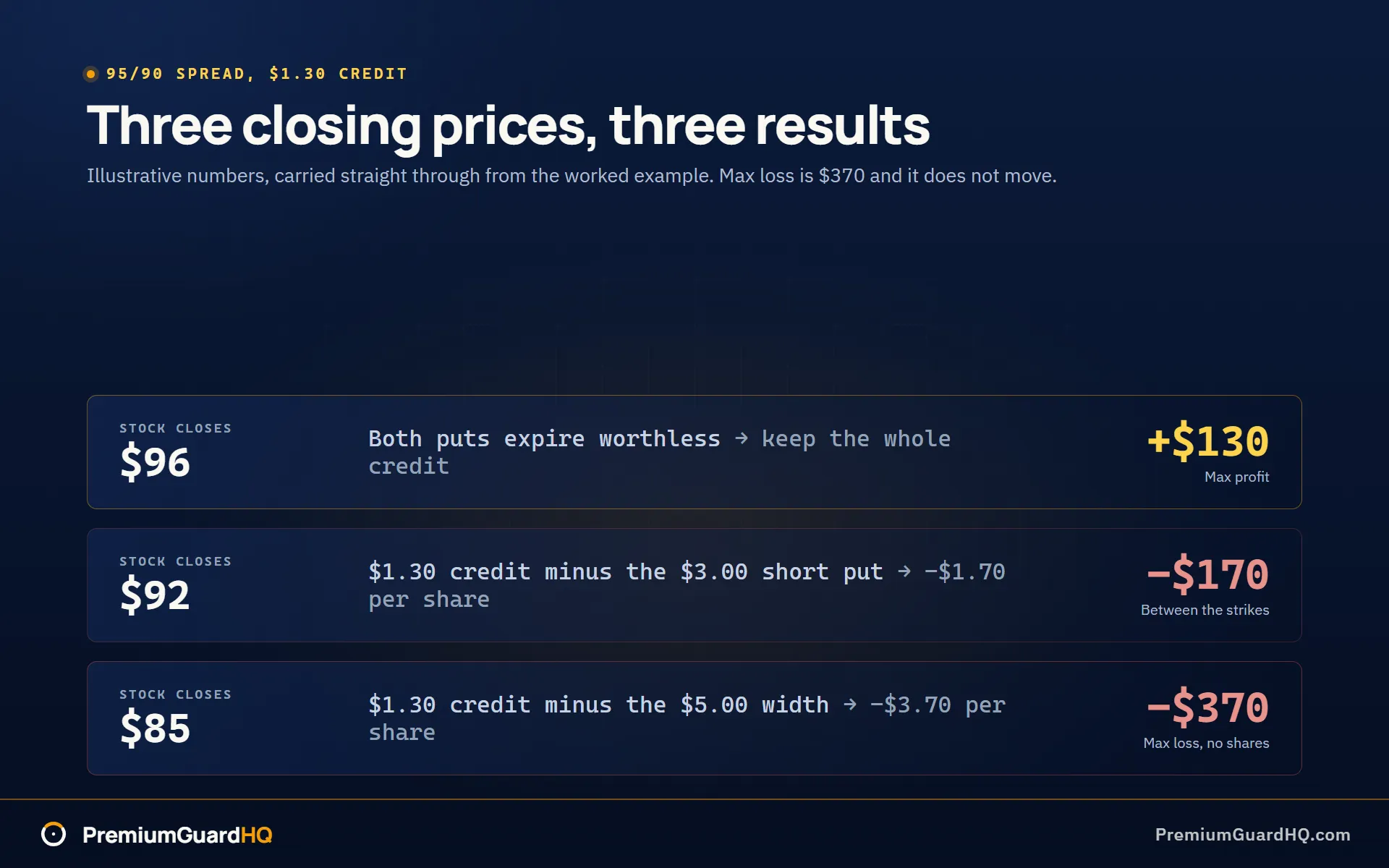
- Stock closes at $96. Both puts expire worthless, so you keep the full $130.
- Stock closes at $92. The $95 put is worth about $3.00 and the $90 put is worthless. Your result is $1.30 minus $3.00, or a $1.70 per share loss. That comes to $170.
- Stock closes at $85. Both puts have value, but the gap stays capped at $5.00. Your result is $1.30 minus $5.00, or a $3.70 per share loss. That is $370, your max loss. The put you bought absorbs the rest of the drop, so you never end up owning shares.
Now compare that to a plain $95 cash-secured put. A cash-secured put requires setting aside cash to buy the stock if you are assigned. That trade would tie up $9,500 in cash. If the stock closes below $95, you would likely be assigned 100 shares at $95, and your cost basis would be $95 minus the premium collected.
Frequently asked questions about bull put credit spreads
What is the maximum profit a bull put credit spread can produce? Your max profit is the net credit you collected when you opened the trade. That is the cash left over after selling one put and buying a cheaper put. You keep the entire amount if the stock closes at or above your short strike at expiration, because both puts expire worthless and no further action is needed.
What is the maximum loss, and why does it cap there? Max loss equals the gap between your two strikes, minus the net credit, times 100 shares per contract. The cap comes from the long put. Once the stock falls below your long strike, the put you bought gains value at the same rate the short put loses value. The two sides offset, so the loss stops growing no matter how far the stock drops.
Do you end up owning shares if the trade turns against you? If the stock closes below both strikes, no. Your long put offsets the assignment, so you walk away with a capped loss instead of shares. If the stock closes between the two strikes, assignment on the short put is possible, and what happens next can vary with timing.
Can you be assigned early on a bull put spread? Yes. Equity puts can be exercised before expiration, so the stock can be assigned to you early. If that happens, the long put is already in place as the hedge. Your account still has to handle the stock position created by assignment until it is resolved.
If you want a clean ledger of every spread and put-sale cycle without spreadsheet work, PremiumGuardHQ can track your trades from a connected broker and help you reconcile what happened across legs and expirations.