
Selling options for income feels great, until you ask: what’s my max loss? I want that number before I risk a dollar.
A credit spread is the defined-risk cousin of cash-secured puts and covered calls: sell one option, buy a cheaper one further out-of-the-money, or OTM, to cap your loss. You get less premium and tie up less collateral.
By the end, you’ll compute max profit, max loss, and breakeven from two strikes and one credit. For the bigger picture, see the full map of income strategies sorted by goal.
What is a credit spread in options?
A credit spread is an options trade where you sell one call or put and buy another of the same type and expiration, but farther from the stock’s price. This creates a net credit when you open the trade. Your maximum profit is that credit, and your maximum loss is capped and fixed.
This setup is called a vertical spread. Both options share the same expiration day but use different strike prices, the set prices where options can be exercised. The option you sell sits close to the stock’s price. The option you buy sits farther away, limiting your loss. That is how a vertical credit spread is put together, and the same construction applies on both sides of the chain.
There are put credit spreads and call credit spreads. Both use the same math for profit, loss, and breakeven, just in different directions.
How an options credit spread works: the cash flows and the obligation
A credit spread has two legs, and they do different jobs.
The short option is the one you sell. It sits closer to the stock’s price and pays more. Selling it creates an obligation: you promise to buy or sell 100 shares at that strike if you get assigned, meaning the other trader exercises their right against you.
The long option is the one you buy. It sits farther away and costs less. It’s pure protection, capping your loss if the trade moves against you.
You collect more from the short option than you pay for the long one. That gap lands in your account as a net credit, cash you keep once the trade fills.
Both options share the same expiration date; only the strikes differ. That’s what makes this a vertical spread.
At expiration, two outcomes exist. If the stock stays on the safe side of your short strike, both options expire worthless and you keep the full credit. If it moves past both strikes, you take the maximum loss.
Credit and debit spreads work in opposite directions. A credit spread pays you upfront; your biggest gain is that credit. A debit spread costs you upfront; your biggest gain is the strike width minus the debit.
You place both legs as one order, so they fill together as a single trade. The bookkeeping afterward is the part most logs get wrong, because two fills that are really one position land as two unrelated rows. A tracker that treats a two-leg spread as a single trade keeps the credit and the capped loss attached to each other.
The three numbers that define a credit spread: max profit, max loss, breakeven
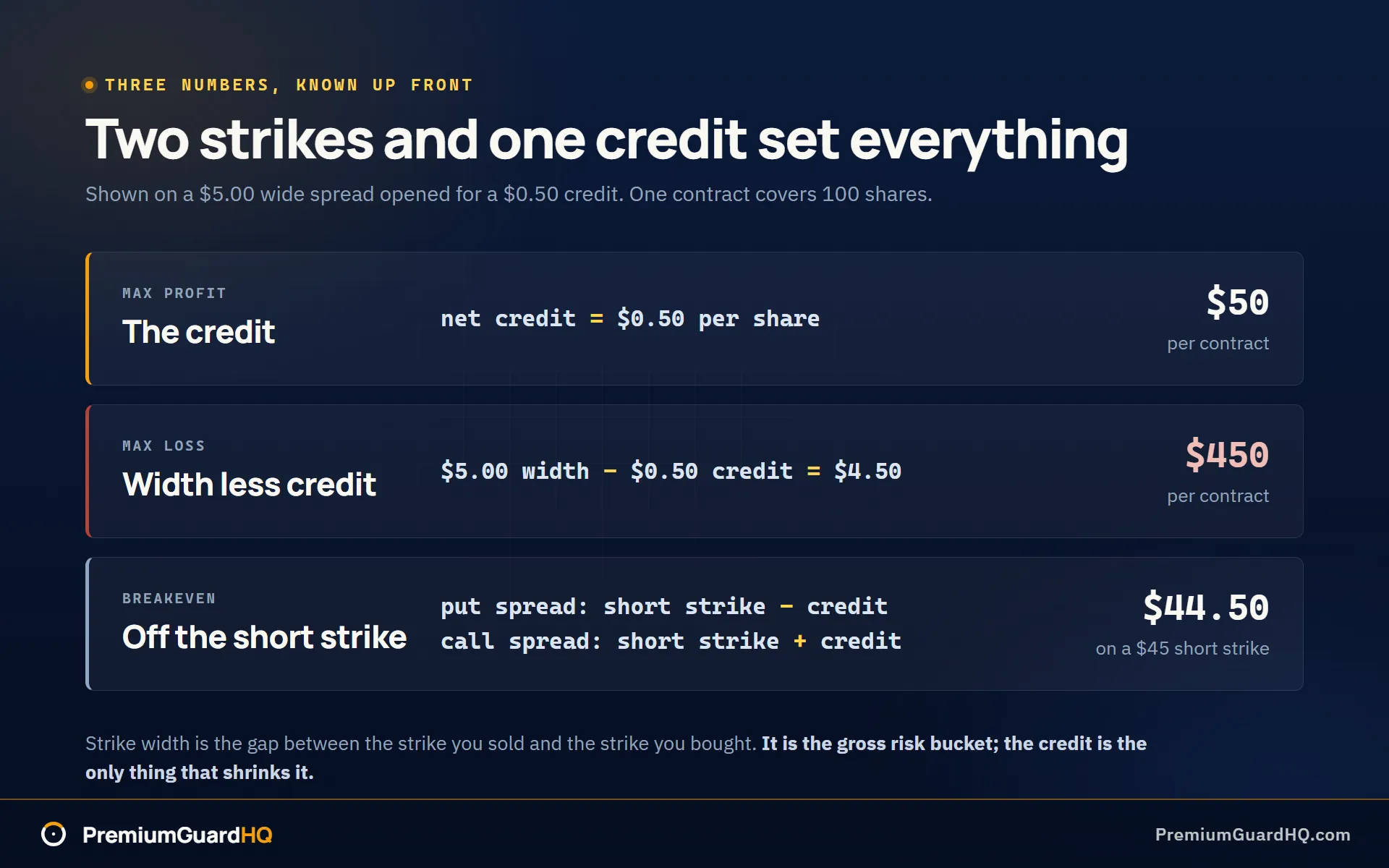
Before you open a credit spread, you know three things: the strike price you sold, the strike price you bought, and the net credit. Net credit is the cash that lands in your account the moment the trade fills. These three inputs let you calculate every number that matters, before the trade even starts.
Max profit equals your net credit. The most you can ever make is the cash you collected on day one. Options are priced per share, so a $0.50 credit means $0.50 per share. One contract covers 100 shares, so you multiply by 100 to get real dollars. A $0.50 credit becomes $50 per contract. Sell five contracts and that is $250.
Max loss equals strike width minus net credit. Strike width is the gap between your two strikes. Sell the $45 strike and buy the $40 strike, and your width is $5. That width is your gross risk bucket, the most the trade could cost before the credit helps at all. Subtract the credit from the width to get your real max loss. A $5 width minus a $0.50 credit leaves $4.50 at risk per share, or $450 per contract.
Breakeven is the price where you stop making money and start losing it. For a put credit spread, breakeven equals the short strike minus the net credit. The short strike is the strike price you sold. For a call credit spread, breakeven equals the short strike plus the net credit. Past that line, in whichever direction the spread faces, losses begin.
If you already think in terms of cash-secured puts and covered calls, treat these three numbers as a defined-risk overlay. They turn the trade into a box you measured before you ever placed it.
Why the long option is there: defined-risk protection and smaller collateral than a naked short
Start with a plain short put. A short put is a promise to buy 100 shares at a set price if the stock falls there. Sell one alone and you have no protection. Traders call this a naked short put, because nothing caps your loss. If the stock drops to zero, you still owe full price for those shares. Your broker locks up a large amount of cash or margin to let you place the trade. A short call works the same way: an uncapped stock rally can cost you without limit.
The long leg of a credit spread changes this. Once you buy that extra option, your loss has a ceiling. The strike you sold and the strike you bought form a fixed range. Nothing past that range can hurt you. You already learned this range sets your max loss.
Because the loss is capped, many brokers only hold back roughly that max-loss amount, plus a small buffer. They stop locking up the full value of the stock. This is why a credit spread usually ties up far less money than a naked short. Collateral rules differ by broker and by what your account can trade, and they sit alongside the risks regulators flag around margin and leverage, so check your own platform before assuming an exact number.
This is the same deal behind a cash-secured put, which locks up cash to buy stock. The mental model behind the cash a short put locks up carries straight over. It is also the same deal behind a covered call, which ties up shares you already own. Both trades pay you for taking on an obligation. A credit spread uses that same idea, but the long option caps your loss and frees up buying power, the cash or margin your broker lets you use for new trades, that those trades lock away.
Worked example: calculate the credit, max loss, and breakeven line by line
Illustrative numbers, not a live quote. This is not a real stock price. No tickers, no real dates.
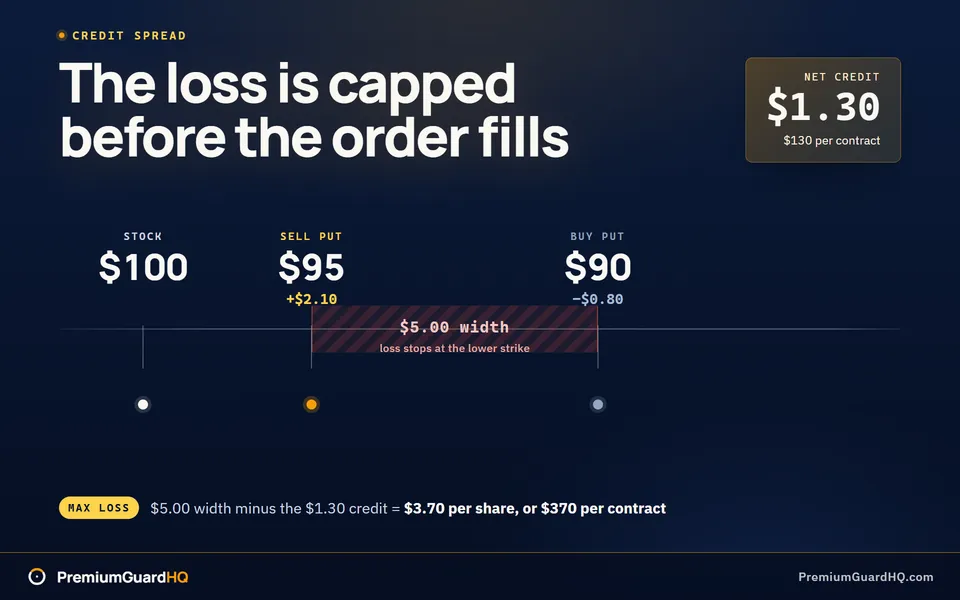
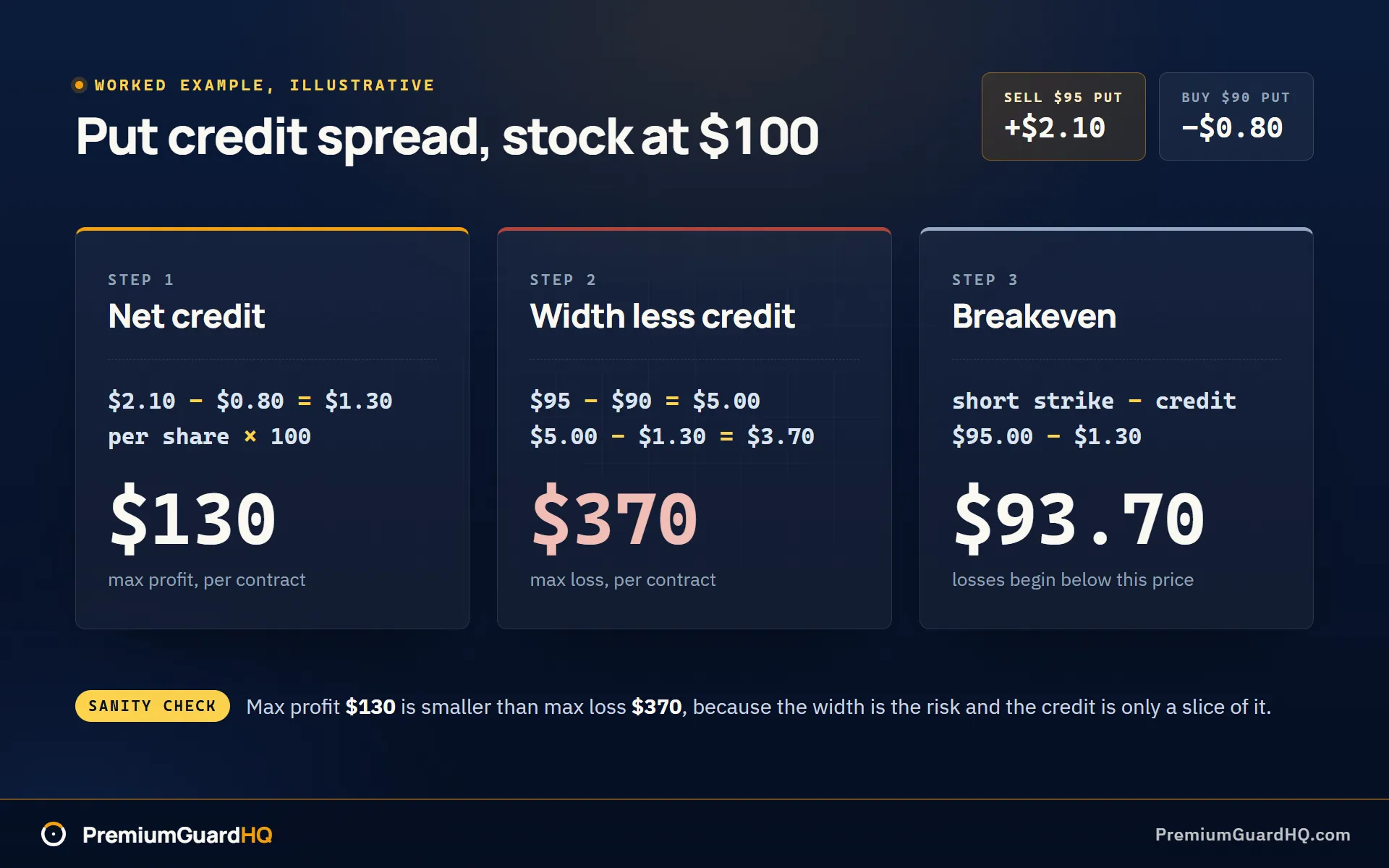
Say a stock trades at $100. You build a put credit spread. A strike is the price written into an option contract. A put credit spread uses two strikes: you sell one put and buy a cheaper put at a lower strike.
- Sell the $95 put for $2.10.
- Buy the $90 put for $0.80.
Step 1: net credit. Subtract what you paid from what you collected: $2.10 minus $0.80 equals $1.30 per share. One contract covers 100 shares, so multiply $1.30 by 100 to get $130. That cash lands in your account the moment the trade fills.
Step 2: strike width and max loss. Strike width is the gap between your two strikes: $95 minus $90 equals $5.00. Subtract your credit: $5.00 minus $1.30 equals $3.70 per share. Multiply by 100 shares for a max loss of $370 per contract.
Step 3: breakeven. For a put credit spread, breakeven equals your short strike minus your credit. Your short strike is the $95 put you sold. $95.00 minus $1.30 equals $93.70. Below that price, you start losing money.
Check the math: max profit of $130 is smaller than max loss of $370. That makes sense, since the strike width is your total risk, and the credit is only a small slice of it.
Want to see this as a picture instead of numbers? Use the calculator to see the capped-loss shape as a picture and diagram the payoff yourself.
Frequently asked questions about credit spreads
What is the difference between a credit spread and a debit spread?
A credit spread pays you cash the moment you open it. You sell one option and buy a cheaper one, and the gap between the two prices lands in your account as a net credit. A debit spread costs you cash upfront instead. You pay more for the option you buy than you collect for the option you sell. With a credit spread, your biggest possible gain is that starting credit. With a debit spread, your biggest possible gain is the strike width minus what you paid.
Does a credit spread have assignment risk?
Yes. Assignment is when the other trader uses their right to buy or sell stock, and it lands on you. The option you sold can still get assigned, sometimes even before expiration. The option you bought caps your worst-case loss on paper, but assignment can still land you with a short-term stock position and a sudden need for more buying power. Buying power is the cash or margin your broker lets you use.
What is pin risk on a credit spread?
Pin risk shows up when the stock finishes right at your short strike as expiration hits. The short strike is the strike price you sold. When the price lands that close, you may not know whether you got assigned until after the market closes. Know how assignment works before you hold multi-leg short options into expiration day.
Is a credit spread basically a cash-secured put or covered call?
It is built on the same idea: you get paid for taking on an obligation. A credit spread adds a long option on top, which caps your worst-case loss. That cap usually means you collect less premium and your broker locks up less collateral than a naked short position would require.