
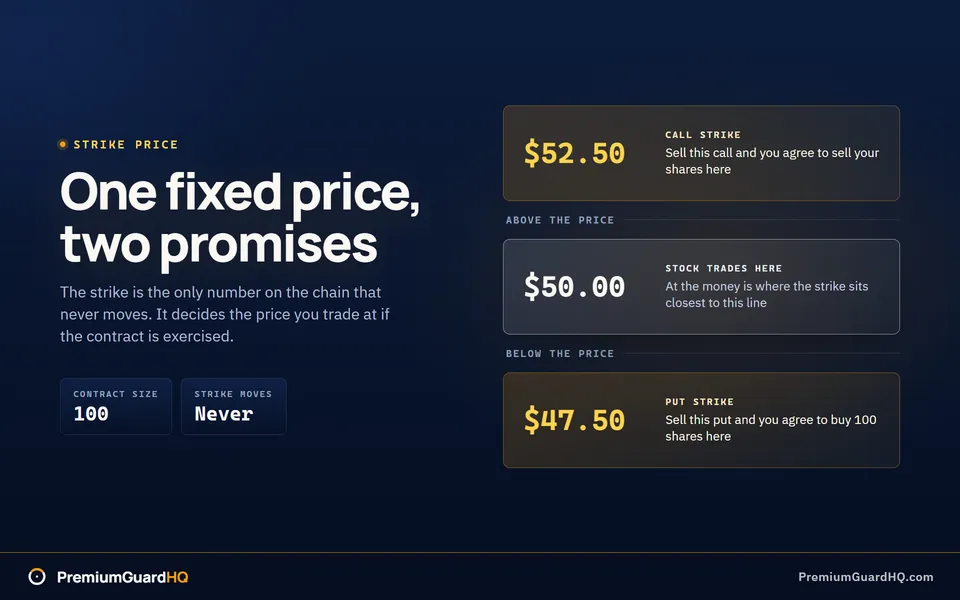
Choose a strike too close to the stock price, and you collect a premium. You also risk owning shares you did not want. That is the trade-off: what is strike price.
The next sections cover premium, delta, and assignment.
What is a strike price in options
A strike price is the fixed price in a stock options contract at which shares trade when the option is exercised. The call holder can buy shares at that price, and the put holder can sell shares at that price. If you sell the option, that price is where you may be assigned 100 shares.
Exercising means using the right to buy or sell at that price. Assignment is the seller’s side of it. You receive a notice telling you that you must buy or sell 100 shares at the strike price.
You do not choose strikes freely. The options exchange posts a fixed menu of prices for each stock, and you pick from that list. Employee stock options also have a strike price, but this article covers only exchange-listed stock options, the type traded through a standard brokerage account.
How strike price works in exchange-listed stock options
Open an options chain and you will see many strikes listed under each expiration date. The expiration date is the day the contract ends. Strikes are the different fixed prices you can choose for the same stock and the same expiration date. Our guide to reading an options chain walks through the full layout.
Each standard contract covers 100 shares of stock. The quoted price is the premium. That is the cost of the contract. Premium is always quoted per share, not per contract. So a $1.25 premium does not mean $1.25. It means you collect or pay $125 in total, because $1.25 x 100 shares equals $125.
Every contract has a buyer and a seller, and the two sides hold different positions, which is the heart of what an option contract grants and obligates. The buyer pays the premium and holds a right. That right means the buyer can exercise the contract or let it expire if that works better. The seller collects the premium and takes on an obligation. That obligation means the seller has no choice. If the buyer exercises, the seller gets assigned. Assignment means the seller must buy or deliver the shares at the strike price, whether the trade still looks good or not.
Moneyness is simply a label for where the strike sits relative to the stock’s current price. Three short terms describe it: in the money, at the money, and out of the money.
One common mix-up: the strike price is not your breakeven price. The strike is the fixed price written into the contract. Breakeven is a separate number you calculate yourself, and it includes the premium you paid or collected. We cover the breakeven math in a later section.
How the strike sets premium and assignment odds
The plain rule is this. Strikes closer to the stock’s current price pay more premium. Premium is the cash you collect upfront for selling an option. Closer strikes also have a higher chance of finishing in-the-money, which means the stock price ends up past your strike at expiration. That raises your assignment odds, meaning you may be forced to buy or sell the stock. Strikes further from the stock price pay less but carry less assignment risk.
Why does this pattern exist? The reason comes in two steps.
First, a closer strike needs a smaller move before it matters. Suppose the stock is at $50 and your strike is $48. The stock only has to drop $2 before that put option starts to bite. A put is an option tied to selling stock at a set price. If the strike is $35 instead, the stock has to fall $15 first. Less distance means less has to go right, or wrong, before the trade ends in assignment.
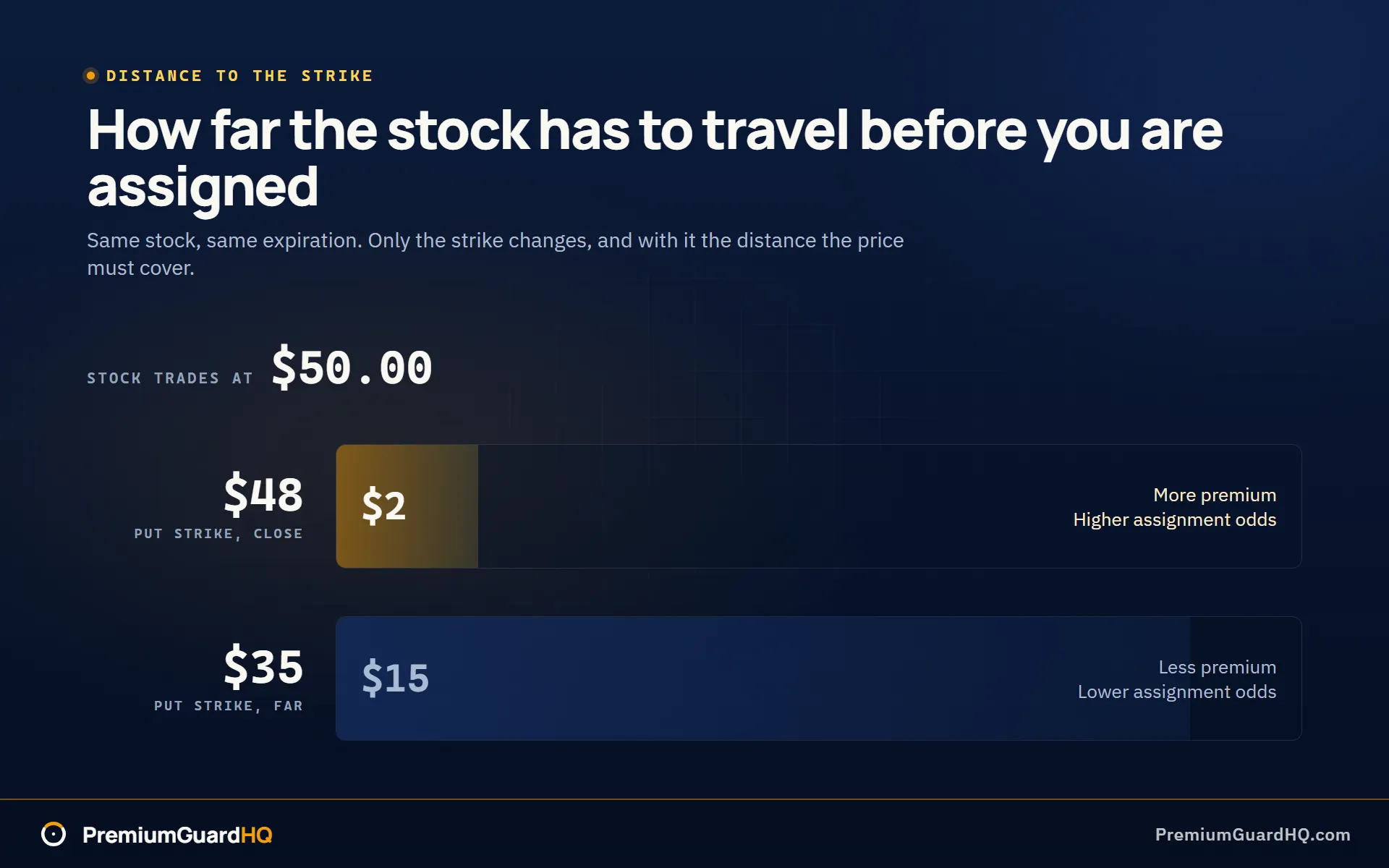
Second, because less has to happen, the market charges more for that contract. Sellers want to be paid for taking on a higher chance of assignment. Premium therefore rises as the strike moves closer to the stock price. A fat premium is payment for a strike that is more likely to get hit.
The same pattern appears for calls and puts, just flipped. A call is an option tied to buying stock at a set price. For a call, a strike near or below the stock’s current price pays more than a strike far above it. For a put, a strike near or above the stock’s current price pays more than a strike far below it.
How do you measure “closer” without doing the math yourself? Traders turn to a number called delta. Delta is a rough stand-in for how much the option’s price moves compared to the stock. Sellers also use it as a rough guide to the odds of finishing in-the-money. Our guide to delta in stock options covers this in depth.
Use delta as a gauge rather than a guarantee. It moves with the stock price and market volatility, so a delta you check today may look different tomorrow.
One last point: a higher delta on a short option usually means a higher chance of assignment. That is because the strike sits closer to the stock price, and closer strikes get hit more often.
How to choose a strike as a seller
When you sell options, the strike price is the price you agree to trade at if you get assigned. You are not making a forecast about where the stock will go. Assignment means the option buyer uses the right, and you have to follow through on the promise. That single shift changes how you pick a number on the options chain.
Start with the cash-secured put. In this trade, you promise to buy 100 shares at the strike price and set aside cash to cover the purchase. The strike is the price you agree to buy shares at if assigned. Choose the share price you would be content to own first. Then look at the premium, the cash the market pays you for making that promise. Our guide to cash-secured puts breaks down the full mechanics, and you can run the collateral and the premium against a strike before you trade.
Now flip it for the covered call. In this trade, you promise to sell 100 shares you already own at the strike price. The strike is the price you agree to sell your shares at if assigned. Start from your planned exit price, the price where you are willing to let the stock go. Premium comes second. It only takes a minute to test a call strike against the shares you already own.
Remember the earlier rule about closer strikes. Strikes closer to the stock price often pay more premium. They also raise the chance of assignment. Choosing a closer strike means choosing more cash upfront and more commitment.
Before you sell anything, say one sentence out loud. For a put: “If assigned, I am comfortable buying at $X.” For a call: “I am comfortable selling at $Y.” If you cannot say that honestly, the strike is wrong, no matter how good the premium looks.
Worked example: one cash-secured put and one covered call
This example is made up to show the math. It is not a real stock quote.
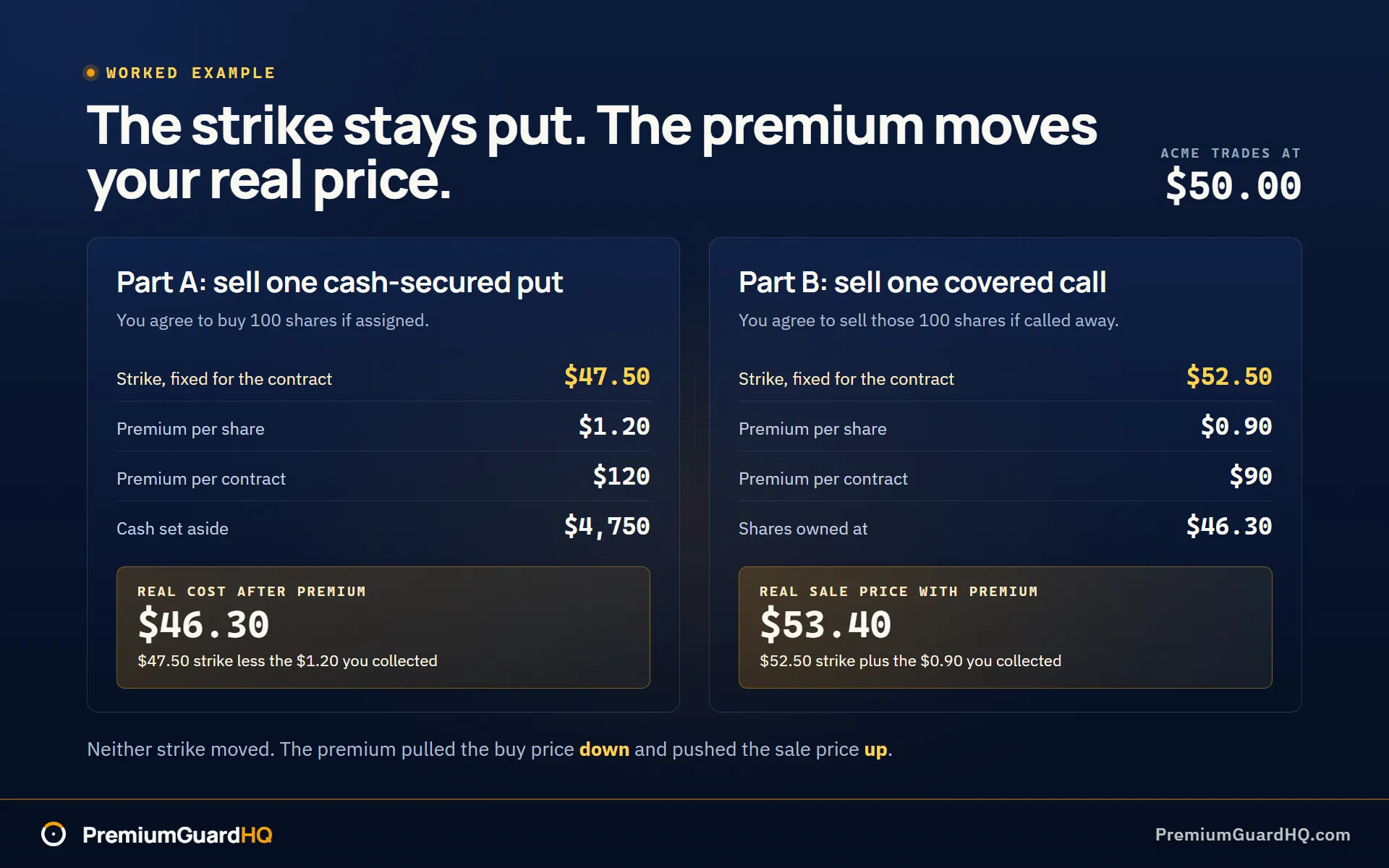
Suppose a stock called ACME trades at $50.00 a share. One options contract always covers 100 shares.
Part A: Sell one cash-secured put
You sell one ACME put with a $47.50 strike. A put is an option tied to selling stock at a set price. You collect $1.20 in premium. Premium is the cash you receive upfront for selling the option.
- Premium per share: $1.20
- Premium per contract: $1.20 x 100 shares = $120
- Cash set aside: $47.50 x 100 shares = $4,750. A cash-secured put requires you to hold this much cash in case you get assigned.
- If assigned, you buy shares at: $47.50. That is the strike. It never moves, no matter what the stock does.
- Your real cost after premium: $47.50 - $1.20 = $46.30 per share
The strike set the buy price. The premium you collected earlier quietly lowered your actual cost.
Part B: Sell one covered call after assignment
Now suppose you got assigned. You own 100 shares at a real cost of $46.30 each. You sell one ACME covered call with a $52.50 strike and collect $0.90 in premium.
- Premium per contract: $0.90 x 100 shares = $90
- If called away, you sell shares at: $52.50. Again, that is the fixed strike.
- Your real sale price including premium: $52.50 + $0.90 = $53.40 per share
What this proves
The strike never changed in either trade. It stayed the fixed price you agreed to buy or sell at. The premium moved. It shifted your real buy price down, then your real sell price up.
Frequently asked questions about strike prices
Can the strike price change after you sell an option?
No. Once you sell a contract, the strike is locked in for the life of that contract. The only exception is a corporate action, such as a stock split or a special dividend. In that case, the exchange can adjust the contract’s deliverables and strike so the contract still carries the same economic value. This is rare and handled automatically. You do not need to do anything.
Why are some strike prices $1 apart and others $2.50, $5, or $10 apart?
Strike spacing is set by exchange listing rules, not by you or your broker. Exchanges base the spacing on the stock’s price and how actively its options trade. Highly liquid stocks, meaning stocks with lots of daily options trading, tend to get tighter strike grids with smaller gaps. Higher-priced or thinly traded stocks usually get wider gaps between strikes.
Is strike price the same as breakeven?
No. The strike is the fixed price written into the contract. Breakeven is a separate number you calculate yourself, and it includes the premium paid or collected. For a call buyer, breakeven equals strike plus premium paid. For a put buyer, breakeven equals strike minus premium paid. See the worked example above for the full math on how premium shifts your real entry and exit price.
What does it mean when a strike is in the money or out of the money?
It describes where the stock price sits compared to your strike. In the money means the stock has moved past your strike in the direction that favors exercise. At the money means the stock is sitting right near the strike. Out of the money means the stock has not reached your strike yet. This is the same moneyness idea covered earlier in the mechanics section.
For a clean record of your option cycles and premiums, PremiumGuardHQ tracks your trades from a connected broker so every fill and closing outcome is visible in one place.