

Search “options strategies” and you get a list. Iron condor. Married put. Ratio spread. Collar. Twenty names, no compass.
You lack a way to pick, not information.
You need to know which few structures match what you’re trying to do, not memorize every one out there. Options strategies work best when you sort them by goal, not by name.
Here’s the plan. Seven strategies, grouped by what you want: income, buying stock cheaper, protecting what you own, or capping your risk. Most income traders stay in one lane. They sell premium, which means they collect cash upfront for taking on an obligation. A few popular strategies don’t even fit that lane. We’ll flag those as we go.
One rule guides everything below. You pick the trade. PremiumGuard shows you the math, plus any drift from your own rules.
We’ll start with two linked building blocks: the cash-secured put and the covered call. Everything else on this list builds outward from them.
1. Covered calls: the repeatable income engine
This is the trade most wheel traders run over and over. It turns stock you already own into steady paychecks.
A covered call means you agree to sell your shares at a set price. This price is called the strike price. In return, someone pays you cash right away. This cash is called the premium. You keep the premium no matter what happens next.
This trade fits when you already own shares and you would be happy selling them at the strike price. You are not chasing a huge price jump. You want steady income more than a shot at big upside.
Here is the trade in plain terms:
- Outlook: Neutral to mildly bullish. You expect the stock to sit still or rise a little.
- Credit or debit: Credit. Cash hits your account the moment you sell the call.
- Risk: The stock can still drop, and that loss is yours to bear. Your upside stops at the strike price, no matter how high the stock climbs.
- Breakeven: What you paid for the stock, minus the premium you collected.
This trade is the main tool for income-focused wheel traders. But it has one real weak spot. In a strong bull run, the stock flies past your strike and gets called away. You miss gains you would have kept by just holding the shares. A fast, sharp drop is different. You already owned the stock, so that downside was never something the covered call created. The premium you collected doesn’t erase the loss, but it does soften it. You come out ahead of where you’d be holding the shares with no premium at all.
Decide your exit rules before you open the trade, while your head is clear. What will you do if your shares get called away? What if the call expires worthless and you still own the stock? What if the stock drops hard and you’re now sitting on a loss? Write down your answers before you’re staring at a loss and guessing what to do.
Rolling is one option worth knowing. Rolling means closing your current call and opening a new one, usually further out in time. Sometimes you pick a new strike price too. You might roll to buy more time or to change your target price if your outlook shifts. We cover the full mechanics, with worked examples, in our covered call guide.
Track your premium income separately from your stock’s price swings. Say the stock drops $3 and you collected $1.20 in premium. Your real income for that cycle is not $1.20. Mixing these two numbers together is how traders convince themselves they’re profitable during a drawdown. PremiumGuard tracks premium profit and stock profit side by side for every cycle, so you always know which number is real income and which one is your stock position losing value.
2. Cash-secured puts: getting paid to set your buy price
You already know how the covered call works. The cash-secured put is its mirror image. It’s the door most wheel traders walk through first.
Here is the payoff in plain words. You get paid right now, in cash. In exchange, you might be asked to buy 100 shares of a stock at a price you already agreed to. That agreed price is called the strike price. Getting asked to buy the shares is called assignment. It happens when the stock is below your strike price when the option expires.
This trade fits one situation well: you already want to own the stock at that strike price, and you’re fine holding it even if the market gets noisy for a while.
Here’s the trade in plain terms:
- Outlook: Neutral to bullish. You expect the stock to hold steady or climb.
- Credit or debit: Credit. The cash lands in your account the moment you sell the put.
- Risk: Close to owning the shares outright below your strike price, but the premium you collected gives you a small cushion.
- Breakeven: Your strike price minus the premium you collected.
This only counts as an income strategy if you treat assignment as part of the plan, not as a mistake. Getting assigned shares is the wheel doing exactly what it’s built to do, not a failure. Your capital just moved from cash into stock, and it’s still working for you. This is the core building block for anyone running the full wheel, the cycle we introduced in the covered call section above.
Three things happen at expiration. The put expires worthless and you keep the full premium. You get assigned and now own the shares. Or you close the trade early. Rolling applies here too. Roll when the price you agreed to buy at no longer matches the price you’re actually willing to pay for that stock today.
Here’s what most guides skip. A wide bid-ask spread can quietly wreck a trade that looked great on paper. That’s the gap between what buyers offer and what sellers ask. A put showing a fat premium on screen can still fill at a much worse price if the spread is wide. Earnings and dividend dates matter too. Getting assigned shares right before an earnings report is a real risk sitting in front of you, not a hypothetical.
For the full mechanics, worked examples, and strike selection, see our cash-secured put guide.
One more thing worth flagging. If you’re paying yourself from premium while your equity base quietly shrinks underneath you, you’re not earning income. You’re spending principal and calling it a paycheck. PremiumGuard catches this by tracking your real cost basis, adjusted for every put you’ve sold, so your income numbers stay honest mid-cycle.
3. Credit spreads: income with a built-in backstop
What if you could sell options and know your worst-case loss before you even place the trade? That’s what a credit spread does. It’s the natural next step once you’ve outgrown selling single puts or calls.
A credit spread means you sell one option and buy another at the same time. Both are on the same stock. Both expire on the same date. The one you sell brings in more cash than the one you buy costs. That difference lands in your account right away. That’s why it’s called a credit.
There are two versions. A bull put spread is the bullish one. You sell a put at a higher strike price and buy a put at a lower strike price. Both sit below the current stock price. A bear call spread is the bearish version. You sell a call at a lower strike and buy a call at a higher strike. Both sit above the current stock price.
Here’s the deal in plain words. You get paid upfront. Your best case is capped at that upfront cash. Your worst case is capped too, and you know the exact number before you place the trade. You give up some premium compared to selling a put or call alone. In exchange, you get a hard ceiling on how much you can lose.
This fits you if you want income without owning 100 shares of stock, and you don’t want a loss that isn’t boxed in.
- Structures: Bull put spread (bullish) or bear call spread (bearish)
- Credit or debit: Credit. Cash lands in your account right away.
- Risk: Defined. It’s the gap between your two strike prices, minus the credit you collected. Nothing more, ever.
- Breakeven: For a bull put spread, it’s your short strike minus the credit. For a bear call spread, it’s your short strike plus the credit.
This fits an income approach, but it is not a wheel cycle. A wheel cycle is when an assigned put turns into stock, then into a covered call. There’s no such handoff here. If you get assigned on the short leg, you close the whole spread instead.
Before you open the trade, write down three numbers. Your profit target is the point where you close early and bank the win. Your max loss tolerance is the point where you cut the trade even if it hasn’t hit the worst case yet. Your plan for a tested short strike covers what you’ll do the moment the stock gets close to the strike you sold. Deciding these in advance keeps you from freezing when the trade moves against you. Your options are usually to close early, roll the trade out in time, or widen the spread for more room.
Two frictions matter more here than with single-leg trades. Spreads have two legs instead of one, so they can be harder to fill at a fair price, especially in less liquid stocks. Commissions also eat a bigger share of a small credit. A $0.30 credit means fees matter a lot more than they do on a fat cash-secured put premium.
Keep spreads separate from your wheel cycles in your own records. Mixing realized profit from a defined-risk spread with the paper gains or losses of a cash-secured put position muddies your income accounting. PremiumGuard reports them as separate income streams, so what you actually earned stays separate from what your open positions are worth on paper.
4. Iron condors: getting paid to bet on a boring stock
Here you actually want the stock to do nothing. Sit still. Go nowhere. That’s the whole bet. Many spreadsheet traders swear by it. Others avoid it completely.
An iron condor is two credit spreads stacked together. A credit spread is a trade where you collect cash upfront and your worst-case loss is capped from the start. Here, you run one spread below the stock price and one above it, on the same stock, expiring the same day. That’s four separate option contracts, or four “legs.” You collect cash upfront from all four combined.
You get paid if the stock stays inside your range until expiration. If it breaks out past either side, your loss is capped, but it still stings. This fits you when you have a real reason to expect sideways trading, and the options chain is liquid enough to enter and exit without fighting a wide bid-ask spread (the gap between what buyers offer and sellers ask).
Trade profile:
- Outlook: Neutral. You’re betting on a range, not a direction.
- Credit or debit: Credit. Cash comes in upfront.
- Risk: Defined. It’s the width of whichever spread gets tested, minus the credit collected.
- Breakeven: Upside is your short call strike plus the credit. Downside is your short put strike minus the credit.
Plenty of wheel traders never touch this trade. Four legs mean four separate fills, and four chances for something to go wrong at entry or exit. It’s more moving parts for a trade that often pays less than the confidence it demands. Comfort managing assignment on a cash-secured put doesn’t mean you’ll enjoy juggling four strikes at once.
The bookkeeping is its own problem. Four fills that are really one trade land in most trade logs as four unrelated rows, and the numbers that matter, meaning the capped loss and both breakevens, only exist once you put the four back together. PremiumGuard reads a condor as one position instead of four loose legs.
“Tested” means one side is under real pressure. The stock has moved close enough to your short strike that a big loss is now likely, not distant. Decide your response before that happens: reduce size, close early, roll the threatened side, convert to a different risk profile, or accept the max loss. Deciding in the moment turns a manageable trade into a panicked one.
Two costs hit harder here than almost anywhere else on this list. Four legs mean four chances for a bad fill, and slippage on each leg quietly eats a credit that looked good on screen. Commissions do the same damage from a different angle. A $0.40 credit on a four-leg trade can shrink to almost nothing after fees.
It’s also easy to open several iron condors on stocks that move together without noticing. If tech names sell off at once, three “diversified” condors can get tested the same afternoon. PremiumGuard flags that kind of concentration across your whole book, so correlated risk doesn’t hide behind trades that look separate.
5. Protective puts: buying insurance for stock you already own
Every strategy so far pays you first and asks questions later. This one flips the script. You pay upfront, and that changes who this trade is for.
A protective put gives you the right to sell your stock at a set price called the strike price. You pay cash for that right. That cash is called the premium. Think of it like insurance. You pay a premium so you know the worst price you’ll ever sell at, no matter how far the stock falls.
This fits you when you’re holding stock for a real reason, maybe a long-term thesis or a big position you don’t want to unwind. But you need a hard floor under it for a set stretch of time.
Here’s the trade in plain terms:
- Outlook: Bullish, but you want a safety net.
- Credit or debit: Debit. Cash leaves your account when you buy the put.
- Risk: Defined on the downside. Your worst case is your stock’s value minus the protection the put gives you. Your upside stays open.
- Breakeven: What you paid for the stock, plus the premium you paid for the put.
Say this part out loud: if you run an income-focused wheel, you’ll probably never use this trade as a habit. It costs money every single time. That recurring cost fights against the premium you’re collecting elsewhere. Time decay, the natural loss in an option’s value as it nears expiration, works against you here instead of for you. This is a defensive trade, not an income trade. It earns its keep a different way.
What are you really paying for? Time, and protection against a sudden gap down, like an overnight crash on bad news. Hoping you can exit fast during a sharp drop sounds fine until the stock gaps down 15% before the market opens, and there’s nothing left to sell at a decent price. A protective put sidesteps that problem. Your floor locks in before the damage happens, not after.
Set the terms before you buy the put. Decide how long the protection lasts and what ends it early: your thesis changes, the risk passes, or you’ve trimmed the position enough that you don’t need the hedge. Extending protection past that window is a new decision with a new cost. Treat every extension like a fresh trade, not something you renew on autopilot.
Two frictions matter here. Puts further out in time trade less often, so the bid-ask spread can be wider than you’d like. That’s the gap between what buyers offer and what sellers ask. Protection also tends to cost the most exactly when you want it most, because fear pushes implied volatility up, and that pushes put premiums up right when you’re reaching for the shelf.
This is exactly why separating Premium P/L from Equity P/L matters. The cost of this put shows up as a hit to your options P/L, not as your strategy suddenly underperforming. PremiumGuard keeps that hedge cost on its own line, so it never gets mistaken for a bad trade when it’s actually doing its job.
6. Collars: trading upside for a cheaper floor
Why pay full price for protection when you can get a discount? A collar is the natural next step after the protective put we just covered.
A collar takes that protective put and adds one move. A protective put means buying a put option to set a floor price, the lowest price you’ll accept for your shares. You still own the stock and still buy that put. But this time, you also sell a call, which is a promise to sell your shares at a set price if the stock gets there. Selling that call brings in cash right away. That cash offsets some or all of what you paid for the put. You give up the stock’s upside above your call strike in exchange for cheaper insurance below.
In plain words, you cap how much you can gain, but you lower the cost of protecting your downside. This fits when you want to stay in the stock but you’re fine giving up some upside for a floor you know in advance.
Here’s the trade in plain terms:
- Components: Stock you own, plus a put you bought, plus a call you sold
- Credit or debit: Depends on your strikes. It can cost a little, pay a little, or net out close to free.
- Risk: Defined on both sides. The put sets your floor. The call sets your ceiling. Your stock’s value can only move inside that range.
- Breakeven: Roughly what you paid for the stock, adjusted by whatever net premium you paid or collected.
A collar is a risk-control move, not an income trade. It protects the income engine you built with covered calls and cash-secured puts, especially through a rough stretch. Think of it as a pause button for your risk, not a new way to get paid.
Know your move before the stock decides for you. If the stock climbs toward your call strike, you accept the cap, roll the call to a higher strike, or unwind the position. If the stock falls toward your put strike, the hedge is doing its job. Your only decision is whether to extend the protection or close things out.
Fills matter more here than the payoff looks like on paper. A collar has three separate pieces moving at once: your stock, the put, and the call. A bad fill on any single leg can quietly erase the cheap protection you were counting on. Watch dividend dates and assignment risk on your short call too. Assignment means your shares get sold early if the call goes in the money. Getting called away right before a dividend can catch you off guard if you weren’t watching the calendar.
A collar should never happen by accident. Hedging costs money, and a collar changes that cost by adding a capped upside on top. It should be a decision you make on purpose, not something you back into because a position got too big or an earnings date snuck up on you. PremiumGuard’s overnight checks flag both conditions, earnings landing inside your expiration week or a position growing past your own size limit, so a collar shows up on your calendar as a deliberate choice, not a scramble.
7. Debit spreads: a defined-risk way to bet on direction
Ever bought a call, watched the stock move your way, and still lost money? Time decay ate your option faster than the stock could climb. Time decay means an option loses value every day just from time passing, even if nothing else changes. That’s the most common way a directional bet turns into a slow bleed. A debit spread is built to fix it.
A debit spread means you buy one option and sell another at the same time. Both options are on the same stock and expire the same day. The one you buy costs more than the one you sell brings in, so cash leaves your account upfront. That’s why it’s called a debit. Selling the second option isn’t for income here. It lowers your cost and shrinks how much time decay can hurt you.
There are two versions. A bull call spread is the bullish one: you buy a call at a lower strike and sell a call at a higher strike. A bear put spread is the bearish version: you buy a put at a higher strike and sell a put at a lower strike. A strike is the set price at which an option lets you buy or sell the stock.
Here’s the trade in plain terms:
- Structures: Bull call spread (bullish) or bear put spread (bearish)
- Credit or debit: Debit. Cash leaves your account when you open the trade.
- Risk: Defined. The most you can lose is the cash you paid, nothing more.
- Breakeven: For a bull call spread, it’s your long strike plus what you paid. For a bear put spread, it’s your long strike minus what you paid.
This fits when you have a real directional opinion and a time window in mind. You want your loss boxed in without paying full price for unlimited upside.
Most income-first wheel traders barely touch this trade. The option you buy still fights time decay every day, and it only pays off if the stock actually moves your way before expiration, the date the option ends. That’s a different game than collecting premium and letting time work for you, which is the whole point of covered calls and cash-secured puts.
Decide what “wrong” looks like before you open the trade. Maybe it’s a price level that tells you your thesis failed. Maybe it’s a date where you’re out no matter what the chart says. Decide too what ends the trade: closing it, cutting size, or accepting the loss. Deciding this upfront costs far less than figuring it out after the trade turns against you.
Don’t wait for expiration to decide if you were right. Taking a partial profit early often beats holding out for every last dollar and watching it fade.
Two legs still need to fill at a fair price, so liquidity matters. Fees run lower than a four-leg trade, but on a small debit, even modest commissions take a real bite out of your profit.
Tagging your intent pays off here. A debit spread is a directional bet, not an income trade. Mixing the two in your own records makes your performance reviews meaningless. PremiumGuard lets you tag each position by intent, so a directional trade never quietly blends into your income numbers and drags your wheel results off course.
How to build your own options trade, step by step
You now know the seven strategies. Here is how to pick one and run it, in order, every time.
Step 1: Start with your goal, not the strategy’s name
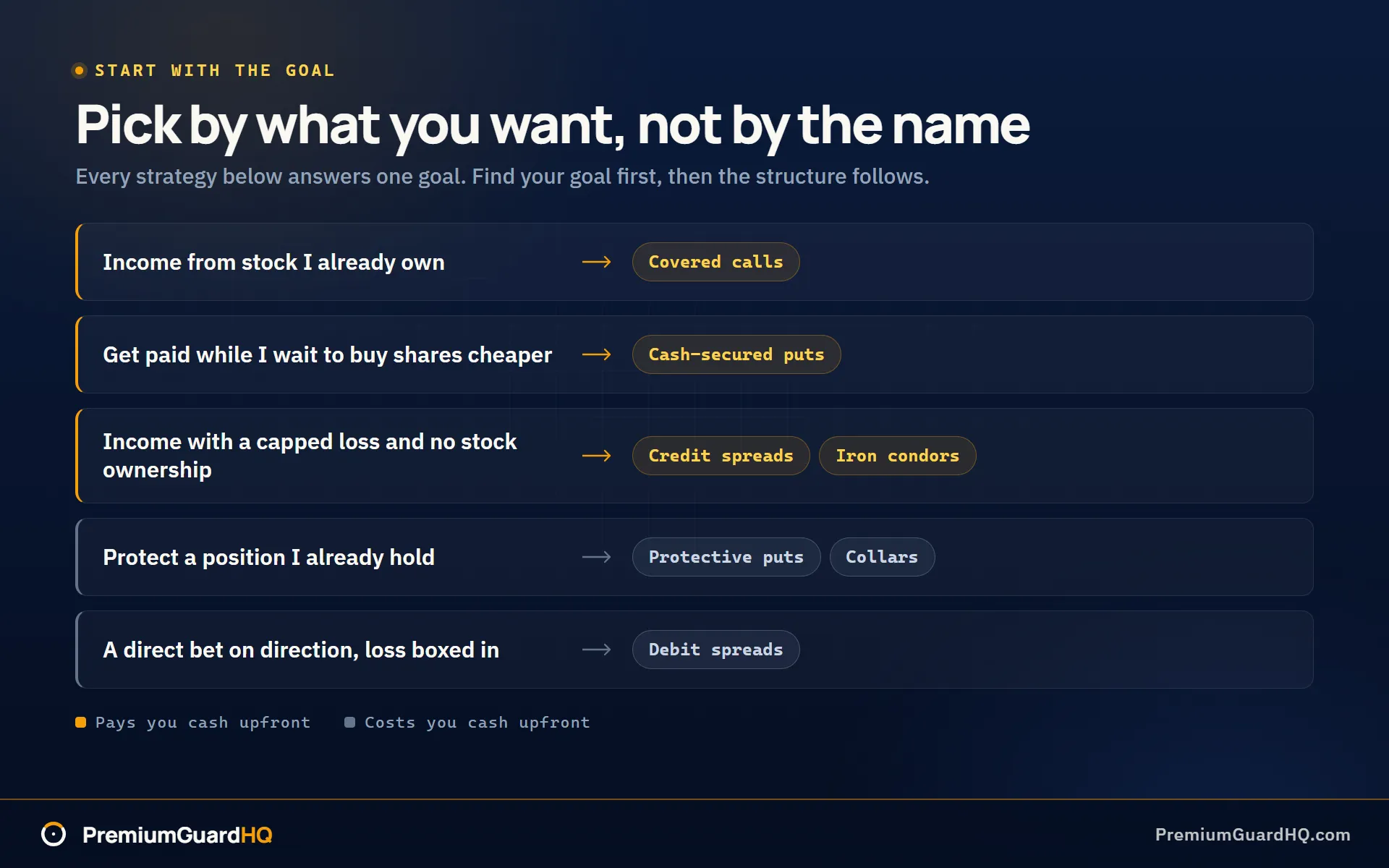
Don’t start by asking “should I run an iron condor.” Start by asking what you actually want. Match your goal to one of these buckets:
- Income from stock you already own: covered calls.
- Get paid while you wait to buy shares cheaper: cash-secured puts.
- Income with a capped, known loss and no stock ownership: credit spreads or iron condors. These pay you cash upfront and cap how much you can lose.
- Protect a position you already hold: protective puts or collars. These act like insurance on stock you own.
- A direct bet on price direction, with your loss boxed in: debit spreads. You pay upfront, and your biggest possible loss is set from the start.
If you can’t say your goal in one sentence, stop. Do not place the trade yet.
Step 2: Sort the trade into credit or debit
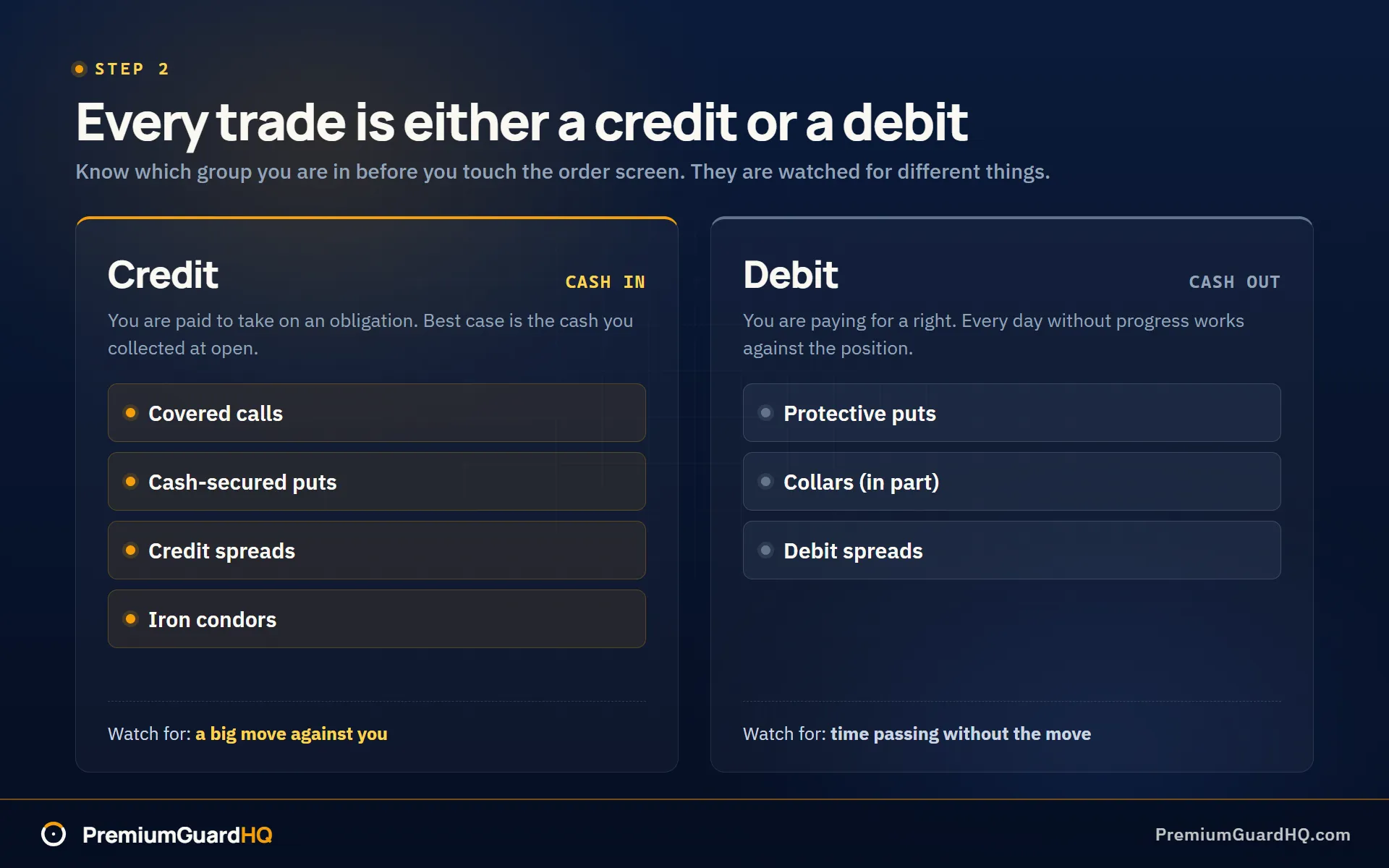
Every trade on this list falls into one of two groups. Know which group you’re in before you touch the order screen.
Credit trades pay you cash upfront. Covered calls, cash-secured puts, credit spreads, and iron condors all work this way. You collect your best-case cash the moment you open the trade. Your risk shows up if the stock makes a big move against you. Your job is watching for that move, not waiting for more cash to show up.
Debit trades cost you cash upfront. Protective puts, collars (in part), and debit spreads all work this way. You paid for a right. Your risk shows up as time passes without the stock moving your way. Every day that ticks by without progress works against you.
Say your bucket out loud before you place the order. Try “this is a credit trade, I’m paid to take on an obligation.” Or try “this is a debit trade, I’m paying for a right.” That one sentence keeps you from managing a debit trade like a credit trade. Mixing up the two is a common way traders lose track of what they should actually be watching.
Step 3: Run the four filters before you click submit
Every trade on this list needs to pass these four checks first, no matter which one you picked.
- Liquidity filter. Look at the bid-ask spread. This is the gap between what buyers offer and what sellers ask. A tight spread means a fair fill. A wide spread means you give up money just to get in or out. Check open interest too. Open interest is how many contracts are currently open on that strike. Low open interest means you might not get a fair price when you want to exit.
- Event filter. Check for earnings dates and dividend dates that fall inside your option’s life span. Earnings can gap the stock overnight past both your strikes. Dividends can trigger early assignment on short calls. Assignment means the other side of your trade forces the deal early, before expiration. Know both dates before you enter, not after.
- Volatility context. Implied volatility, or IV, is the market’s guess at how much the stock will move. High IV means fatter premiums. Premium is the cash you collect or pay for the option. High IV favors credit trades like covered calls and credit spreads. Low IV means options cost less to buy. Low IV favors debit trades like protective puts and debit spreads. Check where IV sits before picking your structure.
- Fee and slippage reality. Every extra leg, meaning every extra piece of the trade, is another place for your profit to leak out. A single-leg trade like a cash-secured put has one fill to worry about. An iron condor has four. Add up what commissions and a bad fill could cost you. Check that number against your expected credit or debit before deciding the trade is worth it.
Skipping any one of these four checks is how a trade that looked good on paper turns into a bad fill, a surprise gap, or a fee bill that eats your gains.
Step 4: Write your risk in one sentence
Before you submit the order, answer two questions out loud.
First: what is my max loss, in real dollars, if the stock gaps hard against me overnight? Not a percentage. A dollar figure you can picture losing.
Second: what are my three exit rules? One for hitting your profit target. One for a set date or time limit. One for what counts as “tested.” Tested means the trade is now under real pressure and needs a response, not a shrug.
Write these down somewhere you’ll actually look again. A note on your phone works fine. The point isn’t the format. The point is having an answer ready before the market forces one on you.
Step 5: Know your minimum adjustment plan by strategy type
Different strategies call for different responses when things get tested. Here’s the baseline plan for each family.
Single-leg short trades (cash-secured puts and covered calls): Your main decision is accept assignment or close early. Assignment here is the wheel doing its job, not a failure. Default to accepting it unless something about the stock’s story has actually changed.
Vertical spreads (credit and debit spreads): A tested short strike means the stock has moved close enough to threaten real loss. Your menu of choices: close early and take the smaller loss, roll the whole spread out in time, or accept the max loss if you already priced it into your plan. Pick one before you’re staring at the position wondering what to do.
Iron condors: The moment one side is tested, act. Reduce size, close the threatened side, or exit the whole trade. Waiting for a “maybe it comes back” move usually costs more than a fast, boring decision made early.
Hedges (protective puts and collars): Define your hedge window before you buy it. Know what ends it early. Maybe the risk you were worried about passes. Maybe your view on the stock changes. Know what it costs you to keep extending it. Treat every extension like a fresh decision, not a renewal you do on autopilot.
Step 6: Use an option strategy builder to see the trade, not to decide it
A good option strategy builder is worth using here. It draws your payoff chart, marks your breakevens (the price points where you stop losing and start winning), and shows your worst-case loss in one picture instead of a page of math.
Use it for that job only: seeing the shape of the trade before you commit. Don’t use it to talk yourself into a trade you can’t actually get out of. A clean payoff chart on an illiquid option chain is still an illiquid option chain. The picture looks the same whether the bid-ask spread is a penny wide or a dollar wide. Run Step 3’s liquidity filter first. Let the builder confirm the shape second.
Where PremiumGuard fits into this plan
Everything above is a decision framework. It’s not a substitute for knowing your real numbers once the trade is live.
Connect your brokers and every cycle above gets tracked automatically. You’ll see Premium P/L, Equity P/L, and Net Income per closed cycle: the three numbers we’ve come back to throughout this guide. You’ll see which strategies are actually earning versus which ones are just moving your equity around and calling it income.
Once income starts coming in, the question shifts from “what did I make” to “how much can I actually take out.” That’s what the Safe Withdrawal Engine is built for. It’s PremiumGuard’s “pay yourself” control. It tells you the exact amount you can withdraw from closed, realized profit without shrinking the equity base that generates it. This matters most during a drawdown, when it’s tempting to withdraw premium out of habit while your account value quietly slides underneath you.
Frequently asked questions
Which options strategy is best for income traders?
It depends on whether you want income on stock you already own or income without owning stock at all. For stock you hold, covered calls are the standard tool. For income without ownership, cash-secured puts, credit spreads, and sometimes iron condors do the job. All four share one trait: you collect cash upfront. Income traders typically skip strategies like debit spreads, because those cost money every time you open one, which fights against the income you’re trying to build.
Why did my long calls or LEAPS lose money even when the stock went up?
Three things were probably working against you at once. Time decay ate at your option’s value every single day, whether the stock moved or not. A drop in implied volatility, the market’s guess at future movement, can shrink your option’s price even on a green day. And if your delta was too low, meaning your option barely tracked the stock’s price at all, a small move up in the stock translated into an even smaller move in your option. Your breakeven includes the premium you paid, so the stock has to clear that price, not just tick upward, before you’re actually profitable. Timing matters as much as direction.
Is selling premium basically just collecting theta as free income?
No. Theta is the daily value an option loses just from time passing, and collecting it is payment for risk, not free money. You get paid for taking on the chance of a big move or an overnight gap against you. Most days nothing dramatic happens, so it can feel like easy income. But the payout exists because sellers are on the hook when a stock gaps hard. Compare implied volatility, the market’s guess at future movement, against how much the stock has actually been moving. If implied volatility is priced far above realized movement, you’re being paid fairly for the risk. If it’s not, you’re taking the same risk for a smaller check.
What matters more in real trading: the payoff diagram or the fill?
The fill. A payoff diagram shows your breakevens and worst-case loss, but it says nothing about whether you can actually get in or out at a fair price. Check the bid-ask spread, the gap between what buyers offer and sellers ask, and check open interest, which tells you how many contracts are active on that strike. A four-leg trade like an iron condor can look great on a chart and still be nearly untradeable if the underlying option chain is thin. Wide spreads and low open interest quietly erase the edge that looked solid on paper.
What is an options strategy builder and when should I use one?
An options strategy builder draws your payoff chart, marks your breakeven prices, and shows your worst-case loss before you place a trade. Use it to see the shape of a trade you’re considering. Do not use it as your only check. It cannot tell you whether the bid-ask spread is a penny wide or a dollar wide. Run a liquidity check first, then use the builder to confirm the trade’s shape. It’s a visualization tool, not a management plan for after the trade is live.
Which strategies will an income trader almost never use?
Protective puts and debit spreads as routine, repeated trades, and naked short calls as a regular habit. Protective puts and debit spreads cost cash every time you open them, which works against an income approach built on collecting cash instead of spending it. Naked short calls carry unlimited risk since there’s no cap on how high a stock can climb against you. That risk profile doesn’t fit an operator who needs to survive to trade another day, not just win on paper once.