
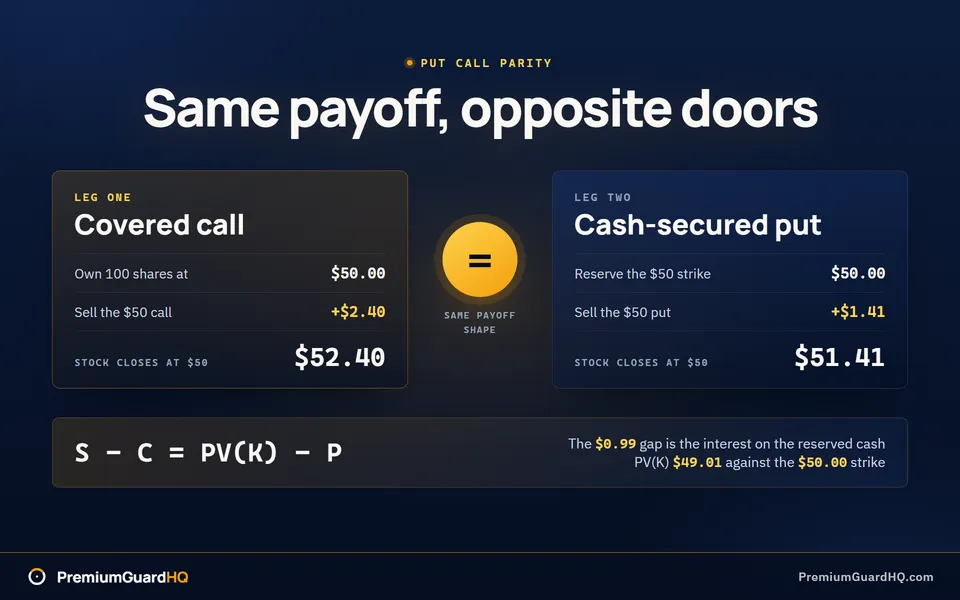
Imagine two traders looking at the same stock, the same strike price, and the same expiration date. One sells a covered call and agrees to sell shares she owns at that price. The other sells a cash-secured put and agrees to buy shares at that same price. Their payoffs almost always line up. That is put call parity, the rule that connects the two trades. It runs through both legs of the wheel strategy.
What is put call parity
Put call parity is the pricing rule for European options on a stock that pays no dividend. Under this rule, the call price minus the put price equals the stock price minus the present value of the strike. If the sides drift apart, someone can lock in a risk-free profit.
With European options, exercise waits until expiration. That is why a covered call and a cash-secured put at the same strike and expiration produce nearly identical profit and loss. Traders use this options parity to switch between a position and its synthetic twin when margin, fees, or execution costs make one side cheaper.
Most US stock options are American-style, so they can be exercised on any day before expiration, and many stocks pay dividends. Both details can nudge live prices slightly away from the exact parity formula.
How put call parity works: two portfolios that must match
Start with the basic idea. You can assemble two separate baskets of investments. If both baskets always pay the same amount on the same future date, regardless of what the market does, they must cost the same today. Otherwise, you could sell the expensive basket, buy the cheap one, and keep the difference. The market would not leave that gap open for long.
The pieces are simple.
S is the stock price today. C is the call price. A call pays off when the stock finishes above a set price. P is the put price. A put pays off when the stock finishes below that same set price. That set price is the strike, written K. Both options must share the same strike and the same expiration date, the day the contract ends.
Another piece is PV(K). This is cash you set aside today that grows with interest into exactly K dollars by expiration day.
Put these together and the central relationship appears: call price minus put price tracks stock price minus that set-aside cash.
“Same strike and expiration” means the exact same contract in every detail. A 50-strike call expiring in June cannot be compared to a 55-strike put expiring in July. Parity holds only when every spec matches, a point worth keeping in mind as you read further about options pricing.
The formula and synthetic positions: turning calls and puts into stock and cash
The main rule looks like this: C − P = S − K·e^(−rT). The e^(−rT) term discounts the strike down to its value in today’s dollars. That is the same discounted strike, or PV(K), from the previous section. So the rule can also be written as C − P = S − PV(K).
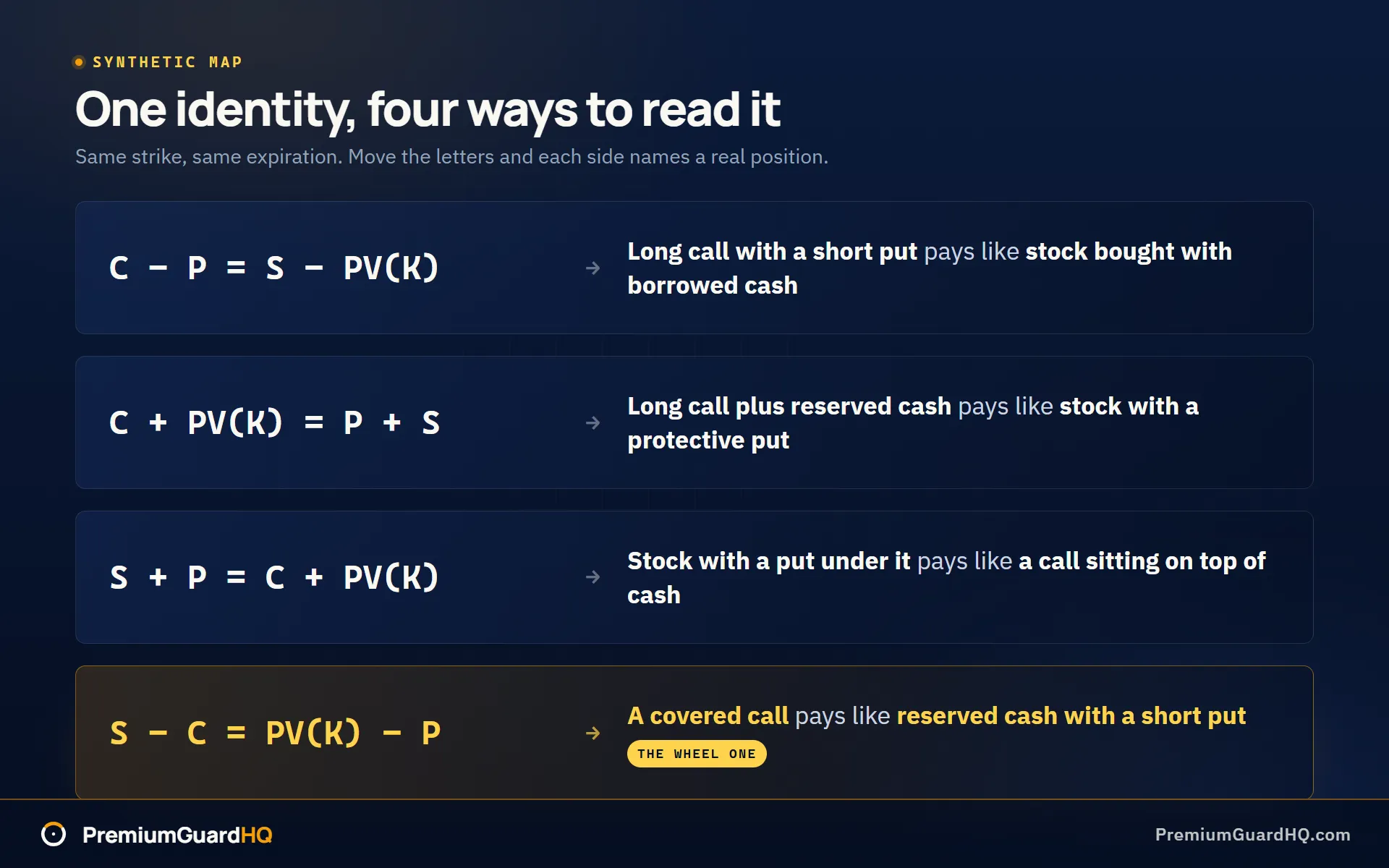
Rearrange the formula and you get a second common form: C + PV(K) = P + S. It is the same rule, just moved around. Both versions show up on other sites, so it helps to recognize them as identical.
The left side means owning a call while being short a put. Being short a put means you sold it, so you have to buy the stock if the owner exercises. The right side means owning the stock while borrowing cash against the strike price. The two sides move together dollar for dollar.
Rearrange the letters again and you get the version a wheel trader uses most:
S + P = C + PV(K)
Owning stock plus owning a put behaves like owning a call plus holding cash reserved for the strike. The put under your stock acts as a safety floor. That floor plays the same role as a call sitting on top of cash.
Here is the logic without any charts:
- If the stock ends above the strike, the put expires worthless and your stock gains keep climbing. The call has value, and your set-aside cash is exactly enough to cover it.
- If the stock ends below the strike, the put protects you down to the strike. The call side loses only the cash it spent. Both sides stop losing at the same point.
That is the practical benefit of learning parity. Premium is the cash you collect for selling an option. When you sell premium in the wheel, synthetics show the actual risk you are carrying, instead of the risk you assumed you had. A covered call is a short put wearing a different wrapper, because both have the same payoff shape. Parity only matches payoffs. It says nothing about whether a trade will make money or whether the premium is worth taking.
The seller version: a covered call equals a cash-secured put
The previous section produced this rule: S = C − P + PV(K). Stock equals a call minus a put, plus cash reserved for the strike. Now rearrange it for sellers.
Begin with the same rule written differently:
C − P = S − PV(K)
Move the pieces so the covered call stands on one side by itself:
S − C = PV(K) − P
The left side is stock you own with a call sold against it. A covered call means you own 100 shares and sold a call against them. The right side is cash equal to PV(K) paired with a put you sold. The minus sign in front of P means you sold the put instead of buying it, and PV(K) is the strike price discounted to today’s dollars, the cash you need today to have the full strike in hand at expiration.
That right side is a cash-secured put. A cash-secured put is a short put backed by cash set aside to buy the shares if you get assigned. So the math says this: a covered call pays off exactly like a cash-secured put at the same strike and expiration date, with the reserved cash doing the job the shares were doing.
That is why the two wheel legs look like mirror images. In both trades, you get paid for agreeing to sell the stock above the strike and for agreeing to absorb losses below it. The only difference is where you begin: one leg starts with shares, the other starts with cash. The underlying risk is the same, just entered from opposite doors.
One note: your broker may show different buying power or a different-looking profit path for a covered call versus a cash-secured put, even at the same strike and expiration. That comes from how each broker calculates margin and financing, not from any flaw in the parity math. The expiration payoff is what stays equal. For a closer look at how these two trades compare, see the practical trade-offs between the two legs.
Worked example: solving for the put and checking both payoffs
The following numbers are made up to teach the math and are not live market data.
Setup:
- Stock price today: $50.00
- Strike price: $50.00
- Time to expiration: 0.50 years, or six months
- Risk-free rate: 4.0%
- Call price: $2.40 per share
PV(K) is the strike price discounted to today’s dollars, because money today is worth more than money later. PV(K) = 50 × e^(-0.04 × 0.50) = 50 × 0.9802 = $49.01.
Put call parity says C − P = S − PV(K). Plug in the numbers:
- 2.40 − P = 50.00 − 49.01 = 0.99
- P = 2.40 − 0.99 = $1.41
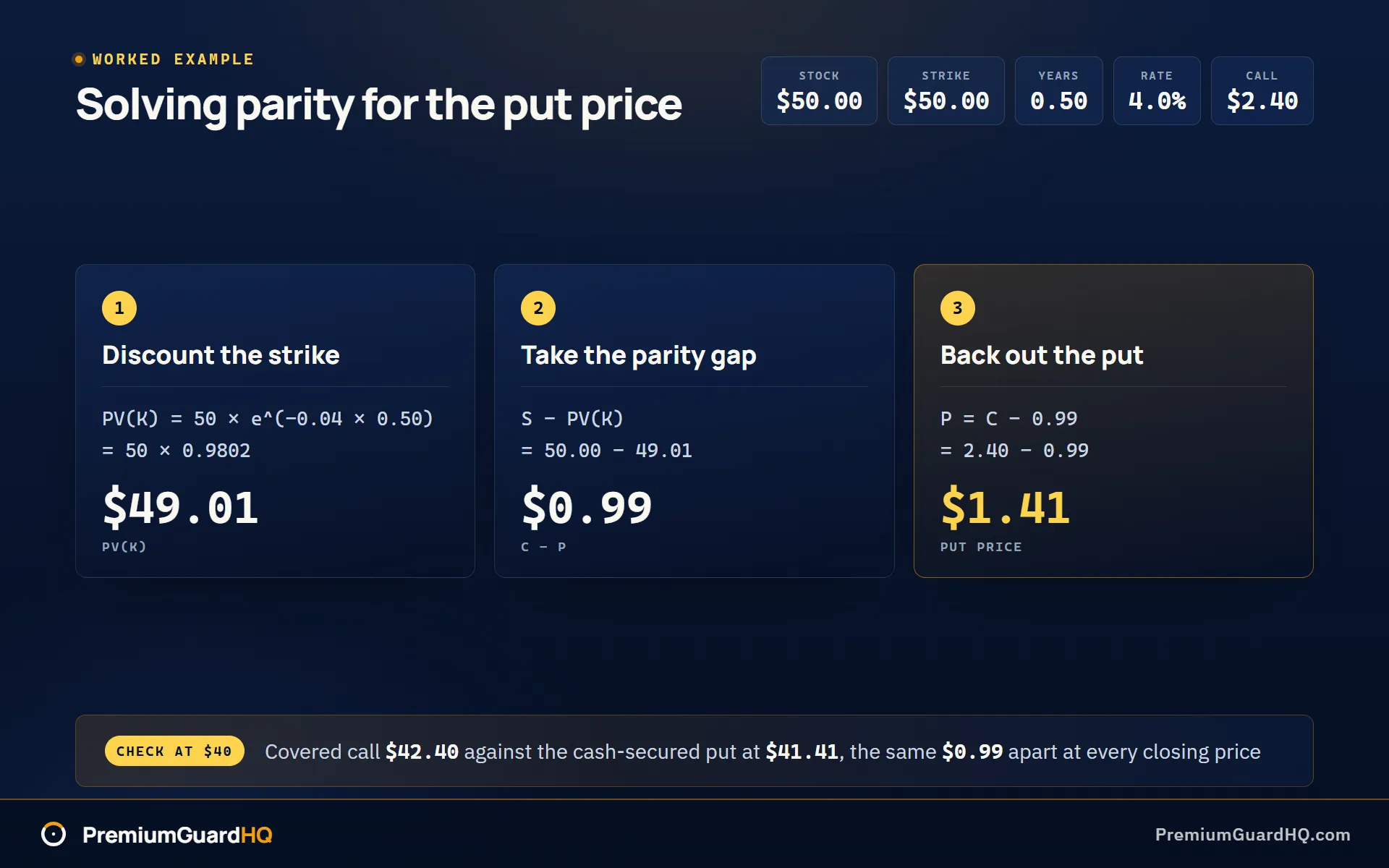
Now confirm that a covered call and a cash-secured put pay the same at expiration. A covered call means you own the stock and sold the call. A cash-secured put means you sold the put and set aside $50.00 in cash per share.
| Stock at expiration | Covered call total | Cash-secured put total |
|---|---|---|
| $40 | Stock $40 + premium $2.40 = $42.40 | Cash $50 − loss $10 + premium $1.41 = $41.41 |
| $50 | Stock $50 + premium $2.40 = $52.40 | Cash $50 + premium $1.41 = $51.41 |
| $60 | Stock $50 (capped) + premium $2.40 = $52.40 | Cash $50 + premium $1.41 = $51.41 |
The one dollar gap between columns is just PV(K) versus K, the cost of tying up cash early. Shift either column by that amount and the two lines match at every price. If you want to test this on your own numbers, the options profit calculator will test both sides at the same strike.
Frequently asked questions
Does put call parity hold for American options on US stocks?
Not exactly. Most US stock options are American-style, so you can exercise early on any day before expiration, not only on the last day. That early exercise right and stock dividends can push live prices slightly away from the exact parity formula. Treat parity as a close approximation and a reasoning tool, not a promise that two live quotes will match to the penny.
What has to match for parity to apply?
The call and put need the same underlying stock, the same strike price, the same expiration date, and the same contract style. Also check which price you are viewing. A mid price sits between the bid and the ask. Comparing mid to mid gives a different gap than comparing one side’s bid to the other’s ask.
If covered calls and cash-secured puts are the same trade, why does my broker show different P and L or buying power?
The gap usually comes from your broker’s margin handling, its collateral location, and any interest on parked cash. None of that weakens the math. Parity says the two trades pay the same at expiration under certain assumptions. It does not say how an account statement will show things from day to day.
How does this relate to the wheel strategy?
The wheel cycles between a cash-secured put and a covered call. Put call parity shows that those two steps are the same short premium bet in different wrappers. The wrapper changes from cash to shares and back again, but the core obligation you are holding usually stays the same.