
Every Sunday night, the same question comes up. You open an option chain and scan the strikes. Which one should you sell?
Sell a strike close to the stock price and you collect a thick premium, the cash paid to you upfront for selling the option. You also get assigned often, which means being forced to buy or sell the stock. Sell a strike far away and assignment almost never happens, but the premium barely moves the needle.
Delta in stock options settles that argument if you know how to read it. Most traders treat delta like leftover math from school, but it gives you a rough decimal read on your assignment odds.
By the end, you will know how to read delta correctly, turn it into real assignment odds, and compare common delta ranges with your eyes open. You will be working from numbers, not a forecast.
What is delta in options trading
Delta measures how much an option’s price should move when the stock moves $1. Traders also use it as a rough estimate of the chance an option finishes in the money at expiration. Option sellers watch delta closely when picking a strike for that second reason.
Delta runs from 0 to 1 for calls and from 0 to -1 for puts. In the money means the option would be worth exercising right now, so a call is in the money when the stock price sits above the strike price, the price you locked when you opened the trade.
A call with a 0.30 delta tends to gain about 30 cents for every $1 the stock rises. Sellers often read that same 0.30 as roughly 30% odds of finishing in the money when they check it. The number is not fixed. It shifts with the stock price and as expiration gets closer. Expiration is the date the option contract ends.
The shortcut is not a guarantee. Delta comes from an options pricing model, a formula that estimates fair value. It is a snapshot, not a promise about what the stock will actually do.
How delta works on an options chain
Open an options chain, the table that lists every strike and expiration date for a stock. The column labeled “delta” tries to summarize two things at once: how much the option’s price moves, and roughly how likely it is to finish in the money. For a call, finishing in the money means above the strike. For a put, it means below the strike.
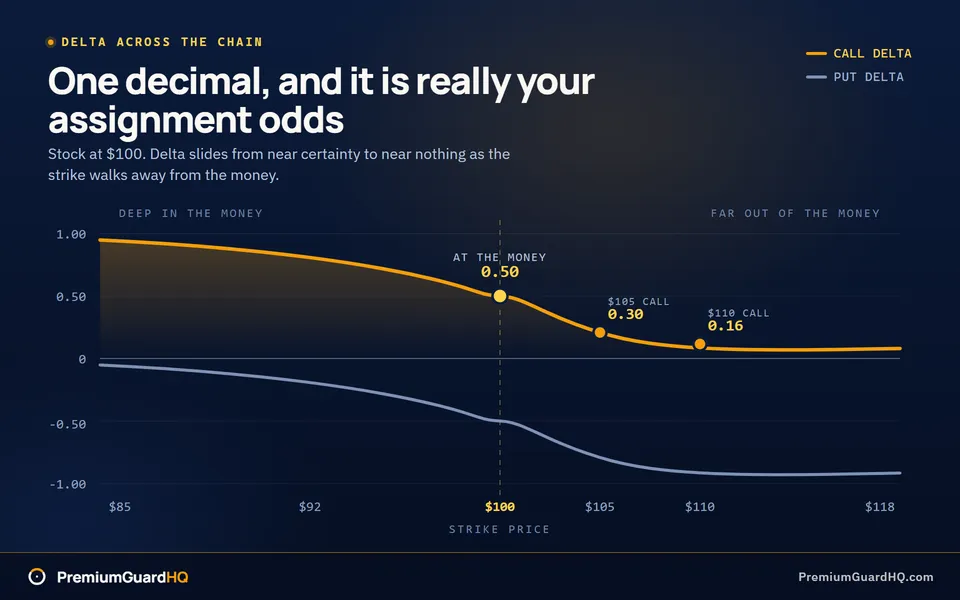
Calls have a positive delta. It runs from near 0.00 for options far from the stock price up to near 1.00 for options deep past the strike.
Puts have a negative delta. It runs from near 0.00 far from the stock price down to near -1.00 deep past the strike. The negative sign only means the put gains value when the stock falls.
One anchor point is worth memorizing. When a strike sits right at the current stock price, it is called at the money. Delta there usually sits close to 0.50 for calls and -0.50 for puts. Treat that as the coin-flip zone, where the odds of finishing above or below the strike are roughly even.
Delta is a snapshot. It changes for three reasons.
- The stock price moves. The strike becomes more or less likely to finish in the money, so delta shifts with it.
- Time passes. As expiration gets closer, delta tends to snap faster toward 0 or 1. A separate measure called gamma drives that snapping. Gamma is enough to know about, since it explains why delta moves faster near expiration.
- Implied volatility shifts. This is the market’s expectation of how much the stock will swing. When that expectation widens or narrows, delta nudges up or down even if the stock price has not moved.
Selling options adds one more layer. When you sell an option, you take the opposite exposure of the buyer. Sell a call with 0.30 delta and you carry roughly negative 0.30 delta yourself. To turn that into a share count, multiply contracts by delta by 100. One contract at 0.30 delta behaves like being short 30 shares. If the stock drops a dollar, your position gains about as much as 30 shares would.
How premium sellers use delta to choose a strike
Selling an option always involves a trade-off. More premium, meaning more cash in your pocket today, almost always comes with a higher chance the trade finishes in the money. That is called ITM. It means the stock ends up beyond your strike price, the price you agreed to buy or sell at. Ending ITM usually leads to assignment, which is when you are forced to buy or sell the stock. Delta does not remove this trade-off. It only makes it easier to see.
The shortcut sellers use is to treat delta as rough odds of finishing in the money. A strike with 0.20 delta gets read as about a 20% chance this finishes in the money. A strike with 0.40 delta gets read as about a 40% chance. That number comes from a pricing model and moves as the stock moves. Treat it as a working guess, not a fact about the future.
With that caveat in mind, here are common delta ranges sellers use. None of these are rules, only patterns you will see often.
- 0.10 to 0.16 delta. A conservative choice. Traders who pick this range usually want to avoid assignment more than they want extra premium. It is common for a keep-the-shares covered call or a cautious cash-secured put. A covered call is a promise to sell stock you own at a set price. A cash-secured put is a promise to buy stock at a set price, backed by cash set aside.
- 0.20 to 0.30 delta. A middle ground. Traders here want real premium, but still want assignment to stay occasional rather than constant.
- 0.40 to 0.50 delta. Close to a coin flip. More premium, but also more assignment and more sensitivity to small stock price moves.
The same ranges map onto the wheel strategy, a cycle of selling cash-secured puts and selling covered calls on stock you already own. With a covered call, delta is your rough odds of getting your shares called away. With a cash-secured put, delta is your rough odds of getting assigned the stock. For a full breakdown of how those two trades differ, start there. For the full cycle explained step by step, read the wheel guide.
Time changes what a given delta means for you. Many sellers stick to a window of about 30 to 45 DTE. DTE means days to expiration, or how many days remain before the contract ends. Two options can show the exact same delta today. The one closer to expiration can swing to a very different delta tomorrow, because less time left makes the price more sensitive to every move in the stock. Same delta, different time, very different path to get there.
Carry one number idea forward: delta does not tell you what the stock will do. It tells you what you are being paid for. A higher delta means you are selling more assignment risk in exchange for more premium.
Why delta moves and why it can surprise premium sellers
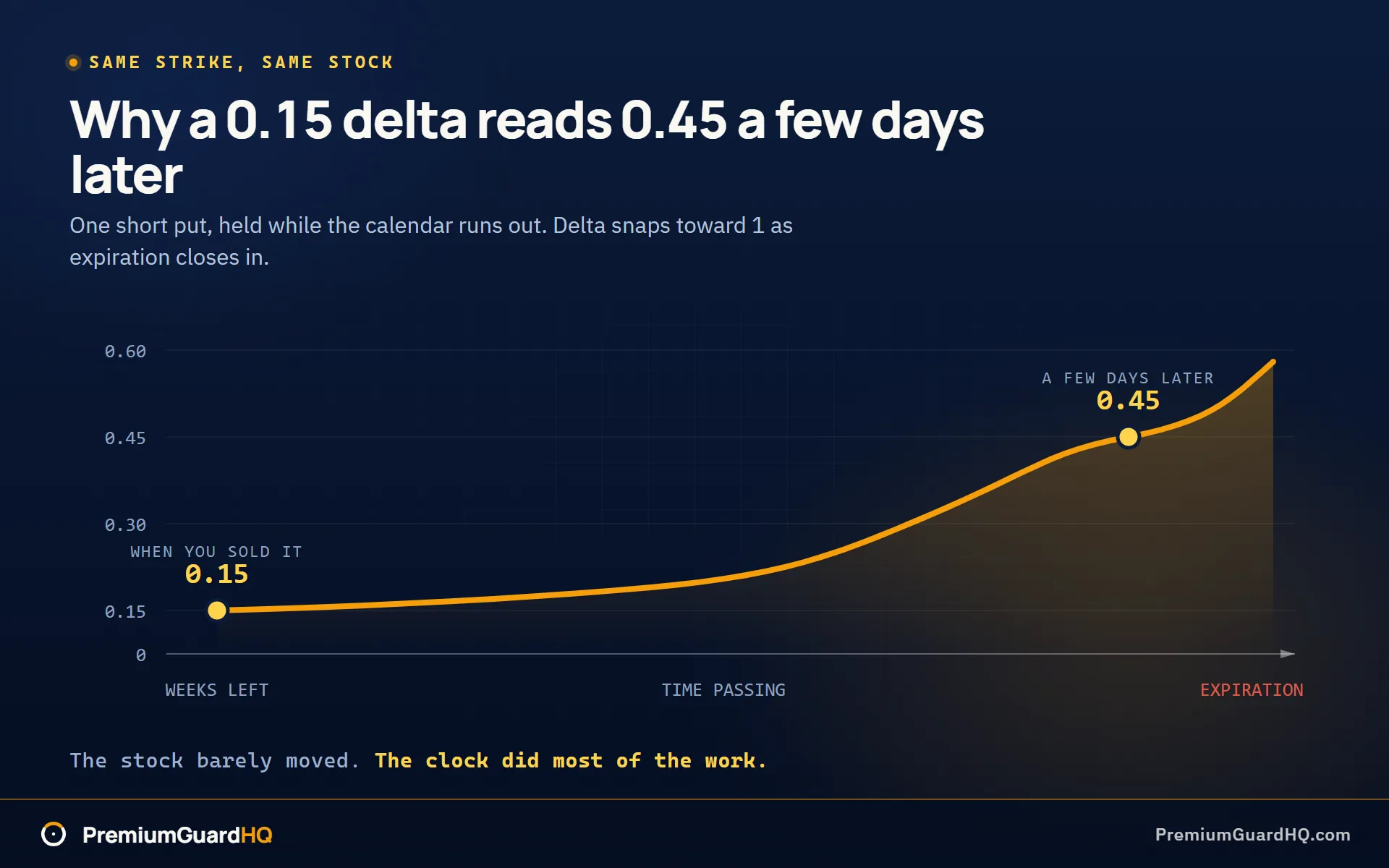
Most option sellers have lived through some version of this moment. You sold a put, a contract that gives someone else the right to sell you 100 shares at a set price. It had a 0.15 delta, so it looked like roughly a 15% chance of finishing in the money. That felt safe. A few days later, you check again and the delta reads 0.45. Nothing crazy happened to the stock. Why did your risk seem to jump?
Two forces produce that move, and both are worth knowing before they catch you off guard.
Delta moves faster as expiration gets closer. Gamma is the reason. Gamma measures how fast delta changes when the stock price moves. Think of gamma as delta’s speedometer. Far from expiration, gamma is low and delta shifts slowly. Close to expiration, gamma climbs, and delta can swing hard on a small stock move.
A position that felt calm with weeks left can suddenly get tested within a day or two once time runs short. The stock barely has to move. The clock does most of the work.
One flag is worth raising here. 0DTE options are contracts that expire the same day. Delta on these can jump around in ways that feel erratic even on ordinary trading days. It is a warning that delta behaves less predictably the closer you get to the final hours, not a recommendation to trade or avoid 0DTE.
Delta can also shift when the stock price never moves. This comes from implied volatility, or IV. IV is the market’s guess at how much the stock might swing going forward. When IV rises, the market prices in a wider range of possible outcomes for the stock. That wider range lifts delta on strikes that were previously far out of the money, because a bigger swing suddenly looks more plausible.
That sensitivity has a name. Vanna measures how much delta changes when implied volatility changes. You do not need to calculate it. Around earnings reports and other event-driven weeks, your delta and your perceived odds can shift noticeably even while the stock sits still.
Delta also tells you your exposure in shares, not just odds. Sell one covered call with a 0.30 delta and you carry roughly negative 30 delta. A covered call is a promise to sell stock you already own at a set price. Against the 100 shares backing it, that negative 30 delta behaves like being short 30 of those shares. Sell one cash-secured put with a -0.30 delta and you carry roughly positive 30 delta, similar to being long 30 shares you do not yet hold. A cash-secured put is a promise to buy 100 shares at a set price, backed by cash set aside to cover it.
Treat delta like a dashboard gauge, not a guarantee. When it moves fast, your real risk is moving fast too, whether or not the stock price agrees.
Worked example: picking a covered call strike using 0.16 delta vs 0.30 delta
Suppose a stock sits at $100. You own 100 shares and want to sell a covered call 30 to 45 DTE. DTE means days until the option expires. A covered call is a promise to sell your shares at a set price if the stock gets there. Two strikes are on the table for the same expiration date.
- Strike A: the $110 call. Delta is about 0.16. Premium, the cash you get paid upfront, is $0.70.
- Strike B: the $105 call. Delta is about 0.30. Premium is $1.40.
Start with the cash. Each contract covers 100 shares, so multiply the premium by 100. Strike A pays you about $70. Strike B pays you about $140, twice as much.
Next, read delta as your rough odds of assignment. Assignment means you are forced to sell your shares at the strike price. Strike A’s 0.16 delta means roughly a 16% chance the stock finishes above $110 and an 84% chance it expires worthless so you keep the premium. Strike B’s 0.30 delta means roughly a 30% chance the stock finishes above $105 and a 70% chance it expires worthless.
Delta also shows your current exposure in shares. Strike A carries about negative 16 delta. Strike B carries about negative 30 delta. Against your 100 shares, Strike B offsets almost twice as much of your stock position as Strike A.
| Strike | Delta | Premium | Odds ITM | Odds OTM |
|---|---|---|---|---|
| $110 call | 0.16 | $70 | ~16% | ~84% |
| $105 call | 0.30 | $140 | ~30% | ~70% |
The math makes one thing clear. You did not just pick a strike. You picked how much assignment risk to sell in exchange for an extra $70 of premium.
Neither strike is right or wrong on its own. It depends on the job you want this call to do. If the job is quiet income while you keep your shares, Strike A pays less but keeps the odds of losing your stock lower. If the job is a planned exit at a good price, Strike B pays more now and gets you there faster. It helps to price the two strikes side by side before you commit to either one.
Delta is useful, but it is not assignment insurance
Delta is a strike-picking tool, not risk management. Here are the limits.
Delta as probability is a rule of thumb, not a promise. That 16% chance you read off the option chain earlier comes from a pricing model, not a law of nature. The model leans on current implied volatility, a measure of how much the market expects the stock to move, and on time left until expiration. Both inputs change by the day. A 0.16 delta today is a snapshot, not a guarantee about where the stock lands weeks from now.
Tail risk is real for premium sellers. Tail risk means a rare, big move that a low delta does not warn you about. You can win small amounts many times in a row and then give it all back in one sharp drop. Delta describes the common case well. It says almost nothing about the rare, ugly case, and that rare case is exactly what ends premium-selling accounts. It is worth reading plainly about the risks that come with selling options before you scale a position size up.
Event risk distorts deltas. Earnings reports and macro headlines can push implied volatility up or down fast. That repricing changes your delta and the stock’s likely path to your strike, sometimes overnight, before you can react.
Delta does not replace position sizing. Two trades can both show a 0.20 delta and still carry very different dollar risk. It depends on the stock’s price, how many contracts you sold, and how much of your account sits in that one name. A $20 stock and a $200 stock at the same delta put very different amounts of your capital on the line.
Use delta to pick the strike. Use position sizing and your own rules to make sure the strategy survives the one trade that goes wrong. A high win rate built on low delta still blows up if a single loss is sized bigger than dozens of wins combined.
Frequently asked questions about delta
Is delta the same as the probability an option expires in the money?
Not exactly. Delta is a shortcut sellers use to estimate that probability, but it is not built to measure probability directly. Delta comes from an options pricing model, and that model leans on implied volatility and time to expiration to produce the number. Treating a 0.20 delta as roughly 20% odds works well enough as a guide, but do not treat it as exact. Many brokers now show a separate probability of expiring OTM figure on the option chain. Check that alongside delta if you want a cross-check.
What is a good delta for selling covered calls or cash-secured puts?
There is no universal good delta. It depends on the job you want the trade to do. Sellers who care most about keeping their shares or avoiding assignment often stay in the 0.10 to 0.16 delta range. Sellers who want a more even trade between premium and assignment frequency often land around 0.20 to 0.30. Sellers who want the most premium and do not mind frequent assignment push toward 0.40 to 0.50, close to the money. None of these are rules. See the worked example above for how the tradeoff plays out in real dollars.
Why did my option delta change when the stock price barely moved?
Two things move delta besides the stock price itself. Time passing closer to expiration makes delta shift faster for the same size stock move. Implied volatility, the market’s guess at how much the stock might swing, can also rise or fall on its own and nudge delta with it. That second effect has a name: vanna, which measures how sensitive delta is to changes in implied volatility. It shows up most around earnings reports and other event weeks, when implied volatility jumps even if the stock price sits still.
What does negative delta mean on a put option?
A negative delta on a put reflects that put prices usually rise when the stock falls. That is why puts get a negative sign while calls get a positive one. If you sell a put instead of buying it, you take the opposite exposure. A short put carries positive delta, similar to being long shares you do not yet hold. That is also why selling puts is considered a directionally bullish move. You want the stock to hold up or rise, not fall.