
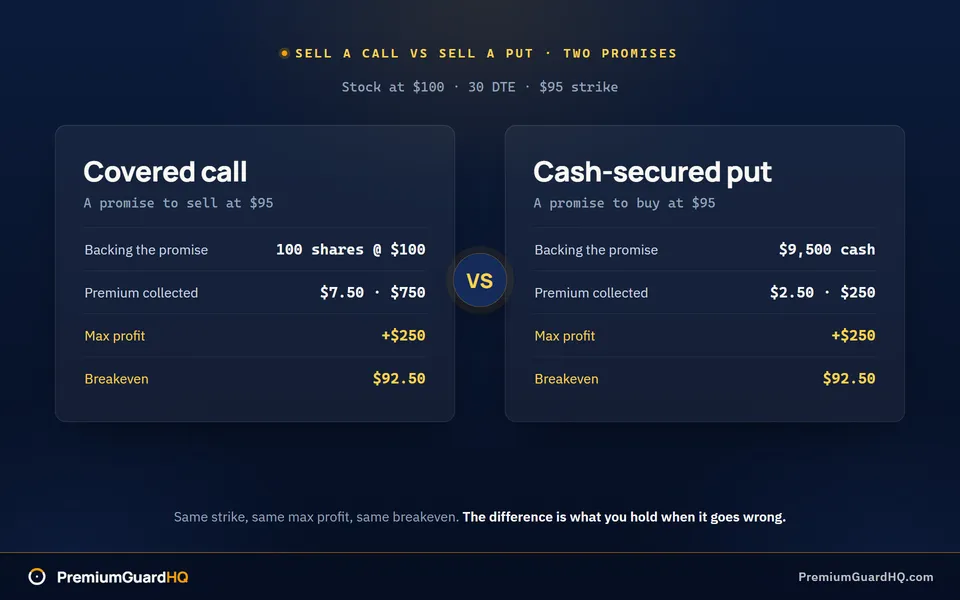
Both trades get called “selling premium.” That means you collect cash upfront for taking on a promise. But the two promises are not the same.
Sell a covered call and the stock rockets up. That covered call is a promise to sell stock you own, at a set price. You watch gains you already had get capped. Sell a cash-secured put and the stock drops fast. A cash-secured put is cash you set aside to buy stock at a set price, if you get assigned, meaning you’re forced to buy. Now you own shares at a price the market has already moved past.
Same mechanic, dressed up two ways. Very different risk.
By the end of this, you’ll know the payoff of each trade, what assignment does to your account, how much cash gets tied up in collateral, and the simple rule the wheel strategy uses to pick the right one.
No picks. No predictions. Just the plain mechanics, so you know what you’re choosing before you choose it.
Covered calls and cash-secured puts: plain-English definition
Sell call vs sell put really means choosing between a covered call and a cash-secured put: two ways to get paid today for a promise you make about the future. Sell a call and you collect cash now, but you may have to sell your shares at a set price later. That price is called the strike. Sell a put and you collect cash now, but you may have to buy shares at a set price later. Both are called “short options,” meaning you sold first and now owe someone a decision.
Calls are usually paired with stock you already own. This is called a covered call, because your shares cover your promise to sell. Puts are usually paired with cash you set aside to buy the stock if needed. This is called a cash-secured put, because the cash secures your promise to buy.
The rest of this guide covers the math behind each trade, what happens when you get assigned, meaning you’re forced to buy or sell your shares, how premium differs between the two, and which one tends to fit better depending on your goal. Premium is simply the cash you collect upfront.
How selling calls and selling puts actually works (cash flows and outcomes)
Selling an option means selling a contract to someone else. You get paid cash right away. That cash is called the premium, and it’s yours to keep no matter what happens later. But collecting premium is not the same as profit. In exchange for that cash, you take on a job: you promise to do something if the buyer asks.
This promise is why people call the trade “short.” Short just means you sold first and now owe a possible action later. One options contract covers 100 shares of stock.
Selling a put works like this. You sell-to-open the put and collect the premium right away. Your broker sets aside cash equal to the strike price times 100. This cash is your collateral, money held in reserve to guarantee you can pay. This setup is called a cash-secured put.
At expiration, two things can happen:
- Stock stays above the strike: the put expires. You keep the full premium and nothing else happens.
- Stock falls below the strike: you can get assigned, meaning you must buy 100 shares at the strike price. Your real cost per share becomes the strike minus the premium you collected.
Selling a call flips this. You already own 100 shares, then sell-to-open the call. Your shares themselves are the collateral, so this setup is called a covered call.
At expiration:
- Stock stays below the strike: the call expires. You keep both the premium and your shares.
- Stock rises above the strike: your shares can get called away, meaning sold at the strike price. You keep the premium, but you get no gains above the strike. That strike is now your ceiling.
One more detail matters before we talk about risk: assignment doesn’t always wait for expiration. Equity options are American-style, meaning the buyer can force assignment on any day before expiration, not just at the end. This early assignment shows up most often with calls that are deep in-the-money, when the stock price sits well above the strike, right before the stock pays a dividend.
Put these two trades together and you get the options wheel strategy. You sell puts until one assigns you stock, then you sell calls against that stock until it gets called away, then you go back to selling puts again. The wheel is just this loop repeating: put phase, call phase, put phase.
Short call vs short put: the payoff, max profit, and breakeven
A short put means you sold a put, a contract that obligates you to buy 100 shares at a set strike price if the buyer exercises it. You set aside cash in case you get assigned, meaning you’re forced to buy those shares. A short call means you sold a call against stock you already own, so you might get forced to sell those shares at the strike price.
Here’s the payoff, side by side:
| Trade | Max profit | Worst case |
|---|---|---|
| Short put | Premium collected (the cash you got paid upfront) | Stock falls toward $0. Loss is large but stops there. |
| Short call | Premium collected | Stock keeps rising with no ceiling, if you don’t own the shares |
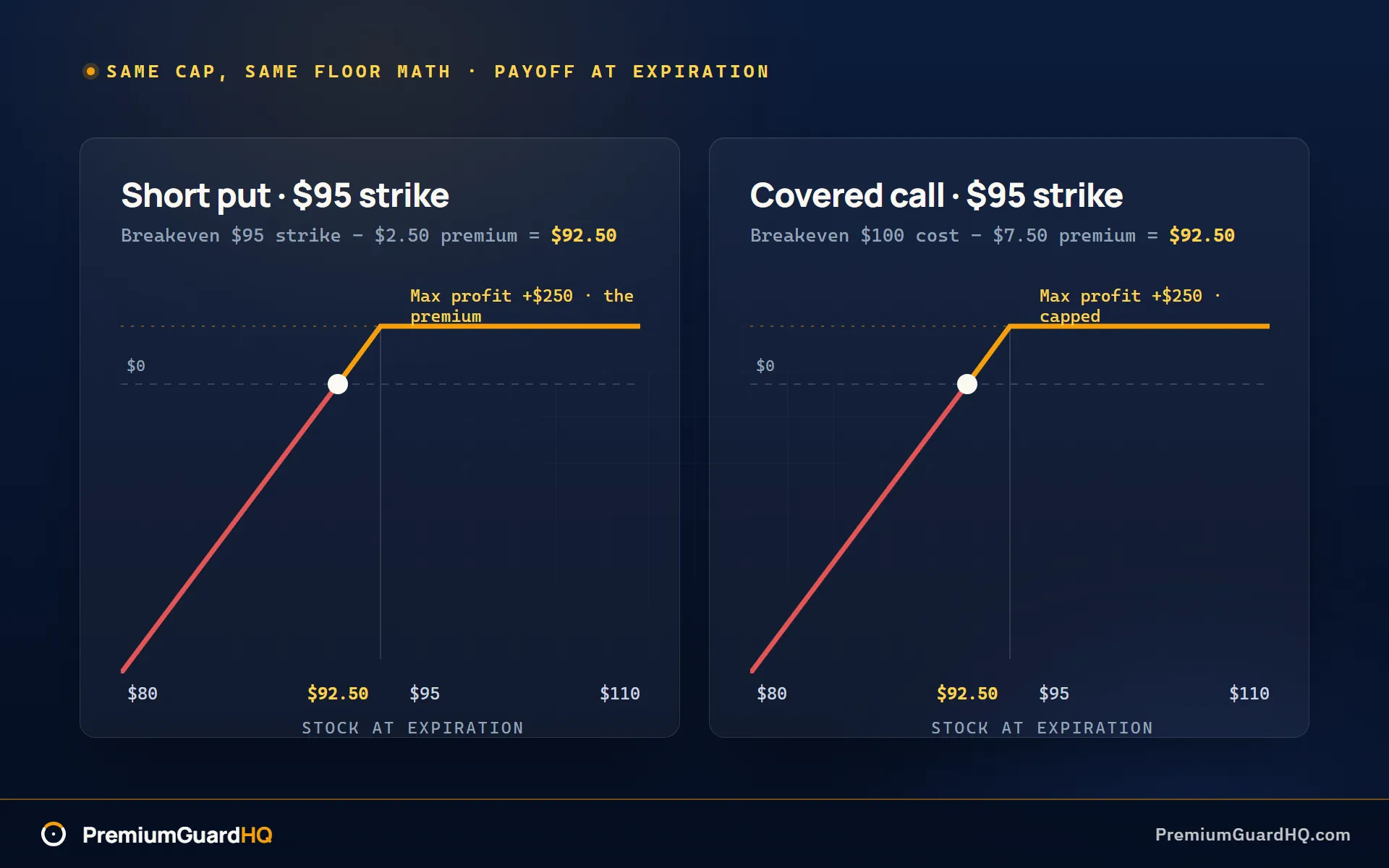
Both trades cap your best case at the premium. You never make more than what you were paid upfront, no matter how far the stock moves in your favor. The worst case is where they split. A short put’s downside is bounded, because a stock can only fall to zero. A short call sold without owning the stock is called “naked,” and it has no ceiling, so the loss has no limit. A covered call avoids that unlimited loss because you already own the shares to deliver.
Breakeven is the price where you stop losing money:
- Short put: strike price minus premium collected.
- Covered call: price you paid for the stock minus premium collected.
In plain terms: a short put pays you to accept the downside. A covered call pays you to give up some of the upside. Neither one hands you unlimited income. Both cap your profit at a fixed number the moment you open the trade.
Collateral and margin: covered, cash-secured, and naked are different trades
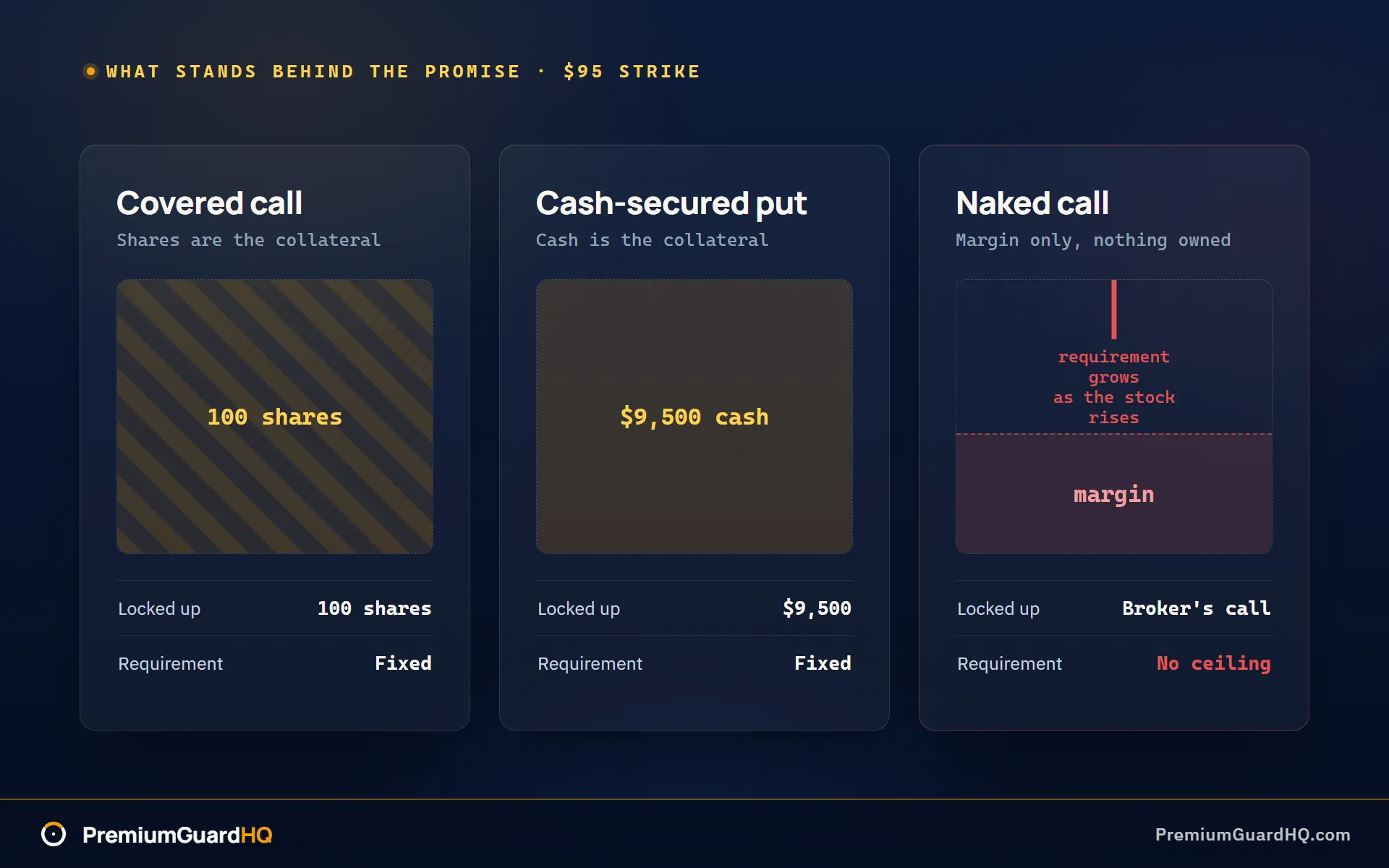
The label matters less than what backs it up. The real risk in either a call or a put trade depends on what stands behind your promise. That backing is called collateral: money or shares your broker holds so you can cover the trade if you get assigned.
- Covered call: shares you already own cover your promise to sell.
- Cash-secured put: cash sitting in your account covers your promise to buy.
- Naked (uncovered) call: nothing backs it except your broker’s margin, a loan of buying power your broker extends against your account.
A cash-secured put locks up strike price times 100 in cash. A covered call locks up 100 shares. Both tie up real money, which limits how many trades you can run at once.
A naked call looks cheaper because no cash or shares get set aside upfront. But that changes fast if the stock price rises. Because the loss has no ceiling, your broker will demand more margin as the price moves against you. This is a margin call, and it can force you to add cash or close the trade at the worst possible time.
Brokers know this. Under Reg-T, the margin rules set by the Federal Reserve, the required margin scales with the stock’s price and how close it sits to the strike. In practice, many brokers set even stricter “house” limits on naked calls, since the upside has no cap and losses can grow fast.
So whenever you weigh a call sale against a put sale, name the structure first. Covered, cash-secured, and naked all wear the same label but carry very different risk.
Covered call vs cash secured put (why they can look the same on a P/L chart)
In plain terms: a covered call means you already own the stock, and you are selling away some of your upside. A cash-secured put means you do not own the stock yet, and you are selling a chance to buy in cheaper. Different starting point, same basic idea.
That is why traders often treat these as one trade. Both do well when the stock holds steady or rises a bit. Both leave you exposed to the stock falling, minus the premium as a small buffer. Plot the profit and loss of a covered call next to a cash-secured put at the same strike price, and the two lines can sit almost on top of each other.
But “almost the same” is not “the same.” Three things set them apart:
- Where you start. A covered call starts with shares already in your account. A cash-secured put starts with cash instead. That matters if the market gaps down overnight, since you already hold the stock in one case and not the other.
- Dividends and early assignment. Assignment means the option buyer forces the trade early. A call that is deep in-the-money, meaning the stock price is well above your strike, can get exercised early, right before a dividend payment, because the buyer wants that payout. Puts almost never face this pressure.
- What job the trade is doing. A cash-secured put is a paid limit order, an order that only buys stock at a price you choose. A covered call is paid management of stock you already hold.
Want to see your exact breakeven point and capped upside before you place either trade? Run the numbers through our covered call calculator and cash-secured put calculator.
One line to remember: in the wheel strategy, the cash-secured put is your entry move, and the covered call is your inventory move.
Short call vs short put risk (what can actually blow up the month)
Both trades look tame on paper. They are not low risk. Here is the honest breakdown.
- Covered call risk: you still own the stock, so you still take almost all of its downside if the price falls. The premium is a small cushion, not real protection. Your upside is capped at the strike price, but your downside stays wide open.
- Cash-secured put risk: a falling stock can force you to buy shares at a price well above where the market has moved. Cash-secured just means you set aside the cash to buy the stock if assigned. That label says nothing about how far the stock can fall. The premium softens the blow a little. It rarely covers a sharp drop.
- Naked call risk: if you sell a call without owning the stock, your loss has no ceiling. A fast-rising stock can also trigger a margin call, where your broker demands more cash or closes the trade for you at the worst possible time.
Early assignment means the option buyer forces the trade before the expiration date arrives. This becomes likely when very little extrinsic value is left compared to what the buyer gains by exercising early. Extrinsic value is the part of the option’s price beyond pure built-in profit. Early assignment shows up most often around dividend dates. A practical check: compare the extrinsic value left on the option to the dividend amount. If the dividend is bigger, early assignment gets more likely.
Assignment itself rarely blows up an account. The real damage comes from oversizing positions, piling into too few tickers, and spending premium as if it is already earned income before the trade cycle even closes.
Why selling puts often pays more (IV skew, not magic)
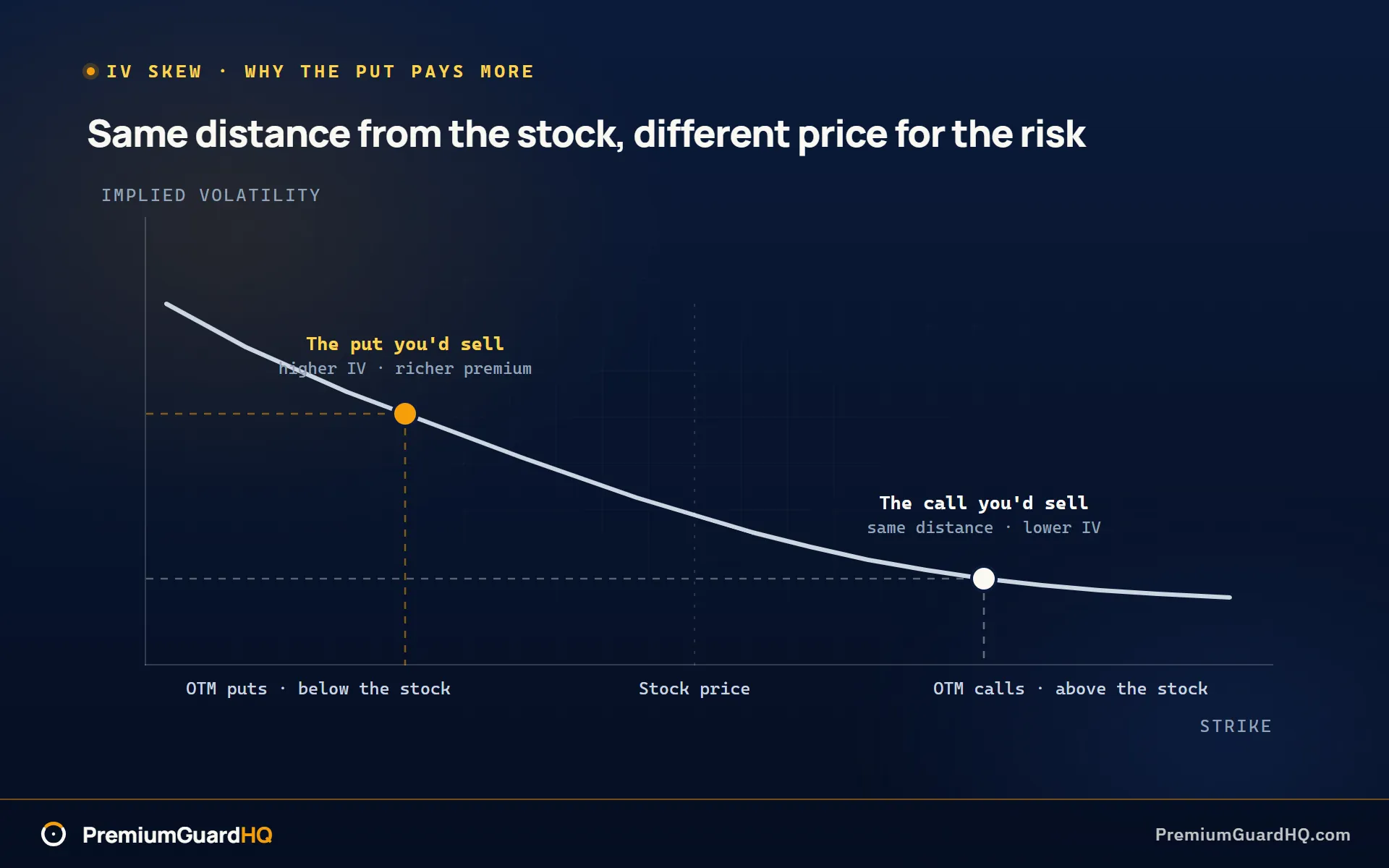
Compare a put and a call sitting the same “distance” from the stock’s price. The put usually pays more. That’s not a broker glitch or some secret edge. It comes from IV skew: downside puts trade with higher implied volatility than upside calls sitting an equal distance away. Implied volatility, or IV, is the market’s guess at how much a stock will move.
Why it exists, in one sentence: more people want to protect against a crash than want to bet on a moonshot, so steady demand for downside protection bids up put prices.
This matters when you compare trades. At the same delta, a rough measure of how far a strike sits from the stock price and how likely it is to finish in the money, a put often pays a richer premium than a call sitting the same distance away. Don’t compare raw dollar premiums side by side. That comparison is misleading.
Instead, normalize the numbers:
- For a cash-secured put, compare premium as a percent of the cash collateral set aside to buy the stock if assigned.
- For a covered call, compare premium as a percent of the stock’s value.
That gives you an apples-to-apples check across both sides.
Skew isn’t fixed. It steepens when markets get nervous, and it can behave differently depending on how far out the expiration date sits. A richer put premium is compensation for downside demand and crash risk, not free money.
Management playbook: close, roll, accept assignment, or get called away
Once a trade is open, you have four choices. None is “correct.” Each one trades something for something else.
- Let it expire. You do nothing new. You choose no new risk and let the trade finish as is.
- Buy to close. You pay cash to end the trade early. This removes risk, but it costs money to do it.
- Roll. You close the current option and open a new one, usually with a later date and a different strike price. You are trading time, strike price, and premium for a new setup.
- Accept assignment, or get called away. You let the trade convert. A short put turns your cash into shares. A short call turns your shares into cash.
While you decide, track two numbers.
Percent of premium captured versus time left. If you already collected 80% of the cash but still have three weeks until expiration, measured in DTE or days to expiration, you’re risking a lot of time for very little extra reward.
Remaining extrinsic value. This is the part of the option’s price that isn’t pure built-in profit. It matters most on short calls near a dividend date. A call with little extrinsic value left is a target for early assignment, since the buyer gains little by waiting.
Three things usually cause management fatigue:
- Expirations set too short (low DTE)
- Too many open positions to watch at once
- Too much money sitting in too few tickers (concentration)
This is also where broker screens start lying to you. After a few rolls and assignments, the cost basis your broker shows often stops matching your real numbers. Serious sellers need per-cycle math that’s actually reconciled, not a running balance that broke three trades ago.
Taxes and recordkeeping: qualified covered calls, wash sales, and why broker P/L can be wrong
This is not tax advice. Options tax rules get complicated fast, and your situation is your own. Talk to a real tax professional before you file. Think of this as a map of where the landmines sit.
Landmine one: qualified covered calls (QCC). If you sell a call that’s too deep in-the-money, meaning the strike price sits well below the current stock price, or too short-dated, the IRS may stop counting your stock’s holding period while that call is open. That can turn a long-term gain into a short-term one, taxed at a higher rate, even though you never sold the stock. A long-term gain is normally taxed at a lower rate.
Landmine two: wash sales. If you close an option at a loss and then open something “substantially identical” within the wash-sale window, the loss gets disallowed for now. It gets added to the cost of the new position instead. The tricky part: the IRS has never drawn a clean line for what counts as “substantially identical” among options. Rolling a put or call, meaning closing it and opening a new one at a different strike or date, can trigger this without you noticing.
Landmine three: some index options fall under Section 1256, a tax rule that treats them differently from stock options, including different wash-sale exposure. Just know this category exists before you assume every option is taxed the same way.
Bottom line: if you treat premium as income, none of it is real until the cycle closes and the number is reconciled. Broker screens adjust your cost basis quietly in the background, so the number you see is not always the number you earned. Clean, per-cycle tracking is what tells you the truth.
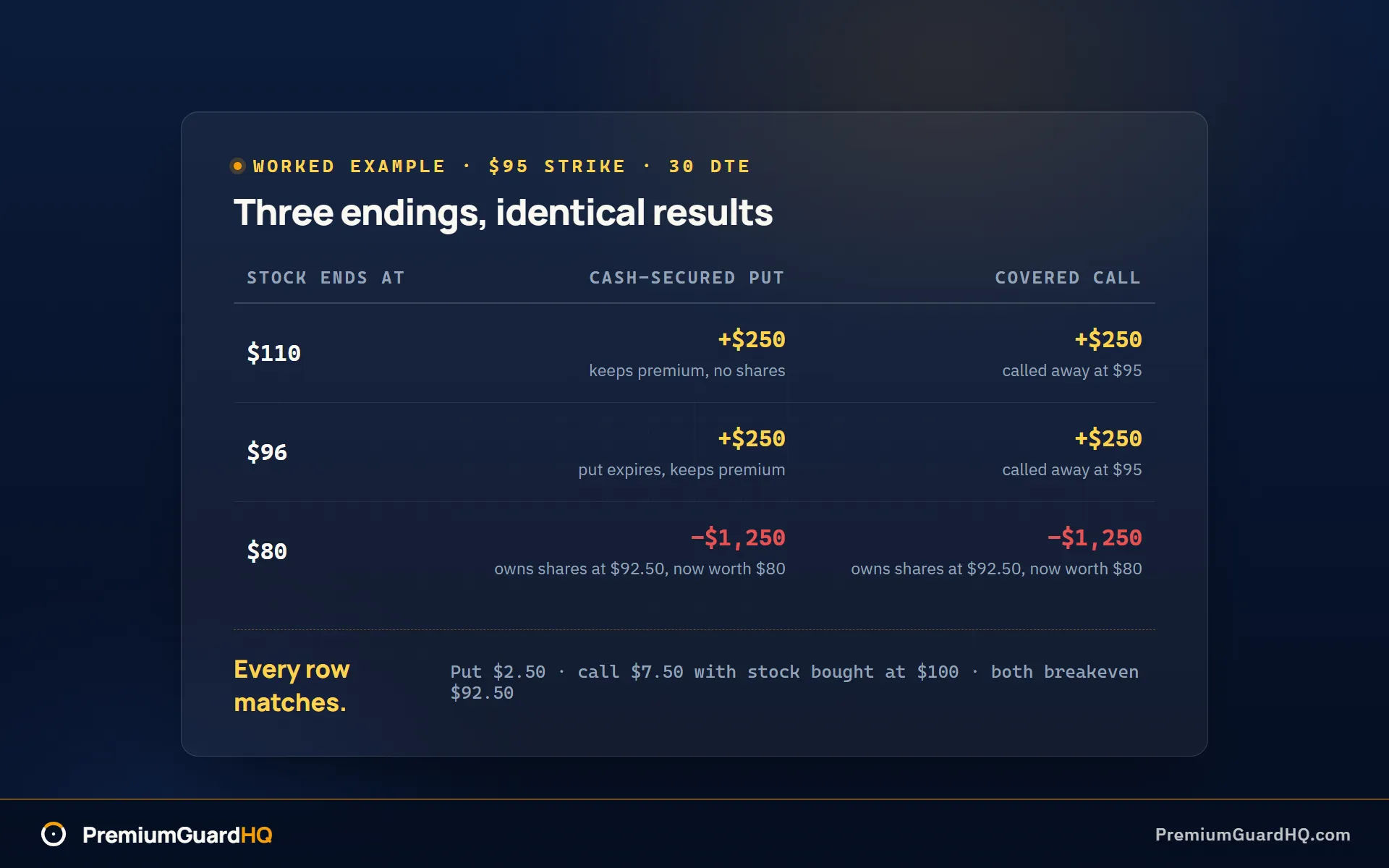
Worked example: cash-secured put vs covered call with the same strike (same payoff)
Here are real numbers. A stock trades at $100. You’re looking 30 days out, or 30 DTE. The strike price is $95, the price you agree to buy or sell at. To keep the math simple, assume the $95 call sells for $7.50 and the $95 put sells for $2.50. These prices are for illustration only, not a real quote.
Trade A: sell a cash-secured put at the $95 strike. You collect $250 in premium ($2.50 x 100 shares). Your broker sets aside about $9,500 in cash. That’s your collateral, held in reserve in case you must buy the shares. If you get assigned and forced to buy the shares, your real cost per share is $95 minus $2.50, or $92.50. The most you can make on this trade is the $250 premium.
Trade B: buy 100 shares at $100, then sell a covered call at the $95 strike. You collect $750 in premium. If the stock gets called away, meaning sold at the strike, at $95, your profit is (95 minus 100) x 100, plus 750, which equals +$250. Same max profit as Trade A. Your breakeven is also $92.50.
Now watch what happens at three different ending stock prices:
| Stock ends at | Cash-secured put P/L | Covered call P/L |
|---|---|---|
| $110 | +$250 (keeps premium, no shares) | +$250 (called away at $95) |
| $96 | +$250 (put expires, keeps premium) | +$250 (called away at $95) |
| $80 | -$1,250 (owns shares at $92.50, now worth $80) | -$1,250 (owns shares at $92.50, now worth $80) |
Every row matches. Same strike, same premium math, same outcome no matter where the stock lands.
Choosing between selling a call and selling a put is often really just a choice between starting in shares or starting in cash.
Pros and cons of selling puts vs selling calls (the honest list)
Both trades earn their keep in some conditions and cost you in others. Here’s the honest list, no spin.
Pro: premium up front can smooth returns in sideways markets. When a stock goes nowhere for weeks, buy-and-hold investors earn nothing. You still collect the premium, the cash you get paid for selling the option, turning a flat month into a small win.
Pro: cash-secured puts work like a paid limit order. A limit order only buys stock at a price you pick, and you wait for free. Selling a put pays you while you wait for that same price.
Pro: covered calls turn stock you already own into extra income. You give up upside above the strike, the price you agreed to sell at. In exchange, you get paid for shares that were otherwise just sitting there doing nothing.
Con: capped upside costs real money in a strong rally. A covered call caps your gain at the strike. If the stock doubles, you still only make the strike price plus the premium, and that gap between what you made and what you could have made is a real cost.
Con: the stock’s downside is still mostly yours. The premium is a thin cushion, not protection. A sharp drop hurts almost as much with the option as without it, whether you sold a put or a call.
Con: assignment locks up capital and creates work. Assignment means you’re forced to buy or sell your shares. Getting put stock ties up cash in a position you now have to manage. Getting shares called away means finding a new place for that capital, and either event adds a task to your week.
Premium selling is a business of small wins and occasional large tests. Your position sizing and how concentrated you are in a few tickers decide whether you survive those tests.
When to sell calls vs puts (an operator decision framework)
Once you know the mechanics, the choice comes down to one question: what do you already hold, and what do you want next?
If you already own shares, a covered call fits naturally. Selling one means giving someone the right to buy your stock at a set price. You’re not deciding whether to own the stock. You’re deciding whether to get paid while you hold it. If you don’t own shares yet and want to buy in at a lower price, a cash-secured put fits better. That means setting aside cash to buy a stock if it drops to your price. You get paid to wait for your price, instead of placing a limit order for free, an order that only buys at a price you choose. Either way the strike is a second decision, and delta gives you a rough read on the assignment odds before you commit to one.
Three profiles show how this plays out:
- Inventory manager: already holds the shares. Goal is turning idle stock into monthly income, accepting a capped upside, the price where gains stop, as the tradeoff.
- Paid limit buyer: wants to own a stock, but only at a lower price. Goal is getting paid while waiting for the market to come to them.
- Capital preservation first: cares most about position size, spreading risk across tickers, and knowing exactly how much cash or stock is set aside as collateral. This profile sticks to cash-secured puts and covered calls, and skips naked calls entirely, meaning it never sells a call without owning the stock.
One rule worth keeping close: premium is unearned until the wheel closes, meaning the full cycle, put then call then exit, has finished. Decide what to withdraw based on closed, reconciled results, not the cash sitting in an open position.
Frequently asked questions
Selling calls explained: what am I actually committing to?
When you sell a call, you’re giving someone else the right to buy your shares from you at a set price, the strike. If you already own the shares, this is a covered call, meaning your stock covers the promise. The premium is your pay for agreeing to cap your upside. If the stock climbs past the strike, you still sell at the strike, no higher. See “Short call vs short put: the payoff, max profit, and breakeven” above for the full math.
Selling puts explained: what happens if it goes against me?
Selling a put means you might have to buy 100 shares at the strike price, even if the stock has since dropped well below it. A cash-secured put means you already set aside the cash for that purchase, so the buy doesn’t catch you short on funds. The premium lowers your real cost per share, but it doesn’t erase the drop. You’re still on the hook for the difference between the strike and wherever the stock actually lands.
Is selling puts riskier than selling calls?
It depends on the structure, not just the label. A naked call, one sold without owning the stock, has no ceiling on loss, since a stock can climb indefinitely. Covered calls and cash-secured puts sit closer together in risk: both carry the stock’s downside almost in full, cushioned only by the premium collected. Neither is “safe.” See “Short call vs short put risk” above for the full breakdown.
Covered call vs cash-secured put: which is better?
Neither is better in general. At the same strike, the two often produce nearly identical profit-and-loss outcomes, as shown in the worked example above. A covered call starts with shares you already own, a cash-secured put starts with cash. Assignment timing, dividend exposure, and what you already hold in your account should drive the choice, not a blanket preference.
Will rolling options create a wash sale?
Sometimes, and it’s not always obvious. A wash sale gets triggered when you close a position at a loss and open something “substantially identical” within the wash-sale window. The IRS has never drawn a clean line for what counts as “substantially identical” among options, so rolling, meaning closing one option and opening another at a different strike or date, can trigger this without you realizing it. Keep detailed records and ask a qualified tax professional if this matters to your filing.