
You have seen the screenshots. One person turns $500 into $8,000 in a week. Another loses an entire account on one bad bet. Both stories fall under the same heading: what is options trading. From the outside, the whole thing looks like a casino with extra steps.
It is not. An options contract is simply an agreement between two people. The contract has a price, a deadline, and one specific job. Once you see those pieces, the mystery fades.
The deadline is plain. Every option carries an expiration date, the day the agreement ends. Traders shorten the remaining time to “DTE,” or days to expiration.
By the end of this article, you should be able to do three things. Define an option in one sentence. Tell a call from a put without pausing. Explain why serious traders use these tools with no hype attached.
PremiumGuardHQ covers options the way an operator would: contracts, cash flows, and risk exposures. Not predictions.
What is options trading?
Options trading means buying and selling contracts tied to a stock or another asset. The buyer pays a fee for the right, but not the obligation, to buy or sell that asset at a fixed price by a fixed date. The seller collects the fee and must perform if the buyer exercises that right.
That fixed price is the strike price. The contract records it as the exact number where a trade can happen. The fixed date is the expiration date, the deadline after which the contract no longer exists. The fee the buyer pays is the premium, and it belongs to the seller no matter what happens next.
The asset behind the contract is the underlying asset. Usually it is a stock. It can also be an ETF, a basket of stocks that trades like a single stock, or an index such as the S&P 500, which tracks a broad group of stocks.
Options trading differs from stock trading in one major way. Buying a stock gives you a small ownership stake in a company. Buying an option gives you a contract about the stock, not the stock itself.
This article is for learning purposes only. It is not investment advice.
How an option contract works from open to expiration
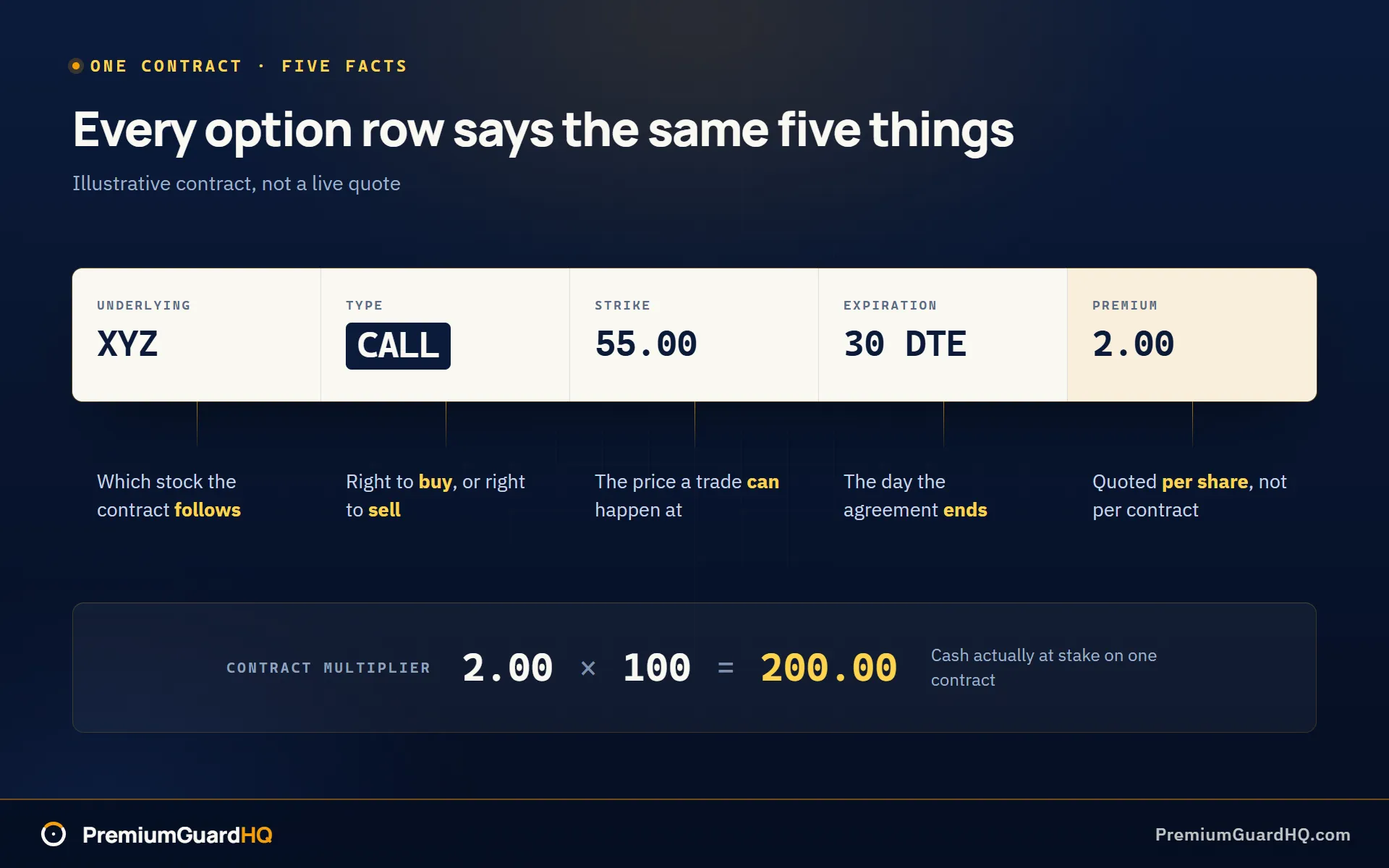
Any trading screen shows the same five facts for an option contract. The underlying symbol tells you which stock the contract follows. Then the screen shows call or put, the strike price, the expiration date, and the premium, which is the contract price. Spot these five facts and you can read any option contract on any platform.
One detail trips up nearly every beginner. A single option contract normally stands for 100 shares, not 1 share. The industry calls this the contract multiplier. A premium quote of $2 does not cost $2. It costs $2 times 100, or $200. The multiplier applies to buyers and sellers the same way.
Every contract has only two roles. The buyer pays the premium up front, and that premium is the most a buyer can lose on a basic position. The seller collects the premium up front. In return, the seller accepts a duty. If the buyer uses the contract, the seller must perform.
Every contract ends one of four ways.
Close the position. Most traders never wait for expiration. A buyer sells the contract back to the market. A seller buys the same contract back to cancel the duty. This is called closing, and it is the most common ending.
Expire worthless. If nobody uses the contract by the deadline, it disappears. The buyer loses the full premium paid. The seller keeps the full premium and owes nothing more.
Exercise. The buyer uses the right in the contract. For a call, exercise means buying 100 shares at the strike price. For a put, exercise means selling 100 shares at the strike price. Some contracts settle in cash instead of shares.
Assignment. This is the seller’s side of exercise. When a buyer exercises, the exchange chooses a seller to complete the deal. That seller is assigned and must deliver shares, buy shares, or pay cash, depending on the contract. If you want what assignment actually does to your account, that is its own walkthrough.
One more detail helps. Stock and ETF options can usually be exercised any day before expiration. These are American-style options. Many index options allow exercise only on the expiration date and pay in cash. These are European-style options, and the design lowers the odds of early assignment.
Broker execution screens differ. This article covers what the contract means, not which buttons to click.
Calls, puts, and what the contract actually commits you to
A call handles buying. A put handles selling. The rest is contract detail.
Calls, in plain terms. Buying a call gives you the right to buy 100 shares at a set price called the strike price. You never have to exercise that right. Selling a call puts you on the opposite side. You must sell 100 shares at the strike price if the buyer exercises. The payment you collect as the seller is the premium. It pays you for two things: the time left on the contract, and the chance the stock moves in the buyer’s favor before the contract ends.
Puts, in plain terms. Buying a put gives you the right to sell 100 shares at the strike price. Selling a put gives you the duty to buy 100 shares at the strike price, but only if the buyer exercises. For a full breakdown of put options on both sides of the trade, we have a longer piece.
Owning a call does not make you a stock owner. It gives you the right to buy later. That mix-up causes early confusion.
Six small terms clear up most of the rest:
- Strike price. The price set in the contract where a trade can happen.
- Expiration date. The final day the contract exists.
- Premium. The contract price, paid by the buyer to the seller.
- In the money, at the money, out of the money. These labels tell you whether exercising right now would make money. A call is in the money when the stock trades above the strike. A put is in the money when the stock trades below the strike. At the money means the stock price and strike are close. Out of the money means exercising now would lose money, so the holder would not do it.
- Exercise and assignment. Exercise is the buyer using the right. Assignment is the seller being picked to perform. Assignment is not a sign of a failed trade; the contract is working as designed.
- Contract multiplier. One contract usually covers 100 shares. A quoted premium of $1.25 is not $1.25. It is $1.25 times 100, or $125 out of pocket.
The buyer and the seller sit in different positions. The buyer pays for a chance at a good outcome and races the clock. Each day without movement brings the buyer one day closer to losing the whole premium. The seller collects payment up front for taking the other side, carries the duty to buy or sell if assigned, and must manage that risk rather than just keeping the check.
Quick number check. A quoted premium of $2.10 becomes $210 per contract after the multiplier. That $210 is the most a buyer can lose. It is also cash the seller collects and must be ready to support. Before you size a position, multiply the quote by 100. Skipping that step is how a “cheap” option becomes a bigger bet than planned.
Why option prices move: time, volatility, and the Greeks
Almost every new trader hits the same confusion. The stock goes up. Your call option should win when the stock goes up. It falls instead. What happened?
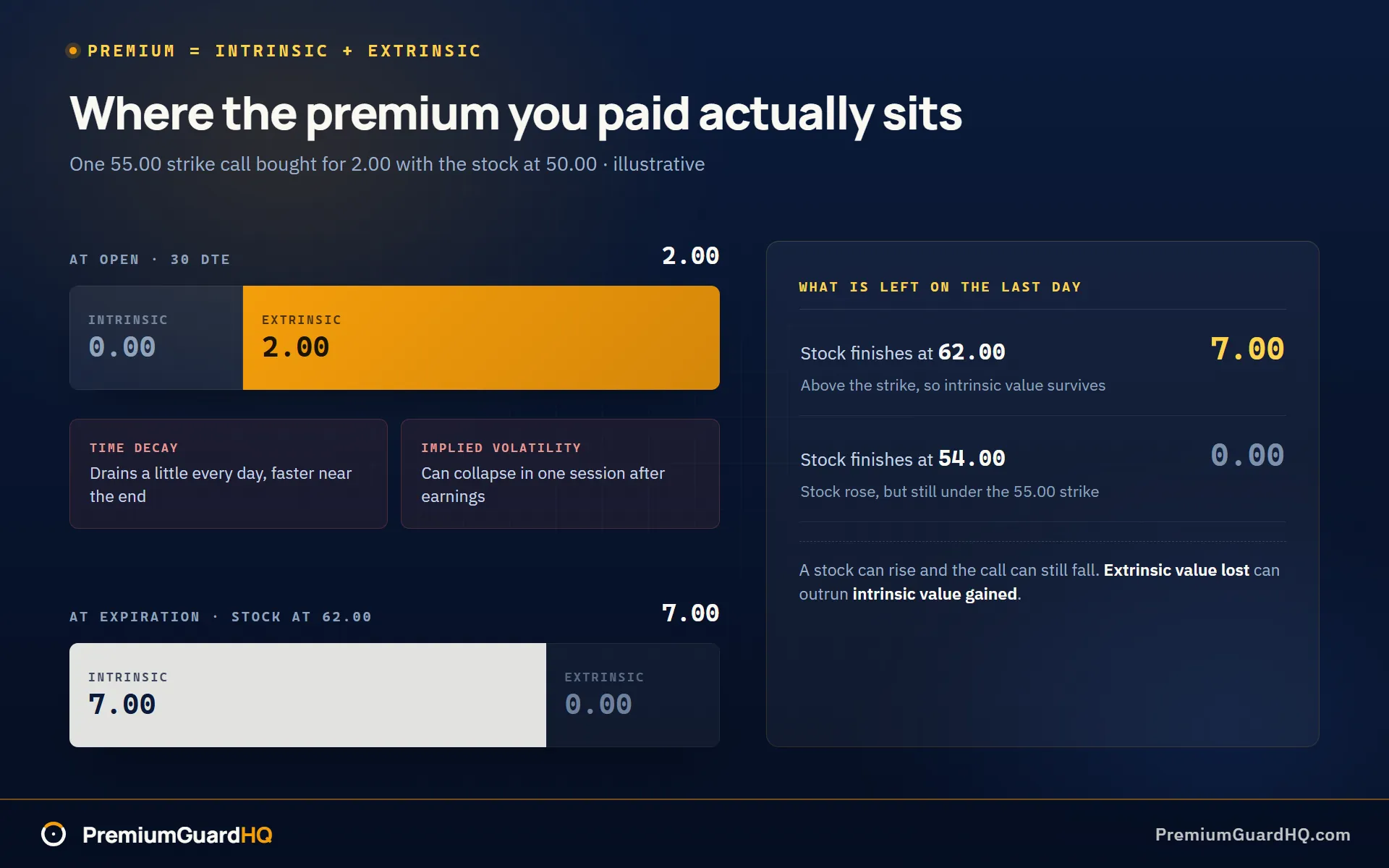
The price of an option is the premium, and how an option’s premium is built decides what happens next. The premium is two numbers added together. Intrinsic value is what the option would be worth if you exercised it right now. Extrinsic value covers time left and uncertainty. Premium equals intrinsic value plus extrinsic value.
Intrinsic value is simple arithmetic. For a call, it is the stock price minus the strike price, never less than zero. The strike price is the set price written into the option contract. For a put, intrinsic value is the strike price minus the stock price, also never less than zero. At expiration, extrinsic value reaches zero. Intrinsic value is all that remains. That is why an option’s final worth is easy to check on the last day.
Extrinsic value causes most of the confusion. Two forces move it.
Time decay is the first force. Each passing day leaves less time for the stock to make a large move. Extrinsic value shrinks daily, and the shrinkage speeds up near expiration. Buyers feel this as a clock working against them, even on days when the stock barely moves.
Implied volatility, or IV, is the second force. IV reflects what implied volatility is actually measuring, the market’s guess at how much the stock might swing before expiration. Higher IV means fatter premiums because big swings are more likely. When uncertainty fades, such as right after an earnings report, IV can drop quickly. The premium can shrink even if the stock price barely moved. Traders call this a volatility crush.
This explains the opening puzzle. The stock rose a little, but IV fell a lot after the earnings announcement. The lost extrinsic value outweighed the gained intrinsic value. The call lost money on a stock that went up.
The Greeks: a risk dashboard, not a crystal ball
The Greeks are numbers that measure how sensitive an option’s price is to a few variables. They show exposure rather than predicting prices.
- Delta: the option price change when the stock moves $1.
- Theta: the daily value loss from time decay alone.
- Gamma: how fast delta changes as the stock moves.
- Vega: the option price change when IV shifts by one point.
- Rho: sensitivity to interest rates, and the least important for most short-term trades.
What the payoff looks like on a chart
A payoff diagram plots profit or loss at expiration against the stock price. A bought call shows a flat loss equal to the premium paid, then a line that turns upward once the stock passes break-even. Loss is capped. Gains are open-ended.
A bought put shows the same flat loss, and the profit line climbs as the stock price falls. A covered call means selling a call against stock you already own. Its chart shows premium income, a capped top once the stock passes the strike, and the same stock downside you would have without an option.
Two break-even formulas matter here:
- A bought call breaks even at the strike price plus the premium paid.
- A bought put breaks even at the strike price minus the premium paid.
Reading the option chain
An option chain lists every available strike and expiration date for a stock. Two prices sit side by side. The bid is what buyers offer. The ask is what sellers want. The gap between them is the spread, and a wide spread is a hidden cost you pay when entering and exiting a trade.
Volume shows how many contracts traded today. Open interest shows how many contracts are still open and active. Thin volume and low open interest usually mean wider spreads and worse fills, so you get a worse price when you buy or sell.
Why anyone uses options: magnified exposure, hedging, income
Options traders generally want one of three results. They want more gain for each dollar spent. They want lower risk on stock they already own. Or they want cash now in exchange for giving up some upside later. Every options trade moves risk from one person to another. The question is always which risk, and who takes it.
More exposure with a capped cash loss. Buying a call or a put lets you control 100 shares of stock without paying full price. A call option gives you the right to buy stock at a set price. A put option gives you the right to sell stock at a set price. You pay a smaller amount called a premium instead of buying the whole stock position. A small cash outlay can control a much larger position.
The tradeoff is real. Options have an expiration date, the day the contract ends. If the stock does not move as expected before that date, the contract can expire worthless. You lose the full premium paid. Buying options loses more often than it wins big because time works against the buyer every day.
Hedging and insurance. Suppose you already own stock. A protective put works like insurance on a house. You pay a premium to lock in a floor price for your shares for a set window. If the stock crashes, the put gains value and offsets the loss. If nothing bad happens, you paid for protection you did not need. That feels the same as paying a home insurance bill that only matters when you actually need it.
That cost drags on returns in calm markets. It is the price of sleeping better during shaky ones.
Income from selling optionality. Sellers take the other side of the insurance trade and get paid for it. A covered call means you own 100 shares and sell a call against them. You collect the premium right away. In exchange, you cap your upside at the strike price, the price written into the contract. You also accept that your shares may be called away, meaning sold to someone else, if the stock rises past that price.
A cash-secured put means you set aside enough cash to buy 100 shares at a strike price, then sell a put. You collect the premium right away. In exchange, you accept the duty to buy those shares if the stock falls below the strike. You can work out what a given strike actually commits in cash before you sell anything. Both trades change “maybe something happens” into “I get paid now, and I accept a defined outcome later.” This is the mindset PremiumGuardHQ is built around: premium counts as income only after a position closes, not the moment it lands in your account.
Multi-leg spreads combine several contracts to define risk on both sides of a trade. They are common, but building one falls outside this article.
Worked example: one call contract, two endings
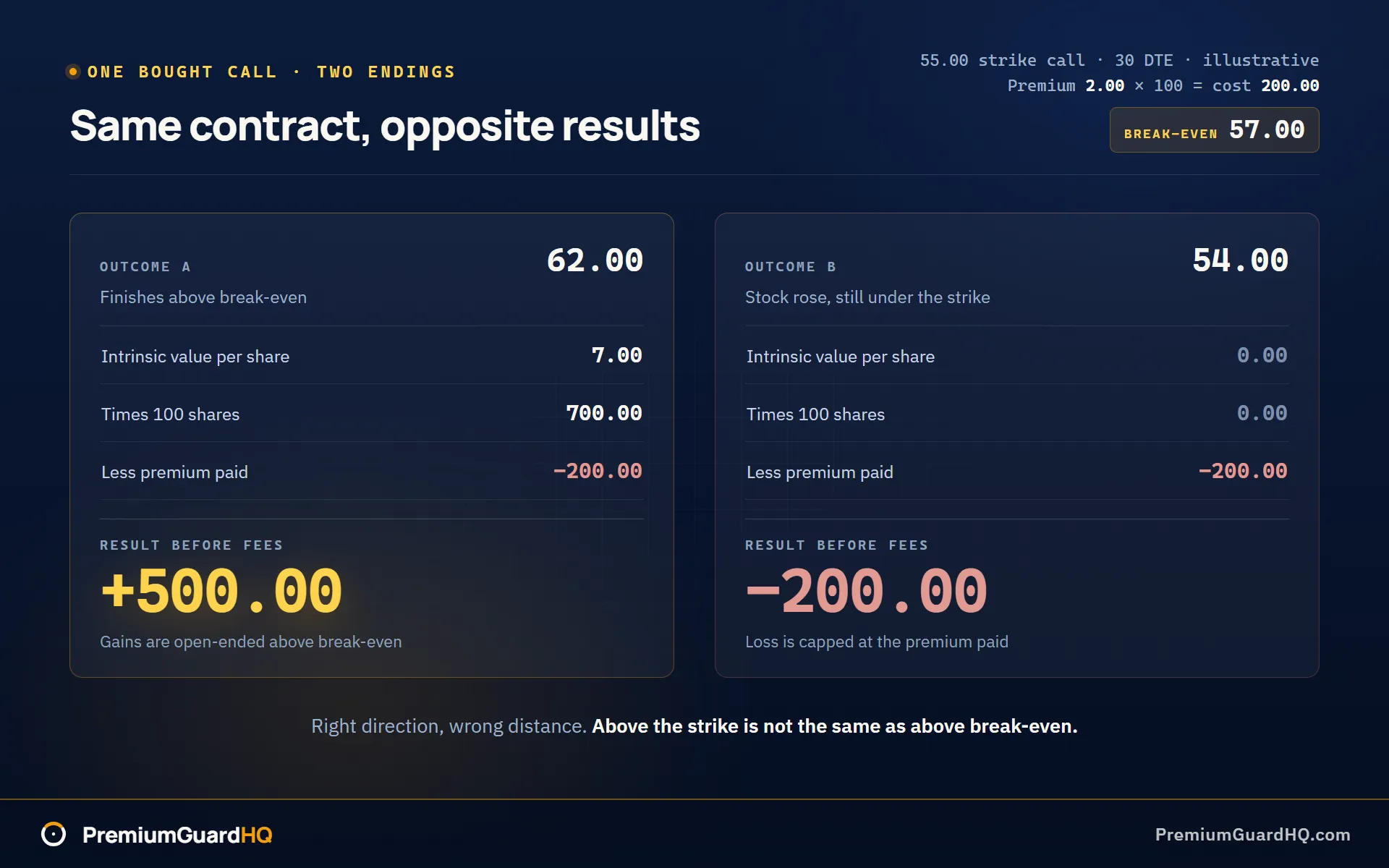
Here is the math with simple numbers. A stock trades at $50. You buy 1 call option with a $55 strike price that expires in 30 days, paying a $2.00 premium. The strike price is the price written into the contract. The premium is the price you pay for the contract.
The premium is quoted per share, but one contract covers 100 shares. Your real cost is $2.00 times 100, or $200. That $200 is the most you can lose on the trade, no matter what the stock does.
Before you profit, the stock has to cover the strike price plus what you paid. Add the two: a $55 strike plus a $2.00 premium equals $57. That is your break-even price at expiration. Below $57, you are not in profit, even if the stock sits above the strike.
Outcome A: the stock finishes at $62. Your call now has intrinsic value, which is the stock price minus the strike price. That is $62 minus $55, or $7. Multiply by contract size: $7 times 100 equals $700. Subtract what you paid: $700 minus $200 leaves a $500 profit, before fees.
Outcome B: the stock finishes at $54. The stock did rise from $50. But $54 is still below the $55 strike. The call expires worthless, meaning no value remains. You lose the full $200 premium paid. Nothing comes back.
That second outcome surprises most new traders. Your direction call was right. The stock rose. You still lost money. Direction alone is not enough. Time and implied volatility, the market’s guess at how much the stock will move, decide the price you can actually exit at before expiration. It costs nothing to check the break-even and both outcomes before you place the trade.
The tradeoffs and risks beginners underestimate
Options let you control a large stock position with a small cash outlay. That is the whole appeal, and it is also the danger. A small payment can carry substantial risk that grows fast.
Time decay risk. An option loses a little value each day from the passage of time. A buyer can be right about the direction and still lose money if the move arrives too slowly or too close to the expiration date. Being right late can still mean losing the entire payment.
Volatility crush risk. A stock can move in the right direction and the option can still fall. This happens when implied volatility, the market’s guess at how much the stock will swing, drops faster than the stock price rises. You can call the direction correctly and still lose.
Liquidity risk. Some options are hard to buy or sell at a fair price. A wide bid-ask spread, the gap between what buyers offer and sellers ask, plus low open interest, the number of active contracts, makes trading more expensive. You can be right about the stock and still give up money to a bad fill.
Assignment risk for sellers. Selling an option can create a real duty: buying or delivering 100 shares. Assignment means the other side forces that duty on you. American-style stock options can assign any day before expiration. European-style index options only settle on the expiration date.
Undefined risk. Selling a call option without owning the stock behind it is a naked call. A stock has no price ceiling, so a naked call carries theoretically unlimited loss. Other strategies can cap that loss, but they fall outside this article.
Taxes are another thing worth checking. Some index options receive special 60/40 tax treatment under Section 1256 of the tax code, so part of the gain is taxed at lower long-term rates no matter how long you held it. Many stock options do not receive this treatment. Talk to a qualified tax professional before assuming how a trade will be taxed.
Once the vocabulary stops being the obstacle, the remaining work is mechanical: getting an account approved and placing an order that fills.
Frequently asked questions
Do options usually get exercised?
No. Most option positions close before expiration rather than being exercised. A trader who bought a call can sell it back to the market for whatever it is worth. A trader who sold a put can buy it back to cancel the duty. Closing early locks in a profit or loss without waiting for the final day. Exercise is one possible ending, and it happens only when the holder actually wants to buy or sell the underlying asset.
What are the Greeks in options trading, and do they matter for beginners?
Yes, but you do not need to be a math person to use them. The Greeks measure the risks held in a position. Delta shows how much the option moves when the stock moves one dollar. Theta shows how much value you lose each day from time passing. Gamma shows how fast delta itself can change. Vega shows how much the option price moves when implied volatility shifts. You can skip the hand calculations, but you should know which ones apply to your position.
What is the difference between American-style and European-style options?
American-style options can be exercised any day before expiration. European-style options can be exercised only on the expiration date itself. Most stock and ETF options are American-style and settle by handing over actual shares. Many index options are European-style and settle in cash. The difference matters most to sellers because American-style contracts carry a higher early assignment risk.
How are options taxed in the United States?
It depends on how the position closes. Gains and losses from closing, selling, or letting an option expire generally count as capital gains or losses. Certain nonequity index options fall under the 60/40 split written into Section 1256 of the tax code instead, as covered above. Broker tax forms do not always report premiums the way traders expect, so check your records closely. This is a summary, not tax advice. Use IRS Publication 550 and a tax professional for your actual situation.