
You already know the textbook line. A put is “a bet the stock drops.” That line is true, but it is only half the story.
Open an option chain, or read a post about “selling puts for income,” and it feels like a different market. That’s because every put option has two sides. One person buys the put and makes a bet. The other person sells the put and gets paid for taking the other side of that bet. Skip this fact, and payoff charts will never make sense.
This guide covers both sides in plain numbers, with no guessing about where the stock goes next. By the end, you can say what a put is in one sentence, read a payoff chart, and know exactly what a put seller must do if things go wrong.
First, the one-sentence definition.
What is a put option?
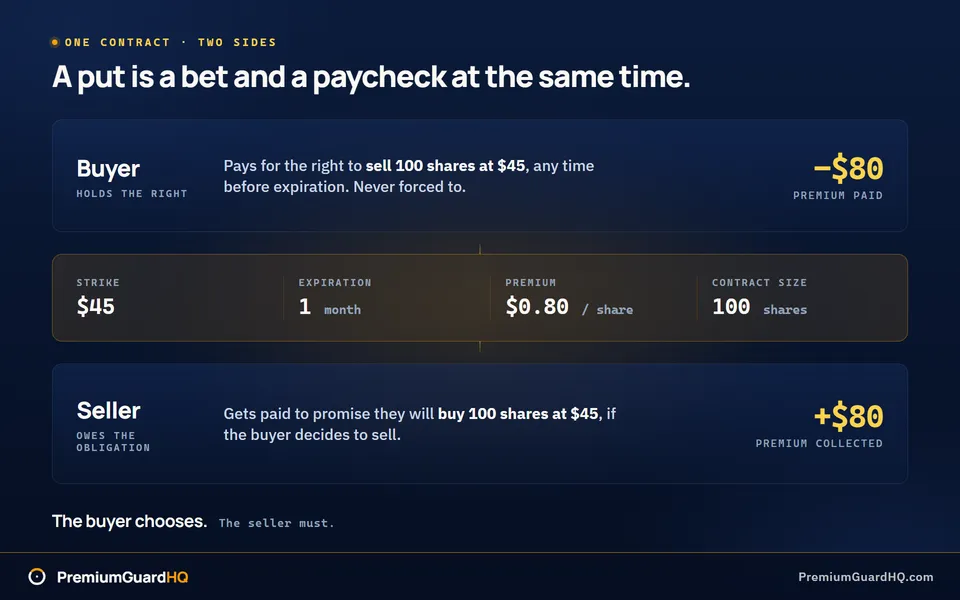
A put option is a contract between two people. The buyer pays for the right to sell 100 shares of stock at a set price on or before a set date. The seller collects that payment and must buy the shares at that price if the buyer chooses to sell.
The set price is called the strike. The set date is called expiration. The payment the buyer hands over is called the premium. It is the price of the contract, quoted per share. So a $1.50 premium on a standard contract means $150 out of the buyer’s pocket, since one contract covers 100 shares.
The buyer is never forced to sell. That is the “right, not the obligation” part. The seller has no such choice. If the buyer decides to sell at the strike price, the seller must buy. This is true no matter what the stock is doing that day.
In plain terms, the buyer is paying for downside protection, or making a bet that the stock will fall. The seller is getting paid today to take on that risk. Puts are the mirror image of call options, where the right is to buy shares instead of sell them.
How put options work step by step: from quote to expiration
Every put trade follows the same path from open to close. Here is that path, broken into simple steps.
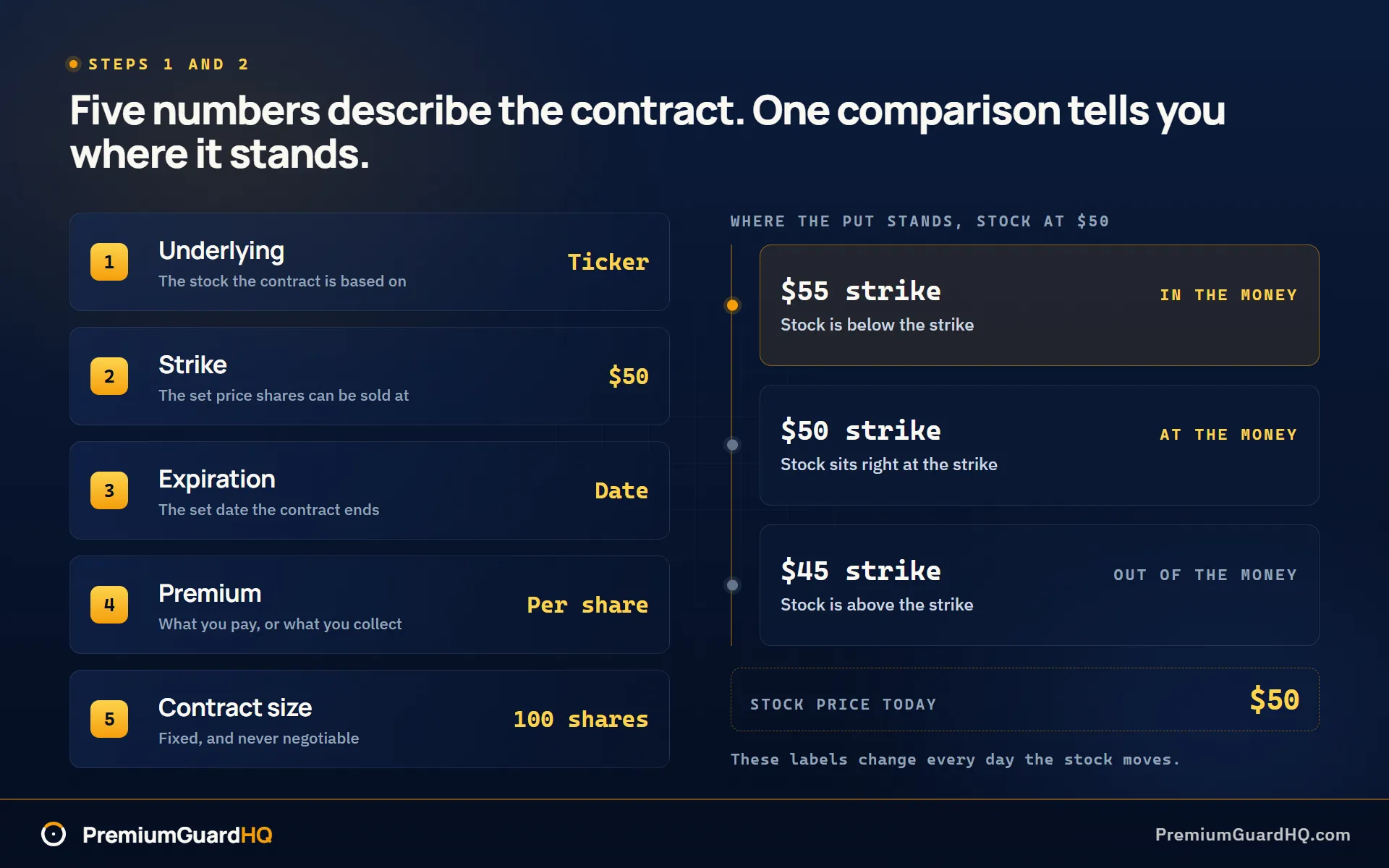
Step 1: Read the five numbers on every contract. Every put has five pieces of information. The underlying is the stock the contract is based on. It is shown by a ticker symbol, like AAPL or TSLA. The strike is the set price at which shares can be sold. The expiration is the set date the contract ends. The premium is the price you pay or receive for the contract. The contract size is 100 shares. Read those five things and you know everything the contract promises.
Step 2: Know where the stock sits compared to the strike. At any moment, a put is in one of three states. It is in the money, or ITM, when the stock price is below the strike. It is at the money, or ATM, when the stock price sits right at the strike. It is out of the money, or OTM, when the stock price is above the strike. These labels change every day the stock moves, right up until expiration.
Step 3: Watch value move opposite the stock. A put usually gains value when the stock drops. It loses value when the stock rises. A put buyer holds the right to sell at a fixed price. That right is worth more the lower the stock falls, since selling at the strike beats selling at the market price.
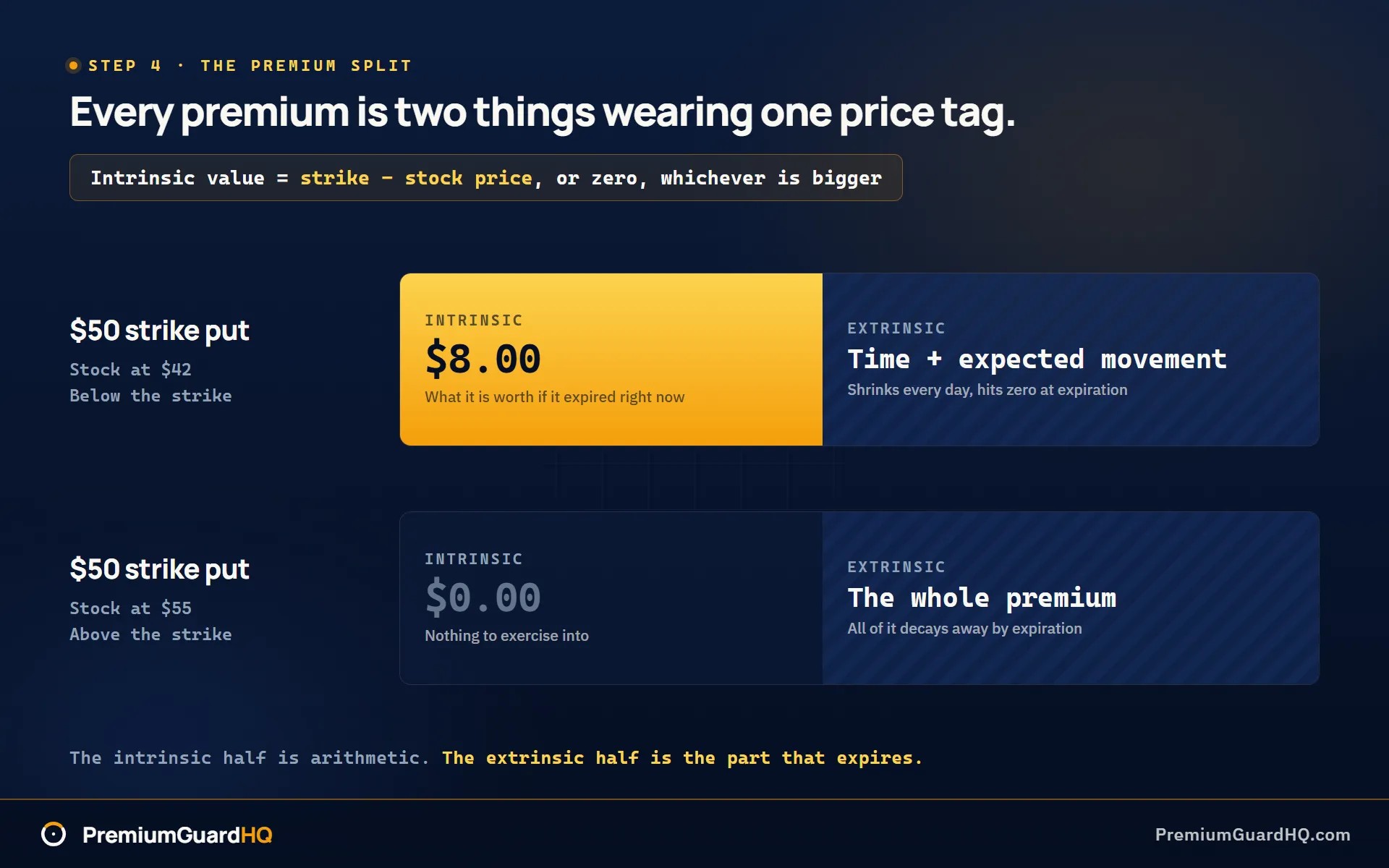
Step 4: Split the price into two parts. Every put’s premium is made of two pieces. Intrinsic value is the amount the put would be worth if it expired right now. The formula is simple: intrinsic value equals the strike price minus the stock price, or zero, whichever is bigger. A $50 strike put on a $42 stock has $8 of intrinsic value. A $50 strike put on a $55 stock has zero. The rest of the premium is extrinsic value. This is the extra amount the market charges for time left until expiration and for how much the stock might move. That expected movement is called implied volatility. Extrinsic value shrinks every day and hits zero at expiration.
Step 5: Know the buyer’s three exits. A put buyer can do one of three things before expiration. Most often, the buyer simply sells the option back on the market to lock in a gain or a loss. This is called closing the position. The buyer can also exercise the put. Exercising turns the contract into an actual stock sale at the strike price, and the mechanics differ depending on whether the buyer already owns the shares. Third, the buyer can do nothing and let the put expire. If it is out of the money at that point, it expires worthless and the buyer loses the full premium paid.
Step 6: Know the seller’s two outcomes. The seller has fewer paths. If the put expires out of the money, the seller keeps the full premium and the contract simply ends. If the put is in the money at expiration, the seller faces assignment. Assignment means the seller must buy 100 shares at the strike price, no matter the market price that day. A seller who set aside enough cash in advance to cover that purchase is running a cash-secured put.
Step 7: Compare calls and puts side by side.
| Role | Right or obligation |
|---|---|
| Call buyer | Right to buy shares at the strike |
| Call seller | Obligation to sell shares at the strike |
| Put buyer | Right to sell shares at the strike |
| Put seller | Obligation to buy shares at the strike |
Once these steps make sense, the math behind them is easy to check with a calculator. A put option calculator needs six inputs to estimate a contract’s value: the stock price, the strike, the time left until expiration, implied volatility, the risk-free interest rate, and any dividends the stock pays. Feed those in and the calculator will estimate fair value. It will not tell you the exact price you would get in a real trade, since that depends on the bid-ask spread, the gap between what buyers offer and sellers ask. It also cannot fully capture early-exercise quirks on American-style options, or sudden jumps in implied volatility around events like earnings.
What is a long put option: payoff, breakeven, and the long put graph
Now look at the trade from the buyer’s side. When someone says they are “long a put,” they mean they bought it. A long put is buying the right to sell 100 shares at the strike price. What matters now is the payoff: how much money you make or lose, based on where the stock ends up.
The long put payoff at expiration
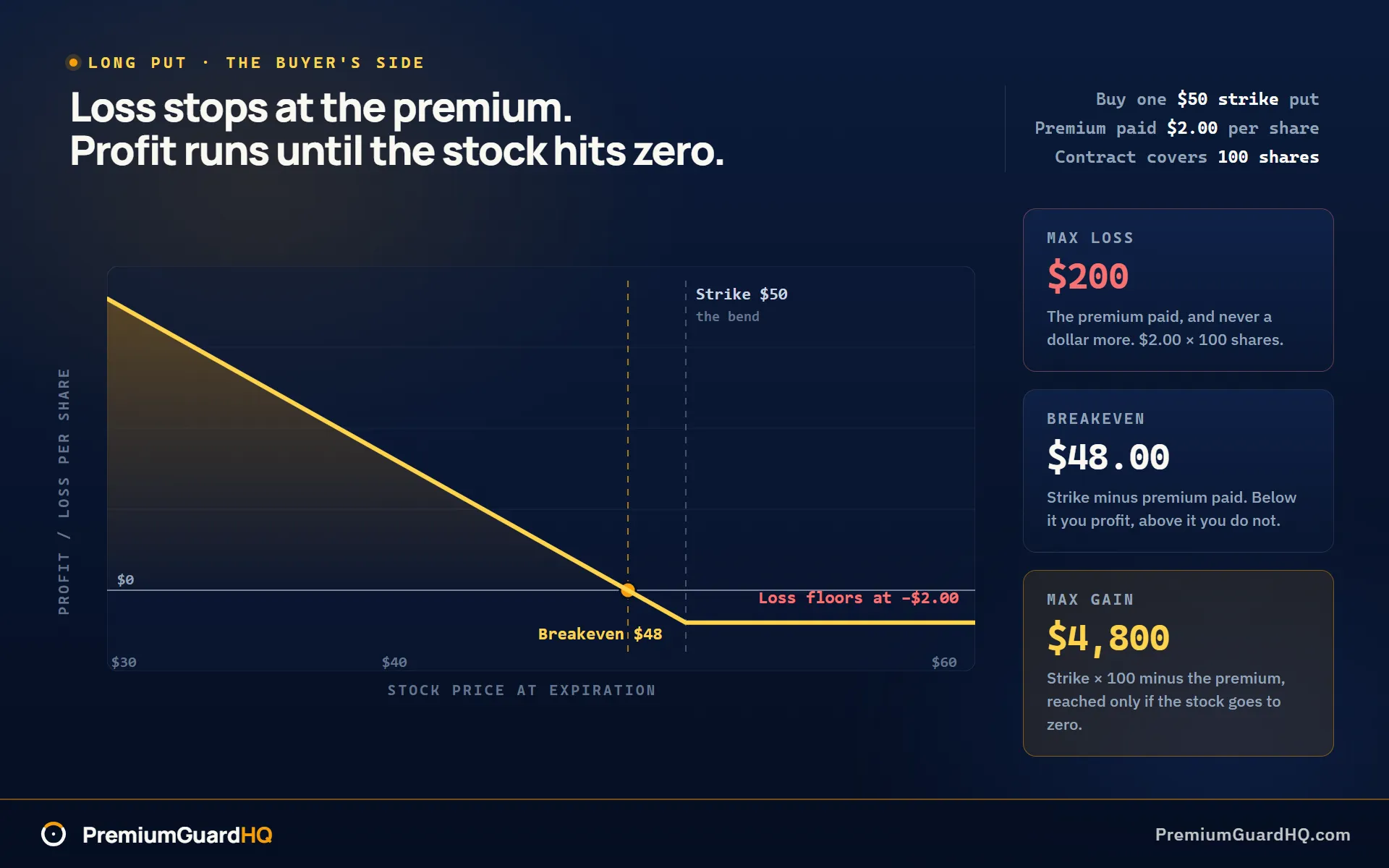
Picture a simple line chart. The bottom axis shows the stock price at expiration. The side axis shows your profit or loss. This is the long put graph. Once you see it drawn out, the trade clicks into place.
Start on the left, where the stock price is low. Your put lets you sell shares for much more than they’re worth on the market. Your profit grows dollar for dollar as the stock keeps falling. But there’s a floor: the stock can only fall to zero, it cannot go negative. So your max gain is large but capped, at strike price times 100, minus the premium you paid.
Now look at the right side, where the stock price is high. Nobody would use their put to sell shares for less than the market price, so the put simply expires worthless. Your loss is the premium you paid to buy it, plus any fees. It doesn’t matter if the stock rises by $5 or $500, your loss stops there. This is the max loss, and it is always the premium paid.
Between those two ends sits the bend in the line, the spot where the whole picture changes. That bend happens exactly at the strike price. Below the strike, the put has value, and that value grows as the stock falls further. Above the strike, the put is worthless. This bend is the most important spot on the chart, since it marks where the trade’s entire personality flips.
One more number matters: breakeven. This is the stock price where you get back exactly what you paid, no more, no less.
Breakeven = strike price minus premium paid
Say you buy a $50 strike put for $2. Your breakeven is $48. If the stock lands at $48 at expiration, you get back exactly what you paid. Below $48, you’re in profit. Above $48 but still under $50, you get some money back, just not enough to cover the full premium.
Puts and calls, side by side
A long put buyer profits when the stock falls. A long call buyer, someone who bought the right to buy shares, profits when the stock rises. They are mirror images, drawn on opposite sides of the same chart. Keep that picture in mind. It will stop you from mixing them up later.
Why traders buy long puts
People buy puts for one of two reasons.
- Hedging. This works like insurance for stock you already own. You pay a premium upfront. If your stock crashes, the put’s rising value offsets the loss. This is often called a protective put. You hope you never need it, the same way you hope you never file a home insurance claim.
- Speculation. Some traders buy puts simply because they think a stock will fall, without owning any shares. Short selling means borrowing and selling shares you don’t own, betting the price falls so you can buy them back cheaper. A long put caps your risk at the premium paid, while short selling has no ceiling, since a stock can climb without limit.
Sanity-checking a long put with a calculator
Before you buy, run the numbers through a put option calculator. It needs six inputs: stock price, strike, days left until expiration, implied volatility, the risk-free rate, and dividends.
The output worth understanding is the theoretical price, plus a few sensitivity numbers called Greeks. Delta on a long put is negative, usually between 0 and -1. It estimates how much the put’s price moves for a $1 move in the stock. Theta is usually negative for a buyer, meaning the put loses a small slice of value every day just from time passing. Vega is usually positive, meaning the put gains value if implied volatility rises.
One note worth remembering: delta is a sensitivity estimate, not a promise. A delta of -0.40 suggests the put might gain about $0.40 if the stock drops $1, all else equal. It is not a guarantee.
”The stock dropped, so why didn’t my put go up?”
This trips up almost everyone the first time. Three usual culprits explain it. Time decay, the daily erosion from theta, may have eaten into gains from the stock’s drop. Implied volatility may have fallen, shrinking the option’s extra value even as the stock moved your way. This volatility drop is sometimes called IV crush, and it’s common right after earnings reports. You may also have paid a wide bid-ask spread, so your entry price was already worse than the quoted premium suggested.
A long put only exists because someone else agreed to sell it. That seller’s payoff curve looks nothing like this one, and it’s worth understanding why.
Short put vs long put: what changes when you sell the contract
Flip the trade around and the whole picture flips with it. A long put is the one you just learned. It gives the buyer the right to sell shares at the strike price. That strike price is the set price written into the contract. A short put is the other side of that same contract. When you sell a put, you take on the obligation to buy 100 shares at the strike price, if the buyer decides to use their right. You are not hoping for a move. You are getting paid to make a promise.
The short put payoff at expiration
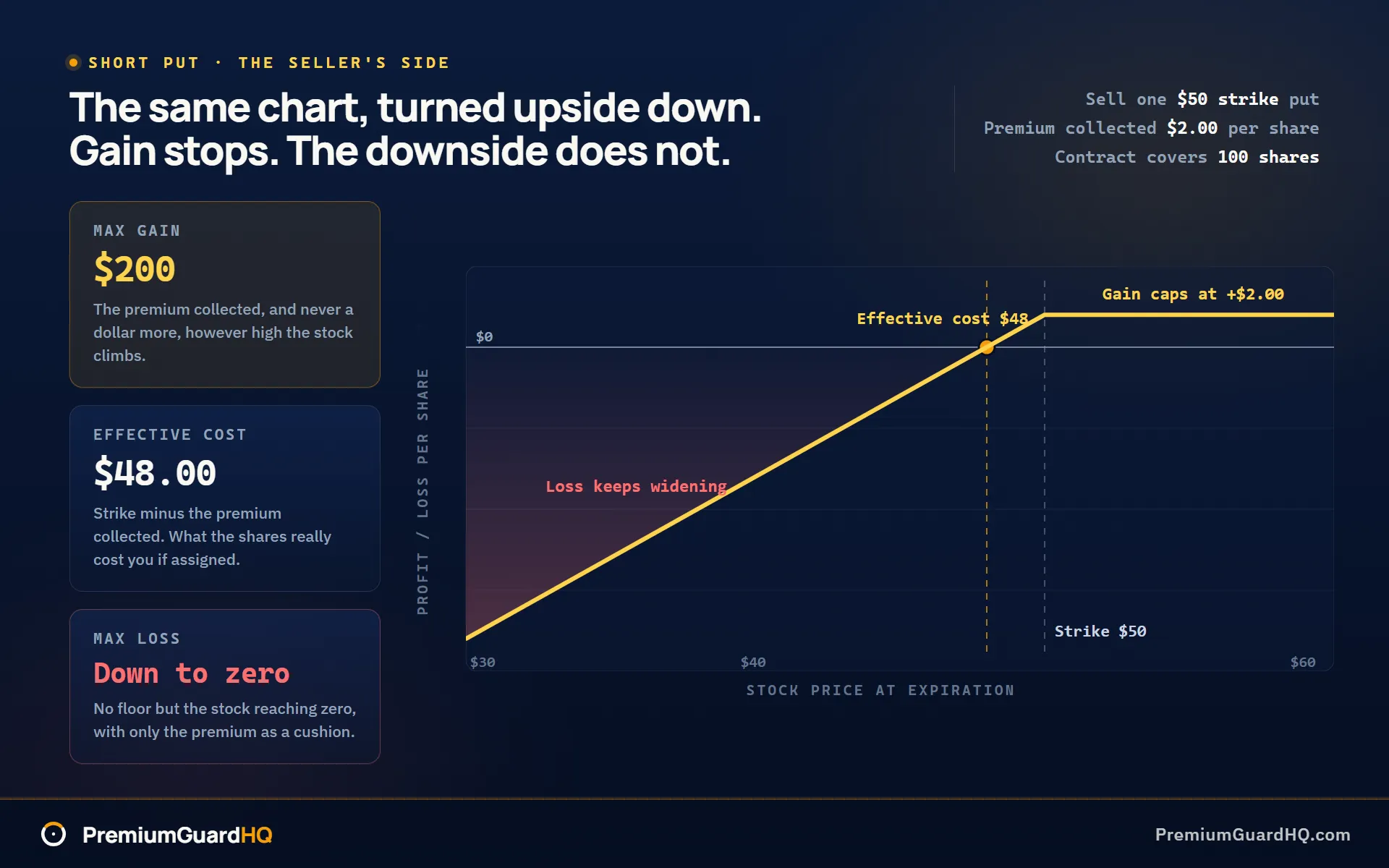
The seller’s payoff is the mirror image of the buyer’s, but it is not equal in both directions. Your max gain is small and fixed. It is the premium, the cash you collected when you sold the put, and nothing more. It doesn’t matter how high the stock climbs. You already have your full profit locked in the moment the put expires worthless, meaning the buyer never used their right to sell.
The risk runs the other way. If the stock falls far below the strike, you still must buy 100 shares at that strike price, even though the stock is worth much less. There is no floor to soften this besides zero. A big drop in the stock means a big paper loss on shares you’re now holding. This is the seller’s main risk: large downside if the stock falls hard, with only the premium collected to cushion it.
That premium does shift your entry point, though. Sellers often talk about an effective purchase price instead of the strike price alone. If you get assigned, meaning you end up buying the shares, your real cost per share works out to roughly the strike price minus the premium you collected. Sell a $50 strike put and collect $2 in premium, and your shares effectively cost you around $48 each if you end up owning them. That’s better than buying at $50 outright, but it is still a real stock position with real downside below $48.
Cash-secured vs naked puts
Selling a put means promising to buy shares. The question is how that promise gets backed. A cash-secured put means you set aside the full cash needed to buy 100 shares at the strike price. That cash sits untouched in your account until the contract closes. Sell a $50 strike put and you’d have $5,000 set aside per contract, ready to cover assignment, the moment you actually have to buy the shares.
A naked put is sometimes called a portfolio-secured put. It does not set aside the full amount. Instead, your broker uses margin rules to decide how much cash or collateral you actually need to hold, usually less than the full purchase amount. This changes how much of your account gets tied up. It does not change what happens if the stock crashes. You still owe 100 shares at the strike price if assigned. The risk is identical either way. Only the cash requirement differs, and exact margin math varies by broker, so treat this as a definition rather than a formula to calculate yourself.
What assignment actually means
Assignment is the moment the obligation becomes real. It means you now must buy 100 shares at the strike price. The cash you set aside, or the margin your broker required, gets used to complete that purchase.
Assignment usually happens right around expiration, and only if the put is in the money. In the money means the stock is trading below the strike. But there’s a wrinkle worth knowing. Most stock options in the U.S. are American-style, which means the buyer can choose to exercise early, at any point before expiration, not just on the last day. Early assignment is uncommon, but it can happen, especially if the put is deep in the money or the stock is about to pay a dividend.
When a short put position moves against a seller, or works out well, sellers typically respond in one of a few ways. They might close the position early by buying back the put before expiration. They might roll it, closing the current put and opening a new one at a different strike or a later date. Or they might simply accept assignment and take the shares. Which of these makes sense depends on the situation, and that decision tree deserves its own full explanation rather than a rushed summary here.
Why people call this “selling puts for income”
This is the trade behind the phrase “selling puts for income.” The idea is simple to state. Collect premium now, then either keep it as pure profit if the stock stays above the strike, or end up buying shares at a discount to today’s price if it doesn’t. Many traders use this as a deliberate way to enter stock positions they already wanted, while getting paid to wait. For the full income workflow, including how to pick a strike, when to close early, how to roll, and how to handle assignment, see our full guide on selling puts for income. If you are also weighing whether to sell puts or sell calls instead, our sell call vs sell put comparison breaks down that choice directly.
Where this gets blurry across a real trading history
One thing rarely mentioned in the basic explanation: selling puts across many months can look like steady income on a winning streak. That feeling lasts right up until a drawdown and an assignment blur the picture. A trader might feel like they made money all year, then struggle to explain what actually happened once shares got assigned below cost basis in a rough month. This blur comes from mixing options income with stock price swings in your head, instead of tracking them separately.
This is the problem PremiumGuardHQ was built to sort out. The platform separates Premium P/L from Equity P/L. Premium P/L is the money made or lost from the option contracts themselves. Equity P/L is the gains or losses on shares you end up holding. Both roll into a Net Income figure, so a trader can see exactly what was realized from cycles that closed, versus what is still sitting out there as open risk. PremiumGuardHQ also runs a Safe Withdrawal Engine, which calculates the amount that can actually be pulled out of an account from realized, closed-cycle profits, without quietly shrinking the capital base that generates future income. None of this tells you which puts to sell or when. It just makes sure the numbers you’re looking at are the real ones.
Worked example: one put contract, buyer payoff and seller payoff
Here’s the whole trade with real numbers, so both sides click into place at once.
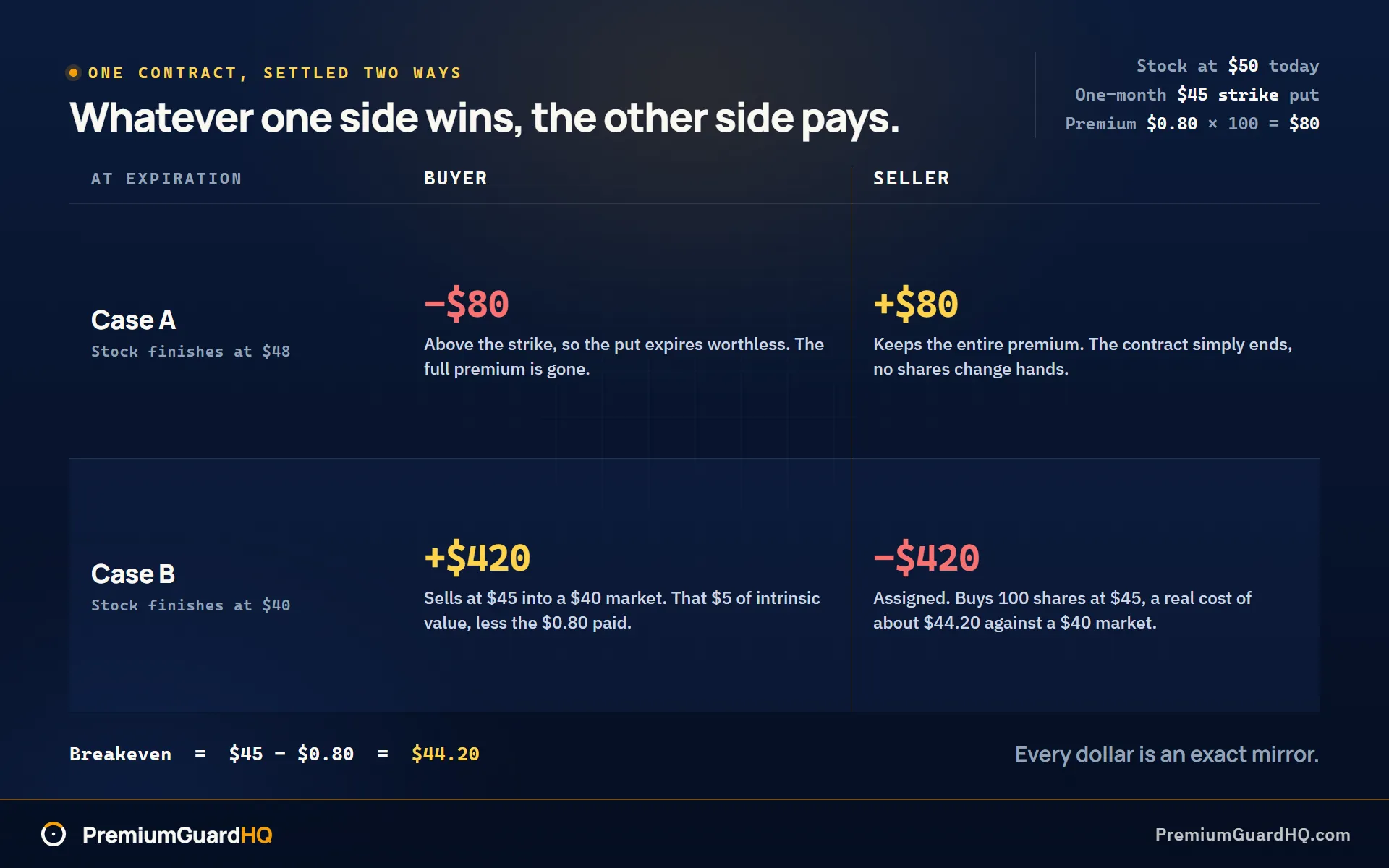
The setup. A stock trades at $50. A put option gives its owner the right to sell 100 shares at a set price. A one-month put with a $45 strike costs $0.80 per share. That $0.80 is called the premium. It’s the price you pay to buy the contract, or the price you collect if you sell it. One contract covers 100 shares, so this put costs $80 total. Someone buys it. Someone else sells it. Here is how both sides play out.
The buyer’s side
Case A: the stock finishes at $48. That’s above the $45 strike price, so the put has no value. It expires worthless. The buyer loses the full $80 paid. Nothing more, nothing less.
Case B: the stock finishes at $40. The put lets its owner sell at $45 when the stock only sells for $40 in the market. That $5 gap is called intrinsic value. It’s the value the option is really worth. Subtract the $0.80 paid for the put, and the buyer nets $4.20 per share, or $420 on the full contract.
Breakeven is the strike price minus the premium: $45 minus $0.80, or $44.20. Below $44.20, the buyer makes a profit. Right at $44.20, the buyer just gets their money back.
The seller’s side
The seller’s numbers mirror the buyer’s, but flipped.
Case A: the stock finishes at $48. The put expires worthless, so the seller keeps the full $80 premium. That’s the entire profit, and it’s already locked in.
Case B: the stock finishes at $40. The seller gets assigned. Assignment means the seller must buy 100 shares at the $45 strike price, even though the stock only trades at $40. Counting the $0.80 premium already collected, the seller’s real cost works out to about $44.20 per share. Against a $40 market price, that’s roughly a $4.20 per share paper loss. That’s the exact mirror of the buyer’s $4.20 gain.
Why closing differs from exercising
A buyer holding an in-the-money put, meaning one worth exercising, often sells the contract back on the market instead of exercising it. The reason: the contract may still carry extra value beyond its $5 of intrinsic value, tied to the time left before expiration. Selling the contract captures that extra value. Exercising it throws that value away.
Benefits and risks of put options: what a put does not protect you from
A put option is a contract that gives you the right to sell a stock at a set price. Both sides of a put trade sound clean on paper. Real trades have rough edges. Here is the honest list, for buyers and sellers both.
What long puts get you right. Buying a put, known as a long put, has a defined risk. Your worst case is set the moment you buy it. It is simply the premium you paid, the price of the option, and nothing more. A long put can also protect stock you already own. If the stock drops, the put gains value and offsets some of that loss. Or you can use it as a plain bet that a stock will fall, without the unlimited risk that comes from short selling a stock outright.
Where long puts fall short. Three things quietly ruin good long put trades. The first is time decay. Every day that passes eats a little value from your put, even if you turn out to be right about the direction. Being right too late can still mean losing money. The second is falling implied volatility, sometimes called IV crush. Implied volatility is the market’s guess at how much a stock might move, and when that guess drops, your put can lose value even while the stock falls in your favor. The third is a wide bid-ask spread. That is the gap between the price buyers offer and the price sellers ask. A wide gap can turn a fair-looking price on screen into a bad fill in real life, especially on stocks that do not trade often.
What short puts get you right. Selling a put pays you money upfront, called the premium. That premium can also work like a paid limit order, an order to buy a stock only at a price you choose. If you get assigned, meaning you end up buying the shares, your real cost per share drops below the strike price by the amount of premium you collected.
Where short puts fall short. The premium is small next to a real drawdown, a sharp drop in the stock price. A stock can fall far more than the premium ever covered, leaving a short put seller holding a large paper loss. Assignment also locks up capital. Shares show up in your account, and that ties up money you may have wanted to use elsewhere. On top of that, taxes and broker reporting around assignment often get confusing. Cost basis, the price used to calculate your gain or loss, and realized profit and loss can look different than a trader expects, especially once premium gets folded into the math.
None of this is a reason to avoid puts. It is a reason to know the edges before you trade one.
Frequently asked questions
What is the difference between a call and a put option?
A call gives its buyer the right to buy 100 shares at a set price. A put gives its buyer the right to sell 100 shares at a set price. On the other side of each trade, the seller takes on the opposite job. A call seller must sell shares if asked. A put seller must buy shares if asked. Simple memory hook: calls are upside rights, puts are downside rights.
What is a long put option in plain English?
A long put means you paid a premium, the price of the contract, for the right to sell shares at a set price called the strike. The bet is not simply “the stock will fall.” It is more specific than that: the stock needs to fall far enough, before the contract expires, to beat the premium you paid. A small dip that does not clear that bar can still lose money. See “What is a long put option” above for the full payoff breakdown.
What is a short put vs a long put?
A long put has a capped loss and a large potential gain. The most you can lose is the premium you paid. A short put flips that. Your gain is capped at the premium you collected, but your loss can run much larger if the stock falls hard, since you are on the hook to buy shares at the strike. Selling a put and setting aside the full cash needed to buy those shares is called a cash-secured put.
How do I use a put option calculator?
Enter six inputs: the stock’s current price, the strike price, the time left until expiration, implied volatility, the risk-free interest rate, and any dividends the stock pays. The calculator will estimate a fair value, plus sensitivity numbers called Greeks. Pay attention to breakeven, the price at expiration where you get back exactly what you paid, along with delta, theta, and vega. These are estimates, not guarantees. A wide bid-ask spread, the gap between buy and sell prices, or a sudden shift in implied volatility can move your actual result away from what the calculator showed.
How are put options taxed in the U.S.?
For most individual traders, gains and losses from puts on individual stocks are treated as capital gains or losses, and the details shift depending on whether you closed the position, let it expire, or got assigned shares. Some index options get different tax treatment under a rule known as Section 1256, which does not apply to single-stock equity options. Broker-reported cost basis, the price used to figure your gain or loss, can look off once premiums get folded in. Confirm your numbers against your official tax forms, and check with a qualified tax professional before filing.