
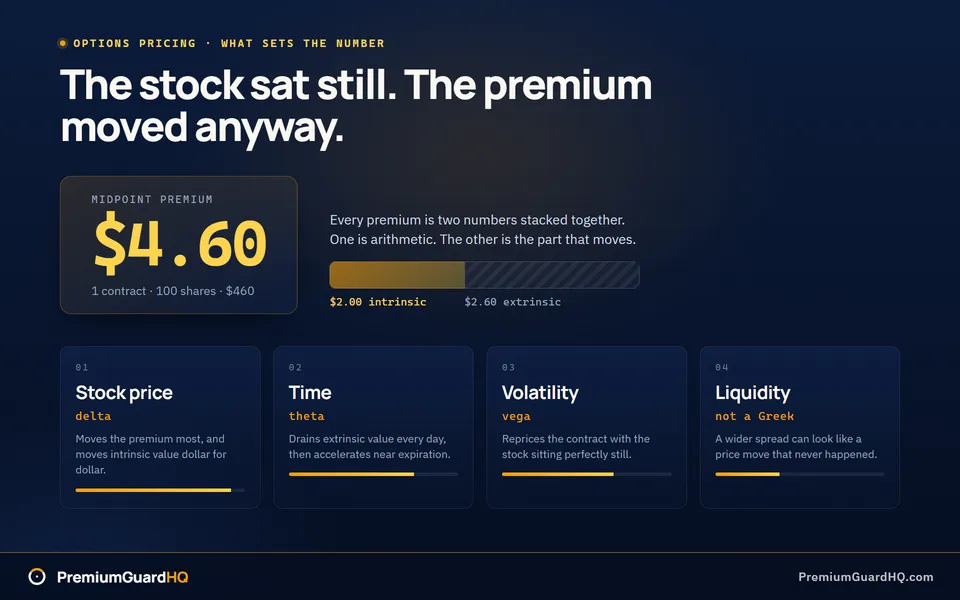
You open the chain. The premium moved. But the stock barely budged.
If you sell options for income, that gap between “stock did nothing” and “price did something anyway” is not random. It is information you have not learned to read yet.
Options pricing is the process of figuring out what a fair price for an option should be. That price is called the premium. It comes from a small set of inputs working together, not from guesswork or manipulation.
Here’s what you’ll walk away with. You’ll learn what an option’s price is actually built from. You’ll learn which variables push that price around. You’ll learn how pricing calculators get their number. And you’ll learn why the market price can still disagree with the model’s number.
Four inputs. One skill. Once you have it, you can check any premium swing instead of just shrugging at it.
Start with the cleanest possible definition of options pricing.
What is options pricing
Options pricing is how traders figure out an option’s premium, which is the price of the option. You can read the premium straight from the market’s bid and ask. Or you can estimate it with a pricing model that uses the stock price, strike price, time left, and expected volatility.
The premium is quoted per share, then multiplied by 100 for one standard contract. That premium is made of two parts. Intrinsic value is what the option is worth if you used it right now. Extrinsic value is everything else, like time left, expected movement, interest rates, and dividends. The industry’s own primer on what goes into an option’s premium breaks it down along those same two lines.
It also helps to know about two different prices you will see. A pricing calculator gives you a theoretical value. This is just the calculator’s best guess at what the option should be worth. The price you can actually trade at is the bid and ask you see live in the option chain. These two numbers are often close, but they are not always the same.
How options pricing works step by step
Here’s the actual sequence you’d walk through if you were checking whether a premium made sense.
Step 1: Start with what you can observe. Open the chain and you’ll see three prices for any option. The chain is just the list of available options for a stock, sorted by strike price and expiration date. The bid is the highest price someone will pay you right now. The ask is the lowest price someone will sell for right now. The midpoint splits the difference between the two.
There’s also a “last price,” which is whatever the most recent trade happened to be. Ignore it if the option barely trades. That price could be from an hour ago, and the market has since moved on.
One more detail that trips up new sellers. The premium you see is quoted per share, not per contract. One contract covers 100 shares. A $1.20 premium means $1.20 times 100 shares times however many contracts you trade. Sell one contract at $1.20, and $120 lands in your account, minus fees.
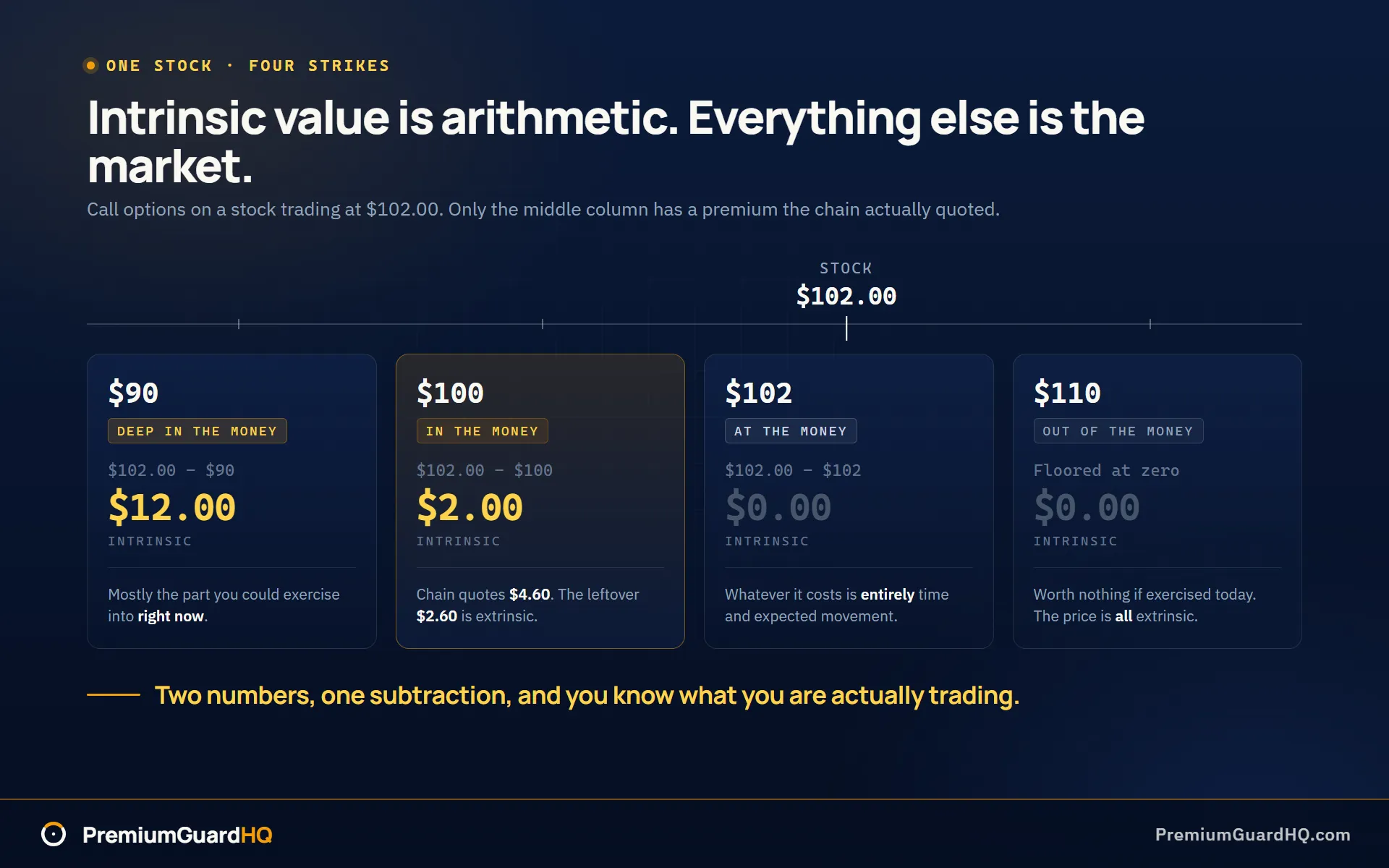
Step 2: Split the premium into two numbers. Every premium is made of two parts: intrinsic value and extrinsic value. Intrinsic value for a call is the stock price minus the strike price, floored at zero. A call option gives you the right to buy stock at a set price called the strike. It’s the reverse for a put, which gives you the right to sell stock at the strike: strike price minus stock price, floored at zero.
Whatever premium is left over after you subtract intrinsic value is extrinsic value. That leftover chunk is where time and expected movement live. A deep in-the-money option, one where the stock price is well past the strike, might be almost all intrinsic value. A far out-of-the-money option is almost entirely extrinsic value, because it has no worth if exercised today.
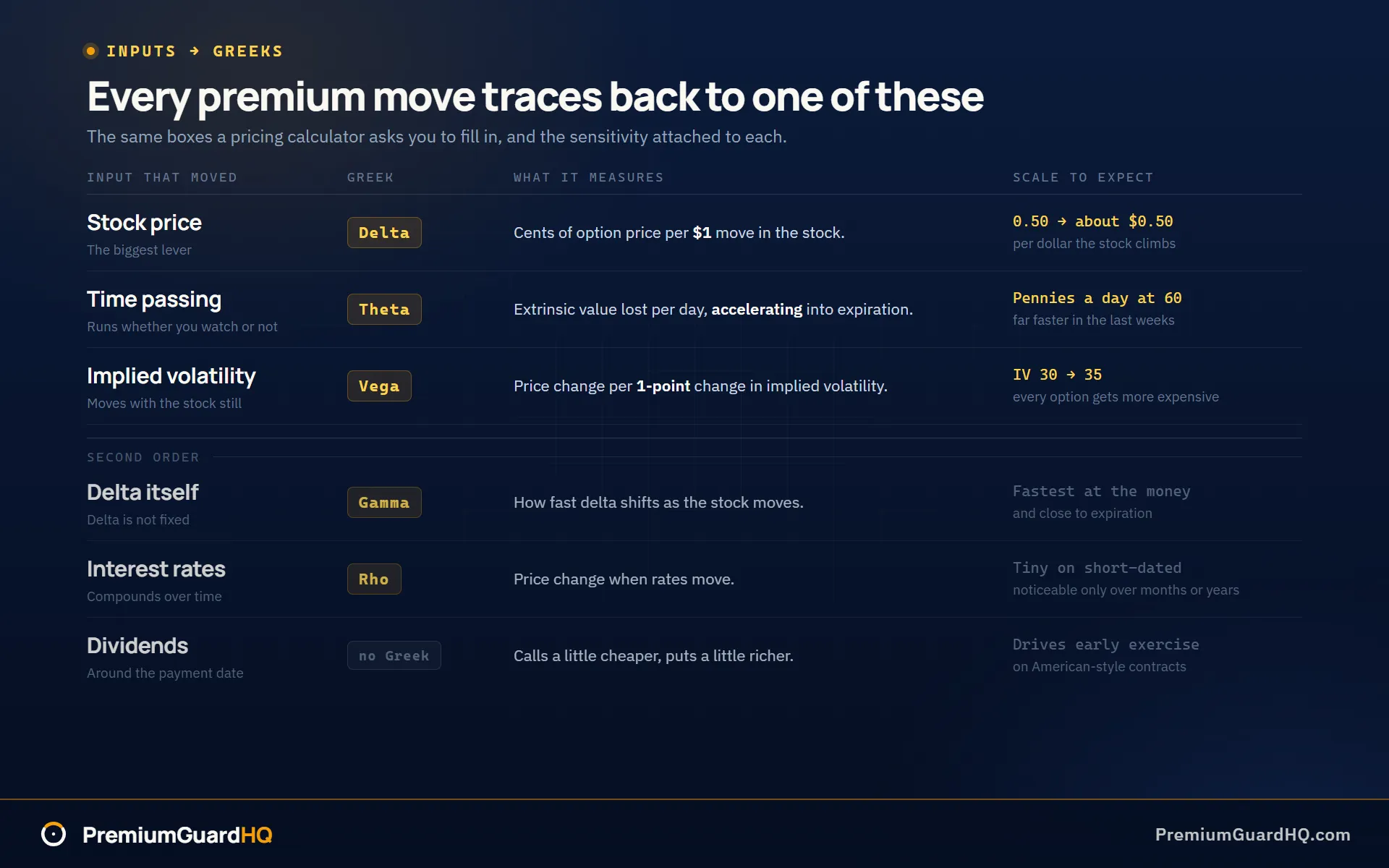
Step 3: Map what changed to five drivers. When extrinsic value shifts, one of five things moved: the stock price, time passing, expected volatility, interest rates, or dividends. Traders call the sensitivities to these five inputs the Greeks. Delta measures sensitivity to stock price. Theta measures sensitivity to time. Vega measures sensitivity to volatility. Rho measures sensitivity to interest rates. These are the exact same five boxes a pricing calculator asks you to fill in.
Step 4: See where calculators fit. A pricing model takes those five inputs and spits out a theoretical value plus the Greeks. Feed it a volatility guess and it hands you back a price. Feed it today’s market price instead, and it can work backward to tell you what volatility the market is implying. That backed-out number is called implied volatility, and it’s usually more useful than a model price, because it tells you what the market currently expects, not what you expect.
Step 5: Reconcile model versus market. The model is a reference point, not a verdict. The real market price gets negotiated around bid-ask spreads, how many contracts are actually trading, and plain supply and demand. Thin trading means wider spreads and prices that can drift further from the model’s answer.
One hard rule sits underneath all of it: prices can’t let anyone lock in free, riskless money. That’s the boundary options pricing lives inside, not your personal forecast for the stock.
Intrinsic vs extrinsic value: the premium split you can audit
You already learned the two pieces that make up every option’s price. Now turn that into a check you can run on any contract. Here is the only math most option sellers need day to day:
Premium = Intrinsic value + Extrinsic value
Premium is the price of an option. If an option costs $2.50 per share, that $2.50 splits between those two buckets. Multiply by 100 and you get the price for one contract, since one options contract covers 100 shares. A $2.50 premium is $250 per contract. Keep that multiplier in your head. It matters more than people think, and it comes back later in this article.
Intrinsic value: what the option is worth right now
Intrinsic value is what you’d get if you used the option immediately. A call option gives you the right to buy stock at a set price. Its intrinsic value is the stock price minus that strike price, and it never goes below zero. A put option gives you the right to sell stock at a set price. Its intrinsic value is the strike price minus the stock price, also floored at zero.
There’s a fast vocabulary that goes with this. In-the-money, shortened to ITM, means the option has intrinsic value right now. Out-of-the-money, or OTM, means it has none. At-the-money, or ATM, means the stock price and strike are roughly equal. Don’t memorize these as jargon. Use them as a quick label you slap on a contract in one glance. One caution on the label: ITM tells you the option holds intrinsic value, not that the trade is profitable, and the price that decides profit is your breakeven.
Extrinsic value: what you’re paying for time and uncertainty
Extrinsic value is everything in the premium that isn’t intrinsic value. It exists because there’s still time left on the contract. Time means the stock could move further in-the-money, or move into the money if it isn’t there yet. That chance has worth, even if the stock sits still today.
Two things drive most of this leftover value. Time left until expiration is one: the more days left, the more room the stock has to move, so extrinsic value tends to be higher. Expected volatility is the other, and it’s usually the bigger lever. A stock expected to swing hard carries fatter extrinsic value than a calm one, even with the same number of days left. Smaller effects like interest rates and dividend payments nudge the number too, but they rarely matter much for shorter-dated contracts.
The bid/ask problem: two people can both be right
Intrinsic value is pure math. Anyone with a calculator gets the same number. Extrinsic value works differently: it’s whatever the market is willing to pay right now, and the market is made of a bid and an ask that can sit far apart.
A bid is the highest price a buyer will pay. An ask is the lowest price a seller will accept. Wide gaps between them often show up looking like “mystery extrinsic value.” You compute intrinsic value, compare it to the midpoint price between bid and ask, and the leftover looks bigger or smaller than expected. The model isn’t wrong. The market just isn’t giving you a tight, fair execution price at that moment. Thin trading causes this constantly, so check the spread width before you assume your math is off.
Three mistakes this split prevents
Mistake 1: Thinking an in-the-money option is automatically safe. Having intrinsic value doesn’t mean the extrinsic value is small. A long-dated, in-the-money option can still carry a large extrinsic chunk, and that chunk can shrink fast as expiration nears or volatility drops.
Mistake 2: Confusing premium collected with locked-in profit. Premium is cash that lands in your account the moment you sell. That’s cash flow, not profit. Your actual profit or loss depends on how the position closes: whether it expires worthless, gets bought back early, or ends in assignment. Assignment means you’re forced to buy or sell the stock at the strike price. That distinction is the whole story behind what actually turns premium into income.
Mistake 3: Forgetting the multiplier. An option quoted at $0.85 is not an “85 cent option.” It’s $85 per contract, since one standard equity contract covers 100 shares. Miss that, and every mental estimate of your risk and reward is off by a factor of 100.
The 15-second check
Next time you’re looking at option prices, run this:
- Compute intrinsic value from the stock price and strike price.
- Compare it to the midpoint premium.
- Whatever is left over is the extrinsic value you’re actually trading.
Two numbers, one subtraction, and you know exactly what part of your premium is locked-in math and what part is a bet on time and movement.
What moves an option’s price in real time
You know that extrinsic value is where the action happens. Intrinsic value is just subtraction. But what actually pushes extrinsic value up or down while you’re watching the chain? Four things, in order of how much they usually matter.
Stock price matters most. When the stock price rises, the chance a call ends up worth something goes up, so its premium usually rises too. Delta measures this. Delta tells you how many cents an option’s price moves for every $1 move in the stock. An option with a delta of 0.50 gains roughly $0.50 for every dollar the stock climbs.
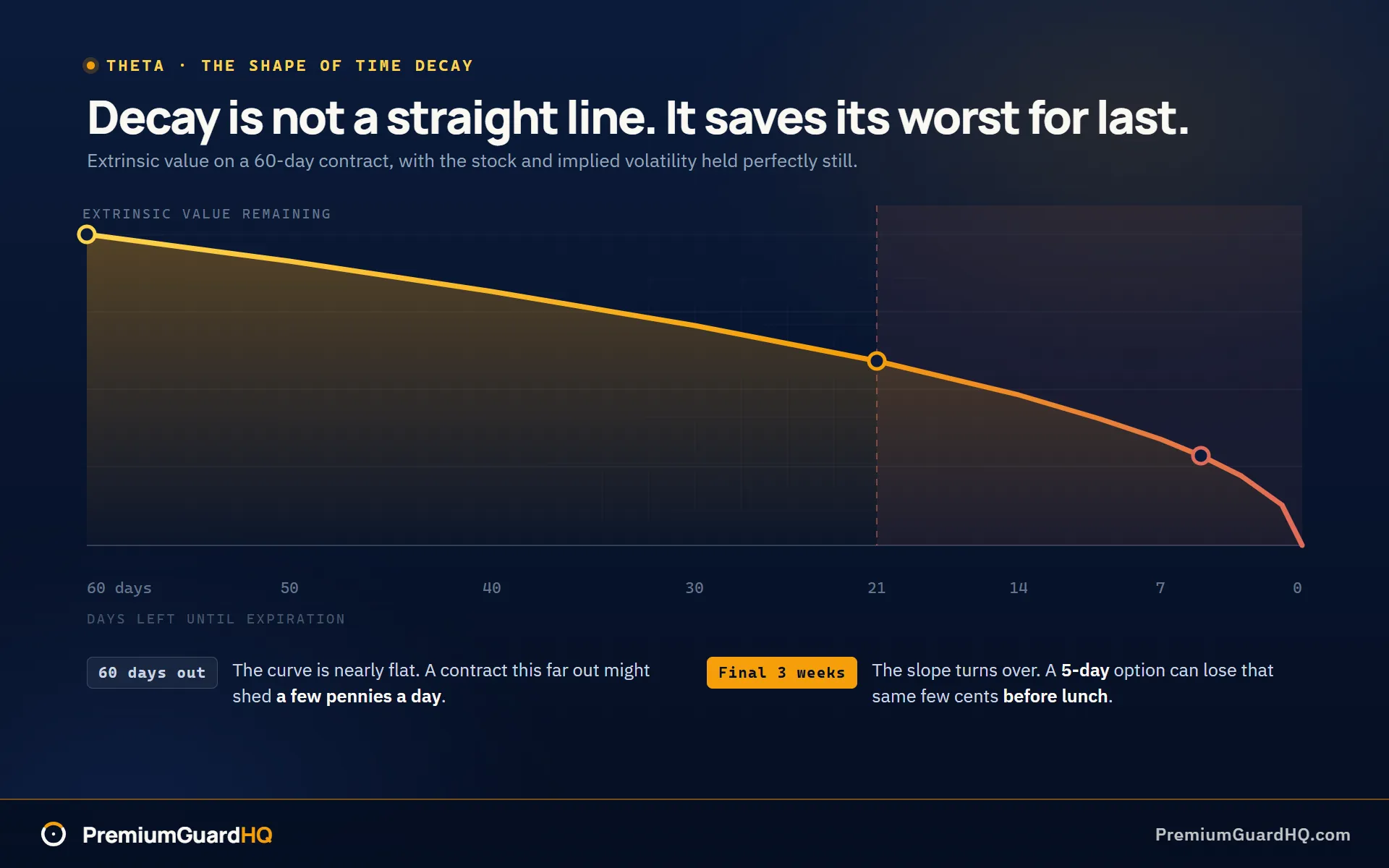
Time is the second biggest force. Every day that passes, an option has less time left to become valuable, so extrinsic value shrinks. That daily shrink is called theta, often called “time decay.” Theta is not a straight line. It moves slowly far from expiration and speeds up hard in the final two or three weeks. A 60-day option might lose a few pennies a day. A 5-day option can lose that much before lunch.
Implied volatility, or IV, is the third force. It’s the one that confuses people most, because it can move the premium with the stock price sitting still. IV is the market’s guess at how much the stock will swing before expiration. Vega measures how much an option’s price changes for each 1-point change in IV. If IV jumps from 30 to 35 heading into an earnings report, every option on that stock gets more expensive, even if the stock hasn’t moved a cent. Earnings, news, and Fed announcements are the usual causes.
Bid/ask spread and liquidity round out the big four. This one is not a Greek at all, just supply and demand for that specific contract. A thinly traded option can show a premium jump that’s really just the spread widening or narrowing, with no real repricing happening underneath. Check volume and open interest before you trust a price move as real.
The second-order effects
Two more forces matter, but usually only in specific contracts.
Gamma measures how fast delta itself changes. Delta is not fixed. It shifts as the stock moves, and that shift is fastest for options that are at-the-money and close to expiration. That’s why a near-the-money option in its last week can react differently to the same $1 stock move than it did a month earlier. Same stock, same strike, very different delta behavior.
Rho measures sensitivity to interest rates. Here’s the practical rule: rho is usually tiny for short-dated equity options, the kind most premium sellers trade. It only becomes noticeable in options with many months or years left, since a small rate applied over a long stretch of time adds up. If you’re selling weekly or monthly cash-secured puts, you can mostly ignore rho.
Dividends matter too, in a narrower way. A stock expected to pay a dividend before expiration tends to make its calls a little cheaper and its puts a little richer. That happens because the stock price is expected to drop by roughly the dividend amount on the payment date. This is also why early exercise becomes relevant around dividend dates for American-style options. American-style just means the option can be exercised any time before expiration, not only at expiration.
Why did my premium change if the stock didn’t move?
Run through this checklist:
- Implied volatility moved. Earnings week, a headline, or market-wide fear can push IV up or down with zero stock movement. Reading what an elevated IV number is actually telling you is a skill of its own.
- Time passed. Theta chips away at extrinsic value every single day, whether you’re watching or not.
- The spread widened or narrowed. Liquidity dried up or came back, and the quote you’re staring at just reflects that, not a real repricing.
- Skew shifted. The market can re-price how much it fears a drop versus a rally, even with IV on the at-the-money strike looking unchanged. Skew is the difference in implied volatility between different strikes. It shows up as puts getting relatively more expensive than calls, or the reverse, which is a large part of why puts and calls price differently.
Tying it back to the intrinsic and extrinsic split
If you’re in-the-money, a stock price move changes your intrinsic value directly, dollar for dollar past the strike. If you’re out-of-the-money, that same stock move mostly just nudges the odds, which shows up entirely in extrinsic value. Time and implied volatility only ever touch the extrinsic side. They never touch intrinsic value at all.
The operator-grade takeaway
Treat the Greeks as a dashboard, not a set of facts to memorize. They tell you where a price move came from. They are estimates from a model, snapshotted at one instant, not a promise about what happens next. Before you decide a premium move means something, check the chain first. Sometimes the move is just the market repricing the spread, and nothing about your position actually changed.
Option valuation models and calculators: what they compute and what they miss
You’ve seen where an option’s price comes from. Now look at the tool that puts it together: the pricing calculator. A calculator is really just a pricing model wearing a friendly interface. Knowing what’s happening underneath helps you trust the number the right amount, not more.
What a calculator is actually doing
You plug in five things: the stock price, the strike price, the time left until expiration, how much the stock is expected to swing, and interest rates. Some calculators also ask about dividends. Dividends are cash payments a company sends to shareholders. The calculator hands back a theoretical value, its best guess at fair price, plus the Greeks, the sensitivities you already learned about.
Worth separating from that job: what a position is worth today and what it does if you hold it to the end are two different questions, and only the first one needs a model. If you take the premium the chain is actually quoting and ask what the trade pays at every possible closing price, no volatility guess is involved at all, because at expiration there is no time value left to estimate. You can map the profit and loss at expiration for a single contract or a four-leg spread, breakevens marked, and it is exact arithmetic rather than a model’s opinion.
Calculators run two ways. Feed in a volatility guess and you get a price. Feed in today’s market price and you get implied volatility instead, the volatility level the market is pricing in right now. Most traders use the second version more, since it shows what the market expects rather than what you’re guessing. It is also why a tracker can solve implied volatility out of the price you actually paid instead of assuming a number on your behalf.
Black-Scholes in plain language
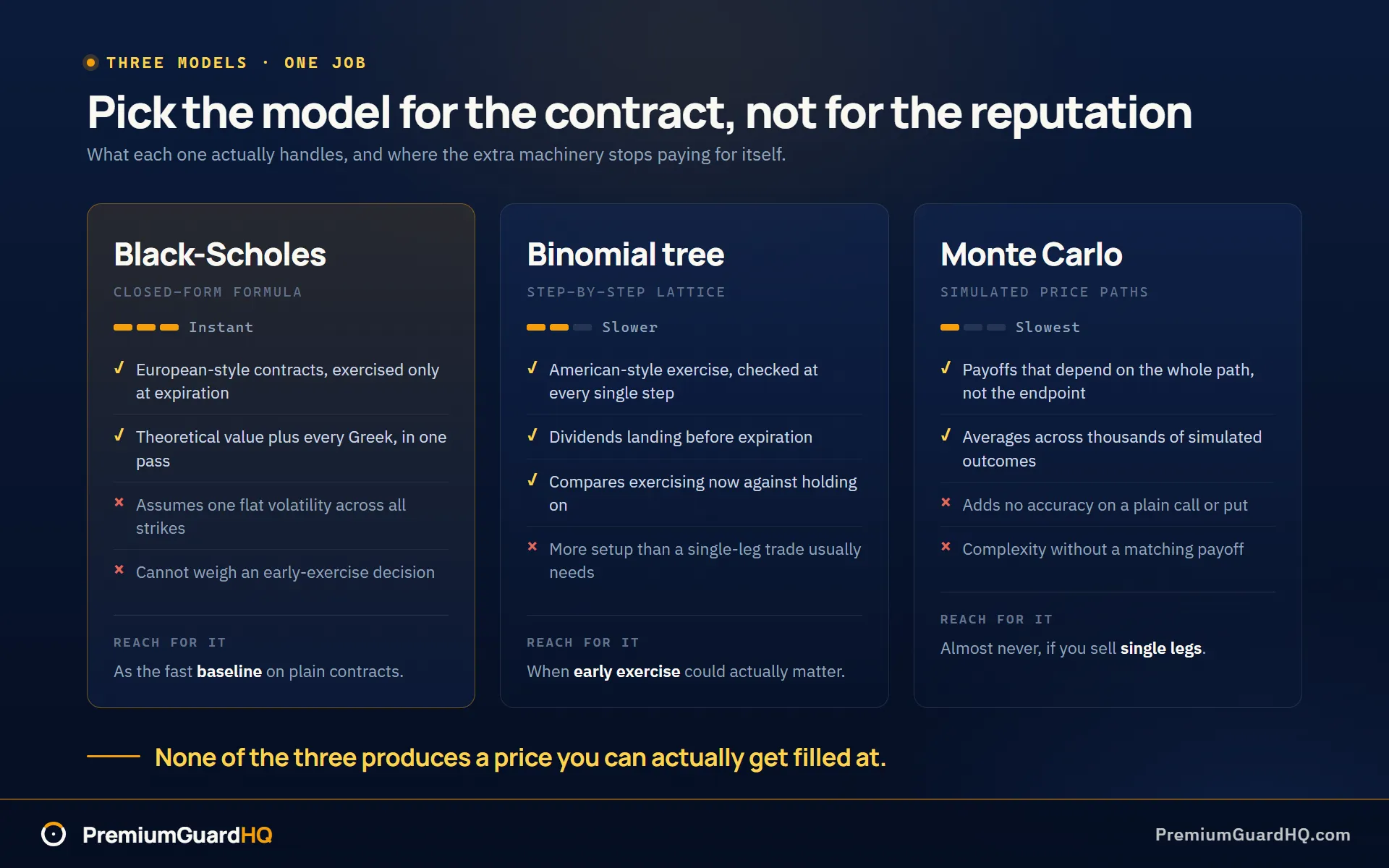
Black-Scholes is the default model almost every calculator starts with. It is a formula, so you plug numbers in and get an answer instantly, with no waiting and no simulation. That speed makes it the standard baseline for options that can only be exercised at expiration, called European-style options.
Here’s the plain version of what it does. It weighs the upside benefit of holding the option against the cost of paying the strike price later, with that cost discounted back to today’s dollars. Each piece gets weighted by a model-based probability of ending up in the money. Two building blocks inside the formula, called d1 and d2, handle that probability weighting. You’ll see them worked with real numbers in the next section, no need to memorize them here.
When Black-Scholes is not enough
Black-Scholes assumes you can only use the option at expiration, never early. Most stock options traded in the US are American-style, meaning you can exercise any time before expiration. Most of the time that difference barely matters, so Black-Scholes still gives a close estimate.
It matters more around dividends. A stock paying a dividend can make early exercise of a call worthwhile right before the payment date, since the stock price is expected to drop by roughly the dividend amount right after. Black-Scholes doesn’t account for that early-exercise decision, so its price can drift from reality on dividend-paying stocks with a payout coming up soon.
Binomial tree model: what changes and why it helps
A binomial tree model breaks the time until expiration into small steps instead of treating it as one smooth stretch. At each step, the stock can move up or down by a set amount. The model then works backward from expiration to today, a process called backward induction, checking at every step whether exercising early beats holding on.
That step-by-step check is exactly what Black-Scholes can’t do. It gives a natural way to compare exercising now against holding, which is why trees are the go-to model for American-style options, especially ones with a dividend coming before expiration.
Monte Carlo: when you are simulating paths, not just endpoints
Monte Carlo simulation takes a different approach. Instead of one formula or one tree, it runs thousands of simulated price paths for the stock and averages the payoff across all of them. This helps for payoffs that depend on the whole path the stock took, not just where it landed, like an option based on the average price over a month instead of the final price.
For a plain single-leg equity call or put, the kind most premium sellers trade, Monte Carlo is overkill. It runs slower and adds complexity without adding accuracy for a payoff this simple.
Theoretical price vs market price: the gap competitors under-teach
Here’s the part most explainers skip. A model’s theoretical value and the market’s actual price are not the same thing, and they don’t have to be.
The market price is wherever supply and demand happen to clear, somewhere inside the bid and the ask. A model can be mathematically correct and still miss that live number for a few reasons:
- Volatility smile and skew. Real markets price different strikes with different implied volatilities, not one flat number the way basic Black-Scholes assumes.
- Jumps and shifting volatility. Stocks gap on news, and volatility itself changes over time. Simple models assume smoother, steadier behavior than markets actually show.
- Execution reality. A wide bid-ask spread or thin open interest can matter more than any model input. Open interest means how many contracts are actively trading. The theoretical value is not a price you can trade at. You trade at whatever the market actually gives you.
How to use calculators like an operator
A short protocol, without telling you what to trade:
- Sanity-check your inputs. Time should be in years, not days. Rate should be a decimal, like 0.05, not 5. Volatility should be annualized.
- Stress test it twice. Bump implied volatility up and down, then separately push the date forward by a week. Watch how much the theoretical value and Greeks shift.
- Compare model value to the midpoint first. Then zoom out to the full bid-ask spread before drawing any conclusion.
- Treat wide spreads as a warning label. If the spread is wide, the model is a reference point, not a tradable fair value. The market, not the formula, decides what you actually get filled at.
Worked example: pricing one options contract
Here is one contract, start to finish, with real numbers.
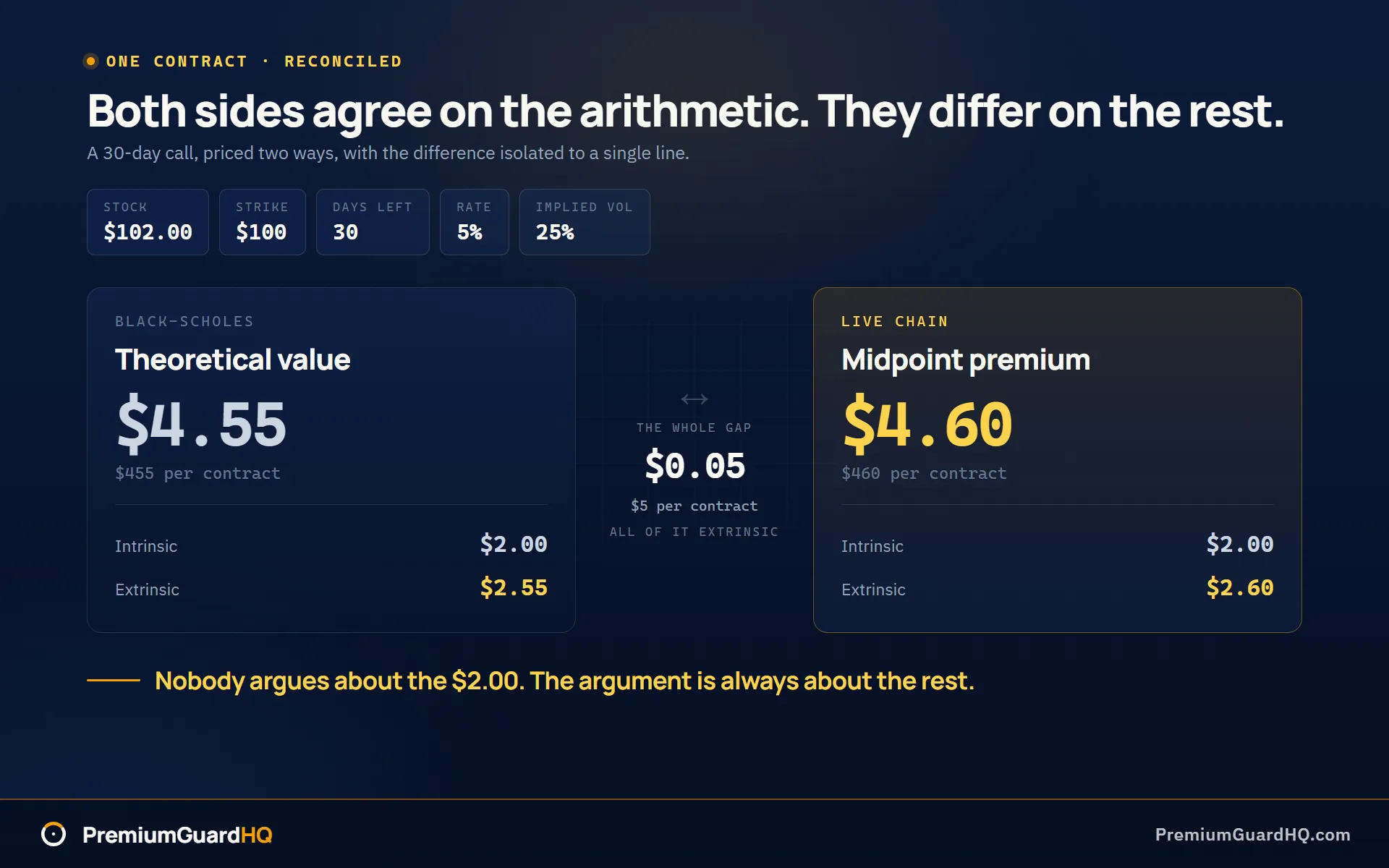
The setup. A stock trades at $102.00. You are looking at a call option, which gives you the right to buy the stock at a set price called the strike. The strike here is $100. There are 30 days left until the option expires. The options chain shows a midpoint premium of $4.60, the price halfway between the highest buy offer and the lowest sell offer. One contract covers 100 shares, so every per-share number gets multiplied by 100 to get real dollars.
Step A: split the price into intrinsic and extrinsic value. Intrinsic value is the part of the price backed by real, immediate profit. For a call, it is the stock price minus the strike, floored at zero. That is $102.00 minus $100, or $2.00. Extrinsic value is whatever premium is left over after you remove intrinsic value. Take the $4.60 premium and subtract the $2.00 intrinsic value, and you get $2.60 of extrinsic value. In contract dollars: $200 intrinsic, $260 extrinsic, $460 total.
Step B: build a theoretical price with a pricing model. Feed the same option into a Black-Scholes calculator, a formula that estimates what an option should be worth. It needs five inputs: stock price $102, strike $100, time left as a fraction of a year (30 divided by 365), an interest rate guess of 5%, no dividend, and an implied volatility guess of 25%. Implied volatility is the market’s guess at how much the stock will swing around. The formula runs these numbers through a statistical function. In Excel, that step uses NORM.S.DIST( , TRUE), and the full formula is C = S*EXP(-q*T)*N(d1) - K*EXP(-r*T)*N(d2). Plugging in these numbers gives a theoretical value of roughly $4.55.
Step C: compare the two numbers. The model says $4.55. The market says $4.60. That is five cents apart, or five dollars per contract, basically nothing. Now split the model’s price the same way. Theoretical extrinsic value is $4.55 minus $2.00, or $2.55, against the market’s $2.60. Still within a nickel.
What this proves. Intrinsic value is pure subtraction. Everyone agrees on the $2.00, no argument possible. Extrinsic value is where the model’s guess and the market’s live price can drift apart, even if only by pennies here. That gap is where time, implied volatility, and plain supply and demand actually live.
Limits and pitfalls of options pricing models
The last example showed a model doing real work. Now here is where it can fool you. A model is a set of guesses turned into math. It is only as good as those guesses, and the market is happy to break them.
The market does not follow the model’s rules. Black-Scholes assumes one flat volatility number for every strike price. Volatility is the market’s estimate of how much a stock will swing. Real markets do not use one flat number. Puts far from the current stock price often trade with higher implied volatility than calls close to the price. Traders call this pattern skew. Basic models also assume the stock moves in smooth, tiny steps. It does not. Earnings reports and overnight news can make a stock jump straight from one price to another, with no smooth path in between.
You cannot trade a model’s number. A model’s “theoretical value” is just a calculated guess. It is not a price a broker will actually fill your order at. In a thin options chain, meaning a strike with few buyers and sellers, the spread can be wide. The spread is the gap between the highest price a buyer will pay and the lowest price a seller will accept. A wide spread can be bigger than any small edge the model claims to find, so the model’s edge disappears once you try to trade it.
Early exercise is real, not a rounding error. Most stock options let the holder exercise, meaning cash in the option for stock, at any time before expiration. This right matters most around dividend dates. Simple pricing models that ignore this right can drift noticeably from the true market price.
Bad inputs give bad answers, silently. Mixing up days and years for time to expiration, or entering volatility as a whole number instead of a decimal, can throw off the output without any warning. This is why two calculators can show two different prices for the same option: they are not using the same inputs.
Greeks are snapshots, not promises. Greeks are numbers that estimate how much an option’s price moves when one factor, like the stock price, changes a little. They only describe small moves from today’s exact conditions. A big price swing, or even just a day passing, changes the Greeks themselves.
Use models to check your thinking and stress-test different scenarios. Never treat their output as a guaranteed price.
Frequently asked questions
How do you calculate the intrinsic value of an option?
For a call option, intrinsic value is the stock price minus the strike price, floored at zero. A call gives you the right to buy stock at a set price called the strike. For a put option, it’s the strike price minus the stock price, also floored at zero. A put gives you the right to sell stock at the strike. Either way, intrinsic value can never go negative. If the math comes out below zero, the answer is just zero.
Why does an option’s price change when the stock barely moves?
Usually one of two things is happening: time decay or a shift in implied volatility. Time decay, called theta, chips away at extrinsic value every single day, even with the stock sitting still. Implied volatility is the market’s guess at how much the stock will swing, and it can jump on news or before earnings with zero stock movement. A wider or narrower bid-ask spread can also make the quote look different with no real repricing underneath. See “What moves an option’s price in real time” above for the full breakdown.
What is an options price calculator, and why does it differ from my broker’s quote?
A calculator outputs a theoretical value, which is just a model’s best guess at fair price based on the inputs you feed it. Your broker’s quote is the real, executable bid and ask, the actual prices you can trade at right now. Those two numbers often sit close together, but they aren’t forced to match, since the market price also reflects spreads, thin trading, and plain supply and demand that no model can capture.
Which model should an option valuation calculator use: Black-Scholes or binomial?
Black-Scholes works fine as a fast baseline for plain, European-style options, meaning ones that can only be exercised at expiration. Reach for a binomial tree model instead when early exercise could matter, which usually means American-style options on a stock paying a dividend before expiration. The tree checks at each step whether exercising early beats holding, something Black-Scholes simply can’t do.
Does rho actually matter for equity options?
Rarely, for the kind of options most premium sellers trade. Rho measures how sensitive an option’s price is to interest rates, and it stays small on short-dated contracts since there isn’t much time for rate effects to compound. It becomes more noticeable on options with many months or years left until expiration. If you’re selling weekly or monthly cash-secured puts, rho is safe to ignore.