
Assignment is simply the next step in the wheel.
Options assignment happens when the person who bought your option decides to use the contract. If you sold a put, you now buy the stock. A put option gives the holder the right to sell stock to you at a set price. If you sold a call, you now sell the stock. A call option gives the holder the right to buy stock from you at a set price.
By the end of this article, you will know what assignment is, when it can happen, and what your account will show the next morning. That includes early assignment, which means the option can be assigned before its expiration date.
One note: PremiumGuard is analytics, not a broker or a signal service. We make the math visible so you can see the numbers behind every assignment.
Want the bigger picture first? The wheel strategy overview shows how puts, assignment, and calls connect into one loop. If assignment risk is climbing on a position, rolling covered calls shows how to push that decision down the road.
What options assignment means
Options assignment occurs when an option seller has to complete the deal because the buyer exercised the contract. If you sold a put, you must buy 100 shares at the strike price. If you sold a call, you must sell 100 shares at that price. It can happen before or at expiration.
The buyer chooses, and the seller follows through. That one line explains the whole arrangement. The strike price is the set price written into the contract. Each contract controls 100 shares, so two contracts move 200 shares when assigned.
A common mix-up: an option that is in the money is not the same as an assigned option. In the money just means the stock price has crossed your strike price. Assignment only happens when the buyer actually exercises, or when the option is automatically exercised at expiration. Before you sell, the option chain gives you a rough read on those odds through what delta says about your chance of assignment.
How options assignment actually processes and what lands in your account
Two events trigger assignment. The first is early exercise, when the buyer decides to use the option before expiration. The second is auto-exercise at expiration, when an option that finishes in the money is exercised automatically because the stock price has passed the strike. The buyer can file paperwork to stop it, but the default is exercise.
Here is the chain of events behind the scenes. The option buyer tells their broker they want to exercise. That broker sends the request to the OCC, short for Options Clearing Corporation. The OCC sits in the middle of every options trade in the country. It handles how assignments are allocated to clearing firms based on who holds matching short positions. Your broker then receives the notice and picks which customer account gets assigned. Some brokers pick randomly. Others use a first-in-first-out method, assigning the oldest open position first.
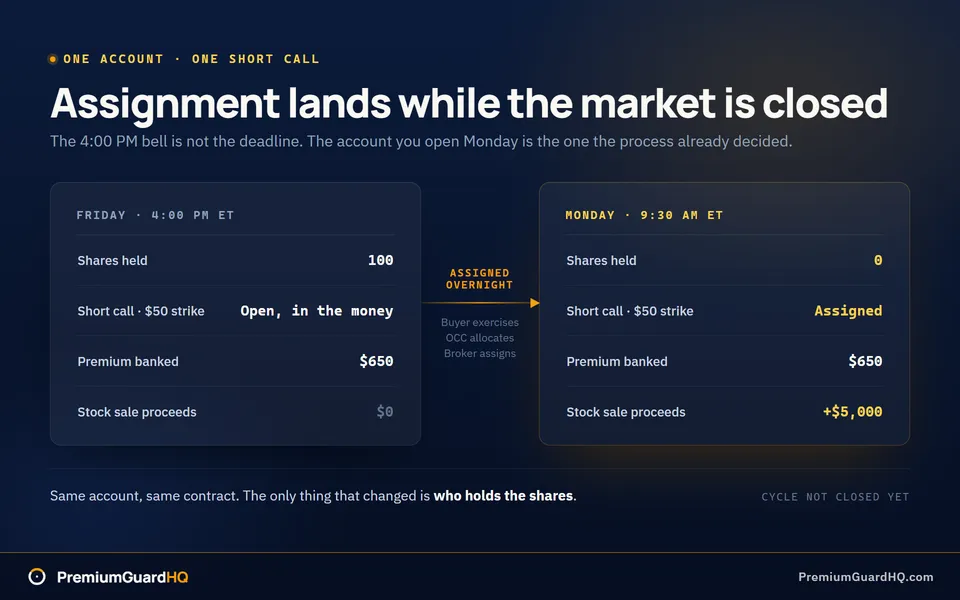
People often miss this: the 4:00 PM ET market close is not the final deadline. Buyers can submit exercise instructions after the close, up until their broker’s own cutoff. News or price moves after 4:00 PM can therefore still trigger an exercise decision. You usually will not see the final result until processing finishes overnight. It appears as an update the next morning.
What shows up in your account? If your short call is assigned, your shares leave and cash equal to the strike price times 100 arrives. If your short put is assigned, shares arrive instead and the same cash amount leaves. Stock settlement follows the normal schedule for stock trades, but buying power and margin numbers can change right away.
One more thing worth knowing: pin risk. It happens when the stock closes almost exactly at your strike price. You may not know whether you were assigned until processing completes. If you hold multiple contracts, some can be assigned while others are not.
When early assignment happens: dividend risk, low extrinsic value, and the overnight surprise
Most short options run to expiration without much trouble. Early assignment occurs when the option buyer exercises before expiration. It is the exception, not the rule, but it can happen on any day you are short an American-style equity option. American-style means the buyer can exercise whenever they want, not only at expiration. Rare does not mean impossible. It means you should know what makes early assignment more likely.
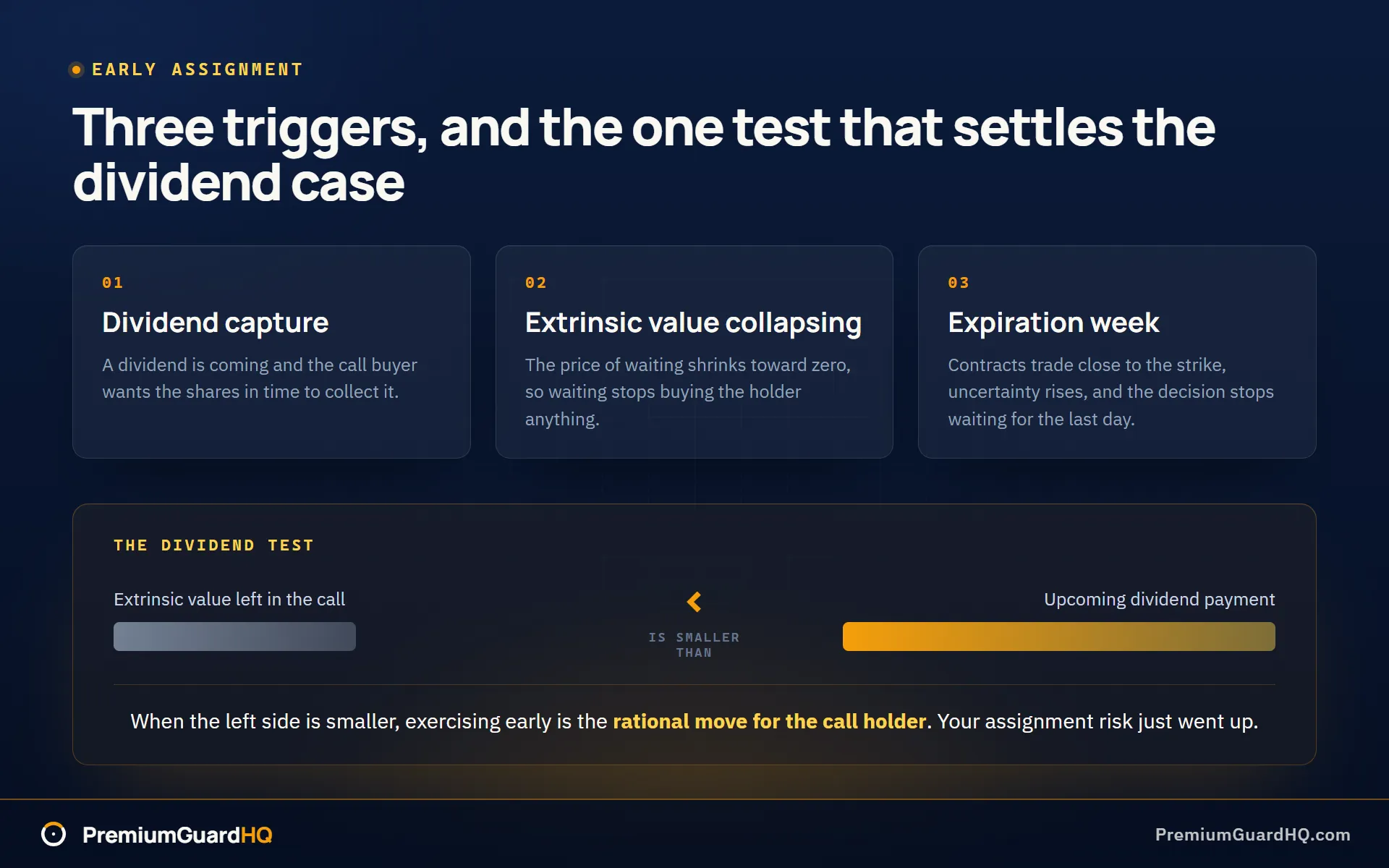
Three real triggers stand behind it.
Dividend capture matters most for short calls. If you sold a call and the stock pays a dividend soon, that is why a call holder exercises early, just to own the shares in time to collect that payment.
Extrinsic value collapsing is the second trigger. An option’s price has two parts. Intrinsic value for a call is the stock price minus the strike price, floored at zero. Extrinsic value is whatever is left after subtracting intrinsic value from the option’s total price. Think of extrinsic value as the price of waiting. Once it shrinks close to zero, the buyer has little reason to keep waiting instead of exercising now.
Expiration week processing is the third trigger. As contracts trade closer to the strike price, uncertainty near that price goes up. So does the chance that someone exercises early instead of leaving the decision to the last day.
A simple rule applies to the dividend case. Compare the extrinsic value with the upcoming dividend payment. When extrinsic value is smaller than the dividend, exercising early becomes the smart move for the call holder. They give up the leftover time value but gain a dividend payment worth more than that amount. When you see that gap during expiration week, your assignment risk has increased.
What does the surprise actually look like in the account? You will see an assignment notice, a changed share count, and a stock trade booked at your strike price. The side effects can feel odd. Buying power can swing for a short time, cash can sit unsettled, and your broker may apply different margin rules until everything settles. Margin is borrowed money from your broker, and brokers watch it closely after assignment. Brokers may also sell positions, restrict trading, or block withdrawals if an assignment would leave the account short on funds. That is a policy decision by the broker, not something the market did to you. The mechanics are identical wherever you trade, even though the screens are not, as the order flow for a covered call on Robinhood shows.
Assignment risk tends to spike right when a short call moves in the money and extrinsic value collapses. In the money means the stock price is above the strike price for a call, so exercising it would make money. That is often the exact moment operators look at rolling the covered call instead of waiting it out.
In the money covered call assignment: what changes when you sold the call ITM or deep ITM
Everything above applies to any covered call. This section covers one case: you sold the call in the money on purpose.
A covered call commits you to sell 100 shares you already own at a set price. In the money means the strike price sits below today’s stock price. If you sold a call with a $45 strike while the stock trades at $50, that call is in the money. Go further and the stock trades well above your strike, say $60 against that same $45 strike, and you have a deep in the money call. Deep in the money means most of the option’s price comes from that price gap. Very little comes from time left or uncertainty.
Assignment on an ITM covered call works the same way as described earlier. Your shares are sold at the strike price. You keep every dollar of premium collected for selling the call. You give up any stock gain above the strike, because the buyer gets that instead.
Why sell a call in the money on purpose? It brings in more premium than an out of the money call, and more of that premium is already locked in at the moment you sell rather than depending on where the stock finishes. The trade behaves more like a bond: smaller swings and more certainty. It also gives you a larger cushion against a price drop, since more of the position’s value is banked through the option price. The tradeoff is a higher chance of your shares being called away. Some traders want that. It moves their money out of the stock and back to cash on purpose.
Here is the math many guides skip, and it is worth running before you sell so you can price the assignment before you sell the call. If you get assigned:
-
Net proceeds if assigned = (strike x 100) + (premium received x 100)
-
Net profit or loss on the shares = (strike minus your stock cost basis) x 100
-
Total profit or loss for the whole cycle = shares profit or loss + option premium
The catch is that even an in the money call can lose money overall. If your stock cost basis sits above the strike, and the premium you collected does not cover that gap, the cycle loses money even though you collected a premium.
Deep in the money, little time value left, plus a dividend coming due: that combination is the setup from the earlier section where early assignment becomes more likely. Having your shares called away is simply the normal turning point in the wheel, where your money rotates back to cash and the cycle starts over.
Worked example: selling an in-the-money covered call and getting assigned
Here is how the numbers play out.
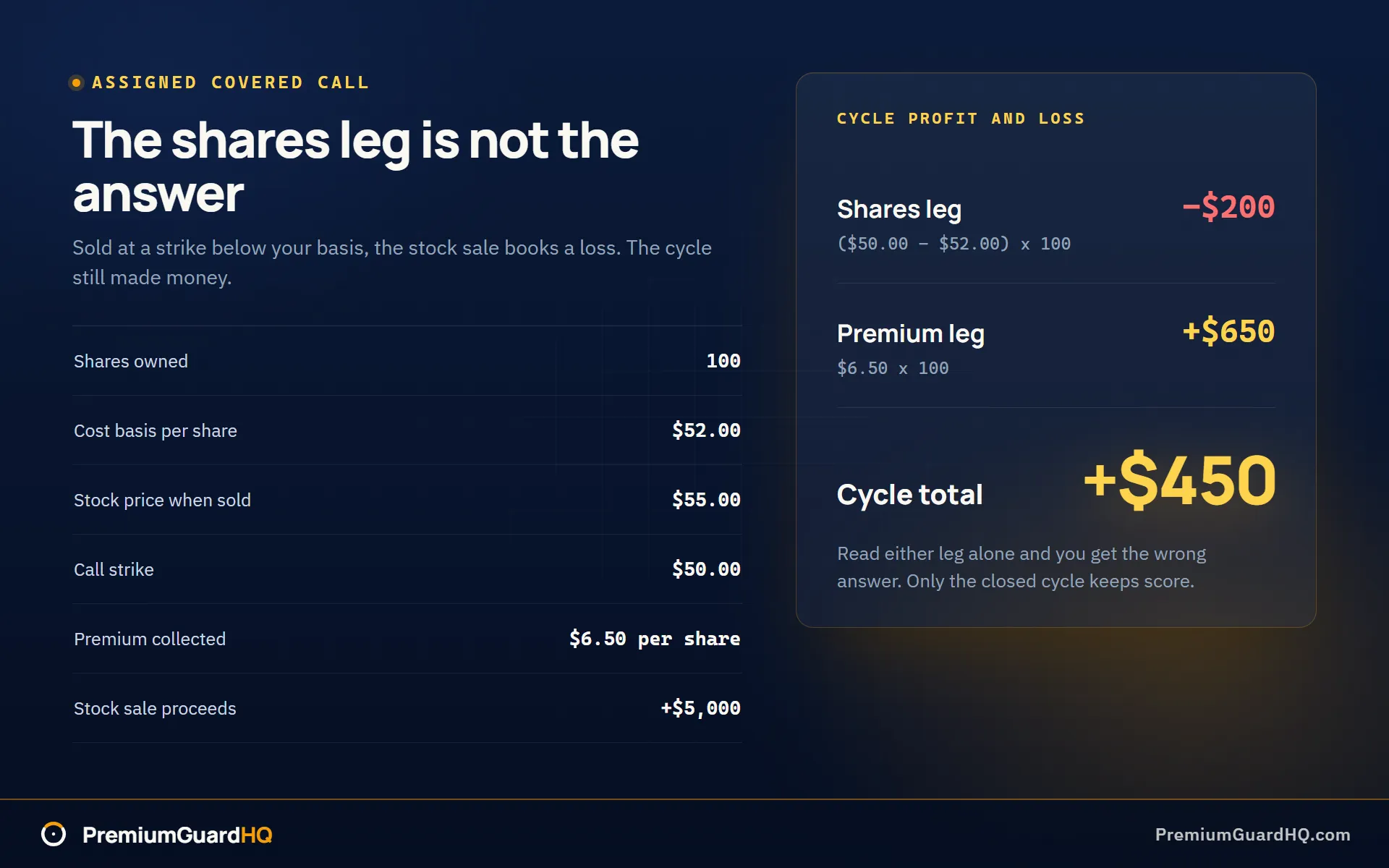
Suppose you own 100 shares with a cost basis of $52.00. That is what you paid per share. The stock now trades at $55.00. You sell 1 covered call with a $50 strike price. A covered call means you have agreed to sell your shares at that set price if the buyer wants them. The strike price is the set price.
Because $50 is below the current stock price of $55, this call is in the money. In the money means the stock price is already past the strike, so the option is likely to be used. You collect $6.50 in premium. Premium is the upfront cash the option buyer pays you for making that promise. On 100 shares, the premium equals $650.
The stock stays above $50, so at expiration your shares get called away. Someone uses their right to buy your shares at $50. Your 100 shares leave the account, and cash equal to $50 times 100 arrives in their place.
Here is what shows up in your account:
-
Shares: 100 shares delivered and removed from your account
-
Stock sale proceeds: +$5,000 cash, equal to $50 times 100
-
Option premium: +$650 cash, already in your account from the call sale
Now figure out what you actually made. Do this math yourself instead of trusting whatever number your broker shows you.
-
Shares leg profit or loss: ($50.00 minus $52.00) x 100 = -$200. You sold the shares for less than you paid for them.
-
Premium profit or loss: +$650. This part is pure gain.
-
Total profit for the cycle: -$200 plus $650 = +$450.
The shares leg alone looks like a loss. Assignment can feel like the trade went wrong. Add the premium to the shares, though, and the full cycle made $450. The stock sale by itself never tells the whole story.
Frequently asked questions
Can I still get assigned even if my option looked out of the money at market close?
Yes. The 4:00 PM ET close is not always the final word. After-hours price moves and broker submission deadlines mean the option holder can still submit exercise instructions after the market closes. The safest rule to remember: if you are short an option and the stock price is anywhere near your strike price heading into expiration, treat assignment as possible, not unlikely.
Can I stop my option from being exercised or assigned?
Not as the seller. Once you sell an option, the buyer has the right to exercise it. The buyer can sometimes file a do-not-exercise instruction with their broker to skip automatic exercise at expiration, but that choice belongs to them, not you. Broker deadlines for that instruction vary and often fall earlier than expected, so do not count on it as protection.
How long does it take for cash and shares to show up after assignment?
Assignment books a stock trade at your strike price for 100 shares per contract. That stock trade settles on the normal stock settlement schedule. Your account’s buying power and margin numbers, which measure how much you can trade with, can update the same day depending on your broker’s rules. If the assignment leaves your account short on funds, the broker may apply restrictions or sell positions under your account agreement.
Does covered call assignment change my taxes or dividend eligibility?
It can. Assignment is a sale of your shares, so it can change how long you held the stock, and that affects tax treatment. Dividend eligibility depends on the holding-period rules that decide whether a dividend is qualified, measured around the ex-dividend date, the cutoff date for qualifying for a dividend. Getting called away can knock you out of that window. Tax rules are specific to your exact dates and situation, so check your trade confirmations and talk to a tax professional.