

CSP appears constantly in wheel trading discussions. The pitch sounds straightforward: you get paid for agreeing to buy a stock. Most explanations skip what happens to your cash, and that gap creates the most confusion for new traders. The focus below is numbers. This article contains no picks or predictions.
What is a cash-secured put?
A cash-secured put is an options trade where you sell a put contract and collect a fee up front. You also keep enough cash in reserve to buy 100 shares at a set price if assignment happens. That reserve requirement is where the name comes from.
The fee you collect is the premium. The set price is the strike price. You trade the premium today for a possible stock purchase later. The premium belongs to you no matter what the stock does next.
Only two endings exist. The put expires worthless, you keep the full premium and your cash is released. Or you get assigned, and the reserved cash turns into 100 shares at the strike price. Assignment means the buyer on the other side exercised their right to sell you the shares.
How a cash-secured put works in your account
Step 1: You pick a strike and an expiration. The strike is the price you agree to pay if you buy the stock. The expiration is the deadline. After that date, the contract ends one way or the other.
Step 2: You sell the put. This makes you short the put. Short means you took on the obligation instead of buying the right. The moment the order fills, the premium lands in your account as cash. It belongs to you immediately.
Step 3: Your broker locks up collateral. Collateral is cash your broker sets aside so you can pay for the shares if assignment happens. Assigned means the buyer on the other side used their right to sell you the stock. For one contract, the amount equals the strike price times 100. A $40 strike locks up $4,000. That cash stays frozen while the put is open.
Step 4: One of two things happens at expiration.
- Stock above the strike: the put usually expires worthless. Your obligation ends, the locked cash is released, and you keep the premium. Nothing else occurs.
- Stock below the strike: assignment is likely. You buy 100 shares at the strike price. The reserved cash does not leave your account. It changes form from cash into shares.
One more thing worth knowing. Assignment can happen before expiration, not only on the deadline. Assignment is allocated by the clearing system, and it is more common near expiration when the option is in the money, meaning the stock price sits below your strike. The safest way to think about it: assignment can happen at any time, so you are never caught off guard.
Execution is its own topic: how to actually enter the order and build a repeatable weekly routine. If you want that checklist, it lives in a separate guide to selling cash-secured puts for income.
What you are actually committing to: collateral and payoff math
New sellers often misunderstand what cash-secured means. The term tells you where the purchase money comes from. It says nothing about whether the trade is safe. You are using your own cash instead of borrowed funds, and the underlying risk stays the same.
When you sell a cash-secured put, you promise to buy 100 shares at a chosen strike price if the stock falls to that level by the expiration date. In return, you receive a premium up front.
Before you sell one, check three numbers. Every time.
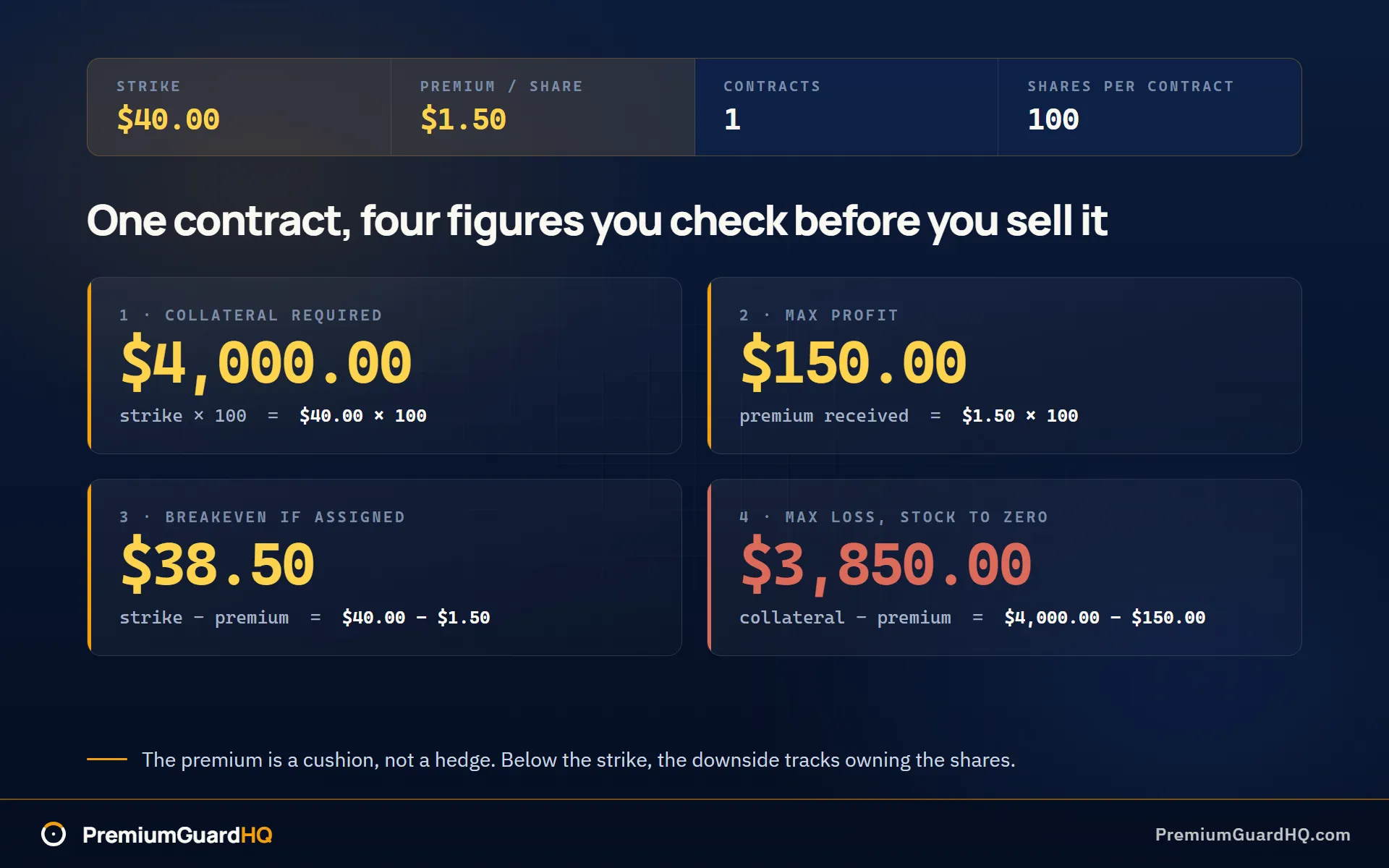
1. Collateral required. This is the cash your broker locks up per contract.
Collateral = strike price × 100
If you sell a put at a $40 strike, your broker locks up $4,000. That money is tied up while the contract is open. You cannot use it for anything else until the trade closes.
2. Maximum profit. This comes straight from the premium you collected when you sold the put.
Max profit = premium received
If the put expires worthless, meaning the stock stayed above your strike, that premium is the whole win. You do not get more than that from the option itself, no matter how far the stock climbs.
3. Breakeven if assigned. Assignment means the stock fell below your strike and you were forced to buy it. This number tells you your real cost per share if that happens.
Breakeven = strike − premium (per share)
Say you sold that $40 strike put and collected $1.50 per share, or $150 per contract. Your effective buy price becomes $38.50. The premium did not disappear. It knocked $1.50 off what you actually paid for the stock.
Now the part nobody likes to talk about: how much you can lose.
Worst case: the stock drops to $0 after you get assigned. That is the floor.
Max loss = (strike × 100) − premium received
On that same $40 strike put with $150 collected, your max loss is $4,000 minus $150, or $3,850 per contract. This is why a cash-secured put behaves a lot like owning the stock outright. The premium gives you a small cushion, but below your strike, the downside is nearly the same as holding shares.
One more number worth knowing, mostly for comparing trades. It is called annualized return on capital, or annualized ROC for short.
Annualized ROC = (premium ÷ collateral) × (365 ÷ days held)
This lets you compare two different puts on the same stock, with different expiration dates, on equal footing. A put that pays less premium but expires sooner can have a higher annualized ROC than one that pays more but drags on for months. That is useful to know. But treat it as a normalizing tool, not a promise. It does not guarantee you will earn that rate over and over. You can put the collateral, the breakeven and the annualized ROC on one screen instead of running four separate arithmetic steps by hand.
Here is how a cash-secured put compares to something simpler:
| Limit order | Cash-secured put | |
|---|---|---|
| Expresses willingness to buy at a price | Yes | Yes |
| Pays you upfront | No | Yes, the premium |
| Can still get filled in a fast drop | Yes | Yes, through assignment |
Both are ways of saying “I’ll buy at this price.” The put just gets paid for saying it.
This is why PremiumGuardHQ tracks premium and equity separately, cycle by cycle. The premium is visible on day one, the moment it lands in your account. The real outcome only gets earned once the cycle closes.
Worked example: pricing one 1-contract cash-secured put end to end
The numbers below are fictional and for teaching only. They are not a recommendation.
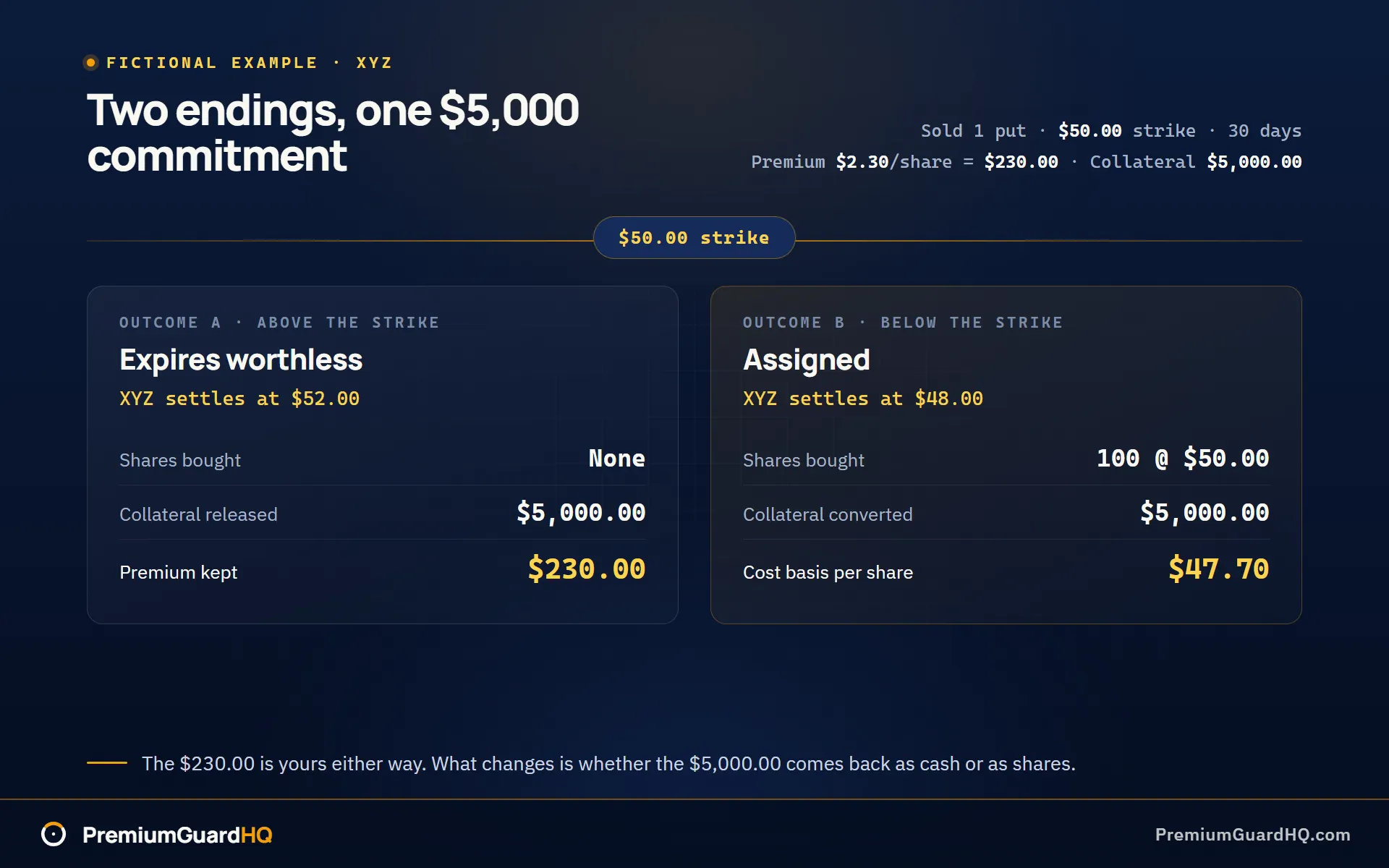
Assume stock XYZ trades at $55.00. You sell 1 put contract with a $50 strike. The strike is the price you agree to buy at if assigned. The contract expires in 30 days. You collect $2.30 per share in premium, the cash payment for selling the put.
Here is the math, one line at a time:
- Premium received: $2.30 × 100 shares = $230. This cash lands in your account right away.
- Cash collateral required: $50 × 100 = $5,000. Your broker locks up this much cash until the trade closes.
- Breakeven if assigned: $50.00 − $2.30 = $47.70. This is your real cost per share if you end up buying the stock.
- Max profit: $230. That is the ceiling, no matter how high XYZ climbs.
- Max loss: $5,000 − $230 = $4,770. That is the worst case, if XYZ falls all the way to $0 after you are assigned.
Now watch how it plays out.
Outcome A: the put expires worthless. XYZ sits at $52 at expiration, the day the contract ends. That is above your $50 strike, so nobody exercises the put and forces a sale. Your $5,000 collateral gets freed up. You keep the full $230.
Outcome B: you get assigned. XYZ sits at $48 at expiration. That is below your strike, so the put gets exercised. You buy 100 shares at $50 each, and your $5,000 in cash converts into stock. Your real cost basis is $47.70 per share, once you count the premium you already collected. From here, you own shares, and deciding what to do next is a different playbook, covered in the wheel and put-selling income guides.
Notice the trade is a $5,000 commitment that may or may not turn into shares. The $230 premium is the cash you collected up front.
Frequently asked questions
How much cash do you need to sell one cash-secured put?
For a standard equity option, you need the strike price times 100 per contract. A $50 strike means $5,000 in reserved cash, exactly like the worked example above. Your broker might not call it “cash requirement” on the order screen. Some label it “collateral” instead. Either way, it is the same locked-up cash.
Is a cash-secured put basically a limit order?
They are similar in one way and different in two others. Both say “I’ll buy at this price.” That is where the similarity ends.
- A limit order does not pay you anything. A cash-secured put pays you the premium upfront, but it comes with real option mechanics attached, including what actually happens on the day you are assigned.
- A limit order can fill any time the stock touches your price during the day. A cash-secured put can expire completely worthless even if the stock never drops anywhere near your strike.
Can you sell cash-secured puts in an IRA or Roth IRA?
Often, yes. Many brokers allow cash-secured puts inside IRAs and Roth IRAs once your account has the options approval level the strategy requires. An IRA is a retirement account with tax rules attached. A Roth IRA is a version where withdrawals in retirement are tax-free.
- The cash rule does not change. Your account still needs enough cash sitting there to cover assignment if it happens.
- Every broker sets its own permissions for options inside retirement accounts. Check your broker’s IRA options rules and disclosures before you place the trade.
Can a cash-secured put trigger a wash sale?
It can, and this is the part traders miss most often. A wash sale is a tax rule that disallows a loss if you buy back a “substantially identical” position too soon after selling it at a loss.
- The wash sale rules can reach options, not just stock.
- If you sold a stock at a loss and then get assigned the same stock through a put within the wash sale window, that loss might get disallowed.
- Timing across different accounts matters too. Replacing a position inside an IRA can carry an especially harsh version of this penalty. If this situation applies to you, talk to a qualified tax professional before you file.
If you run multiple CSP cycles, tracking premium versus equity by cycle is where most spreadsheets break. PremiumGuardHQ is built to keep those numbers separated and auditable.