
Here’s the pitch you’ve probably heard: sell puts, collect cash every month, repeat forever. Sounds like free money.
It’s not free. Selling put options for income means getting paid today for a promise you make about tomorrow. You agree to buy 100 shares of a stock at a price you pick. That’s called the strike price. You also set aside cash to cover that purchase. That’s why it’s called a cash secured put strategy.
The mechanics take ten minutes to learn. Managing what happens after takes longer. Here’s the part most traders miss: the cash you collect is not income yet, just cash sitting in your account. Whether it becomes real profit depends on what the stock does next.
First, the clean definition.
What it means to sell puts for income
Selling puts for income means you sell a put option and collect a payment right away, called the premium. In exchange, you take on a job. If the stock falls below the price you picked, you must buy 100 shares at that price. This is called a cash secured put, and it means you already set aside enough cash to buy those shares if you have to.
Think of it like a paid limit order. A limit order is a request to buy a stock only at a certain price. Normally that request is free to place. Here, someone pays you upfront just for making the promise. That payment is yours to keep no matter what happens next, but it is not the same thing as profit. It only becomes real income once the full trade is closed out.
From here, only two things can happen.
- The stock stays above your price. The option expires worthless. You keep the full premium and can sell another put.
- The stock drops below your price. You get assigned, which means you must buy the 100 shares at the price you picked. Then you decide what to do next. Many traders choose to sell covered calls against those shares, which is a way to collect more payments while they wait to sell the stock.
Either way, selling the put is really just a paid promise, not free money. The obligation behind it is real, so only sell puts on a stock you would not mind owning.
How a cash-secured put actually works
Here is the full lifecycle with real numbers.
Step 1: Pick the contract. Every put has four parts: the stock, the strike price, the expiration date, and the contract size. One options contract almost always covers 100 shares. DTE means “days to expiration.” It just counts how many days are left before the option ends. Most income sellers pick a strike below the current stock price. That is called out of the money. It means the stock has to fall before you get assigned, or forced to buy the shares.
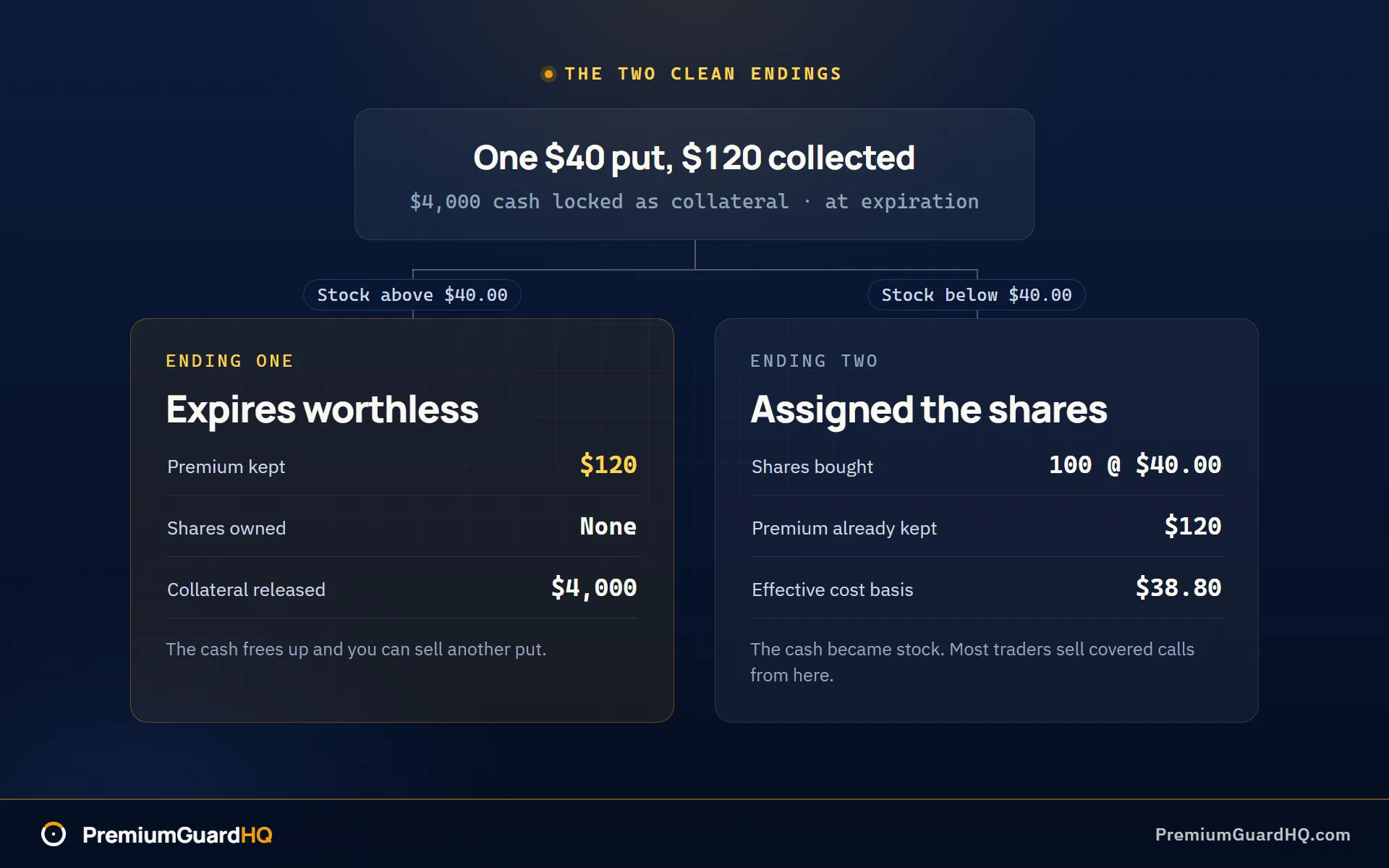
Step 2: The collateral math. This trade is cash-secured. That means your broker locks up cash to cover it. The math is simple: strike price times 100 times number of contracts. Sell one put at a $40 strike, and your broker sets aside $4,000. That money is not lost. It just cannot be used for anything else while the trade is open.
Step 3: Premium and your real cost. Premium is the cash you collect upfront for selling the put. Say you collect $1.20 per share, or $120 total, for that $40 put. If you get assigned, your real cost per share is not $40, but $40 minus $1.20, or $38.80. That is your effective cost basis: the actual price you paid once you count the cash you already collected.
Step 4: The two clean endings. At expiration, two things can happen. If the stock sits above $40, the put expires worthless and you keep the full $120. If the stock sits below $40, you get assigned. You buy 100 shares at $40 each, but your real cost is still $38.80 a share, thanks to the premium.
Step 5: The path most sellers actually use. Few traders wait until the last day. Many close early once they have captured a good chunk of the premium. A common rule of thumb, not advice, is closing once you have captured 50% to 80% of the max profit. This cuts how long your money sits at risk.
Some traders roll instead of closing. A roll is two trades done together: buy back the put you sold, called buy-to-close, and sell a new put further out, called sell-to-open. If you collect more cash than you pay out, that is rolling for a credit. If you pay more than you collect, that is a debit. Either way, it is simple cashflow math, not a way to avoid a loss.
Step 6: Where this leads. Get assigned, and you now own 100 shares per contract. That is the exact point where many traders shift into selling covered calls on those same shares. A covered call is a promise to sell stock you own at a set price. This starts the next leg of the wheel.
One catch: your broker’s cost basis screen often will not match your real cycle profit once premiums and wash sales get involved. A wash sale is a tax rule that can adjust your cost basis in ways that hide your actual trading result. Reconciling premium collected against actual equity movement is where the real picture lives.
The cash-secured put strategy: a repeatable income process, not a one-off trade
Here is the strategy in one line: sell cash-secured puts, again and again, only on stocks you would genuinely be happy to own at your strike price. A cash-secured put means you set aside enough cash to buy 100 shares if the stock falls below the price you picked. That repeating part matters. One good trade proves nothing. A process you repeat for months is what builds real income.
Before you sell a put, run three checks.
- Can you afford it? Make sure you can cover 100 shares at your strike price without pulling cash from somewhere else.
- Is it liquid? Liquid means you can buy and sell the option easily at a fair price. Check that the gap between the buy price and sell price is small. Also check that open interest is high, which means many other contracts are already open on that stock.
- Any big events coming? Check for earnings reports or other events that could cause a sudden price jump before your option expires.
Once the trade is open, track your results by closed cycles. A closed cycle is a trade that has fully finished, either the put expired or you got assigned the stock and sold it. Do not judge yourself by how much premium you collected this week. A pile of premium means nothing if one bad assignment wipes it out later. Not every tool keeps score that way, which is why comparing wheel trackers usually comes down to how each one decides a cycle is finished.
Up next: how you pick the strike price and expiration date decides both how often you win and how often you get assigned. The strike price is the price you agree to buy the stock at. The expiration date is the day the contract ends.
Picking strikes and expirations: delta, DTE, and the weekly vs monthly trade-off
Every strike and date you pick answers one question. How much are you getting paid for the risk you are taking? That is what you are optimizing: premium per unit of risk, not premium per trade. A fat premium on a strike you would hate to own means nothing.
Delta is a number between 0 and 1. It works as a rough shortcut for risk. A put with a 0.20 delta has roughly a 20% chance of finishing in the money, which means the stock falls below your strike and you get assigned. Assignment means you are forced to buy the stock. Lower delta usually means less premium, but also a smaller chance you get assigned.
DTE means days to expiration, and it matters just as much. Many sellers stick to 30 to 45 DTE. That window gives you time to adjust if the trade moves against you. It also avoids the wild price swings that happen right before expiration, when small stock moves cause big option price swings. This effect is called gamma. Selling weekly puts trades more often, which sounds efficient, but it also means more trades sitting near expiration at once, right where those price swings hit hardest. That demands closer, more frequent checking, not less.
Higher implied volatility, or IV, usually pays a bigger premium. IV is the market’s estimate of how much the stock will move. That premium reflects the market pricing in real, expected risk, not a gift. A juicy premium on a high-IV stock is compensation for danger, not free money.
The simplest rule: pick strikes you would still be fine owning if the stock drops and you get assigned. If a high delta, short DTE combination pays well but you would not want the stock at that strike, skip it. The premium is not worth the risk.
Cash-secured put vs covered call: where the wheel strategy fits
You now know how a cash-secured put works. A covered call is its mirror image, so seeing them side by side makes the choice clear.
With a cash-secured put, you hold cash. You get paid to promise you’ll buy shares at a set price, called the strike price, if the stock falls that low. With a covered call, you hold shares you already own. You get paid to promise you’ll sell those shares at the strike price if the stock rises that high. One trade starts with cash and might end in stock. The other starts with stock and might end in cash.
The wheel strategy is the loop between them. You sell cash-secured puts until you get assigned shares. Assignment means the stock fell below your strike, so you’re required to buy it. Then you sell covered calls on those shares until they get called away, meaning sold at your strike, or you go back to selling puts again.
The risk changes shape depending on which trade you’re in. A cash-secured put has downside that looks a lot like owning the stock outright once it falls below your strike, minus the premium you collected. A covered call caps your upside instead. If the stock rockets past your call strike, you still sell at that strike and miss the extra gain above it.
The wheel is a workflow, not a safer version of either trade: a way to keep your cash and your shares both working, instead of sitting idle while you wait for assignment or for a call to expire.
How much can you make selling puts
Income from selling puts equals three things multiplied together: how much you get paid, how much cash you put up, and how long that cash stays locked up. A put is a contract where you agree to buy a stock at a set price if it falls that low. Change any of the three factors and your income changes too. There is no single number that applies to everyone.
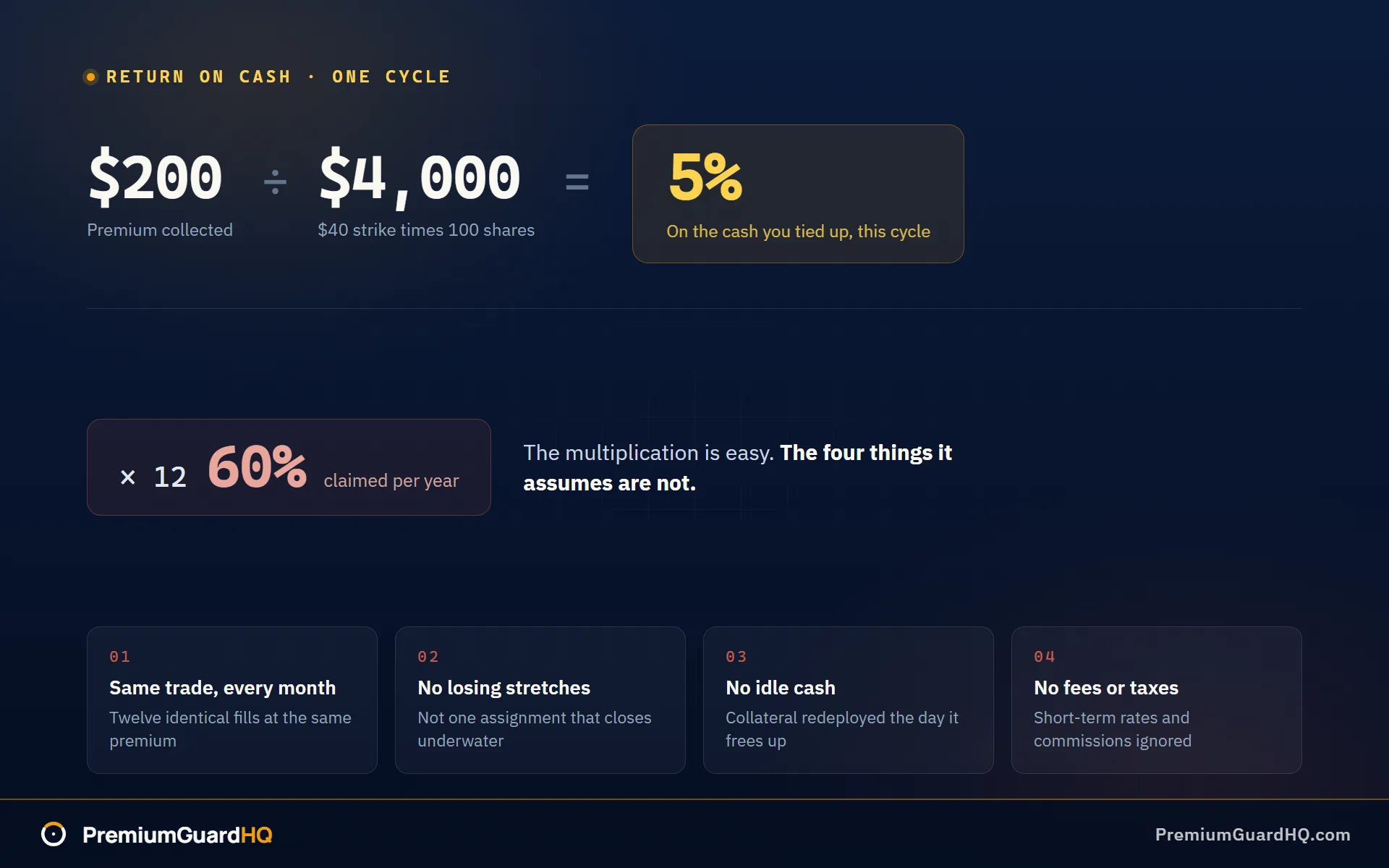
Here is the basic math. Return on cash equals the premium you collect, divided by the strike price times 100. The strike price is the price you agree to buy the stock at. Sell a put with a $2 premium on a $40 strike, and that is $200 divided by $4,000, or 5%.
Some traders multiply that 5% by 12 to claim a “60% yearly return.” Be careful with that trick. It assumes you repeat the exact same trade every month with no losing stretches and no idle cash sitting around doing nothing. Real trading has both.
Four things drive your actual results:
- How jumpy the market is. Premiums grow when fear grows and shrink when things calm down.
- Which strike you pick. This sets your delta, the rough odds that you get assigned the stock.
- How you manage the trade. Closing early, rolling to a new date, or accepting assignment all change your outcome.
- Which stocks you trade. This decides what you end up holding when the market drops.
Track three numbers separately, never as one blended figure: premium profit and loss, stock profit and loss once you own shares, and how much cash you actually withdrew versus left in the account. Mixing these together hides whether you are really growing your money or just moving it around.
Best stocks to sell puts on: a screening framework that avoids premium traps
Selling a put means agreeing to buy 100 shares if the stock falls below your strike price. A strike price is the price you agreed to pay. So your list of “best stocks to sell puts on” is really a list of stocks you’d be okay owning if things go wrong. Pick badly, and no amount of premium, the cash you collect upfront for selling the put, makes up for it.
Run every candidate through five checks.
- Liquid options. Look for a small gap between the buy price and the sell price. This gap is called the bid-ask spread. Also check for steady trading volume and high open interest, which means lots of other contracts are already open. Thin markets make good exits hard and can cost you money just entering and leaving a trade.
- No earnings during your trade. Avoid holding a put through an earnings report unless you’re choosing that risk on purpose. Earnings can gap a stock overnight, past any strike price you picked, before you get a chance to react.
- Understand why the premium is fat. High implied volatility means bigger premiums. Implied volatility is the market’s guess at how much a stock will swing before your option expires. That’s fine, but ask why it’s high. A known, understandable reason, like a pending news event, beats a hidden surprise waiting to hit you.
- A business built to survive. Profitable, steady companies, or broad index funds that hold many stocks at once, hold up better over years of repeated trades than shaky, story-driven stocks.
- A price that fits your account. Each contract covers 100 shares. A stock priced too high can force you to put a huge chunk of your money into one name just to sell one put, leaving you overexposed if that one stock drops. Traders who hit the same wall on the call side sometimes run a poor man’s covered call, which swaps the 100 shares for one long-dated option.
If you wouldn’t want to hold this stock for months after getting assigned, skip it. No premium fixes that.
Worked example: one cash-secured put, three outcomes
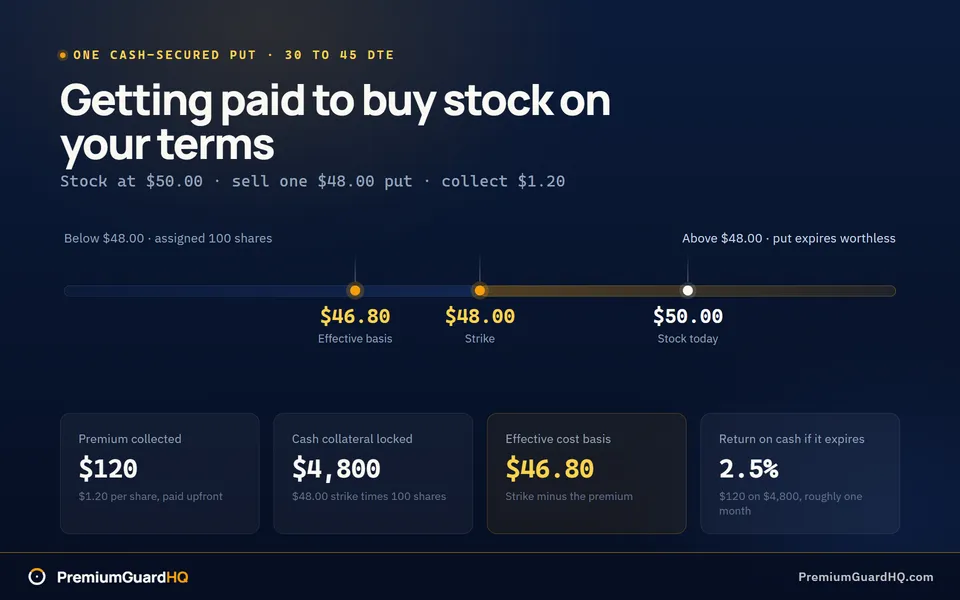
Let’s run one trade three ways. A stock sits at $50. You sell one put, 30 to 45 days to expiration, or DTE. That just means how many days until the contract ends. You pick a $48 strike price, meaning you agree to buy 100 shares at $48 if the stock falls that low.
You collect $1.20 per share in premium, the fee the buyer pays you for taking on that promise. That’s $120 total. Your broker locks up $4,800 in cash to cover the trade. This locked-up cash is called collateral, and it equals the strike price times 100 shares. Your real cost per share, if you end up buying the stock, is $48.00 minus the $1.20 premium: $46.80. Traders call this the effective basis.
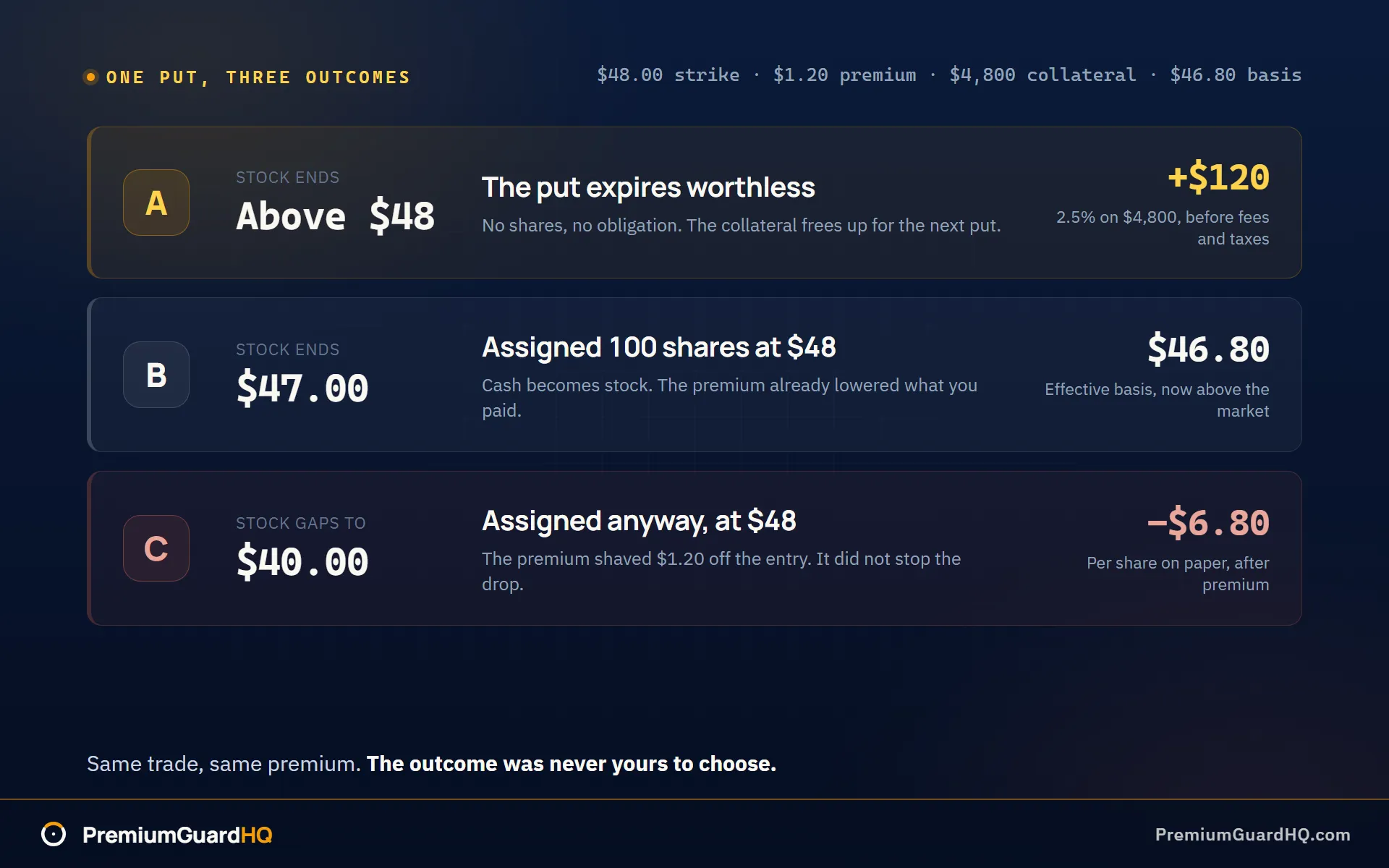
Outcome A: the stock stays above $48. The put expires worthless. You keep the full $120, before fees and taxes. That’s a 2.5% return on the $4,800 you had locked up, for one month or so of waiting. This is the outcome most put sellers hope for.
Outcome B: the stock closes at $47. You get assigned. Assignment means you’re now required to buy the 100 shares at $48 each, since the stock fell below your strike. Your real cost is still $46.80 a share, thanks to the premium you already collected. From here, the common next move is selling a covered call above that $46.80 basis: a promise to sell those same shares later at a set price, which brings in more premium and sets up a possible profitable exit. This is the wheel strategy in motion.
Outcome C: the stock gaps down to $40. This is the outcome that actually hurts. You still have to buy 100 shares at $48. Your real cost is $46.80, but the stock is only worth $40. That’s a $6.80 per share paper loss, even after the premium. The premium never protected you from the drop. It only shaved $1.20 off your entry price.
One more thing worth seeing clearly: rolling. Say the put’s price climbs from $1.20 to $3.50 as the stock falls. To roll, you buy back your original put to close it out. That costs you $3.50. Then you sell a new put with a later expiration date, which might bring in $3.50 or more. The difference between what you pay to close and what you collect to reopen is your net credit or debit. That gap is the entire math behind a roll. It is not a magic fix, just two separate trades.
Risks of selling puts for income: the ones that actually end income programs
Selling puts feels calm most weeks. That calm can hide the real risks, so it helps to name them in order, worst to least.
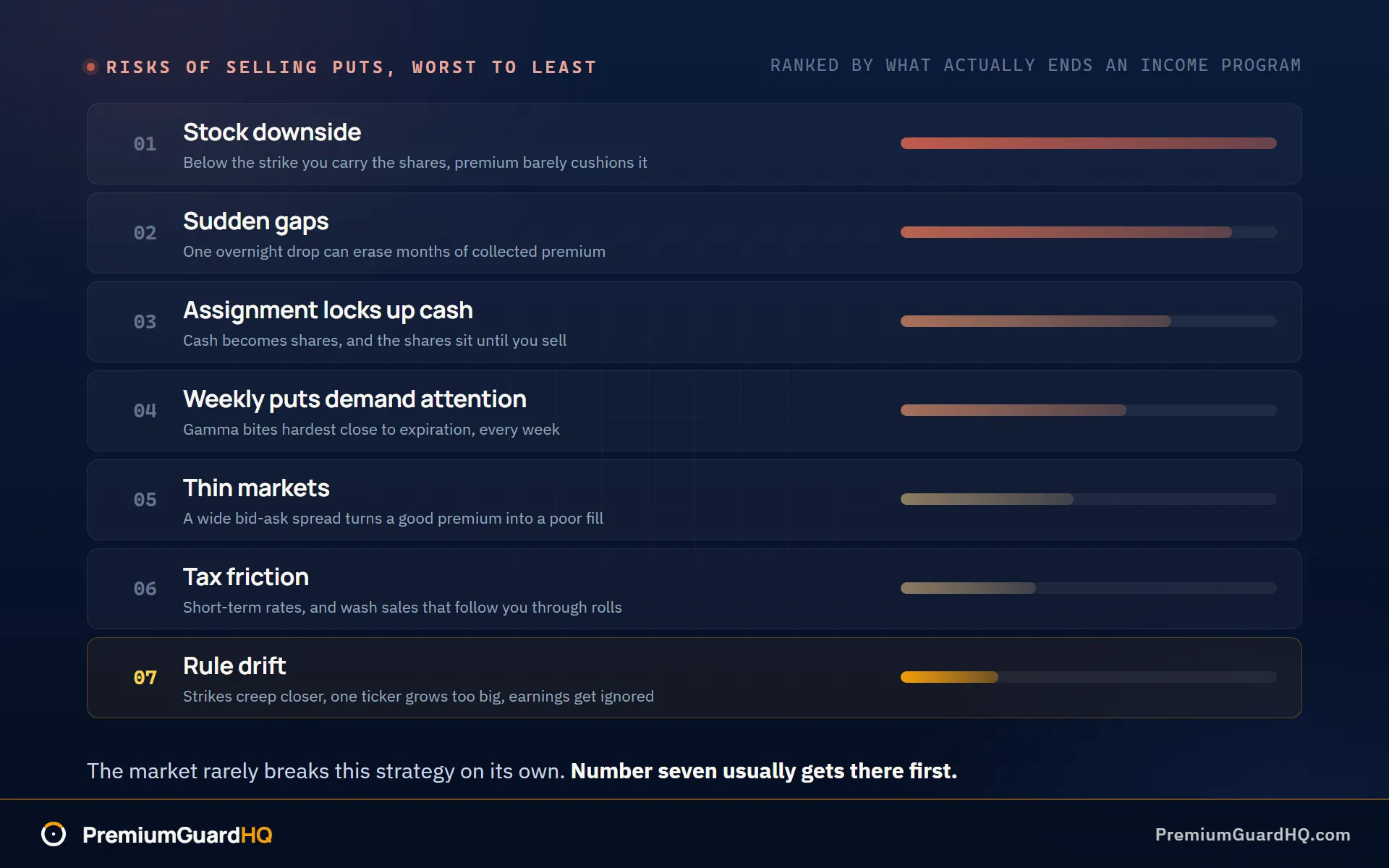
Stock downside is the core risk. A cash-secured put means you set aside cash to buy 100 shares if the stock falls below your strike price. The strike is the price you agreed to buy at. Once the stock drops below that strike, you carry stock downside exposure. The premium you collected upfront, the cash paid to you for selling the put, only cushions the fall a little.
Sudden gaps hurt the most. A gap is a sharp price drop that happens overnight, before you can react. One bad gap can wipe out months of collected premium in a single day. This is the risk that catches operators who mistake a string of small wins for safety.
Assignment locks up your cash. Assignment means the stock gets put to you and you’re forced to buy it at the strike price. Once assigned, your cash turns into shares. Those shares sit in your account until you sell them, so you lose the flexibility to open new puts with that money.
Weekly puts demand more attention. Options close to expiration swing harder on small stock price moves. This swing is called gamma. Selling puts every week means living inside that swing constantly, which raises both your risk and your workload.
Thin markets cost you money. A wide bid-ask spread is the gap between the price buyers offer and the price sellers ask. A wide spread can turn a good-looking premium into a poor real fill once you actually place the trade.
Taxes add friction. Frequent put selling is usually taxed as short-term gains, which are taxed at your regular income rate instead of a lower rate. Rolling a put, closing it early and opening a new one, can trigger wash sale rules. Those rules adjust your cost basis in ways that get confusing fast, so talk to a tax professional if you run this as a real program.
Rule drift is the quiet killer. Strikes creep closer to the stock price. One ticker grows too large a share of the account. Earnings dates get ignored. The market rarely breaks this strategy on its own. Your own drifting rules usually do it first, which is why the risks above matter less than watching yourself.
Is selling puts for income right for you?
Green light. You are fine owning the stock if you get assigned. Assignment means you are forced to buy shares at the strike price you agreed to. You check your positions often, not just once a month. You treat the premium you collect as business revenue that gets recorded and reconciled, not free spending money. You can sit through a drawdown, a stretch where your account value drops, without changing your rules mid-trade.
Yellow light. You want income but hate the idea of owning shares. You keep trading weekly options more than your plan calls for. You have a habit of bending your own rules once things get stressful. If this sounds like you, start slower: pick longer DTE, meaning more days until the option expires, and put less cash into each trade. Treat it as practice mode, not a permanent rule.
Red light. You need guaranteed income to pay real bills. You cannot handle watching your account value drop for a while. You would be forced to sell stock at a bad time if you got assigned. This strategy is not built for you right now.
The goal isn’t squeezing out the biggest premium this week, but staying in the game, cycle after cycle, without blowing yourself up.
Frequently Asked Questions
Is selling cash-secured puts safer than buying the stock? Not really. A cash-secured put means you set aside cash to buy 100 shares if the stock falls below your strike price. Once the stock drops below that strike, your downside looks almost the same as if you owned the shares outright. The premium you collected, the cash paid to you upfront for selling the put, only trims the loss slightly. It is a small cushion, not a hedge. Entry discipline is what actually separates the two: you picked your buy price in advance, and you got paid while you waited for it.
What happens if I get assigned early, before expiration? Early assignment means the option buyer forces the trade before the contract’s end date. This usually happens around dividend dates or when the stock has fallen far below your strike. The net effect on you is small: you simply buy the shares sooner than planned. What matters is being ready operationally. Make sure the cash is already set aside and that owning those shares now won’t push one stock too large a share of your account.
Weekly vs monthly puts: which is better for income? Monthly puts, usually sold with 30 to 45 days to expiration, or DTE, tend to fit income goals better for most traders. Weekly puts let you open more trades, but they also sit closer to expiration more often. That is where gamma, the effect that makes option prices swing harder on small stock moves, hits hardest. More frequent trades mean more monitoring, not less. Many income plans stick with 30 to 45 DTE and stagger entry dates instead, which builds steadier cashflow with less daily attention.
Does rolling a put avoid a loss? No. Rolling means buying back the put you sold, called buy-to-close, and selling a new put with a later date, called sell-to-open. These are two separate trades. Rolling “for a credit” just means the new premium you collect is bigger than what you paid to close the old one. It does not erase or undo the stock’s move against you. It only changes your timing and which strike price you are now exposed to. See the worked example section above for the full math.
How are gains from selling puts taxed, and do wash sales matter when rolling? Frequent put selling is usually taxed as short-term gains, taxed at your regular income rate rather than a lower rate. Rolling closes one trade and opens a separate one, so each roll creates its own tax event. Wash sale rules, which can adjust your cost basis in ways that hide your real result, may or may not apply to a rolled position depending on the exact details. This gets complicated fast for anyone trading often. Talk to a CPA who understands options before you assume how a systematic program will be taxed.
Can you run cash-secured puts in a retirement account? Often yes, but not always. Many retirement accounts allow cash-secured puts and covered calls, but the exact rules depend on your broker and the type of account you hold. Some accounts restrict options entirely or require extra approval steps. Confirm your broker’s specific permissions and any operational limits before you assume you can run this strategy inside a retirement account. Approval levels and assignment handling also vary between brokers.