
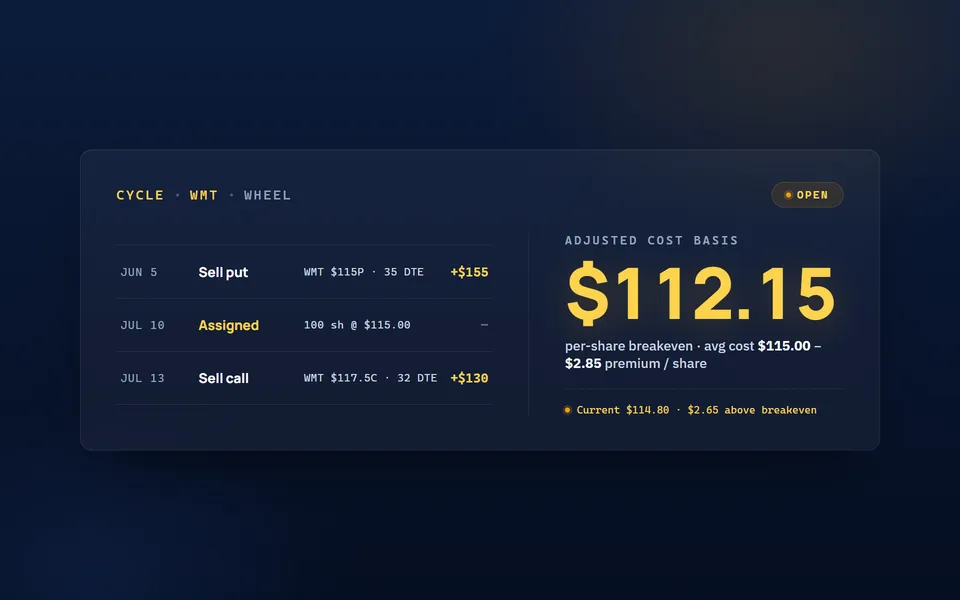
Ask a room of wheel traders how their month went and someone will say “good, except I got assigned on two names.” Listen to the word except. It carries an assumption that assignment is the bad outcome, the thing that happens when a trade goes wrong.
That assumption quietly wrecks more wheel accounts than any single bad position. Because if assignment is failure, you start doing things to avoid it: rolling puts past your comfort zone, closing early for pennies, picking strikes so far out of the money that the premium stops paying for the capital you have parked. You end up running a strategy whose entire design premise is taking assignment, while working hard to make sure it never happens.
The put was an entry order that paid you
A cash-secured put on a stock you want to own, at a strike you priced in advance, is a limit buy order that pays you to rest. When it fills, you did not lose. You bought the stock you chose, at the price you chose, minus the premium you collected for waiting. Selling that put is the opening move of the options wheel strategy.
The trade only becomes a problem in two cases, and both were decided before you sold the put:
- You did not actually want the shares. The premium was attractive and the ticker was popular, so you sold the put on a name you would never hold through a drawdown. Assignment just revealed that mistake.
- The strike was not a price you believed in. If you would not have bought the stock there with cash, the put should not have been sold there either.
Fix those two decisions at entry and assignment stops being an event. It becomes a state change: your collateral converts from cash to shares, and the cycle moves from puts to covered calls.
Where the accounting goes wrong
Assignment is also the moment most trackers lose the thread. The put you sold and the shares you now hold are one continuous position, but your broker’s ledger treats them as two unrelated events: a closed option and a fresh stock purchase at the strike price.
That split hides the number that matters, your effective cost basis. If you sold the $95 put on a $100 stock and collected $2.40, you own shares at $92.60, not $95. Every covered call you sell from here lowers it further. Your exit math, your break-even, and your real return on the cycle all hang on that running figure.
Track it by hand across a dozen tickers and a few months of rolls, and one missed adjustment quietly bends every number downstream. This is exactly the failure that pushed us to build cycle detection into PremiumGuardHQ: the platform stitches the put, the assignment, the shares, and every subsequent call into one cycle and carries the cost basis through automatically.
What to do with the next assignment
When the next one hits, skip the except. Run the checklist instead:
- Confirm the effective basis: strike minus every premium collected so far on the cycle.
- Price the first covered call from that basis, not from the strike and not from where the stock trades today.
- Log the cycle as open. The premium you have collected stays unearned until the wheel closes.
Assignment is the wheel turning. The traders who last are the ones whose numbers turn with it.