
You are picking one of these brokers to run your wheel. The wheel means selling cash-secured puts and covered calls, month after month, on stock you don’t mind owning. Most comparison pages only talk about contract fees. That’s the smallest cost you’ll ever pay.
The real cost shows up on assignment day. Assignment is what happens when someone uses your option against you. A put gets assigned and you suddenly own 100 shares you have to pay for. A call gets assigned and you lose shares you already own. When one of the best brokers for options trading handles that cleanly, your morning is easy. When it doesn’t, your morning is a mess.
This comparison was written by the PremiumGuardHQ team. We use only broker-published pricing pages. We date every number, and we say plainly where a broker wins or where we could not verify a claim. By the end, you will know which broker causes the least pain on your next assignment.
Verdict: Schwab is the least painful broker when you get assigned every month
Schwab is the better default broker for traders who expect assignment most cycles, since its pricing page clearly lists $0 commission on exercised and assigned options. If lowest cost per contract at scale matters more to you, IBKR is the stronger pick.
That $0 line matters because assignment is not rare in the wheel strategy. Assignment means the stock gets bought or sold from you automatically when an option you sold reaches its strike price. For a wheel seller, this happens often, sometimes every single month. A broker that buries or complicates that cost adds friction to something that should be routine. Schwab also keeps its standard options pricing simple at $0.65 per contract.
Schwab is not the cheapest broker on paper, though. If your main goal is the lowest published per-contract cost on stock and ETF options, Robinhood can win there. Its pricing page lists $0 commission, with regulatory and clearing fees passed through on top.
This is an informational comparison, not financial advice. No single broker fits every trader.
Schwab vs Fidelity vs IBKR vs Robinhood vs tastytrade: at-a-glance for wheel sellers
These are the broker-published numbers that matter most when the wheel actually rotates into assignment. Assignment is when your broker forces the stock trade because the option you sold got used against you. That is the moment hidden fees hurt most, so this table starts there before covering everyday trading costs.
| Wheel friction point | Schwab | Fidelity | IBKR | Robinhood | tastytrade |
|---|---|---|---|---|---|
| Options commission model | $0 base + $0.65/contract online | $0 base; $0.65 per contract online | $0.65/contract up to 10,000 contracts a month, $1.00 minimum per order | Free on stocks, ETFs, and options | $1 to open per contract, $0 to close, $10 max per leg opening |
| Exercised and assigned options | $0 online commission | Not verified in supplied inputs | No commission on US exercise and assignment | Not verified in supplied inputs | Not verified in supplied inputs |
| Contract-fee floor or special case | None stated beyond $0.65/contract | Buy to close orders of $0.65 or less cost $0 | $1.00 minimum per order | Pass-through regulatory and clearing fees on top of $0 commission | $10 cap per leg on opening trades |
| Account minimums | No account or trade minimums | No minimum to open an account | No account minimums stated | Not verified in supplied inputs | Not verified in supplied inputs |
All pricing comes from broker-published pages. Dated as of August 2026, because broker pricing changes. Where the published pages did not state a policy, we marked it Not verified rather than guessing.
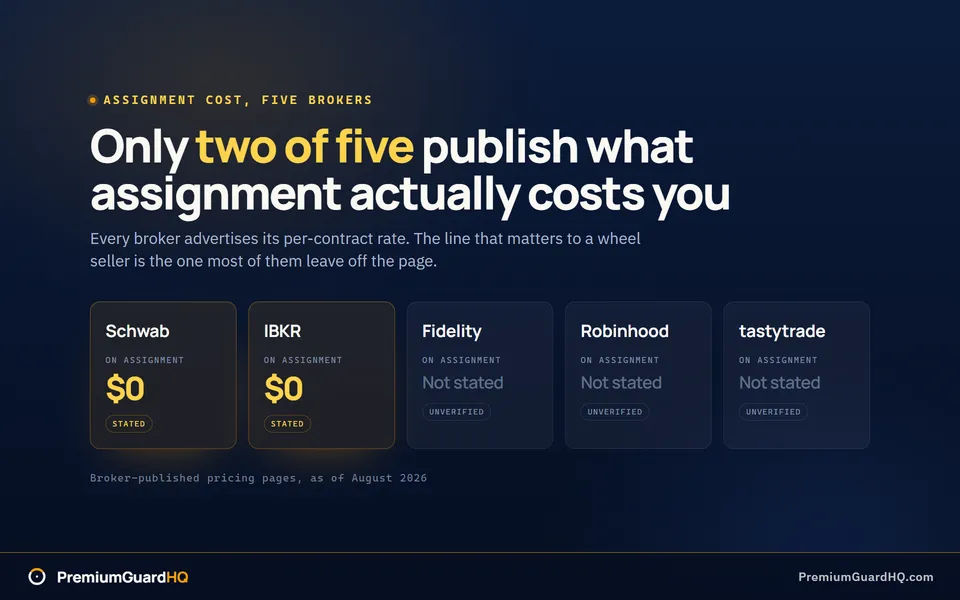
Two brokers, Schwab and IBKR, state plainly that assignment itself costs nothing extra. The other three do not state a policy on their pricing pages, so we left those cells blank rather than assume they match.
Options approval levels and how fast you actually get approved
Your broker has to approve you before you can sell your first put. That permission step is called options approval. A put is a contract that lets someone sell you 100 shares at a set price. To sell one yourself, you first need your broker’s permission.
You fill out a short form, and the broker gives you a level based on your experience and account size. That level decides what you’re allowed to trade. Selling cash-secured puts and covered calls, the two moves that make up the wheel, usually need a low approval level. A cash-secured put means you set aside the cash to buy the shares if you get assigned. A covered call means you sell someone the right to buy stock you already own. How fast approval comes back, and what level you land on, changes from broker to broker. On Robinhood specifically, covered calls sit at Level 2, and the order flow from approval to filled ticket walks through it.
Here is the honest problem: none of the pages we checked actually say. Schwab’s pricing page does not mention approval levels or turnaround time. Neither does IBKR’s options commissions page, Robinhood’s fee article, or tastytrade’s pricing page. These are pricing pages, not account-opening pages, so that gap makes sense. It does not mean the process is slow or hard. It means we cannot verify it from what we have, and we will not guess.
Fidelity is the one exception. Its page includes a line pointing you to apply online for margin or options approval. That is a small thing, but it is real. It tells you there is a clear, direct path to start the approval process without hunting for it, and it is the only one of the five broker pages we checked that says so.
Winner: Fidelity, on transparency. It is the only published page that explicitly shows an online application path for options approval. The other four brokers may well have equally fast, equally simple processes. We just cannot confirm that from what was in front of us. Once the approval is granted, the Fidelity sell-to-open ticket is four fields and a preview screen.
If you are moving real money into a wheel strategy, transparency about where the button is probably is not enough for you. You want to know your exact level and how many days approval takes. This comparison cannot give you that. The only reliable move is to open the account application yourself, on each broker’s own site, and read what it tells you before you commit a dollar.
Assignment and exercise handling: what it costs and how early it reaches you
Assignment is not rare if you sell puts and calls for income. Assignment means the other side of your option trade uses their right, so shares get bought or sold from your account. A put you sold gets assigned and 100 shares land in your account. A call you sold gets assigned and shares get pulled out of your account. This happens most cycles. The simple question is whether your broker charges you when it happens, and whether it warns you it’s coming.
Start with cost, since that’s where we have real answers. Schwab’s pricing page states plainly that exercised and assigned options carry a $0 online commission. There’s no separate fee schedule to dig through. It’s its own line item, so a wheel seller can find the answer in seconds.
Interactive Brokers matches that. Its options commissions page says commissions are not charged for US exercise and assignment. Same outcome as Schwab, just worded differently. Both brokers charge you nothing extra when assignment happens.
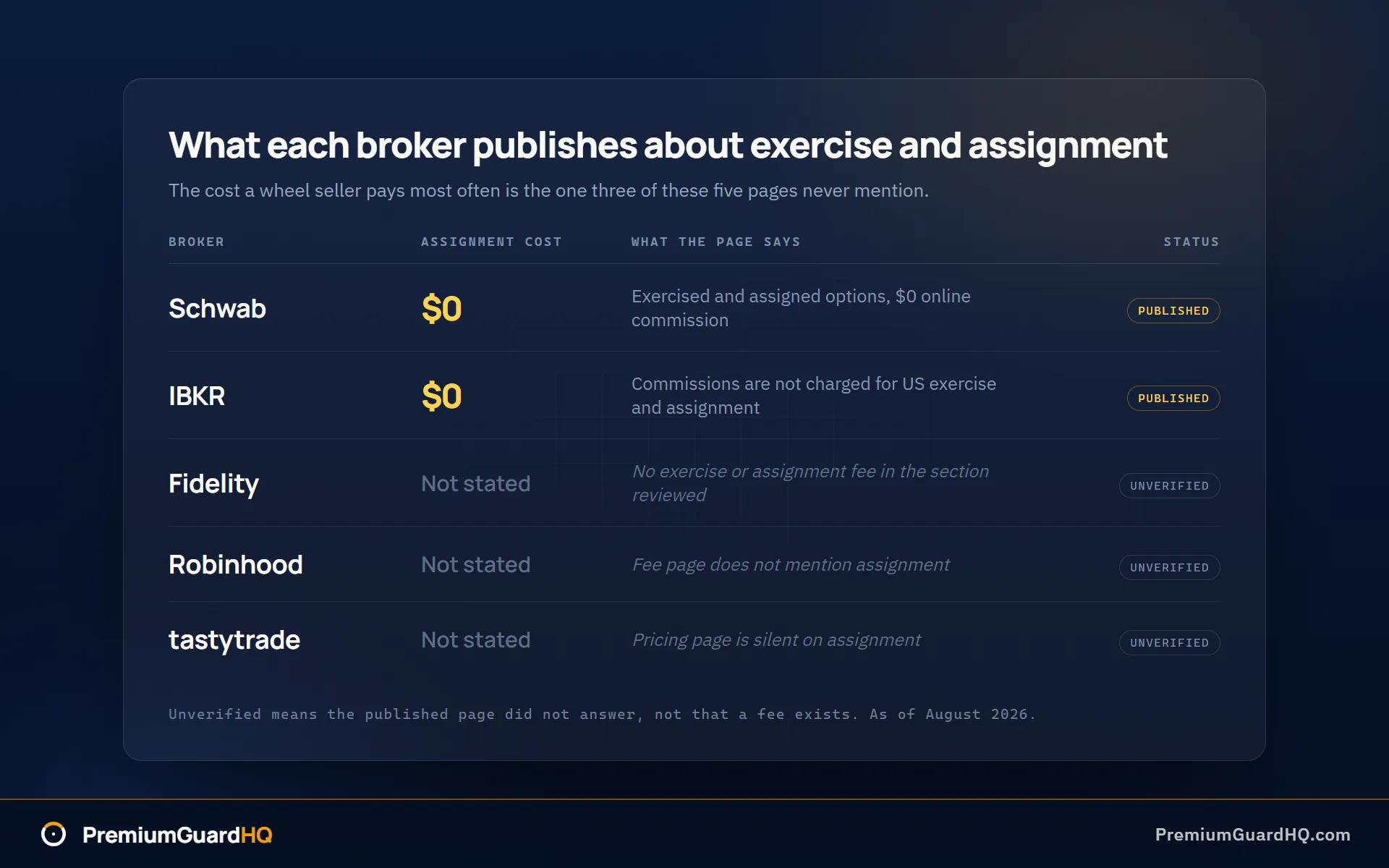
The other three brokers are a different story, not because they charge more, but because we don’t know. Fidelity’s commissions page does not state an exercise or assignment fee in the section we reviewed. Robinhood’s fee page doesn’t mention one either. tastytrade’s pricing page stays silent on it too. That’s not proof of a hidden fee. It means the page we checked didn’t answer the question, so we won’t guess at a number.
There’s a second part to this question that matters just as much: how early do you find out you’ve been assigned? None of the five brokers’ pages told us. Not one stated a cutoff time or a policy for when the alert reaches you. So we’re marking that piece as not verified for all five brokers, rather than guessing which one tells you first.
Winner: Schwab, on published assignment handling. Its pricing page makes the $0 assignment commission impossible to miss for a wheel seller checking costs before they commit. IBKR earns almost the same call, since its own $0 assignment language is just as clear. If you want the most detailed, configurable fee structure and don’t mind digging for it, IBKR’s broader commission model may suit you better, even though both land at $0 here.
Contract fees, exercise fees, and market data costs
This section covers the costs that repeat every cycle. These add up over a year of running the wheel, a strategy where you sell puts and calls again and again on the same stock.
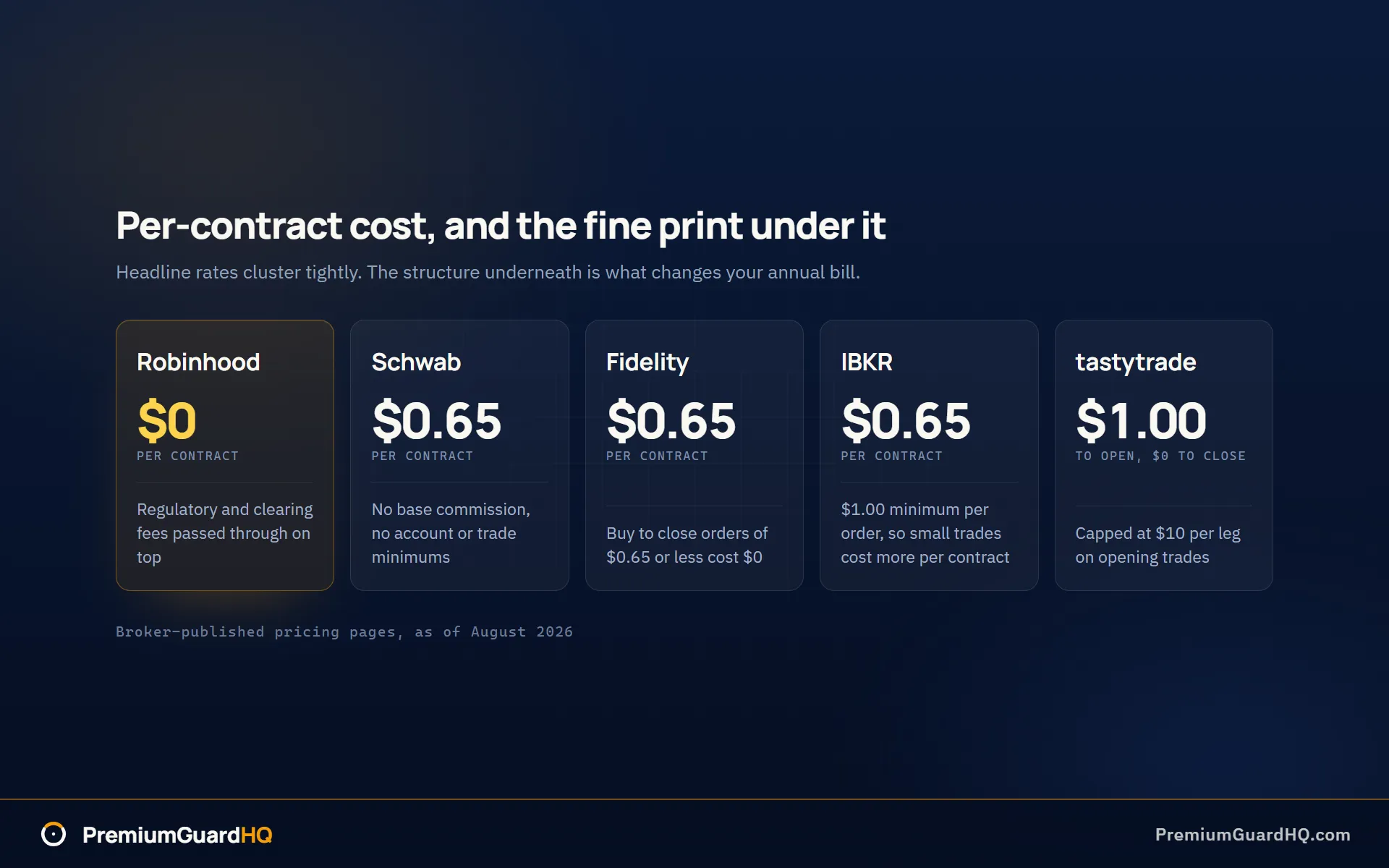
On raw per-contract cost, Robinhood wins. A contract is one options agreement, usually covering 100 shares. Robinhood charges $0 commission on options trades. Its fee page also states that regulatory and clearing fees are passed through on top, which covers costs like clearing charges rather than broker profit. For a small trader running a handful of contracts a month, that is about as cheap as it gets.
The rest cluster close together. Schwab and Fidelity both charge $0.65 per contract with no base commission. Fidelity also waives fees on “buy to close” orders priced at $0.65 or less. A buy to close order ends a position you sold earlier, which helps if you close small, cheap options near expiration. IBKR charges $0.65 per contract up to 10,000 contracts a month, but has a $1.00 minimum per order, so very small trades can cost slightly more per contract than the headline rate suggests. tastytrade charges $1 per contract to open a position, capped at $10 per leg, and $0 to close it. That structure rewards traders who open fewer, bigger positions rather than many small ones.
Per-contract rates are easy to compare in isolation and harder to feel across a year of cycles. If you want to see what a contract actually nets you after fees, price one against your own cost basis rather than against a headline rate.
When the option you sold gets exercised, assignment forces you to buy or sell the stock. Schwab and IBKR both charge $0 commission when this happens. That is a real, stated advantage for a strategy where assignment is routine rather than rare.
Market data is where the fine print lives. Fidelity’s fee page states that real-time quotes, streaming quotes, and streaming Level II quotes (a detailed view of buy and sell orders) cost $0 a year for regular retail use. But it also states that traders classified as “professional” quote users need an active streaming real-time quotes subscription costing about $123.50 a month. That distinction matters. Nobody wants a surprise line item on a statement. Schwab, IBKR, Robinhood, and tastytrade do not state market data pricing in the pages we reviewed, so we cannot compare them here.
Winner: Robinhood, on lowest verified per-contract headline cost. Its published commission-free options trading is the cheapest stated headline combination among the five brokers, before the regulatory and clearing fees that every broker passes through.
That said, Robinhood’s fee page does not state an exercise or assignment commission in what we reviewed. If you get assigned often and want that cost spelled out clearly, Schwab or IBKR may serve you better, even at a slightly higher per-contract rate.
Trade history you can export or connect to outside tools
If you have run 100 or more wheel cycles, you already know the pain. A cycle is one full loop of selling a put, maybe getting assigned stock, then selling calls until the shares leave again. You want your history out of the broker and into something you can actually read.
Here is the honest answer for the five brokers in this comparison. The pricing pages we reviewed for Schwab, Fidelity, IBKR, Robinhood, and tastytrade do not describe export formats. We don’t know what fields show up in a downloaded CSV file. A CSV is just a simple spreadsheet file that most brokers let you save your trade history as. We don’t know if an assignment shows up clearly in that history or gets buried in a generic trade line. We also don’t know if any of the five offer an API. An API lets outside software pull your data automatically, without you downloading anything by hand. So we are not ranking these five brokers on export quality here. Guessing would not be honest. If it is the tracking layer you are shopping for rather than the broker underneath it, we ranked six wheel strategy trackers on that question instead.
What we can verify is how PremiumGuardHQ connects to these same brokers, because that is our own product. PGHQ is a read-only tracker, not a broker. It sits on top of the brokerage accounts you already have. It does not place trades, and read-only means it can look at your history but cannot touch your money or send an order.
PGHQ connects, in production today, to five brokers: Schwab, Interactive Brokers, Robinhood, Fidelity, and tastytrade. Schwab connects through OAuth, a secure login handoff that never shares your password with PGHQ. IBKR connects through a Flex token, a special report key IBKR issues for outside tools. Robinhood and Fidelity connect through SnapTrade, a third-party connector built for exactly this kind of link. Every other broker gets CSV import instead. You can see how each one works before you connect a brokerage account.
This matters more for wheel traders than for most. You need the math redone after each assignment, a cost basis that accounts for the premium you already collected, and income kept separate from swings in what your shares are worth.
Winner: Tie across all five brokers for PGHQ users, because PGHQ supports read-only connections to Schwab, IBKR, Robinhood, Fidelity, and tastytrade in production.
If your main brokerage sits outside these five, this tie does not help you the same way. Webull, E*TRADE, and Vanguard are not supported connections today. For those, and any other broker outside the five, CSV import is the only path in.
Choose your broker based on how you run the wheel
Not every wheel trader has the same needs. Here is how to match your broker to how you run the strategy.
Choose Schwab if you get assigned most cycles and want zero surprises that day. Assignment happens when the person who bought your option uses it, forcing you to buy or sell the stock. Schwab’s pricing page says plainly that exercised and assigned options cost $0 in online commission. That is one less thing to check every time a put or call gets used against you.
Choose IBKR if you are comfortable with a more detailed fee structure and volume-based pricing tiers, and you still want assignment costs spelled out. IBKR’s page states that “commissions are not charged for US exercise and assignment,” matching Schwab on that specific point.
Choose Robinhood if your main concern is the lowest cost on ordinary trades. It offers commission-free options, with regulatory and clearing fees passed through on top. That is hard to beat on paper.
Choose tastytrade if you like paying to open a trade and nothing to close it. It charges $1 per contract to open a position, capped at $10 per leg, and $0 to close. Exchange, clearing, and regulatory fees still apply on top of that, even on the free side.
Whichever broker you pick, remember what it actually does for you. A broker executes your trades and holds your money and shares. It does not track your real income, your true cost basis, or how your wheel positions are drifting from your own plan over time. That is a separate job, one your broker’s pricing page was never built to answer, and it is the reason many sellers track cycles across more than one account somewhere else.
Frequently asked questions
Which broker is best for options trading if I sell the wheel?
If you expect assignment most cycles, Schwab or IBKR make the most sense from the pages we reviewed. Assignment is when the person who bought your option uses it, forcing a stock trade in your account. Schwab lists $0 online commission for exercised and assigned options. IBKR states plainly that it does not charge commissions on US exercise and assignment. This isn’t financial advice, and the right broker still depends on your own workflow and trade size.
Do any of these brokers charge fees for assignment or exercise?
Based on what we reviewed, Schwab and IBKR both state $0 commission on exercise and assignment. Schwab’s pricing page lists it directly, and IBKR’s options commissions page says the same thing in different words. For Fidelity, Robinhood, and tastytrade, the pages we checked did not mention an assignment or exercise fee one way or the other, so we could not verify their policy here.
Are $0 options contracts actually free?
Not entirely. Even brokers that advertise commission-free options trading still pass along small regulatory and exchange fees. Robinhood’s fee page states that regulatory and clearing fees still apply to options trades, covering costs tied to bodies like the OCC, the group that clears every options trade in the US. The exact per-contract amount is not verified here, because published fee schedules change. tastytrade’s pricing page also states that exchange, clearing, and regulatory fees still apply on top of its own commissions, both when you open and close a trade.
Can I connect these brokers to PremiumGuardHQ to track wheel cycles?
Yes, for five of them. PremiumGuardHQ is a read-only tracker, not a broker, so it can’t place trades on your behalf by design. In production today, it connects to Schwab, Interactive Brokers, Robinhood, Fidelity, and tastytrade. If your broker sits outside that list, CSV import is your way in instead. Connecting lets the wheel math get redone the same way across every account you run, instead of piecing it together from separate broker screens.
If you run the wheel across multiple accounts, connect your broker or brokers to PremiumGuardHQ, read-only, to auto-detect cycles, reconcile your real cost basis, and see Premium P/L, Equity P/L, and Net Income kept separate instead of blended into one confusing number.