

Premium feels like profit the moment you collect it, but real operators treat it as unearned until the cycle closes. To master how to sell covered calls for income, you must accept the core tradeoff: you receive cash today in exchange for capped upside tomorrow, while still carrying the downside risk.
This guide provides a repeatable monthly workflow for strike selection, assignment, and rolling. This is the stock-ownership phase of the Wheel. Selling puts is covered separately. Review the prep checklist first.
Before you start: what you need to sell covered calls cleanly
Execution friction leads to unforced errors. Use this checklist to make sure your account and strategy are ready before opening the option chain.
Account and permissions
- Approval: Confirm your broker has approved your account for covered calls (typically Level 1).
- Capability: Verify you can place “Sell to Open” orders for single-leg calls. Spread approval is not required.
Position prerequisites
- Multiplier: Own 100 shares per contract. One contract always represents exactly 100 shares of the underlying stock.
- Availability: Confirm shares are unencumbered. Cancel pending limit sell orders and disable share-lending features that lock positions.
Liquidity and event checks
- Execution: Use tickers with tight bid-ask spreads and high open interest.
- Catalysts: Scan the earnings calendar before selecting your expiration date. Avoid selling into an expiration week containing a major catalyst unless you are specifically trading volatility.
Tooling
Select a tracking method to monitor performance:
- Manual: Broker option chain and spreadsheet calculations.
- Visual: Payoff return visualizer for scenario checks.
- Automated: Analytics platforms like PremiumGuardHQ to reconcile cost basis and track cycle P/L.
Rule hygiene
Document these rules to prevent strategy drift:
- Target DTE (Days to Expiration) range.
- Strike selection rule (e.g., 0.30 delta).
- Triggers for rolling or accepting assignment.
- Maximum capital allocation per ticker.
Step 1: Define your income rules and risk limits
Premium is unearned until the wheel cycle closes. To sell covered calls for income successfully, you must avoid income blindness, where equity losses silently erase the capital base that generates your premium. Create a written rule card for your ticker before looking at an option chain so the strategy stays measurable.
Separate your tracking into three distinct metrics: Premium Collected (raw cash), Equity P/L (unrealized share movement), and Net Outcome (total realized profit). Document three specific rules to avoid the downside trap where a small premium buffer fails to protect against a large equity drawdown:
- Stop all income withdrawals if the stock price drops 10% below your adjusted cost basis.
- Classify premium as earned only if the Net Outcome is positive at cycle close.
- Never chase high implied volatility on deteriorating fundamentals to save a losing trade.
Finally, declare your assignment posture. State whether you are comfortable being called away at the strike or if you will roll the position to keep the shares. In the wheel, this covered call phase follows share ownership acquired through puts.
You should now have a written one-page rule card for this ticker: income definition, risk limits, and an explicit assignment stance (keep shares vs accept call-away).
Step 2: Choose a stock and position size that can survive assignment
Select tickers you are willing to hold for six months or longer. Because covered calls require owning the underlying stock, you must be comfortable holding multiples of 100 shares through a potential drawdown. If business fundamentals deteriorate, the premium becomes irrelevant.
Filter for stock selection
Apply three non-negotiable filters before committing capital:
- Business durability: Choose companies you would buy even if options did not exist.
- Options liquidity: Verify tight bid-ask spreads and high open interest. Avoid tickers where the spread exceeds 5% of the total premium so you do not donate slippage.
- Event timing: Scan the earnings calendar to confirm no reports occur during your chosen expiration week. This prevents unexpected gap risk.
Set position sizing and risk limits
Control risk through strict position sizing. Set a maximum allocation cap for each ticker. Start at 7% and never exceed 15%. If you run multiple covered calls, make sure assignments do not create hidden sector concentration. Owning several hundred shares of one name must not paralyze your remaining portfolio.
If you are called away later, the wheel cycle returns to the cash state before the next acquisition leg. You should now have one ticker selected, a defined share count, and a documented max allocation rule.
Step 3: Select an expiration date and analyze volatility
Select a working window between 30 and 45 days to expiration (DTE). Serious operators cluster in this range because it offers sufficient extrinsic value while maintaining a manageable adjustment cadence. This window lets theta decay accelerate without the extreme price sensitivity found in weekly options.
Analyze implied volatility (IV) before you price the call because delta alone is incomplete. Use IV Percentile to see how often volatility was lower than today over the past year. Use IV Rank to see where today’s IV sits within the 52-week range. If a single historical spike distorts the IV Rank, use IV Percentile as your primary sanity check for richness. Avoid selling calls when premium is structurally cheap.
Check the corporate calendar to ensure the expiration date avoids earnings week. Selling through earnings introduces binary risk that can overwhelm the premium. Set a minimum premium threshold for your process. If the premium is thin for the risk, skip the trade rather than forcing a strike.
You should now have selected a specific expiration date and documented whether implied volatility is relatively high, normal, or low for that ticker using IV Percentile and IV Rank.
Step 4: Select a strike price based on delta and exit targets
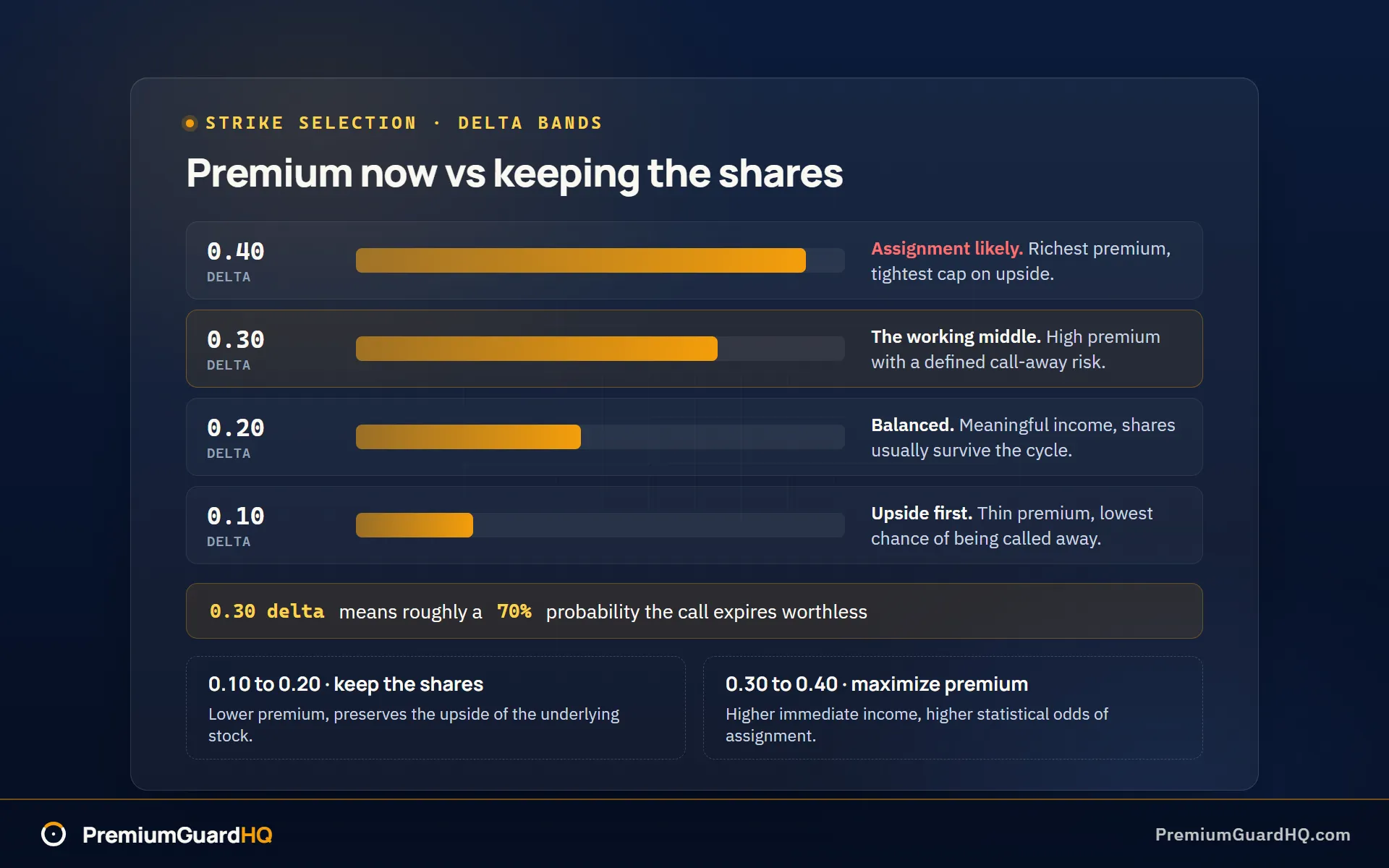
Strike selection defines your profit ceiling. The optimal delta for selling covered calls for income is a slider between immediate premium and the probability of being called away.
Translate your objective into a delta range
- Lower delta (0.10 to 0.20): Offers lower premium and lower call-away probability. Use this range to preserve the upside potential of the underlying stock.
- Higher delta (0.30 to 0.40): Provides higher premium and a tighter upside cap. This increases the statistical probability of assignment.
Apply strike selection rules
- Rule A (Delta-based): Target the 0.10 to 0.30 delta range. Operationally, a 0.30 delta represents a roughly 70% probability of the option expiring worthless.
- Rule B (Price-based): Choose a strike price you would accept as a satisfactory final sell price.
Sanity-check the return and taxes
Use a return calculator to compare premium yield, capped upside, and distance to strike. Verify with a tax professional whether the strike structure affects your holding period (QCC or straddle concepts) per current IRS guidance.
You now have a specific strike selected with a recorded rationale and a return snapshot showing your premium yield and upside cap.
Step 5: Write the covered call and record the trade like an operator
Navigate to your broker’s order entry screen and select Sell to Open. Verify the quantity is exactly one contract for every 100 shares you own. Always use a Limit Order to target the midpoint between the bid and ask prices so you get a fair fill when you sell covered calls for income. If the order remains unfilled after 60 seconds, move your limit by one penny toward the natural price. Avoid market orders to protect your execution price.
Once the order fills, verify that a short call position appears in your account. Confirm your cash balance reflects the premium credit. A trade is not finished until it is logged for future reconciliation. Record these baseline metrics in your trade log or PremiumGuardHQ: underlying price at entry, strike price, expiration date, net premium, and initial delta. Note your assignment posture and any earnings or dividend dates occurring during the cycle. Finally, set a management trigger by defining the price or delta move that forces a position review. You now have an open covered call position and a completed trade log entry with strike, DTE, premium, and initial delta.
Step 6: Manage the position during the month
Management discipline decides the outcome when you sell covered calls for income. Monitor the stock price relative to the strike and the remaining extrinsic value. This value is the premium you are still being paid to carry. If you capture 75% of the premium with 50% of the time remaining, closing early to lock in gains is the professional move.
Follow this management playbook:
- Close early: Buy back the call once decay has removed most of the profit. Freeing up capital for a new cycle is better than waiting weeks for the final pennies.
- Hold: Stay in the trade if the risk is controlled and the remaining premium justifies the time spent carrying the position.
- Stay aware: Track earnings and dividends. Early assignment often occurs near ex-dividend dates for in-the-money calls. Verify your broker notification settings so you see assignment alerts immediately.
Run your checklist in the final week. If the stock is near the strike, decide whether to accept the call-away or roll before expiration day. Set a calendar alert for Wednesday of expiration week to finalize your decision.
You now have a written management decision for this cycle (hold, close, or prepare-to-roll) and an alert or calendar reminder set for expiration week.
Step 7: Manage expiration and assignment
Expiration week requires a decision based on the stock price relative to your strike price.
Review the decision tree
- Stock is below strike: The call expires worthless. You keep the full premium and the shares. The cycle ends, and you can sell a new call for the next period.
- Stock is at or above strike: You face assignment. You will sell your shares at the strike price.
Take action to retain shares
Buy to close the call before Friday afternoon to eliminate assignment risk. Alternatively, roll the position if the new credit meets your specific return rules.
Accept being called away
Allow assignment. Your shares will be replaced by cash proceeds equal to the strike price multiplied by 100. Add the total premium retained to these proceeds to calculate final performance. You are now back in cash and ready to rotate tickers or restart the wheel with a cash-secured put.
You should now have a resolved covered call cycle: either the call expired and you still own shares, or shares were called away at the strike and you are back in cash for that position.
Step 8: Roll covered calls using net-credit math
A roll is a single transaction where you buy to close the current short call and sell to open a new call at a different strike or later expiration. This process keeps rolling from becoming an indefinite can-kick that turns premium collection into a slow loss with extra time risk.
Calculate the roll economics using net-credit math. Subtract the cost to close the old call from the premium received for the new one. Record whether the result is a credit or a debit in your trade log alongside your rationale.
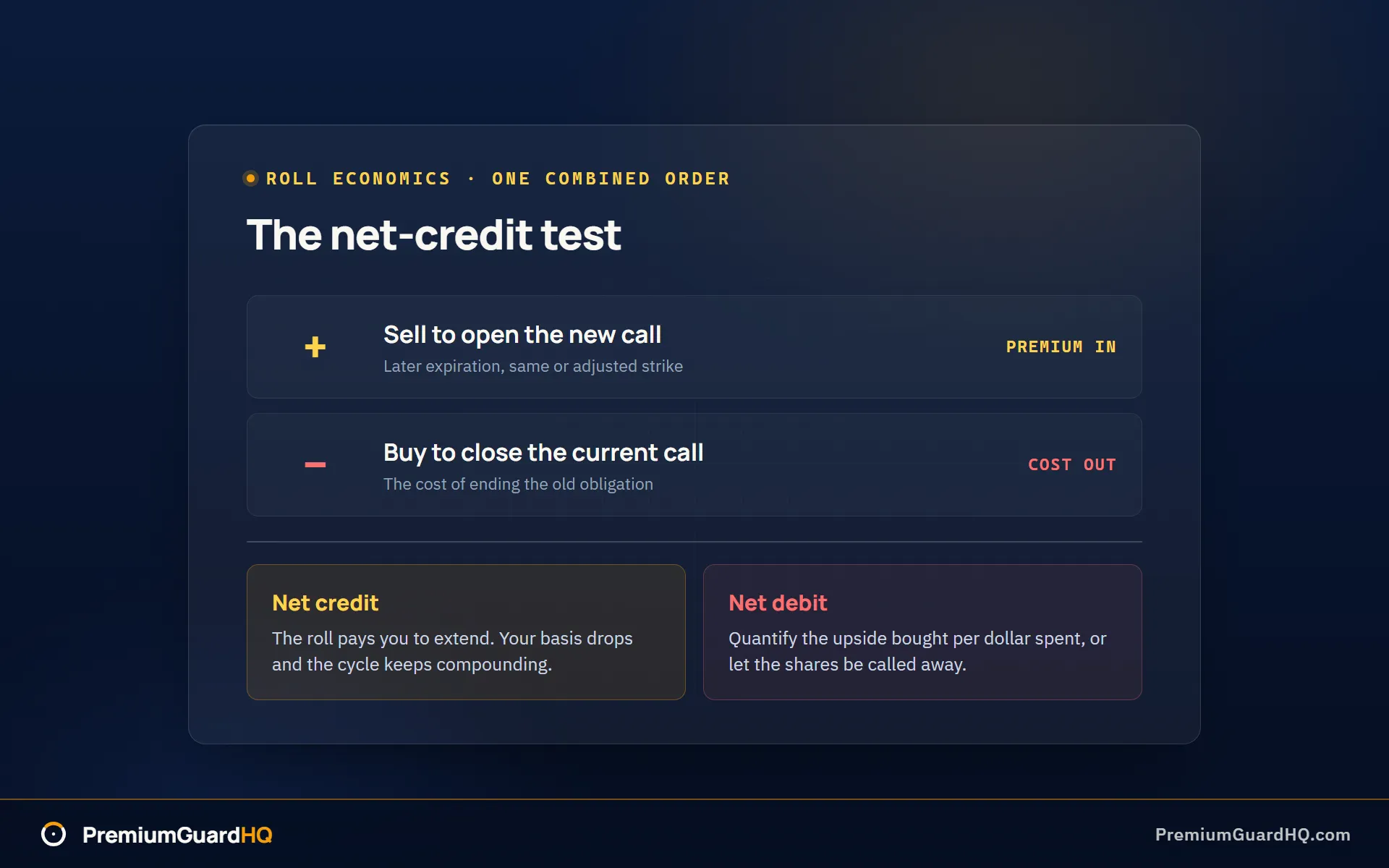
Establish strict acceptance criteria. Target a minimum net-credit threshold that compensates you for the extended time and transaction friction. If you roll for a debit, require a quantified tradeoff. You must define exactly how much additional upside you are buying per dollar of debit spent. If the math is net-negative without a clear benefit, let the shares be called away.
Execute the trade as one combined action using a roll order ticket. Confirm the strikes, expirations, and net credit before submitting. You should now see the original call closed and a new short call opened with the net credit and rationale recorded.
What success looks like: verifying your income
Measure success by the clarity of closed cycles rather than initial credits. This prevents false confidence when premium is collected while the equity base silently shrinks.
Cycle-level verification
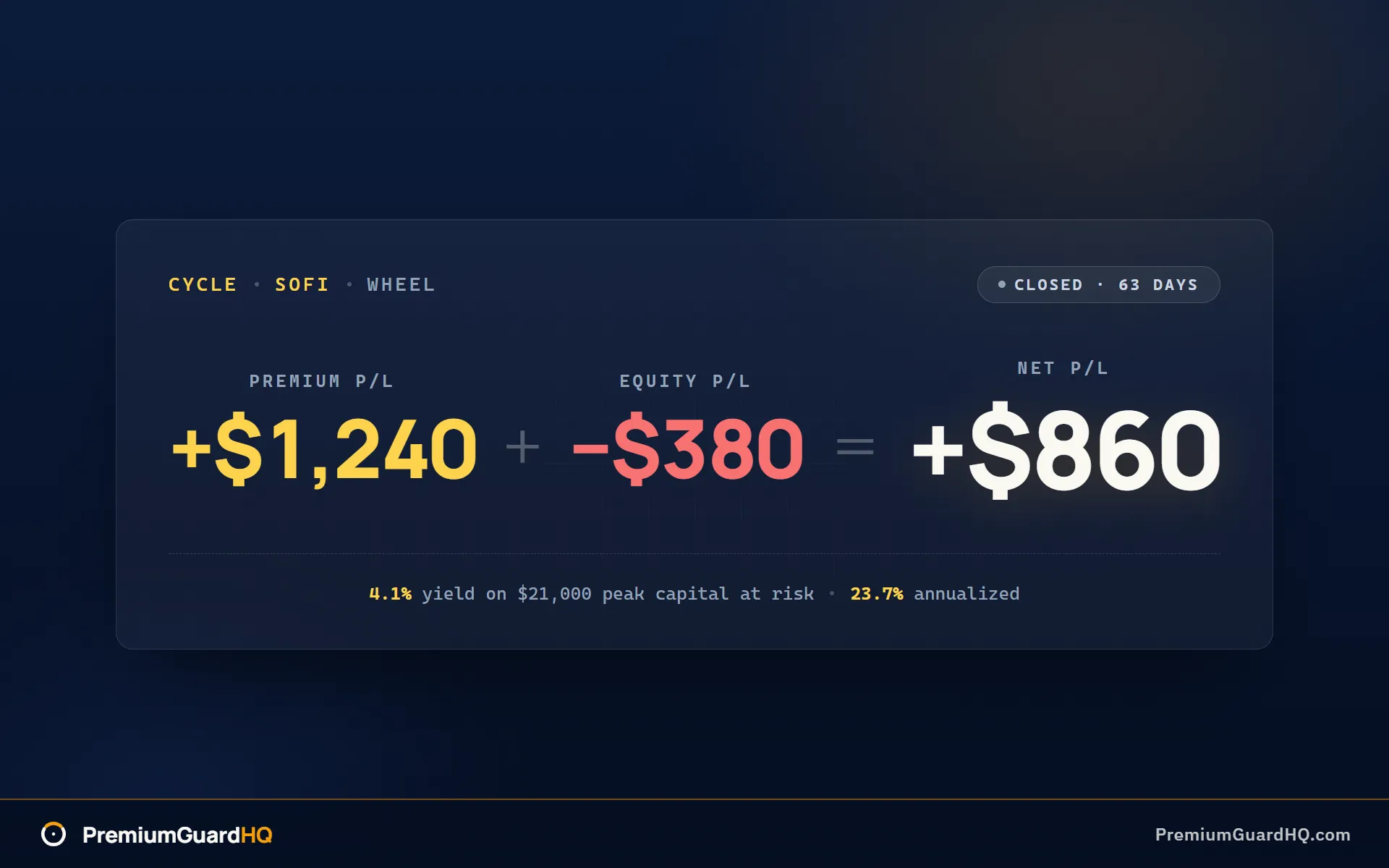
Each cycle must produce two distinct values. You must separate realized premium collected from the equity gain or loss on shares sold or held. Premium is only earned once the cycle concludes via expiration, closing, or assignment.
Portfolio reality checks
Consistency comes from position cadence, not single trade performance. Success means total net income remains positive even after a drawdown month where equity losses exceed premium gains. Across a full year, these closed-cycle numbers are what set your realistic wheel returns, not any single strong month.
Tracking checklist
Broker cost basis is often inaccurate because of wash sales. Reconcile at the cycle level with these metrics:
- Premium P/L: Realized cash from options
- Equity P/L: Share price movement
- Net Income: Total profit or loss
- Capital at Risk: Total exposure per position
Tips and troubleshooting: the mistakes that kill covered call income
Mistake: Chasing premium by moving strikes too close to the money.
Fix: Anchor strike selection to a documented delta band (e.g., 0.15 to 0.30) and a pre-defined assignment posture. Aggressive strikes increase yield but raise the risk of shares being called away during routine market rallies.
Mistake: Selling premium without volatility context.
Fix: Require an IV Percentile check before entry. If premium feels thin, verify if implied volatility is at the lower end of its yearly range. Do not force trades when the market provides insufficient compensation for time risk.
Mistake: Rolling for small credits or repeated debits that do not pay for time.
Fix: Implement a minimum net credit rule for every roll. If you pay a debit to adjust a strike, write a justification that quantifies the additional upside acquired per dollar spent.
Mistake: Ignoring earnings and dividend-related early assignment risk.
Fix: Perform a calendar check before entry. Set a specific reminder for Wednesday of expiration week to scan for upcoming ex-dividend dates. These events frequently trigger early assignment for in-the-money calls.
Mistake: Tax and holding-period surprises on the underlying shares.
Fix: Add a Qualified Covered Call (QCC) checkpoint to your selection workflow. Maintain a list of complex tax positions and confirm details with a qualified professional to avoid inadvertently resetting long-term holding periods.
Frequently asked questions about selling covered calls
What is the best delta for selling covered calls for income?
Most operators target a delta between 0.15 and 0.30 for consistent income. Delta is a statistical proxy for the probability an option will expire in the money, though it is never a guarantee of performance. Lower deltas offer smaller premiums but a higher probability of keeping your shares for long-term appreciation. Higher deltas increase immediate cash flow but raise the likelihood of assignment. Your choice should align with your assignment posture and current implied volatility. If volatility is low, you may need a higher delta to meet your minimum income threshold.
How do I choose a strike price for covered calls?
Use two primary frameworks: delta-based targets for statistical probability or a price-based target using a strike where you would be happy to sell. Always use a return calculator to visualize the specific tradeoff between upfront premium and your capped upside. If the premium does not justify the risk of being called away, skip the trade. Additionally, implement an earnings-week exclusion rule. Avoid selling calls into an expiration week containing a major catalyst to prevent unexpected gap risk from destroying your exit.
What happens when a covered call gets assigned?
When assigned, you are operationally obligated to deliver 100 shares of the underlying stock per contract at the chosen strike price. Your account will show a decrease in shares and a corresponding increase in cash. You keep the original premium regardless of the outcome. Once the shares are gone, the cycle concludes. Your next decision as an operator is whether to rotate capital into a different ticker, pause to reassess the market, or restart the wheel cycle by selling cash-secured puts at a new entry target.
How does this relate to the wheel strategy?
Covered calls are the income-generating leg of the wheel strategy, performed after you acquire shares. The acquisition leg involves selling cash-secured puts, which is a separate tactical phase. Within the wheel framework, you must view premium as unearned until the specific leg of the cycle closes. This prevents the common mistake of withdrawing premium while the underlying equity is in a drawdown. Success requires treating the entire process as a repeatable business cycle where premium and equity performance are reconciled together.
Are covered calls taxable, and can they affect long-term capital gains?
Selling options usually generates short-term capital gains taxable at your ordinary income rate. Be aware that certain call structures can interact with the holding period of your underlying shares. Specifically, deep-in-the-money or non-qualified covered calls can suspend or reset the clock required to achieve long-term capital gains status. Review current IRS guidance regarding Qualified Covered Calls and consult a professional for your specific situation. Keep meticulous records at the cycle level so your total net income numbers are defensible during tax season.