
People often stumble over the word “options” before doing anything else. Sometimes it means a menu of choices: REITs, bonds, or dividend funds. Real estate investment trusts, or REITs, are companies that own property and pass rental income to investors. Other times, “options” means options contracts, the call and put agreements that give someone the right to buy or sell a stock at a set price.
This article is about the second kind. It centers on selling options for passive income, because that is what most people searching the topic are trying to learn.
The part most people skip is that selling options for income is not passive. It can turn into a repeatable process you run like a small business, but only when you actually manage it. No one gets to set it and forget it. There is no autopilot button.
By the end, you will understand the two core income strategies: cash-secured puts and covered calls. With a cash-secured put, you set cash aside so you can buy a stock if you are required to. With a covered call, you sell someone the right to buy a stock you already own at a set price. You will also learn what happens when these contracts expire, and why “income” becomes real money only after a full cycle closes.
What are options income strategies
Options income strategies are methods in which you sell option contracts to collect cash upfront. That cash is a premium. In return, you accept an obligation, such as buying shares at a set price or selling shares at a set price. The premium is not confirmed income until the position closes, expires, or gets assigned.
The word “income” needs a caution label. Premium lands in your account the moment you sell the contract, so it feels like income immediately. But your actual profit, and what you owe in taxes, depends entirely on how the trade ends. A stock can fall after you collect the premium, and that cash cushion may not cover the loss.
The article centers on the two building blocks behind almost every options income approach:
- Cash-secured puts: you agree to buy shares at a set price when the stock falls that far
- Covered calls: you agree to sell shares you already own at a set price when the stock rises that far
Traders who run these two moves in a loop call the pairing “the wheel.”
How selling options for income works: the cash flows, the obligations, the three ways a trade ends
Begin with what happens in your account the moment you sell an option. This is called sell to open. You create a new contract and sell it to someone else. Cash lands in your account right away. That cash is the premium. It is yours immediately. Nothing else has to happen.
That cash is payment for a promise. Sell a cash-secured put and you promise to buy 100 shares at a set price if the buyer chooses to hold you to it. That set price is the strike price. Sell a covered call and you promise to sell 100 shares you already own at the strike price if the buyer chooses to hold you to it.
Your broker will not allow you to make these promises for free. When you sell a cash-secured put, the broker sets aside enough cash to buy 100 shares at the strike price. That cash is called collateral, and it stays locked up until the trade ends. When you sell a covered call, the collateral rule is simpler: you must already own 100 shares per contract before you can sell the call.
Every short option position closes in one of three ways:
- You close it early. You buy back the same contract before it expires. This is a buy to close. Whatever profit or loss exists at that moment locks in for good.
- It expires worthless. The stock never reached your strike price by the expiration date. You keep the full premium and owe nothing further.
- You get assigned. The other side of the trade uses its right. On a short put, your cash converts into shares. You now own stock at the strike price. On a covered call, your shares are sold at the strike price. Any gain above that price is gone for good.
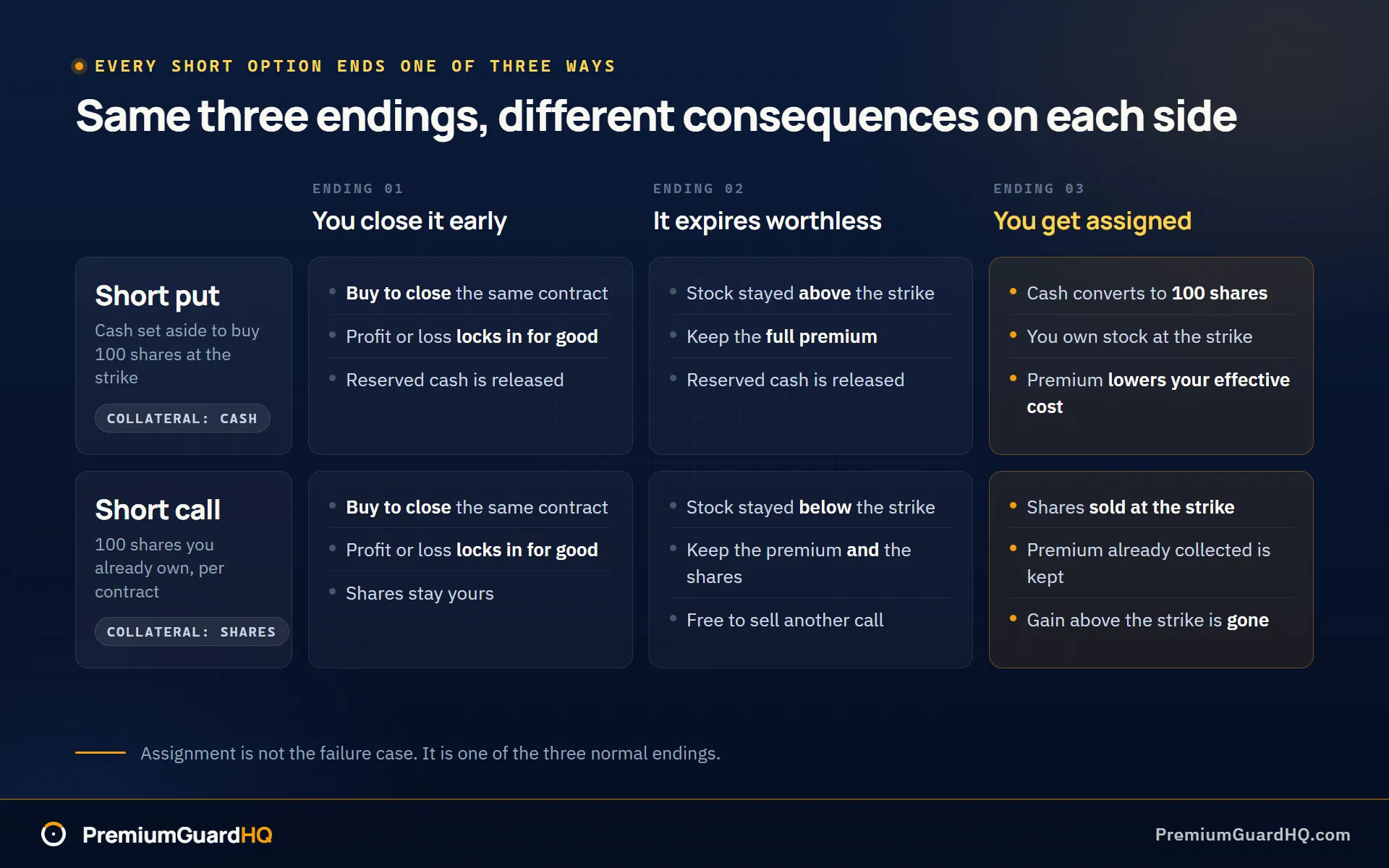
Assignment is not a disaster, but it is also not free. If you get assigned on a put, your safe cash becomes stock that can continue to fall in value. If you get assigned on a call, your upside stops at the strike, no matter how high the stock later climbs.
There is one more detail worth knowing. Most stock and ETF options in the U.S. are American-style. That means they can be assigned on any day before expiration, not only on the final day. Some index products are European-style instead and settle in cash rather than shares. If you trade individual stocks, assume assignment can happen early, and it is worth knowing how American-style and European-style exercise differ before you sell anything.
One idea should frame everything else in this article: premium is unearned income. It becomes earned only when the full cycle closes. Collect a premium today, and you have real cash in hand. But if the stock is quietly losing value underneath you while you count that cash as income, you can spend down your own capital without noticing. Premium inflow can look healthy on the surface while your equity is silently eroding. The two building blocks covered next, cash-secured puts and covered calls, are where this shows up in practice.
What is a cash-secured put: getting paid to wait, with collateral math
A cash-secured put means you sell a put option. A put option is a contract tied to 100 shares of stock. When you sell one, you keep enough cash ready to buy those 100 shares at a price you agree to upfront, called the strike price. You are promising to buy the stock if it falls to your strike, and you keep the cash available in case that happens.
People use this move for one main reason: it pays you upfront. The cash you collect is the premium, and it lands in your account the moment you sell the put. If the stock stays above your strike price through expiration, the day the contract ends, the put expires worthless. Nobody makes you buy anything. You keep every dollar of that premium.
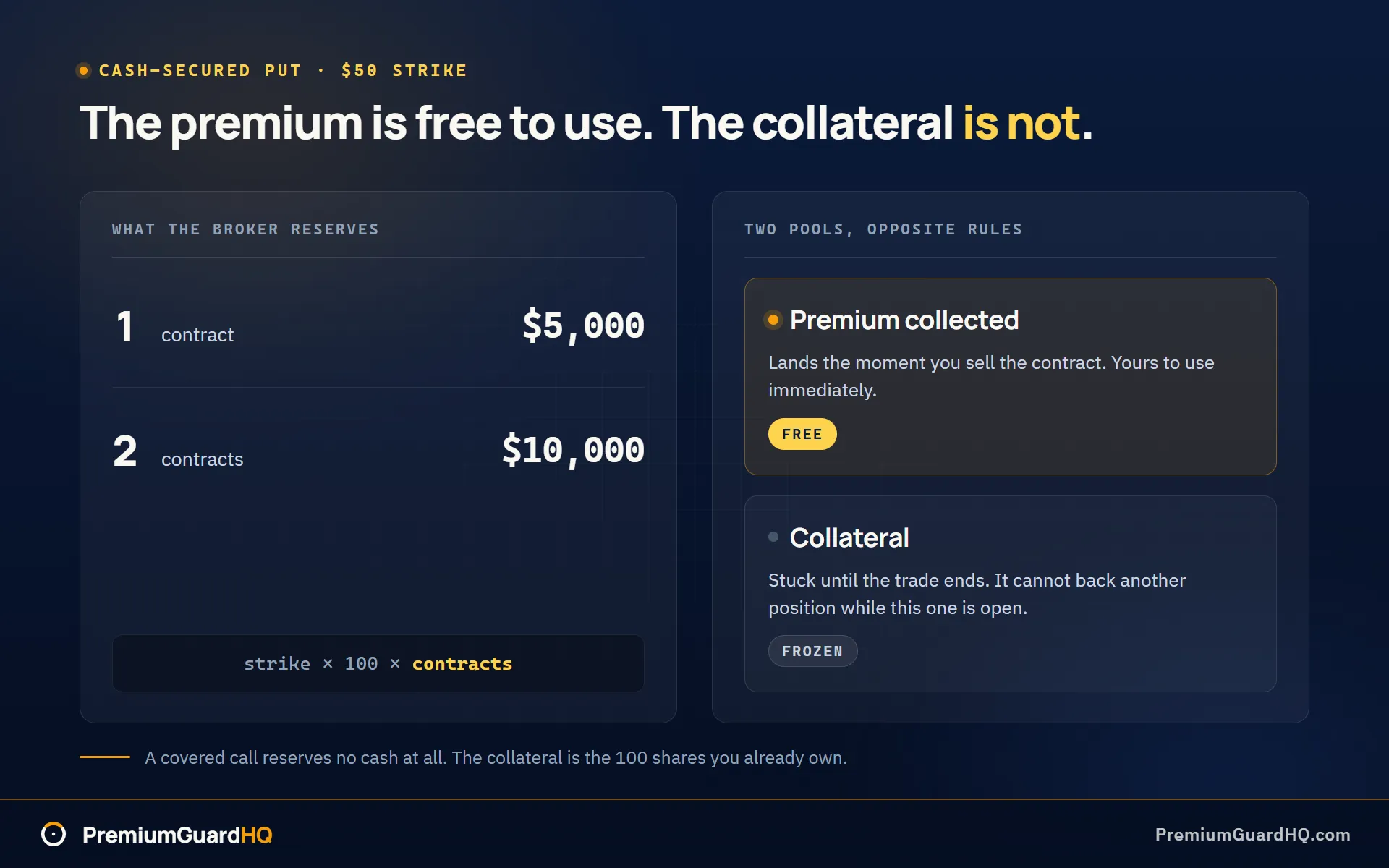
Here is the math on what gets locked up. Your broker sets aside cash equal to the strike price, multiplied by 100, multiplied by the number of contracts you sell. That cash is your collateral. Sell one put at a $50 strike and the broker reserves $5,000. Sell two contracts and that figure jumps to $10,000. The premium hits your account right away, but the reserved cash is stuck. You cannot use it for anything else while the trade is open.
From there, only two things can happen.
Outcome A: the put expires worthless. The stock stayed above your strike. You keep the whole premium, and the $5,000, or whatever amount you set aside, becomes free again. You can use it for another trade.
Outcome B: you get assigned. The stock fell below your strike by expiration, and you are required to buy the shares. Your cash turns into 100 shares of stock at the strike price.
This next part trips up more people than anything else in the process. If you get assigned, your real starting price for the stock is the strike price minus the premium you already collected. Sell a put at a $50 strike and collect $2 in premium, and your effective cost is $48 a share, not counting broker fees. That distinction matters. It is the difference between thinking you are down money and knowing you are actually still ahead. It also sets the starting number for your next move: selling a covered call against those same shares.
Choosing a strike price and an expiration date always involves a trade-off. No single answer is right. A strike closer to the current stock price usually pays a larger premium, but it also raises the odds of assignment. A strike farther away pays less, but assignment becomes less likely. Shorter-dated contracts lose value faster as time passes, which works in your favor as the seller, but they demand more attention because they expire sooner and more often.
Many sellers use a number called delta to compare strikes at a glance. Delta is a number between 0 and 1 that shows roughly how much an option’s price moves when the stock moves one dollar. Some traders treat it as a rough stand-in for the odds of assignment. It is not a guaranteed probability, just a shorthand.
Here is the honest part. Selling cash-secured puts is not a one-time setup you can ignore. You still need to watch the stock price, track the upcoming expiration, and stay aware of assignment risk the whole time the trade is open.
Cash-secured puts are often the opening move in a longer income loop, sometimes called the wheel. You sell the put, and if you get assigned, you move on to selling covered calls against the shares you now own. If you want the strike-by-strike version, we have written up the full cash-secured put workflow separately. One risk shows up often for people who use this income to cover living expenses: they spend the premium as cash flow while the stock sits in a loss that has not been locked in yet. That is why tracking what is actually realized, meaning locked in for good, versus what is only unrealized paper movement, matters as much as the trade itself.
Covered calls and the wheel loop: where income is real only when the cycle closes
Once you own 100 shares of stock, whether by buying them or through assignment on a cash-secured put, you can sell a covered call. A covered call is a promise to sell stock you already own at a set price if the buyer decides to hold you to it. It works almost like the mirror image of a cash-secured put: instead of promising to buy stock, you promise to sell it.
That set price is the strike price, same as before. Sell a call at a strike above the current stock price and you collect cash right away. The cash is the premium, and it is yours the moment you sell the contract. In exchange, you give someone else the right to buy your shares at that strike price. Your upside is capped for as long as the contract stays open. If the stock rockets past your strike, you do not get that extra gain. The buyer does.
There are only two ways a covered call ends.
The call expires worthless. The stock never reached your strike by expiration, the day the contract ends. You keep the full premium and still own your shares. You are free to sell another call against those same shares next month.
Your shares get called away. This is called assignment. The stock rose above your strike, and the buyer used the right to buy. Your shares are sold at the strike price. You keep the premium you already collected, and the stock side of the trade is now closed for good. Traders call this realized, meaning the gain or loss is locked in and final, rather than only sitting on paper.
Put the two building blocks together and you get a loop called the wheel. Sell a cash-secured put. If you are assigned, you now own shares. Sell covered calls against those shares. If the shares get called away, you are back to cash. Then repeat the whole sequence. Turning that loop into a repeatable monthly covered call routine is its own piece of work, and it is where most of the ongoing decisions live.
Why the broker screen can lie to you
Premium is cash at the moment you collect it, but it does not become confirmed income until the position closes and you can add up what actually happened. The gap between collected and earned is where income sellers most often lose the thread. It helps to keep three numbers separate in your head:
- Premium P/L: what you made on options that have actually closed
- Equity P/L: what happened to the value of the stock you are holding
- Net income: the two combined, counting only the parts that are locked in for good
Your broker’s screen often mixes these together in a confusing way. Assignment changes your cost basis, the number used to calculate your real gain or loss. Wash-sale rules can move that same number again behind the scenes. What you see is a profit and loss figure that does not match what actually happened across a full cycle. The screen can show you as profitable while the stock side sits quietly underwater, or show a loss when the premium actually leaves you ahead.
The withdrawal trap
This is where income sellers get hurt without noticing. Suppose you collect premium every month and withdraw it right away to spend, treating it like a paycheck. That works until a drawdown, a stretch where your account value drops, hands you shares below what you paid. Now the capital base that generates future premium has gotten smaller, and you already spent the cushion that was meant to protect it.
One way to avoid this: set a target for how much equity, meaning total account value, you want working in the strategy. Then withdraw money only from profits that are fully realized and closed. Never withdraw from premium sitting on a position that is still open. This is a control problem, not a stock-picking problem, and sizing a withdrawal your equity base can survive is the part worth getting right before the first drawdown arrives.
Covered calls still take time
Do not mistake this for passive income. You still have to watch for assignment risk, track expiration dates, and pay attention to what the stock is doing while your shares are exposed. The wheel loop does not remove any of that work. It just gives the monitoring a repeatable shape. Deciding whether a position deserves a call at all, and which strike and expiration to pick, is the work that comes before any of it.
A worked example: one wheel cycle from cash-secured put to covered call
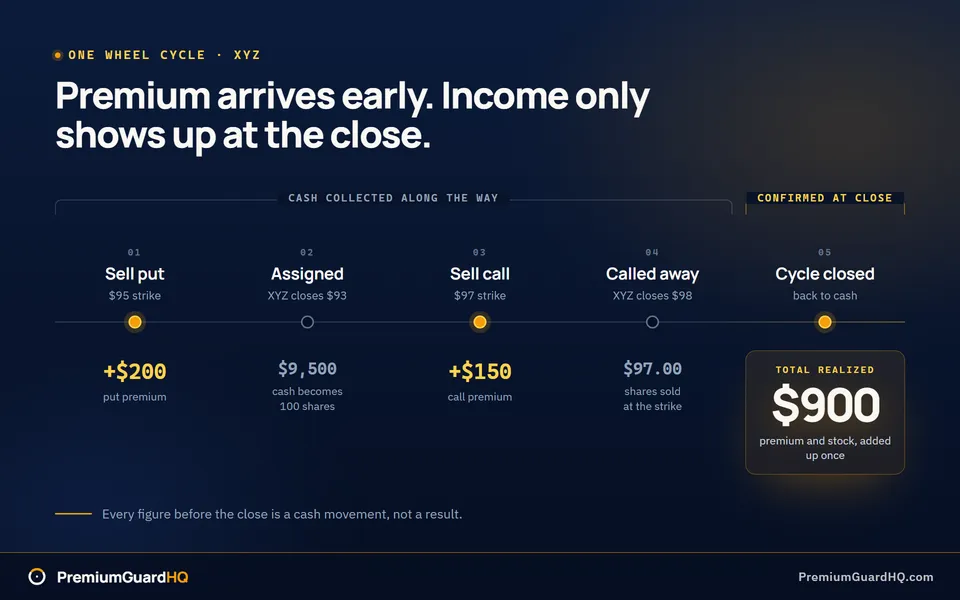
Numbers are easier to trust than words. Here is one full turn of the wheel, start to finish, with round numbers on a made-up stock called XYZ.
XYZ trades at $100. You sell one cash-secured put at a $95 strike price. A strike price is the price at which you agree to buy or sell the stock. Selling this put means you agree to buy 100 shares at $95 if asked. You collect $2.00 per share in premium, the payment you receive for selling the option, which comes to $200 total because one contract covers 100 shares. Your broker sets aside $9,500 as collateral, cash held in reserve in case you have to buy the shares.
At expiration, the day the contract ends, XYZ sits at $93. That is below your $95 strike, so you get assigned. Assignment means you are now required to buy the shares. You pay $95 per share for 100 shares, which is $9,500 out of your account. But your real starting cost is not $95. Subtract the $2.00 premium you already collected, and your effective basis, what the stock actually cost you after that credit, is $93.00 per share.
Now you own the stock, so you sell a covered call. This is a promise to sell your shares at a set price if the stock reaches it. You pick a $97 strike and collect $1.50 per share, or $150 total. Subtract that from your basis and it drops again to $91.50 per share.
At the next expiration, XYZ closes at $98. That is above your $97 strike, so your shares get called away. Called away means your shares are sold at $97, whether you wanted to sell them or not.
Here is the full accounting:
| Component | Amount |
|---|---|
| Put premium collected | $200 |
| Call premium collected | $150 |
| Stock sold at $97, basis $91.50 | $5.50/share = $550 |
| Total realized result | $900 |
The stock gain alone is $97.00 minus $91.50, or $5.50 per share, which comes to $550 on 100 shares. Add the $200 put premium and the $150 call premium, and the full cycle nets $900.
Premium felt real the day it hit your account. But the true result only existed once the whole cycle closed, stock side included.
Frequently asked questions
Is selling options for income passive?
No. Premium can arrive on a schedule, but the work behind it is not automatic. You still have to pick strikes, watch expiration dates, and handle assignment when it happens. For an experienced seller, that might only take an hour or two a week. But it sits closer to a small business you run than to a paycheck that shows up on its own. See “Why the broker screen can lie to you” above for how this plays out in your actual numbers.
What happens if I get assigned early?
Most U.S. stock options can be assigned on any day before expiration, not only on the last day. This is called early assignment. If it happens on a short put, your cash converts into shares sooner than planned. If it happens on a short call, your shares are sold sooner than planned. Either way, the trade does not stop existing; it just resolves ahead of schedule. Your obligation was always there. Early assignment only moves up the date.
How is option premium taxed in a taxable account?
It depends on how the trade ends: closed early, expired, or assigned. There is no single flat answer. Most premium from stock options that closes out short-term gets taxed as short-term gains, at your regular income rate rather than a lower long-term rate. Certain index options follow different rules under their own tax treatment. Check how option premium is treated at tax time and talk to a tax professional about your specific contracts before you assume a rate.
Can I sell cash-secured puts and covered calls in a retirement account?
Many brokers allow both in an IRA once you have approval for options trading at the right level. The catch: retirement accounts do not allow margin-style uncovered risk, so you need the cash or shares in hand to back every position, no exceptions. Options approval levels in a retirement account vary by broker, so confirm what your specific account allows before placing a trade.
Why does my broker’s cost basis look wrong after options trades?
Assignment and premium adjustments change the cost basis number your broker displays, which is the price used to calculate your gain or loss. That number is often not what you would expect. The fix is not to fight your broker’s screen. Track your own numbers per cycle instead: premium collected, what happened to the stock, and the combined net result. That is the only way to know what a closed wheel cycle actually made you. See “Why the broker screen can lie to you” above for the three numbers worth tracking.