
“I own the stock. Now someone wants to pay me to promise I’ll sell it. What am I actually agreeing to?”
That question confuses more new traders than any other options topic. A covered call is a position where you hold at least 100 shares of a stock and sell someone the right to buy those shares from you at a set price before a set date. You get paid cash right away for taking on that obligation. That payment is the premium.
After you finish this piece, you can draw the payoff on a napkin and point to the exact moment your shares may be called away. That moment is called assignment.
The contract is the focus here, rather than the order-entry steps. For those, see the covered call execution workflow.
Here is what you actually agree to when you sell the call.
What is a covered call?
A covered call is a trade where you own 100 shares of a stock and sell a call option against those same shares. The sale puts cash in your account immediately. In exchange, you agree to sell your shares at the strike price if the buyer exercises the option.
The upfront cash is the premium. The fixed sale price is the strike price. The position is called “covered” because you already hold the shares you may need to deliver. You are not promising to produce shares you do not own. That separates it from a “naked” call. With a naked call, assignment would force you to buy the shares in the open market at whatever price they trade for. Assignment happens when the option buyer uses their right, and you must follow through and sell your shares.
Traders use other names for this position. “Overwrite” means you sold a call against shares you already held before the trade. “Buy-write” means you bought the shares and sold the call at the same time, as one combined order. Both labels describe the same setup: shares you own, paired with a call you sold against them.
How a covered call works: the contract mechanics
A covered call rests on three moving parts. The first is the underlying shares. Options trade in 100-share blocks, so one options contract covers exactly 100 shares of stock. That block size is fixed by the standard equity option contract size, not by your broker.
The second part is the short call. “Short” means you sold it, not bought it. This call carries a strike price, the fixed price where the stock would be sold. It also carries an expiration date, the day the contract ends.
The third part is the premium. This is the cash you collected the moment you sold the call. That cash stays yours no matter what happens later.
When you sell the call, you take on one job. If the buyer exercises the option, you must deliver 100 shares at the strike price. There are no exceptions and no second chance at a better price.
Something can happen in one of two windows. Before expiration, the buyer may exercise early. Most stock options permit early exercise on any trading day, not just the final day. So assignment, the event where your shares are sold at the strike, can appear in your account on any ordinary Tuesday. If you want how assignment plays out step by step, that is its own subject.
At expiration, one of two things happens. The option expires worthless and nothing else occurs. Or the stock sits above the strike, known as finishing “in the money,” and exercise becomes much more likely.
Three plain outcomes follow from that contract:
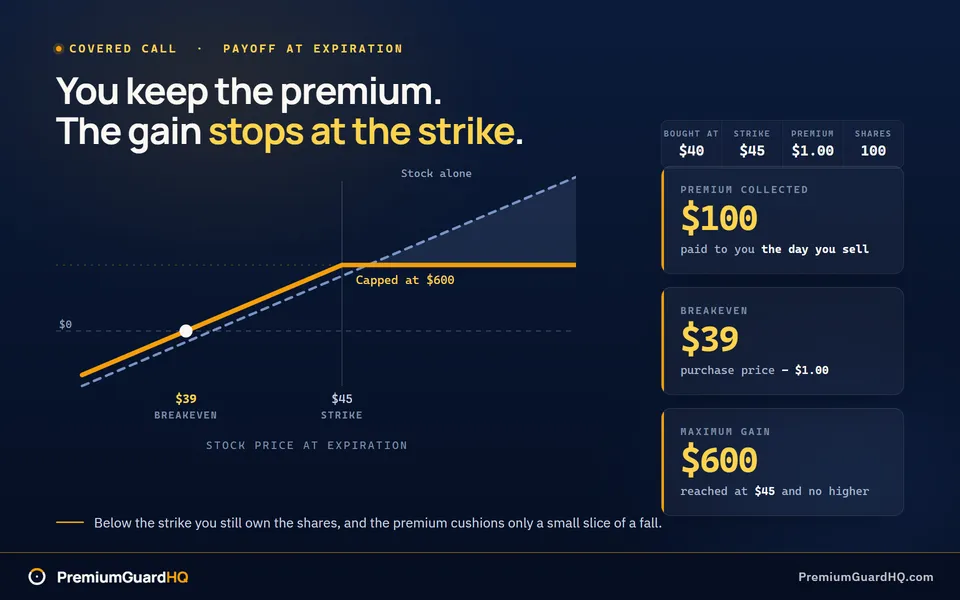
- Stock stays below the strike: the call will probably expire worthless, you keep the premium, and your shares stay in your account.
- Stock rises above the strike: assignment becomes likely, your shares sell at the strike, and you no longer keep any gain above that price.
- Stock falls: you still own the shares, and the premium cushions only a small slice of the loss.
Strike selection, rolling, and placing the actual order belong in the execution guide, not here.
Covered call payoff: what it pays and what it costs
A covered call turns unlimited upside into capped upside. Capped means there is a ceiling on how much you can make. In exchange for that ceiling, you receive cash upfront. That is the entire trade compressed into one sentence.
You can turn that sentence into three numbers. To keep the math simple, we use 100 shares and ignore commissions, fees, and taxes. We also assume everything happens at expiration, the day the contract ends.
- Breakeven. The stock price where you are flat so far. Formula: stock purchase price minus premium received. Buy the stock at $50 and collect $2 in premium, and your breakeven is $48.
- Maximum gain. The ceiling on your profit. Formula: strike price minus stock purchase price, plus premium received. A $55 strike gives you $5 of stock gain above your $50 purchase price. Add the $2 premium and your maximum gain is $7 per share, or $700 total on 100 shares.
- Maximum loss. The worst case, assuming the stock falls all the way to zero. Formula: stock purchase price minus premium received. With the same numbers, the loss is $50 minus $2, or $48 per share.
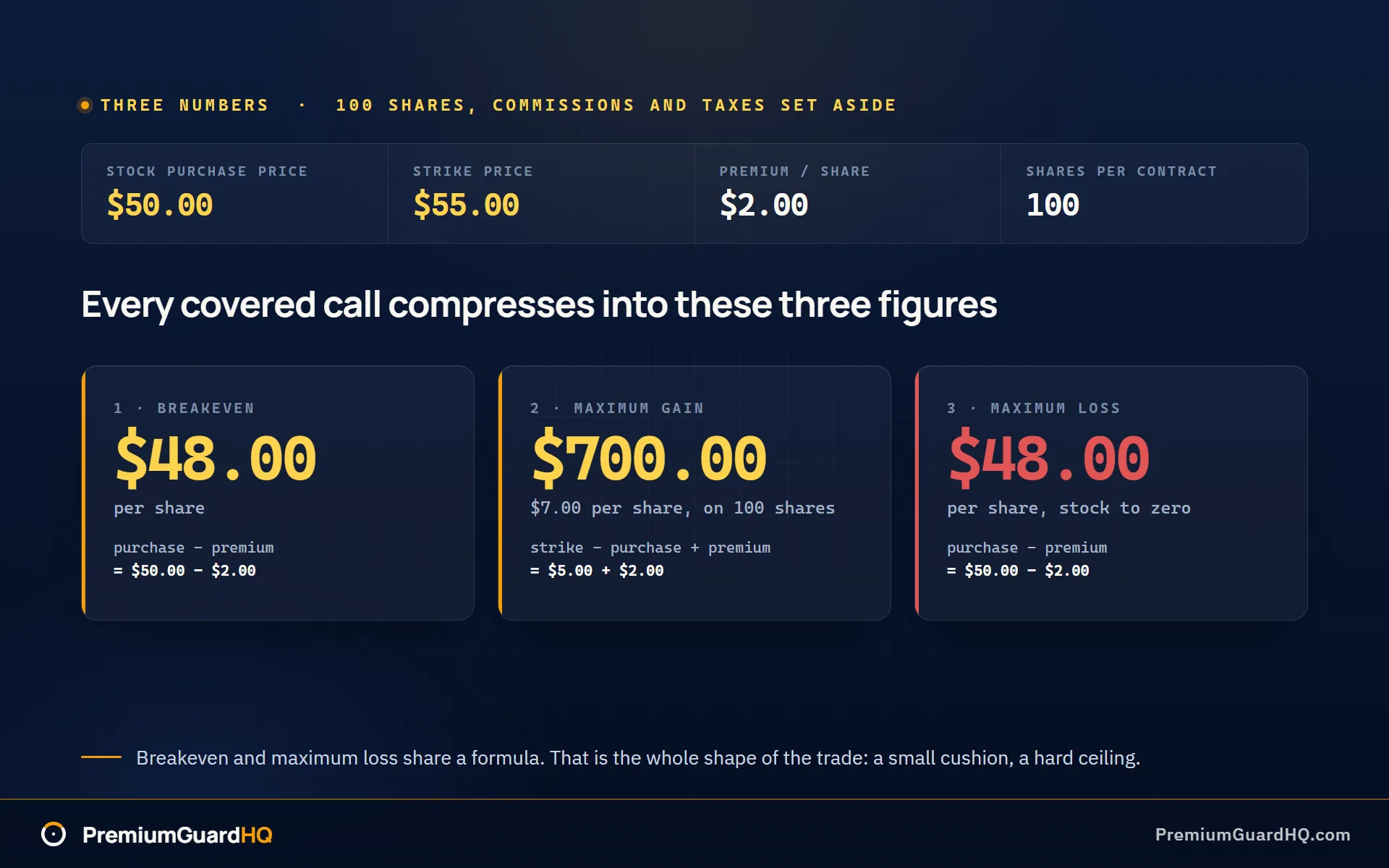
Notice that breakeven and maximum loss come from the same formula. Premium is the only thing moving either one, which is also where your breakeven sits once you have sold premium rather than paid it.
What does the premium actually pay you? It arrives in your account the moment you sell the call, and it is yours no matter what happens next. It is a small cushion. It softens a drop in the stock price by a few dollars, and it adds a little return when the stock sits flat or drifts up slightly.
What does it cost you? Two things. First, your upside above the strike is gone. If the stock rockets past $55, you do not collect those extra dollars, because you already sold someone else the right to buy your shares at $55. Second, the premium is small compared to how far a stock can fall. A few dollars of cushion does very little against a $20 decline, so a real selloff still costs you far more than the premium protects.
Assignment is the contract doing its job. It means the option buyer uses their right to buy your shares at the strike price. Your shares are sold at the strike, and your actual sale price becomes the strike plus the premium collected.
Here is the clearest way to see the cost. Picture two versions of you. One just holds the stock. The other holds the stock and has also sold the call. If the stock shoots up far past the strike, the first version keeps climbing. The second version stops gaining at the strike, plus the premium already banked. That gap is the price of selling the call.
One more detail worth knowing: a stock paying a dividend can sometimes trigger assignment before expiration. That nuance is small enough to save for later.
Worked example: one covered call, three expiration outcomes
Here is one trade, run three different ways, so you can see the real payoff in numbers.
The setup: You buy 100 shares at $40. You sell 1 call with a $45 strike. A call option gives someone else the right to buy your shares at $45 before it expires. You collect $1.00 per share in premium, paid to you right away. That is $100 total for the contract, since one contract covers 100 shares.
Your breakeven price, where you neither gain nor lose money, is $40 minus $1, or $39. Your biggest possible gain, if the stock finishes above $45, is ($45 minus $40) plus $1, or $6 per share. That is $600 total.
Now here are the three ways this trade can end.
| Stock price at expiration | What happens | Gain or loss per share | Total |
|---|---|---|---|
| $44 (below strike) | Call expires worthless. You keep your shares and the premium | $4 stock gain + $1 premium = $5 | $500 |
| $52 (above strike) | Your shares get bought at $45 | $5 stock gain + $1 premium = $6 | $600 |
| $35 (down) | Call expires worthless. You keep your shares | -$5 stock loss + $1 premium = -$4 | -$400 |
Look closely at the $52 row. In that case, the stock climbed from your $40 purchase price to $52, a $12 move. But your shares were sold at $45. You get nothing from the move between $45 and $52. That gain belongs to whoever bought your call.
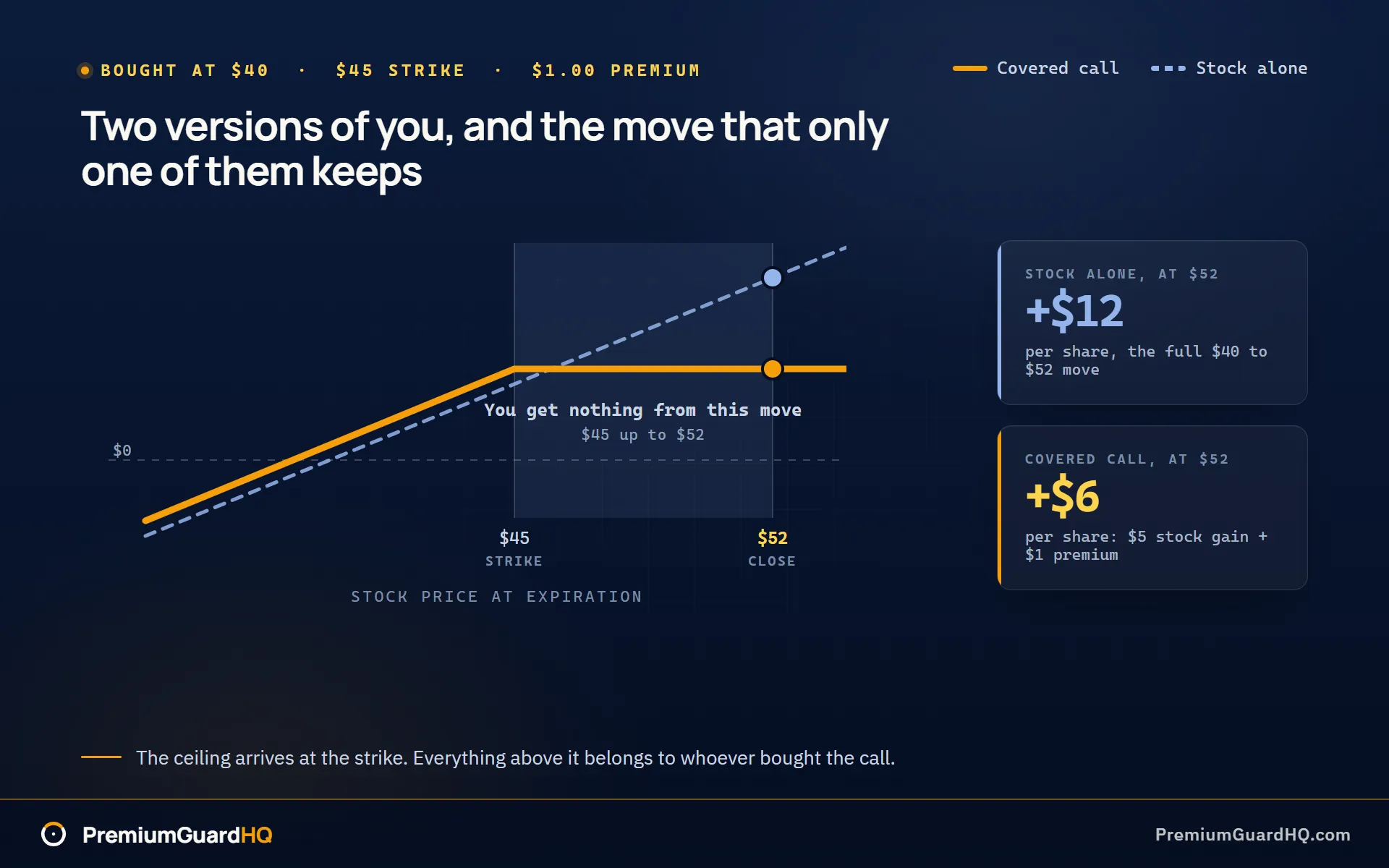
The premium adds one dollar a share to every outcome. But it does not change the shape of the trade. You still lose money if the stock falls, just as you would from owning the stock alone. And you still give up any gain above the strike price, no matter how high the stock climbs. Change the strike or the premium and the whole picture moves, which is quickest to see if you run your own strike and premium through the payoff math.
Frequently asked questions
Can you lose money on a covered call?
Yes. Selling the call does not protect most of your downside. You still own the stock, so if the price drops, you lose money on those shares just like any stockholder would. The premium you collected only offsets a small, fixed amount of that loss. A stock can easily fall far more than the premium you received, which is why a covered call is still considered a stock-owning strategy, not a safe one.
When do covered calls get assigned?
Assignment happens when the person who bought your call decides to use their right to buy your shares at the strike price. Most assignments happen at or near expiration, and only when the stock price is above the strike. But early assignment can happen any day before expiration too. Stock options are “American-style,” which means the buyer can exercise whenever they want, including right before a dividend payment. Your broker then picks which of its customers gets the notice, either at random or by its own procedure, so there is no queue you can watch.
Do you need 100 shares to sell a covered call?
Yes, for a standard listed stock option. One contract equals 100 shares, and you need to own that full amount for the trade to count as “covered.” Without the shares, you cannot sell a true covered call. Traders with smaller accounts sometimes look at funds that run covered call strategies for them, or other stock-substitute setups, but those work differently and are outside the scope of this article.
How are covered calls taxed, and can they affect my holding period?
Tax treatment depends on your account type and where you live. In the U.S., covered calls can fall under special qualified covered call rules, and some call sales can pause or restart the clock on how long you’ve held your stock for tax purposes. This affects whether a later sale counts as short-term or long-term. This is general education, not tax advice. Talk to a qualified tax professional before you trade.