
Your option is about to expire. Or the trade has moved against you. The broker’s app shows a big blue “Roll” button. It looks like an easy way out, a way to erase the problem and start fresh.
Here’s the catch. Rolling an option is not a reset button. A roll is really just two trades done at the same time. You close your old option and open a new one. Whether that combo actually helps you depends on the math behind it, not on how good the button feels to press.
By the end of this guide, you’ll know what a roll really is. You’ll learn how to read the net credit or debit it creates. A net credit means you bring in more money than you spend. A net debit means you pay out more than you collect. You’ll also learn one simple rule that stops a bad roll from turning into a worse one next month, plus one worked example with real numbers.
Covered-call rolling has its own separate guide with more specific tactics. This article stays general, because the core rule applies no matter what option you hold.
Let’s start with what a roll actually is.
What rolling an option means
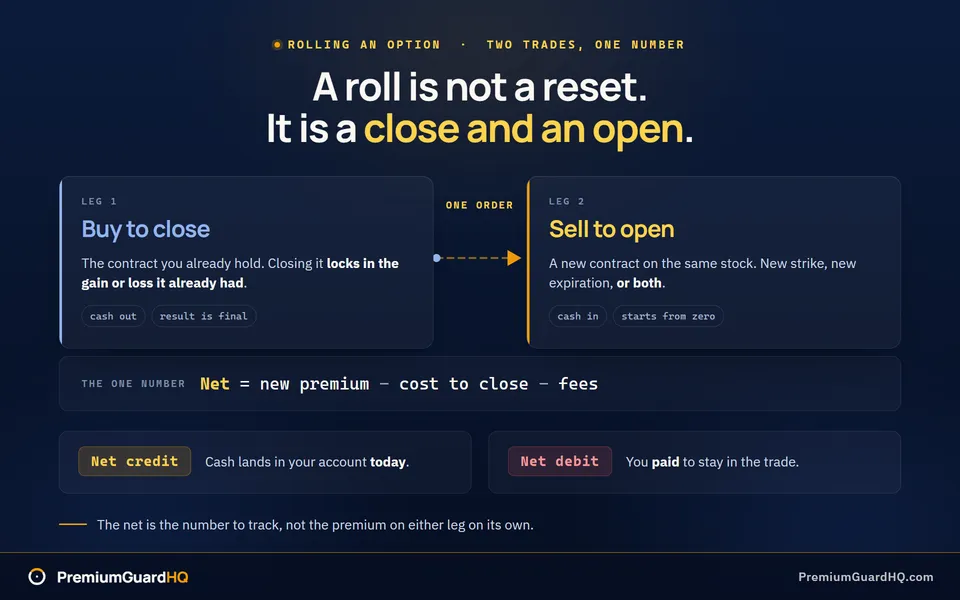
Rolling an option means closing your current contract and opening a new one on the same stock at the same time. The two trades count as one move. The only number that matters is the net credit or net debit, which tells you whether you collected cash or paid cash to make the switch.
You are not changing the stock you own or follow. You are swapping one option contract for a different one. The new contract usually has a different expiration date, a different strike price, or both. The strike price is the set price written into the contract. The expiration date is the day the contract ends.
A roll is not a free do-over. Closing the old contract locks in whatever gain or loss it already had. That profit or loss is final the moment you close it. The new contract then starts its own story from zero, with its own premium and its own outcome ahead of it. Rolling just connects the two trades into one plan. It does not erase what already happened, and it does not keep your old position alive under a new name.
- You are switching contracts, not changing the stock underneath them.
- Rolling does not erase the profit or loss on the trade you just closed.
- The net credit or net debit on the roll is the number to track, not the premium on either leg alone.
How a roll works mechanically
A roll always follows the same five steps, no matter what you hold.
Step 1: Name what you’re closing. If you own a long call or long put, you sell it to close. If you’re short a call or short a put, you buy it to close. Short means you sold the option first and now owe it back. Long means you bought it first and own it outright.
Step 2: Pick the new contract. Same stock. New strike price, new expiration date, or both.
Step 3: Place it as one order if you can. Most brokers let you submit the close and the open together as a single paired order, often called a spread order. This way you are never stuck holding neither contract while the trade is only half done.
Step 4: Run the one number that matters.
Net credit or debit = premium from the new contract minus cost to close the old one minus fees
A net credit means cash lands in your account today. A net debit means you paid money to stay in the trade.
Step 5: Record it as two separate fills. Your broker screen may call it “one roll.” For your own records and for taxes, it is really two trades: a closing trade and an opening trade, placed back to back.
When rolling is the right move
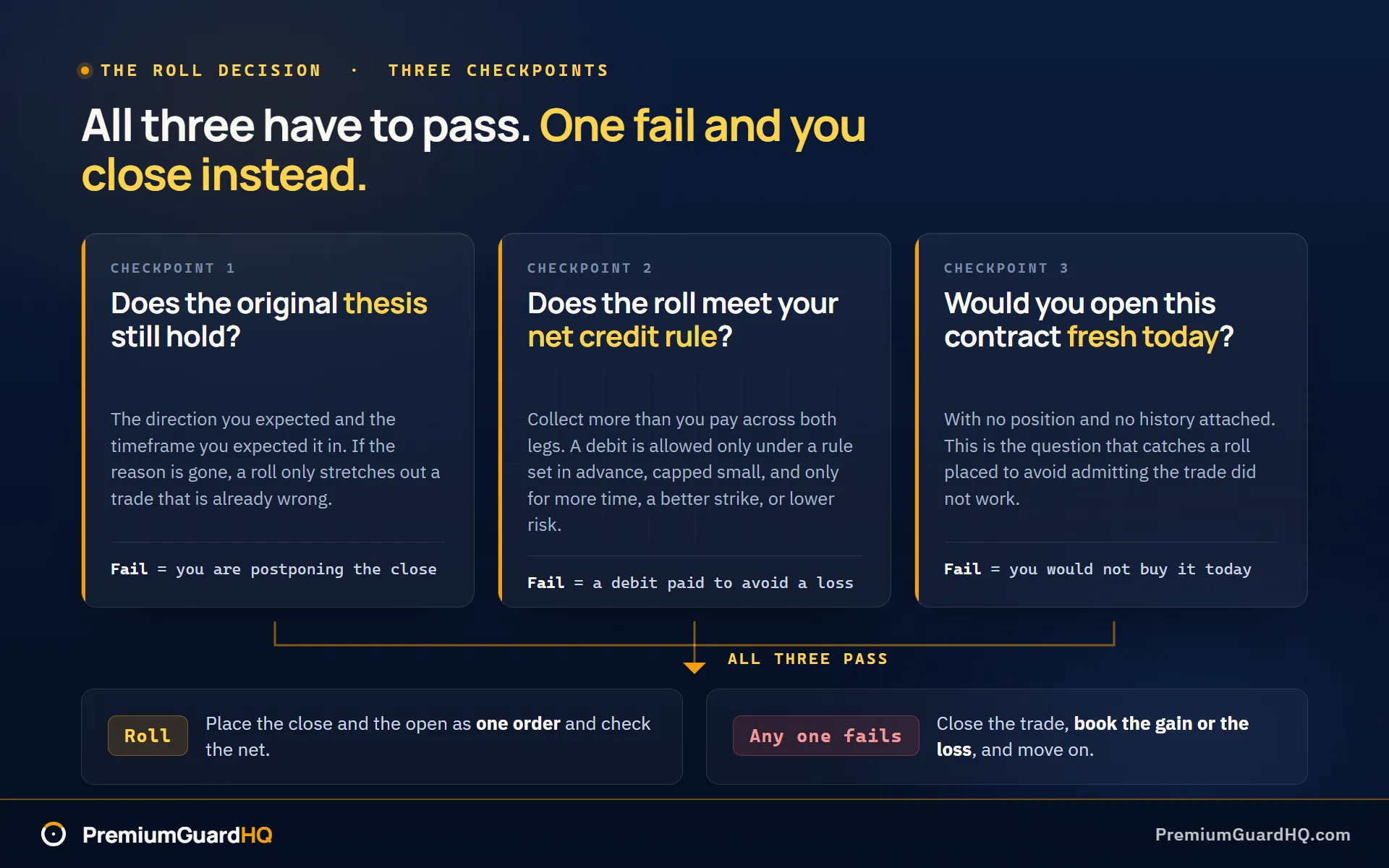
Here’s the rule in one line: roll only when (1) the original thesis still holds, (2) the roll meets your net credit rule, and (3) you would open the new contract fresh today.
Think of this as three checkpoints. If any one fails, don’t roll. Close the trade, take the loss or the gain, and move on. Most expensive rolls happen because a trader skips these checks and hits the button just because it’s there.
Checkpoint 1: Does your thesis still hold? Your thesis is the reason you opened the trade. It has two parts: a direction, meaning you thought the stock would go up, down, or sit still, and a timeframe, meaning when you expected that to happen. If that reason is no longer true, rolling just stretches out a trade that’s already wrong. You’re not managing the position. You’re postponing the decision to close it.
Checkpoint 2: Does the roll meet your net credit rule? Net credit means you collect more cash than you pay when you combine the close and the open. This number matters because it changes your starting point the moment you place the trade. Some rolls do land as a net debit, meaning you pay instead of collect. That’s not automatically wrong, but it should only happen under a rule you set in advance, capped at a small amount, and only when you’re clearly getting something back: more time, a better strike, or lower risk. A debit paid just to avoid a loss is not a trade decision. It is an emotional one, and it usually means you are postponing the close instead of managing the position.
Checkpoint 3: Would you open this new position today, fresh, with no history attached? Never roll into a position you would not open today if you had no position at all. This question catches the most expensive habit in options trading: rolling just to avoid admitting the trade didn’t work.
A quick note on vocabulary, since broker menus use these terms without explaining them.
- Rolling up or down: same expiration date, different strike price.
- Rolling out: same strike price, later expiration date.
- Rolling up-and-out or down-and-out: both change at once.
On timing: many sellers of options manage trades before the final week, often around 21 days left before the contract expires. Late in a contract’s life, price swings hit the option’s value harder, which makes adjustments more expensive.
For covered-call-specific roll playbooks and strike selection, see the covered-call rolling playbook.
Worked example: a roll with a net credit
Here’s how the math works in a real trade.
Say you are short 1 put on XYZ, a made-up stock ticker. Short means you sold the contract, so you owe it back later. The put has a strike price of 50. A strike price is the price you agreed to buy or sell the stock at. This put is about to expire, and you first sold it for a credit of $1.20, or $120 for one contract. One contract covers 100 shares, so every price gets multiplied by 100.
Time has passed and the stock has moved around. That same put now trades for $2.10. You still believe in the trade, but you want more time. You have a rule: only roll if you get paid to do it.
Here is the roll, broken into its two legs:
- Buy to close the old put: you pay $2.10, or $210 for the contract.
- Sell to open a new put, same 50 strike, further out in time: you collect $2.55, or $255 for the contract.
Now find the net:
Net credit equals $2.55 minus $2.10, or $0.45
Per contract, that is $0.45 times 100, or $45 net credit, before fees or slippage. Slippage is the small gap between the price you expect and the price you actually get.
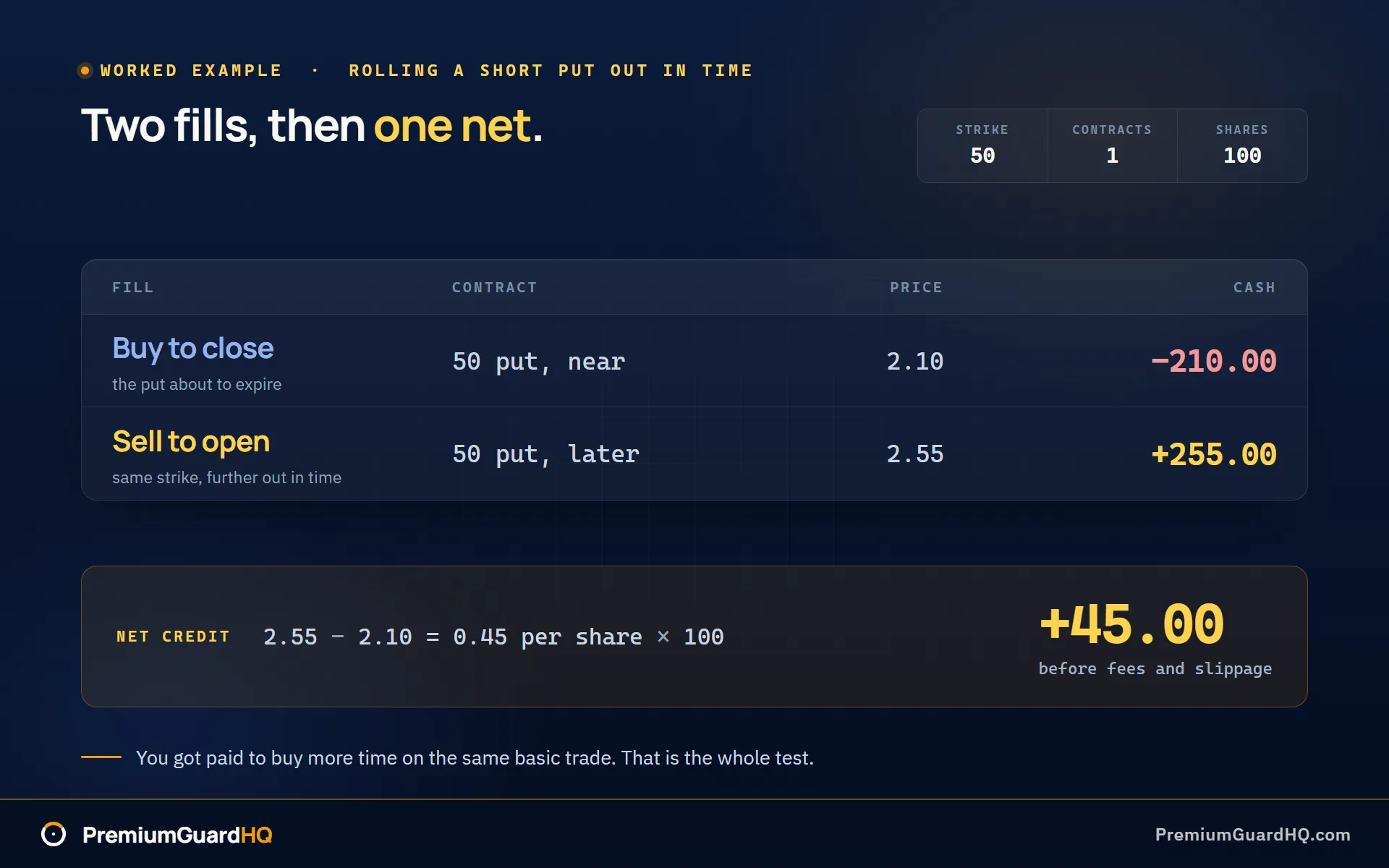
That $45 is the only number that matters here. You got paid to buy more time on the same basic trade. If your thesis still holds, and you would be happy to open this exact new put today with no history attached, this roll passes the math filter from the last section.
One more thing: your fill price depends on the bid and ask quoted in the market at that moment. The bid is the highest price buyers are offering, and the ask is the lowest price sellers want. Always use limit pricing, which sets the worst price you are willing to accept, and check the net on both legs before you submit.
Frequently asked questions
Is rolling an option one trade or two?
Two trades, always. You close the old contract and open a new one, even if your broker’s screen shows it as a single “roll” ticket. Under the hood, the system sends a closing order and an opening order together, often called a spread order. For your own records, and for taxes, treat the roll as two separate fills: one closing trade and one opening trade, placed back to back.
Do I have to roll for a net credit?
Not always, but it’s the safest default. Net credit means you collect more money than you pay. If you want one simple rule to follow, “net credit only” filters out most bad rolls before they happen. A net debit roll, where you pay to make the switch, can still make sense. But only if you decide ahead of time exactly what you’ll pay for, such as more time, a better strike price, or less risk.
Can rolling an option create a wash sale?
It’s possible. The wash sale rule can disallow a loss if you close a losing position and open a substantially similar one too soon after. This rule can apply to options, not just stock. The risk shows up when you roll a losing option within the wash sale window. Broker reporting doesn’t always catch every case correctly. For large positions or year-end rolls, a CPA who understands active options trading is worth the call.
Can you roll multi-leg spreads or iron condors?
Yes, mechanically. A four-leg structure like an iron condor is built from four option contracts at once. But rolling multiple legs is harder to execute cleanly. More legs mean more bid-ask spreads working against you, and more chances for a bad fill. The three-checkpoint test from earlier matters even more here: never roll into a multi-leg structure you would not open fresh today, with no history attached.