

Nobody mentions the part that matters when you start selling cash-secured puts. A cash-secured put is a promise to buy 100 shares at a set price. You hold cash aside to cover that promise. This feels safe. The premium, the cash payment you collect for selling the option, lands in your account right away. It feels like free money.
But the wheel is really about what happens after the put.
Here is the full cycle. You sell a put. You might get assigned the stock. Assignment means the stock lands in your account because the price fell below your strike price, the price you agreed to buy at. Then you sell covered calls against those shares. A covered call is a promise to sell stock you already own at a set price. The stock gets called away, meaning someone buys it from you at that price. Then you start over. That assignment step quietly decides whether the trade was smart.
This is the failure mode I see over and over, and it is the real risk behind the best stocks for wheel strategy searches. The premium looks great right up until you are holding 100 shares of a stock in freefall. At that point, no call strike is high enough to make the math work again. The put paid you for taking on risk. If the business underneath was already shaky, you did not get paid enough for that risk.
So this is not a list of hot tickers for this quarter. Lists like that go stale in a month. Here are 5 criteria that hold up across a full wheel cycle. It does not matter if that cycle takes eight weeks or eight months. It does not matter if you are trading this year or five years from now.
Premium is unearned until the wheel closes. The math matters more than the hype.
Before you touch the put leg, only one question matters.
1. Would you be okay owning this stock?
Here is the blunt truth. A cash-secured put is a promise to buy 100 shares. You set aside cash now, and if the stock drops, you must buy those shares later at the price you agreed to. If owning those shares makes your stomach drop, that ticker is disqualified. Full stop.
This question comes before anything else. Before you check the premium, the money you collect for selling the option. Before you look at implied volatility, which measures how much the market expects a stock to swing. Before you touch delta, a number that estimates the odds your option gets assigned. None of that matters yet.
Here is the one-line test. Would you be fine holding this stock for 6 to 18 months if the price drops right after you get assigned? Not “would it be annoying.” Would you genuinely be fine? If you hesitate, that is a no.
A few quick checks help. Can you explain what the business does in two sentences, without jargon? If you cannot, you do not understand it well enough to own it. Can you name what would need to happen for the stock to recover if it dropped? If you cannot picture a realistic path back up, you are just hoping.
Watch out for binary events too. These are single events, like a court ruling or a drug trial result, that can cause a stock to gap down overnight with no warning. A gap means the price jumps or drops sharply between one day’s close and the next day’s open, skipping right past any strike price you picked.
This is not about loving the company. A stock like Microsoft feels very different to hold through a dip than a small biotech waiting on a single FDA decision. One is a business you can reason about. The other is a coin flip wearing a ticker symbol.
You need to not hate the position when you are sitting in it, long and waiting. If your honest answer is “no” or even “maybe,” the premium is a trap. Walk away.
2. Size the collateral so one trade cannot freeze the account
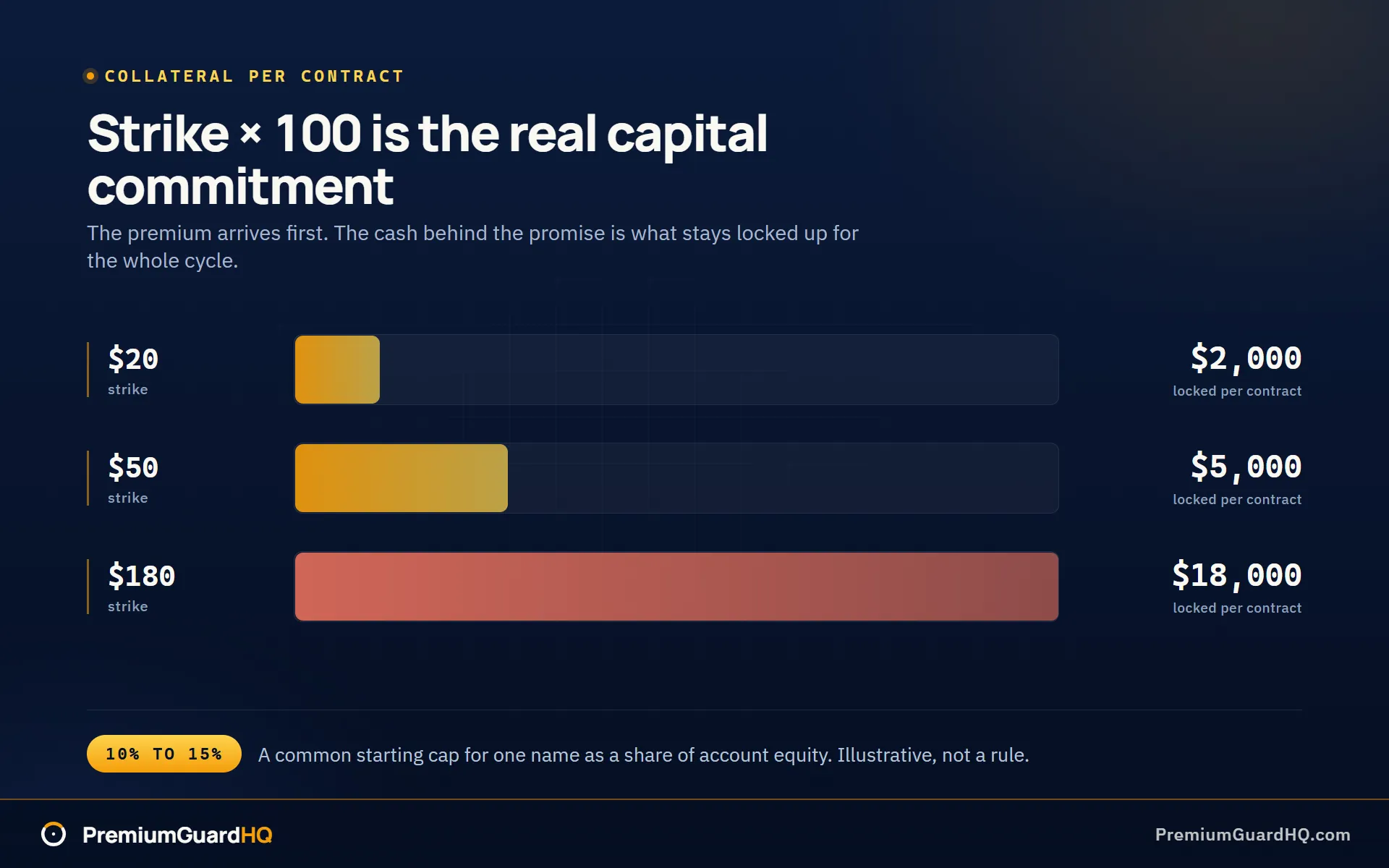
Selling one cash-secured put locks up cash. A cash-secured put means you set aside enough money to buy the stock if you get assigned. Here is the math. Take the strike price. A strike price is the set price you agree to buy the stock at. Multiply it by 100, then by how many contracts you sell.
A $50 strike means $5,000 of your cash sits locked up per contract. It cannot be used for anything else until the position closes. That number is your real capital commitment for the whole cycle, not just the premium you collect upfront. It is worth running what one contract actually locks up before you decide the premium is worth it.
Here is why this matters. If you get assigned, that locked-up cash turns into shares. Assignment means you are required to buy the stock at the strike price. Picture one position eating up 40% of your account. You are stuck. You cannot open new positions. You cannot react if something else needs attention. One trade just froze your whole operation.
Serious operators handle this with a cap. Many keep a single wheel position under a fixed slice of total account equity, often somewhere between 10% and 15% as a starting point. This is illustrative only, not a hard rule. The exact number matters less than having one at all.
This is what “running concurrent wheels” means. It means sizing positions small enough that you can hold several at once, on different stocks, without one assignment taking the whole account hostage.
Five wheels on five stocks that all move together is not diversification. If they are all tech stocks, or all retail stocks, one bad week hits all five at once.
A $20 stock needs $2,000 in collateral per contract. A $180 mega-cap stock needs $18,000. Same strategy, wildly different capital reality. If the share price only leaves room for one position, the wheel is a single-stock bet wearing an options costume.
3. Check options liquidity before you place the trade
The wheel is at least two trades. You sell the put first. The put is a promise to buy a stock at a set price. If you get assigned, meaning you end up buying the stock, you then sell a call. So you pay a hidden fee twice per cycle, not once. That fee is the bid-ask spread.
The bid is what buyers will pay. The ask is what sellers want. The gap between the bid and the ask means you lose money just entering and exiting the trade, even if the stock does exactly what you expected.
Check these things on the same day you plan to trade, not last week:
- Tight bid-ask spreads near the strikes you would actually use, plus a few strikes around it.
- Open interest on multiple strikes, not just one. Open interest counts how many contracts are still active. More contracts means more people already trade that strike.
- Volume that holds up during normal trading hours. Volume counts how many contracts changed hands today. Low volume means you might wait a long time for a fair price.
Those last two are not the same signal, and reading open interest next to volume is what tells you whether a strike is genuinely traded or just sitting there.
A rough guideline: on very liquid stocks, a spread under a dime on at-the-money strikes is a common quality filter. At-the-money means the strike price sits close to the current stock price. Treat this as a starting point, not a hard rule.
Here is the wheel-specific trap. Checking only the put side is not enough. Once you are assigned shares, selling covered calls is not optional if you want the cycle to keep paying you. A covered call is a promise to sell your shares at a set price. If the call-side options on that stock are thin, you are stuck holding shares with no good way to collect more premium.
Always use limit orders, which let you set your own price instead of accepting whatever is offered. Skip this and slippage, the gap between the price you expected and the price you got, quietly eats your profit. Index products like SPY and mega-cap names like Apple show what a tight market looks like. That is an example, not a recommendation.
4. Compare the premium to what the stock actually does
You check the stock’s IV rank. IV stands for implied volatility. It measures how much the market expects a stock to move. IV rank tells you where that number sits today compared to the past year. The rank looks high, so you sell the put feeling good. Then the stock drops hard, you get assigned, and the “rich” premium barely covers the loss.
Here is the missing piece. A high IV rank alone does not tell you if you are getting paid fairly. It only tells you the market expects movement. You also need to know if that expected movement is bigger than what the stock actually does. That is called realized volatility. It measures how much the stock has actually moved, day to day, in the past.
Premium is a payment for uncertainty. The wheel works best when implied volatility stays above realized volatility for months at a time, not just one lucky week. One good week can happen by chance. A pattern across months is something you can actually use.
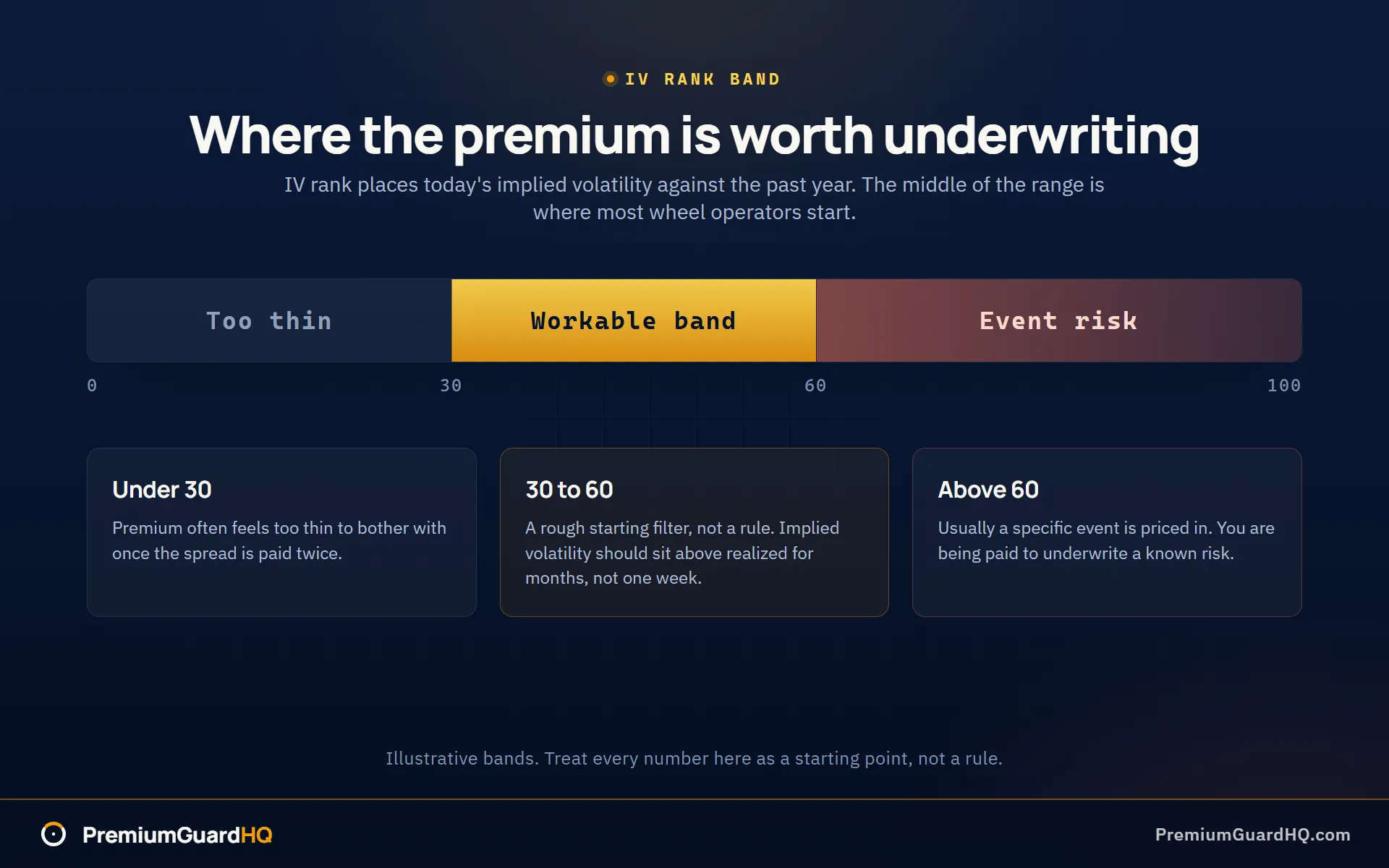
Many wheel operators start with a middle band, often somewhere around the 30 to 60 IV rank range, as a rough filter. This is a guideline, not a rule. Below that range, premium often feels too thin to bother with. Above it, you hit a red-flag zone. Very high IV rank often means the market expects a specific event, like an earnings report or a lawsuit ruling. You are not getting paid for normal uncertainty anymore. You are getting paid to underwrite a known risk. That is the question worth asking about stocks that carry persistently high implied volatility: is the premium compensation, or a warning?
Here is the trap. The put leg can look fantastic during a high IV spike. You feel smart. Then you get assigned, the stock settles down, and IV collapses. Now you are holding shares and your covered call premium is thin. You are collecting weak rent on a property you overpaid to acquire. Never build your whole thesis on one expiry’s premium snapshot. You need the pattern across months, not one juicy number from a single Tuesday.
A stable, liquid name like a large consumer staples stock often trades with moderate, steady IV most of the year. A stock prone to earnings surprises tends to show IV that spikes hard around specific dates and goes quiet in between. This illustrates the pattern. It is not a buy list.
Here is your operator check: if premium only shows up during panic, you are not running a wheel. You are underwriting headlines.
5. Let the business itself be your risk filter
Here is the part that catches people off guard. On the wheel, your real downside is owning the stock if you get assigned shares. The premium you collect is just a buffer. It softens the landing, but it does not stop the fall.
That is why the company underneath the ticker matters more than any Greek or IV number. You need to know it can survive a rough stretch without falling apart. Think of it as a durability check, not a valuation model.
A few signs point to a durable business. Can it pay its bills without constantly borrowing more or selling new shares? Can it handle higher interest rates without debt payments eating profits alive? Does its cash flow come from more than one product, customer, or government decision that could flip overnight?
You can check most of this in a few minutes:
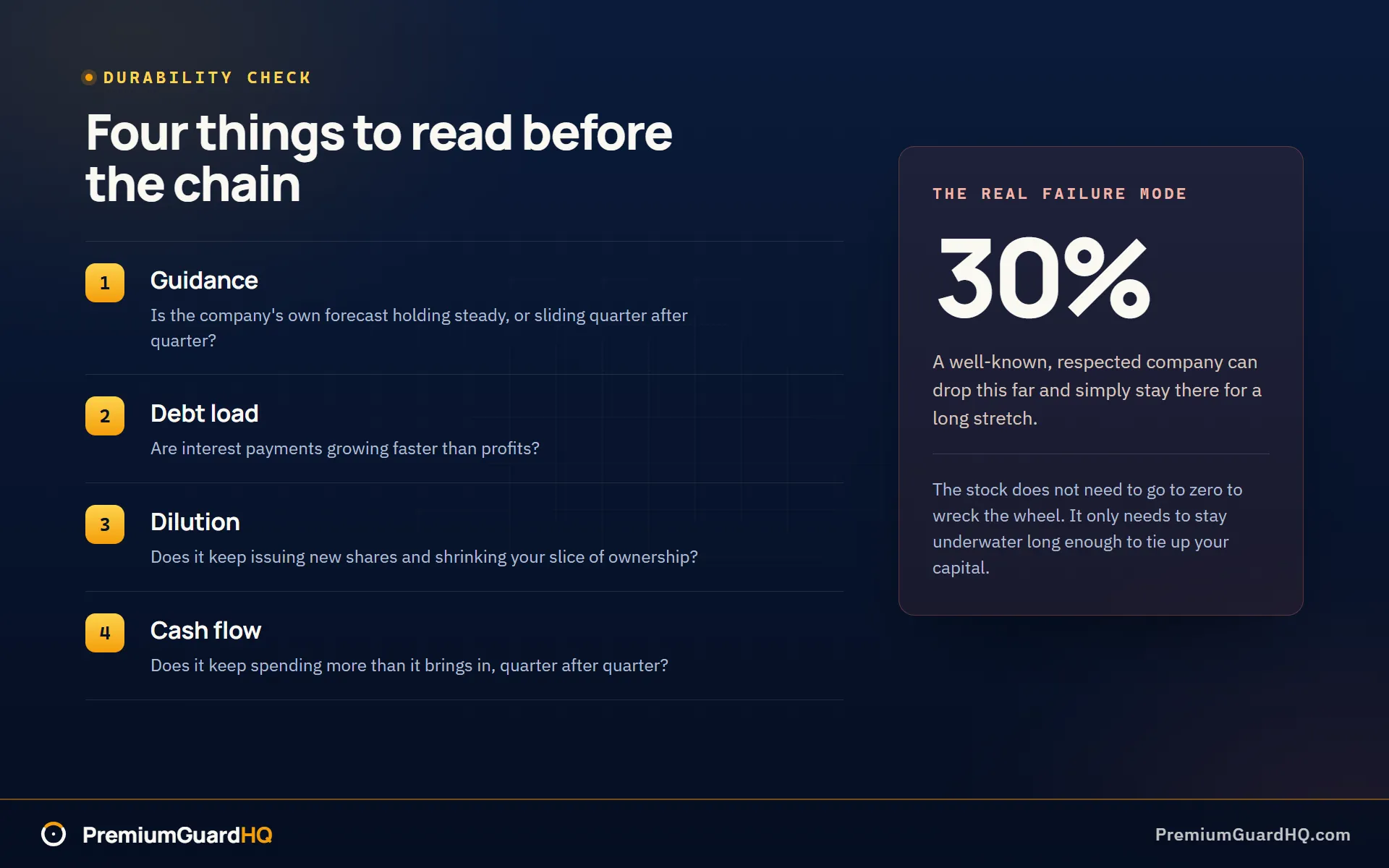
- Look at recent earnings reports. Is guidance, the company’s own forecast for future results, holding steady or sliding?
- Check the debt load. Are interest payments growing faster than profits?
- Watch for repeated dilution, meaning the company keeps issuing new shares and shrinking your slice of ownership.
- Watch for chronic negative cash flow, meaning the company keeps spending more than it brings in, quarter after quarter.
Here is the part that should scare you a little. Well-known, respected companies can drop 30% and just stay there for a long stretch. The stock does not need to go to zero to wreck your wheel. It just needs to stay underwater long enough to tie up your capital and test your patience. The question is whether the business can absorb that period without breaking.
A defensive sector name tends to weather a rough patch better than a highly leveraged or pre-revenue company. That is an illustration, not a recommendation.
You do not earn premium until the wheel closes. A durable business underneath increases your odds of closing the cycle cleanly instead of carrying dead weight for a year.
Frequently asked questions
Are ETFs better than single stocks for the wheel strategy?
ETFs trade a lower blow-up risk for a smaller premium profile. An ETF is a basket of many stocks, so one bad earnings report cannot sink the whole position the way it can with a single name. Liquidity on major ETFs tends to be strong, with tight bid-ask spreads, meaning a narrow gap between what buyers pay and sellers want. ETFs also rotate their holdings over time, dropping weak companies and adding stronger ones, which lowers the odds of permanent damage. The tradeoff is that premium is usually thinner, since single stocks carry more individual risk and get paid more for it.
How much capital do you need for one wheel position?
Take the strike price, the price you agree to buy the stock at, and multiply it by 100. That is your collateral for one contract. A $40 strike ties up $4,000. The bigger question is concentration. See Rule 2 above for the full breakdown. One position should never eat so much of your account that you cannot open others.
What are the tax implications of the wheel in a taxable account?
Most wheel outcomes, premium collected, assignment, and calls getting exercised, create short-term taxable events. Short-term means held under a year, and it is taxed at your regular income rate, which is often higher than long-term rates. That tax drag can quietly shrink your real return. Some index options qualify as Section 1256 contracts, a tax rule that can split gains between short-term and long-term rates regardless of how long you held the position. Eligibility varies, so confirm it and talk to a tax professional before assuming it applies to you.
How do you avoid running five wheels that all crash together?
This is correlation risk. Several of your positions move in the same direction at the same time, usually because they share a sector or a common driver. Five wheels on five stocks sounds diversified until you notice they are all tech, or all small-cap growth names. A cap on each sector, a cap on each position, discussed in Rule 2 above, and a watchlist that mixes different kinds of businesses all help. If one bad headline could hit half your positions at once, you have one bet spread across five tickers.