

Most guides about options trading for beginners start in the wrong place. They plunge straight into the Greeks, which are math formulas that try to predict how an option’s price will move. Or they throw complex trades at you before you know what one contract does. Worse, they show someone turning $2,000 into $50,000 by buying weekly calls. A weekly call is an option that expires in a week or less. That is a slot machine with extra steps, and it is where most beginners lose their first chunk of money.
An option is a contract. It gives you the right, but not the obligation, to buy or sell 100 shares of stock at a set price by a set date.
That is the whole idea in one sentence. Everything else is detail.
By the end of this guide, you will be able to define an option without pausing. You will know how to place a basic trade and close it without surprises. You will also have a clear learning order, one that skips the topics that wreck beginner accounts. That order starts with those weekly lotto calls.
We have watched new traders confuse complexity with skill. Let’s fix that, starting with what an option actually is.
What options trading is
Options trading means buying or selling contracts tied to a stock. Each contract sets a fixed price and a deadline. The buyer pays a small fee for the right to act. The seller collects that fee and must follow through if asked before the deadline.
That fixed price is the strike price. The deadline is the expiration date. The buyer’s small fee is the premium. Learn those three words and you already understand most of the vocabulary that trips up new traders.
Keep these points in mind as you read:
- One stock option contract usually covers 100 shares. Quotes are per share, but your real cost or payout is the quoted price times 100.
- Calls involve buying shares. Puts involve selling shares. In practice, most traders never touch the actual stock. They close the contract for cash before it ends.
How stock options work in the real world: from opening to closing
Before you click anything, learn to read an option’s label. Every option has five parts. The underlying symbol is the stock it is tied to, such as AAPL. After that come call or put, the strike price, the expiration date, and the premium, which is the price you pay or collect.
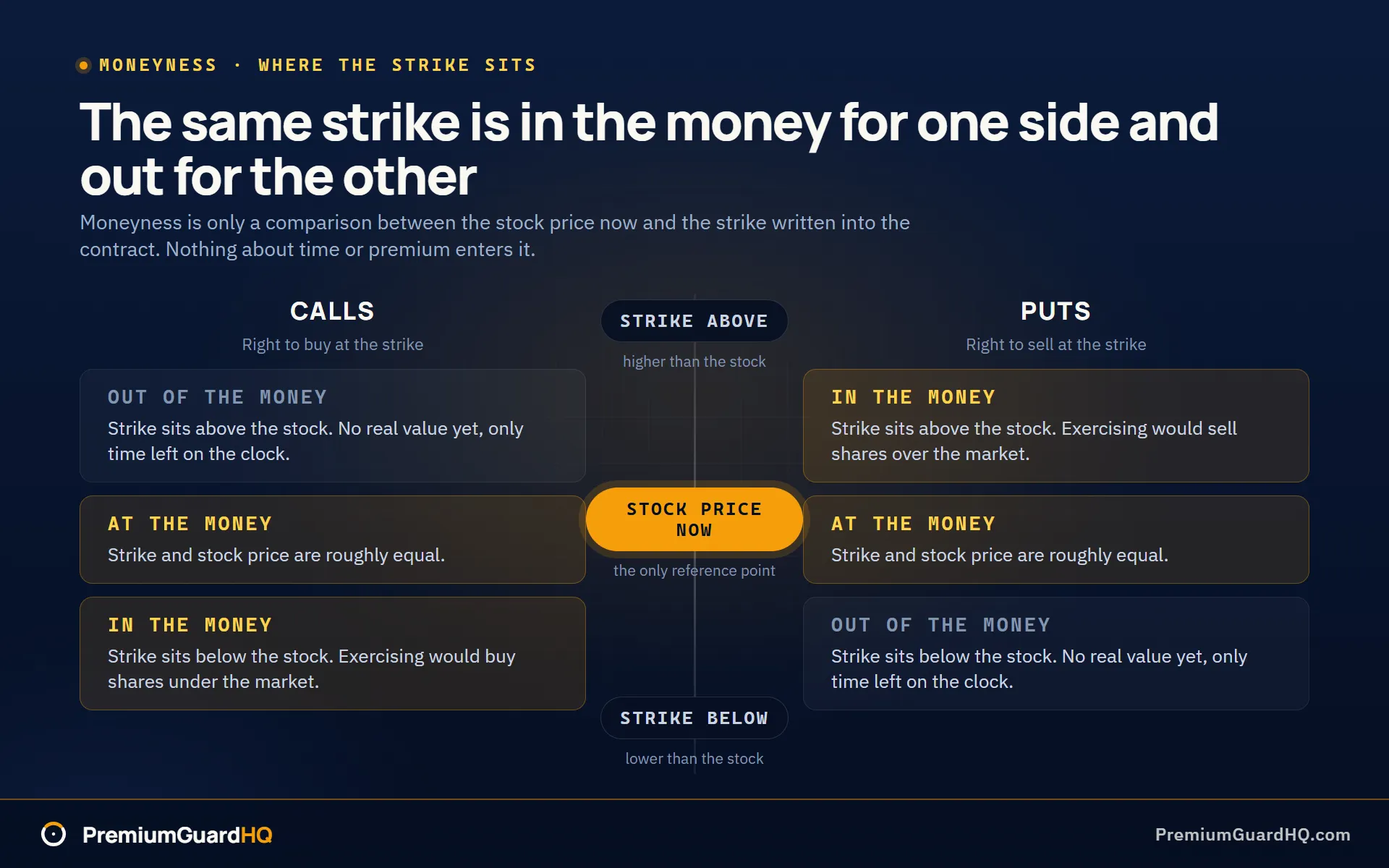
Those five parts also tell you about moneyness. Moneyness simply describes how the stock price compares to the strike price right now. A call is in the money when the stock trades above the strike. A put is in the money when the stock trades below the strike. At the money means the stock price and strike are roughly equal. Out of the money means the option has no real value yet, just hope and time left on the clock.
On the order ticket you will see four choices: buy to open, sell to open, buy to close, and sell to close. Buy to open starts a position where you own the contract. Sell to open starts a position where you owe someone else, so you have taken on an obligation. Buy to close and sell to close end those positions. Mixing up these four choices is the most common beginner mistake, so slow down and check the ticket before you submit.
One contract always equals 100 shares. An option priced at $1.20 costs $1.20 times 100 shares, or $120, plus a small broker fee. The multiplier applies every time, so check the total dollar amount before you click confirm.
Close your position before expiration and you are done. Your profit or loss is locked in no matter what the stock does afterward.
If you hold until expiration, a few outcomes are possible. Out-of-the-money options expire worthless. In-the-money options usually get exercised or assigned, which means stock changes hands between buyer and seller. Buying an option is not the same as exercising it. Buying gives you the contract. Exercising is a separate choice to use it, and you control whether and when that happens.
One last check before you trade. Every option has a bid, which is what buyers offer, an ask, which is what sellers want, and a mid, the price in between. A wide gap between bid and ask quietly costs you money on every trade. Stick to liquid, heavily traded names where that gap stays tight. Brokers also require approval levels before you can trade options, and they restrict riskier strategies like selling uncovered options. It is worth reading what your brokerage firm has to approve before you can trade options so you apply for the right tier the first time.
The beginner learning path: the only order that makes sense
Many guides throw every topic at you at once. That approach backfires. Here is an order that works, with the reason each step comes before the next.
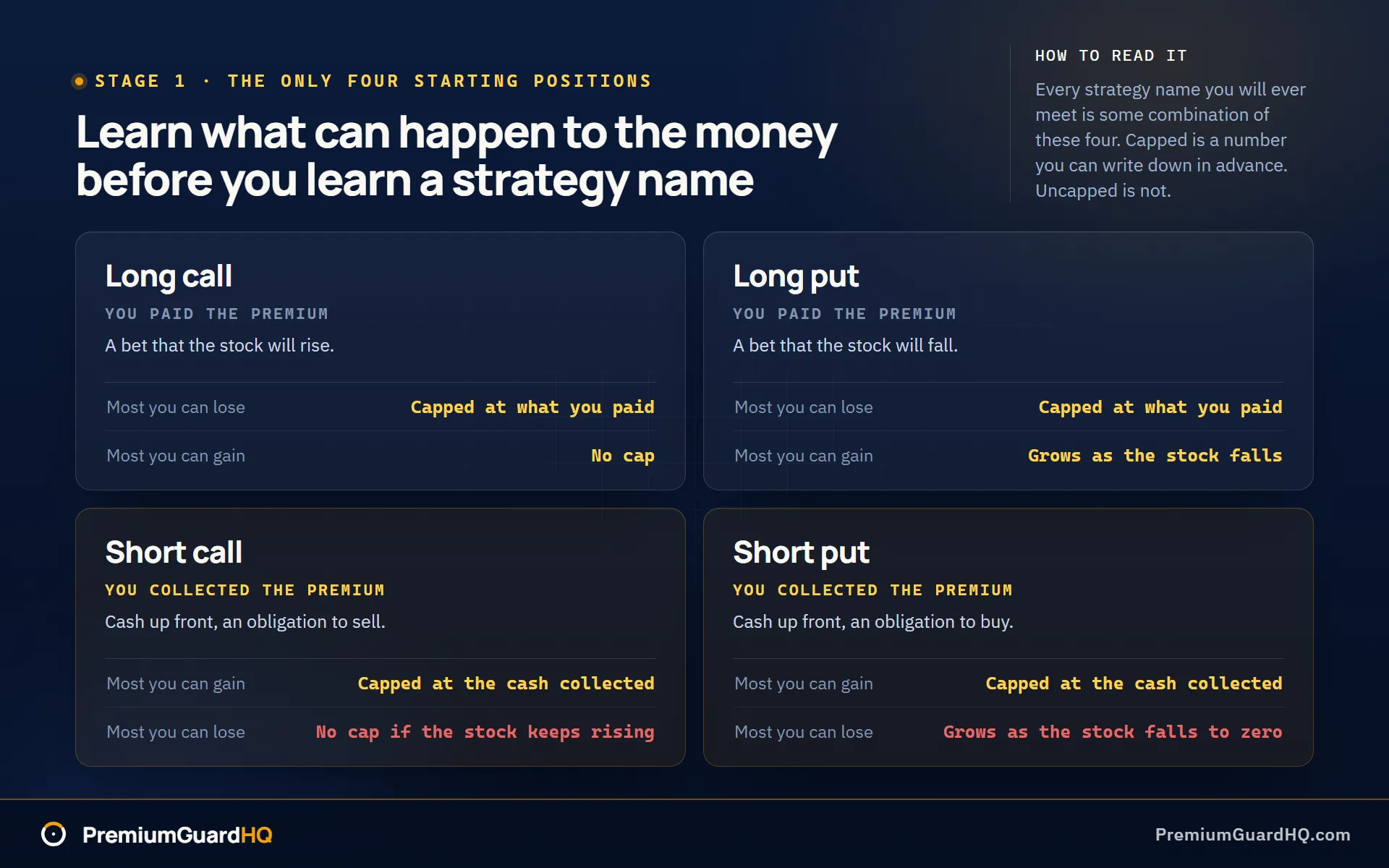
Stage 1: Learn the four basic payoffs. Before any strategy name, learn what can happen to your money. There are only four starting positions in options trading. A long call means you paid to buy a call, a bet that the stock will rise. The most you can lose is what you paid, and your gain has no cap. A long put means you paid to buy a put, a bet that the stock will fall. Your loss is capped at what you paid, and your gain grows as the stock falls. A short call means you sold a call and collected cash up front. Your gain is capped at that cash, but your loss has no cap if the stock keeps rising. A short put means you sold a put and collected cash up front. Your gain is capped at that cash, and your loss grows as the stock falls, down to zero. Learn these four before any strategy name. Every strategy is just these four building blocks combined. If the put side is the part that feels slippery, how long puts and short puts differ walks through both directions on their own.
Stage 2: Learn how to open, close, and size a trade. Once you know the four payoffs, practice sizing positions in real dollars, not contract counts. One contract priced at $1.20 puts $120 on the table, because each contract covers 100 shares. That dollar number should jump out before you click confirm. Before placing any trade, also decide whether you will close early or let the option ride to expiration. Closing early is safer for most beginners. Exercising an option means using your right to buy or sell the stock, and doing it early throws away any time value still left in the option’s price. Letting a broker auto-exercise, or choosing to exercise yourself, is usually a mistake while you are still learning.
Stage 3: Learn what actually moves an option’s price. An option’s premium, the price you pay or collect, has two pieces. Intrinsic value is the part that is already real money right now, based on where the stock sits versus the strike price. Extrinsic value is everything else, mostly a bet on time and future movement. Two Greeks matter at this stage, and only two for now. Greeks are numbers that show how an option’s price reacts to different forces. Delta is a rough stand-in for how much the option acts like owning or shorting 100 shares of stock. Theta is the daily cost of time. It drains value from buyers every single day and quietly pays sellers while they wait.
Stage 4: Only now, learn strategies. With payoffs, mechanics, and pricing in place, strategy names finally make sense. Start with strategies that limit mistakes, stay easy to watch day to day, and have assignment paths you already understand. Assignment means being forced to buy or sell stock because someone exercised an option against you. Jumping into complex strategies or fast weekly bets before this stage is how beginners lose money they did not need to risk.
Options trading cheat sheet: the numbers and definitions you actually use
Bookmark this. It is the short list of words and numbers you will use every time you look at an options chain, a list of available contracts and their prices.
| Term | What it means | What it changes |
|---|---|---|
| Underlying | The stock the option is tied to | Everything about the contract’s value comes from this stock’s price |
| Contract | One options agreement covering 100 shares | Your real dollar size, not just “one trade” |
| Strike | The fixed price written into the contract | Where profit or loss starts counting |
| Expiration | The last day the contract is valid | How much time is left for the stock to move |
| Premium | The price you pay or collect for the contract | Your max cost if buying, your max gain if selling |
| Multiplier | Each contract equals 100 shares | Turns a quoted price into a real dollar amount |
| ITM / ATM / OTM | In, at, or out of the money. This means how the stock price compares to the strike | Tells you if the option has real value right now or just hope |
| Bid / ask / mid | What buyers offer, what sellers want, and the price in between | A wide gap quietly eats your profit on entry and exit |
| Open interest | How many contracts are still open across all traders | Low numbers mean a hard time getting a fair price |
| Implied volatility | The market’s guess at how much the stock will swing | High numbers mean fat premiums, but also bigger risk the option’s price crashes later |
| Assignment | Being forced to buy or sell stock because someone used their option against you | Can turn an options trade into a stock position overnight |
| Buying power / collateral | The cash or margin your broker locks up for a trade | Limits how many positions you can hold at once |
Three rules of thumb help beginners avoid the most common damage. Treat them as habits, not guarantees.
Liquidity first. Choose options with a tight gap between bid and ask, plus real trading volume and open interest. A wide gap costs you money the moment you enter and again when you exit, even if you picked the stock correctly.
Time is a position. Options that expire very soon are often called weeklies. They lose value quickly as each day passes, a cost called time decay. Do not pick something that short just because it looks cheap unless you have a specific reason.
Event risk is priced in. Implied volatility usually jumps before earnings and drops hard right after. That drop is called an IV crush. It can shrink an option’s price even if you guessed the stock’s direction correctly, which hurts anyone who bought the option expecting a big move.
Before you place any trade, answer three questions:
- What is my max loss in dollars, not percent?
- What makes this trade a win, and what is my exact exit plan?
- What happens at expiration if I do absolutely nothing?
If you cannot answer all three in one sentence each, you are not ready to click confirm. The first question is arithmetic rather than judgment, so work out the max loss in dollars before you commit instead of estimating it in your head.
What to ignore as a beginner, and a sensible first trade
A few paths look exciting while mostly losing money. Here is what to skip and why.
Weekly calls as your go-to move. These expire fast, often in days. A call option gives you the right to buy 100 shares at a set price. You already know about time decay, the daily cost that drains an option’s value as expiration approaches. On a weekly call, that drain is brutal. You need the stock to move your way almost immediately, or the contract bleeds out. That is a countdown clock rather than a strategy.
Multi-leg spreads you can’t explain simply. A spread means buying one option and selling another at the same time. If you cannot describe a trade in one plain sentence, hold off risking money on it until you can.
Selling uncovered options. This means selling a call or put without owning the stock or setting aside cash to back it up. People also call this naked selling. The loss can be unlimited, or close to it. Beginners should not touch this.
Illiquid contracts. These are options that do not trade often. You already learned why they are dangerous: a wide gap between the buy price and sell price quietly eats your money, coming and going.
Courses and signal services that skip the math. If someone is selling you picks instead of showing you the real numbers behind a trade, walk away. You want to understand your own risk, not borrow someone else’s guess.
So what is a sensible first trade? A covered call on shares you already own. You sell a call option against 100 shares you already hold and collect cash right away. That cash is called the premium.
Here is why it fits a beginner well. Your size is fixed at 100 shares per contract, so there is no guessing about how big to make the trade. You already own the stock, so there is no guesswork about the company. You agree to something simple: you may have to sell your shares at the strike price, the set price written into the contract, if the stock rises past it.
Set your expectations correctly. A covered call is income plus a capped upside, not a magic yield button. You give up some potential gain in exchange for cash today. For the full picture, read the full covered call playbook.
Two close cousins are worth knowing too. A cash-secured put means setting aside cash to buy a stock at a set price if it falls that far, and the cash-secured put, step by step covers how that collateral works. A protective put works like insurance on stock you own.
Before risking real money, try paper trading. That means placing practice trades with fake money so you can learn order tickets and exits without risk. Keep your early real positions small compared to your account size, so one mistake teaches you a lesson instead of ending your trading.
Worked example: a covered call from open to expiration
Here is a covered call from open to expiration, with illustrative numbers. A covered call is a promise to sell stock you already own at a set price in exchange for cash paid to you today.
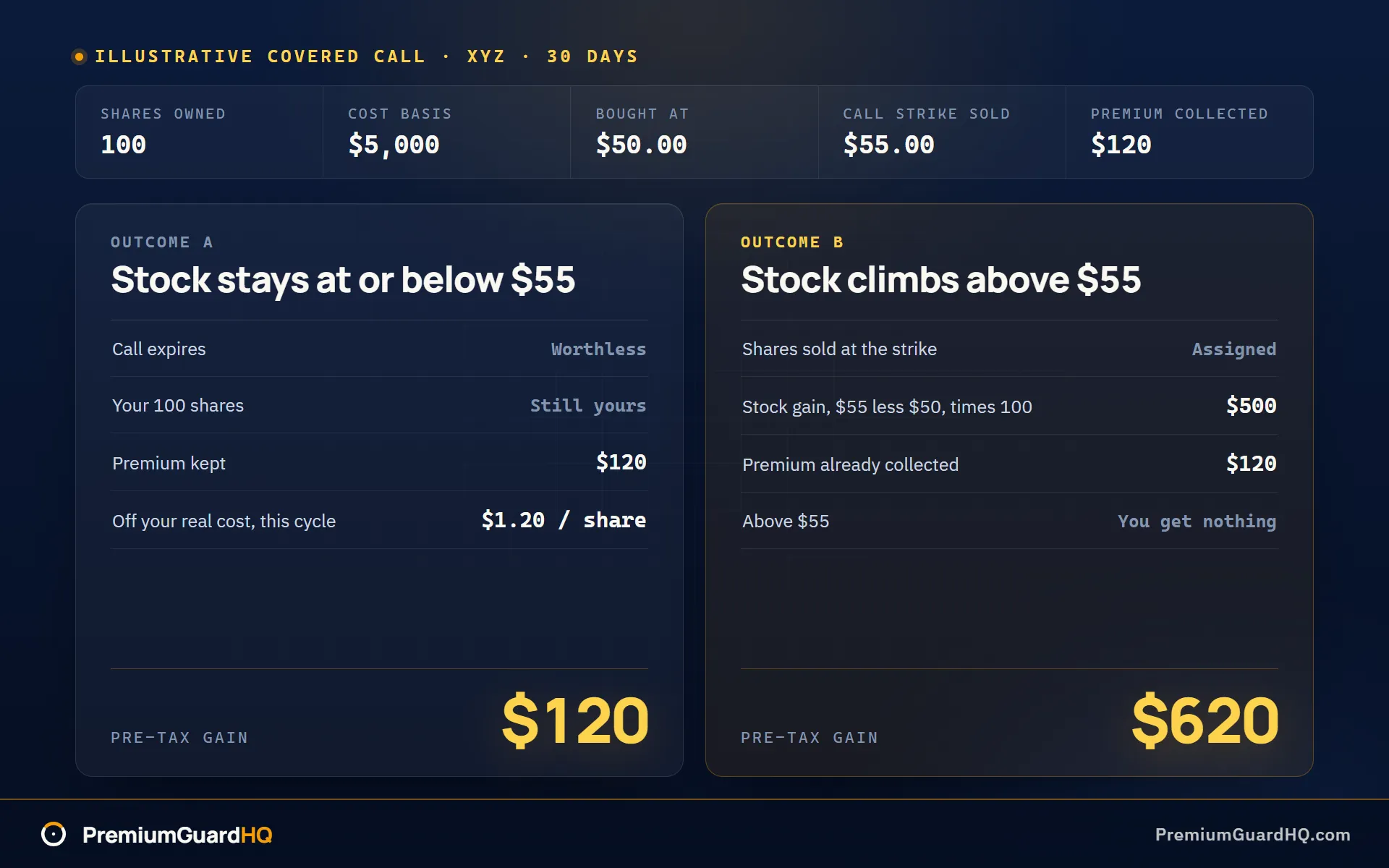
You own 100 shares of a stock called XYZ. You bought them at $50 each, so you paid $5,000 total. That $5,000 is your cost basis, the price you paid to get in.
You sell 1 call option with 30 days left until it expires. Selling the call means someone else now has the right to buy your shares at $55 each if they want to. That $55 is the strike price. For granting that right, you collect a premium of $1.20 per share right away. One contract covers 100 shares, so you receive $1.20 times 100, or $120 cash, deposited into your account before fees or taxes.
From here, two things can happen.
Outcome A: the stock stays at or below $55. Your call expires worthless. The other side never uses their right to buy, so nothing happens to your shares. You keep the full $120. Your 100 shares are still yours. For this one cycle, that $120 works out to $1.20 per share taken off your real cost. You got paid simply for holding stock you already owned.
Outcome B: the stock climbs above $55. Now you get assigned. Assignment means you are required to sell your 100 shares at $55 each, even if the stock is worth much more. Your stock gain is $55 minus $50, times 100 shares, which equals $500. Add the $120 premium you already collected, and your total pre-tax gain above your cost basis is $620.
The tradeoff in one line: you get nothing above $55, even if the stock runs to $70 or $100. You agreed to give up that upside the moment you sold the call. If it helps to see how the two outcomes compare side by side, the arithmetic above is the whole model.
One last note. Most experienced traders close their covered call early to avoid surprises that can pop up over expiration weekend, the stretch of days right before the contract ends.
Tradeoffs and risks beginners actually run into
Options come with real traps. The ones that actually hurt new traders go well beyond losing the money you paid.
Magnified moves cut both ways. A small change in the stock can become a large swing in the option’s value. A 2% move in the stock can move your option 20%. That works for you and against you equally, and it is why small accounts can blow up fast.
You can be right about direction and still lose money. Theta is the daily cost of time. It drains your option’s price every day you hold it, even while you wait for the stock to move your way. Short-dated contracts lose value the fastest. A stock’s implied volatility, which measures how much the market expects it to swing, often drops sharply right after an earnings report. If you bought an option expecting a big move and the stock barely budges, that falling volatility can shrink your option’s value even on a day the stock went your way.
Assignment is a real event. Assignment occurs when you get forced to buy or sell stock because someone used their option against you. If you sell options, be ready for assignment at any time, even before expiration. Have the cash or shares ready to deliver the morning it happens instead of scrambling to find them.
Liquidity costs money you don’t see. Liquidity means how easily you can buy or sell without moving the price. A wide gap between the bid price and the ask price turns a small trade into an expensive round trip. You lose a little on the way in and a little more on the way out, and it adds up fast on thinly traded contracts.
Taxes add friction. Most options profits are short-term gains, which means net short-term gains are taxed as ordinary income at your regular rate rather than the lower long-term rate. Wash-sale rules can disallow a loss if you re-enter a similar position too soon, which leaves messy tax records. Active traders should work with a tax preparer who understands options.
Your own behavior is the biggest risk. The fastest way to lose money is breaking your own rules after a winning streak. Chasing a fat premium on a junk stock you would never otherwise touch is a close second. Both come from the same place: confidence turning into overconfidence.
Frequently asked questions
Do I need options approval or margin to trade options?
Most brokers assign approval levels according to experience, account size, and the answers you give on an application. Margin is a loan from your broker against your account. You do not need the highest approval level or margin to get started. Covered calls and cash-secured puts, the two beginner strategies covered earlier, often qualify for lower approval tiers since your risk is already capped. Read your broker’s permission levels carefully before you apply, so you know exactly what you are allowed to trade and what still requires a higher tier.
Should I close an option trade early or let it expire?
Closing early locks in your result and sidesteps the mechanics of expiration day, including assignment, where you would be forced to buy or sell the stock. Letting an option expire is also fine, as long as you know what happens if it finishes in the money, meaning it has real value at the deadline. As a beginner, lean toward being intentional. Decide your exit plan before you open the trade instead of waiting to see what happens and reacting under pressure.
How are options taxed, and can options trigger wash sales?
Most option profits count as short-term gains and are taxed at your regular income rate, since most contracts are held under a year. Wash-sale rules can disallow a loss if you close at a loss and then re-enter a similar, or substantially identical, option or stock too soon afterward. This can apply across your stock and option positions together, even outside options alone. If you trade often, use tax software built for active traders or work with a CPA who understands options.
Is paper trading worth it for options beginners?
Yes, for learning mechanics. Paper trading means placing practice trades with fake money, and it is a solid way to learn order tickets, how spreads work, and how to exit a position without risking real cash. It falls short on one thing: emotions. Fake money does not feel like real money, so paper trading will not teach you how you react under real pressure. Use it to iron out mechanical mistakes first, then size your early real trades small while you learn the emotional side.