
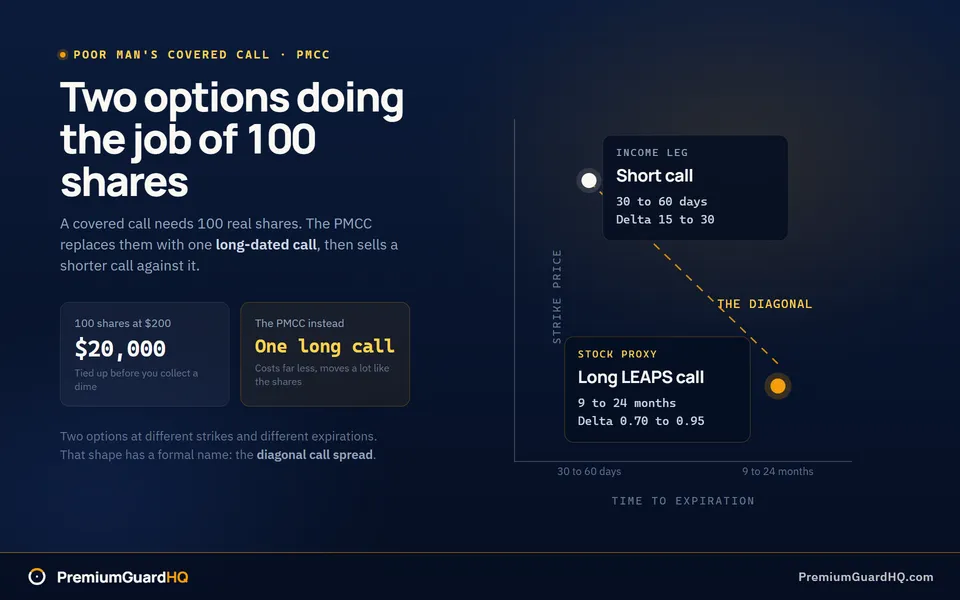
Covered calls are simple. You own 100 shares of stock. You sell a call against them. You collect cash right away. This cash is called a premium. But there’s a catch. Owning 100 shares costs a lot of money. At $200 a share, that’s $20,000 tied up in one stock before you make a dime.
This is the exact problem the poor man’s covered call solves. Traders call it a PMCC for short. Instead of buying 100 shares, you buy one long call option that acts like the stock. This option costs way less than $20,000, but it moves a lot like the shares would.
At PremiumGuard, we track this cycle math every day. Here’s the clean explainer. You’ll learn what a PMCC really is, how its two parts fit together, and the few numbers that decide if the trade makes money. You’ll also learn what can go wrong, like assignment, rolling, and broker rules.
What is a poor man’s covered call (PMCC)?
A poor man’s covered call is a trade with two parts. First, you buy a call option that costs less than owning 100 shares, but moves like those shares. This option has a long time left before it expires, often a year or more. Traders call this kind of long-dated option a LEAPS. Second, you sell a shorter-dated call against it. This lets you collect premium, which is the cash you get paid for selling an option. The goal is to earn income like a normal covered call, but spend less money to start.
Traders call this same trade by different names. You may hear it called a “covered call LEAPS.” You may also hear it called a “diagonal call spread.” This second name describes the actual shape of the trade: two options, at different strike prices, with different expiration dates. All three names point to the same two-part setup.
Here is one key difference to remember. A PMCC is not a real covered call. In a real covered call, you own 100 actual shares of stock. In a PMCC, there are no real shares owned. Instead, you own a long-dated call option that acts like those shares. This option can lose value or expire, which is a risk real stock shares do not carry in the same way.
How the PMCC option strategy works, step by step
Here’s the trade from start to finish, one step at a time.
Step 1: Pick the stock, and check that it trades easily. Check that options on this stock trade easily before you buy anything. The gap between the buy price and the sell price should be small. This gap is called the bid-ask spread. Also check that many contracts trade each day, a number called open interest. Traders often skip this check on the long-dated option, and a wide spread there can quietly eat your profits. Once this checks out, the position behaves like a stock you own with an income machine attached to it.
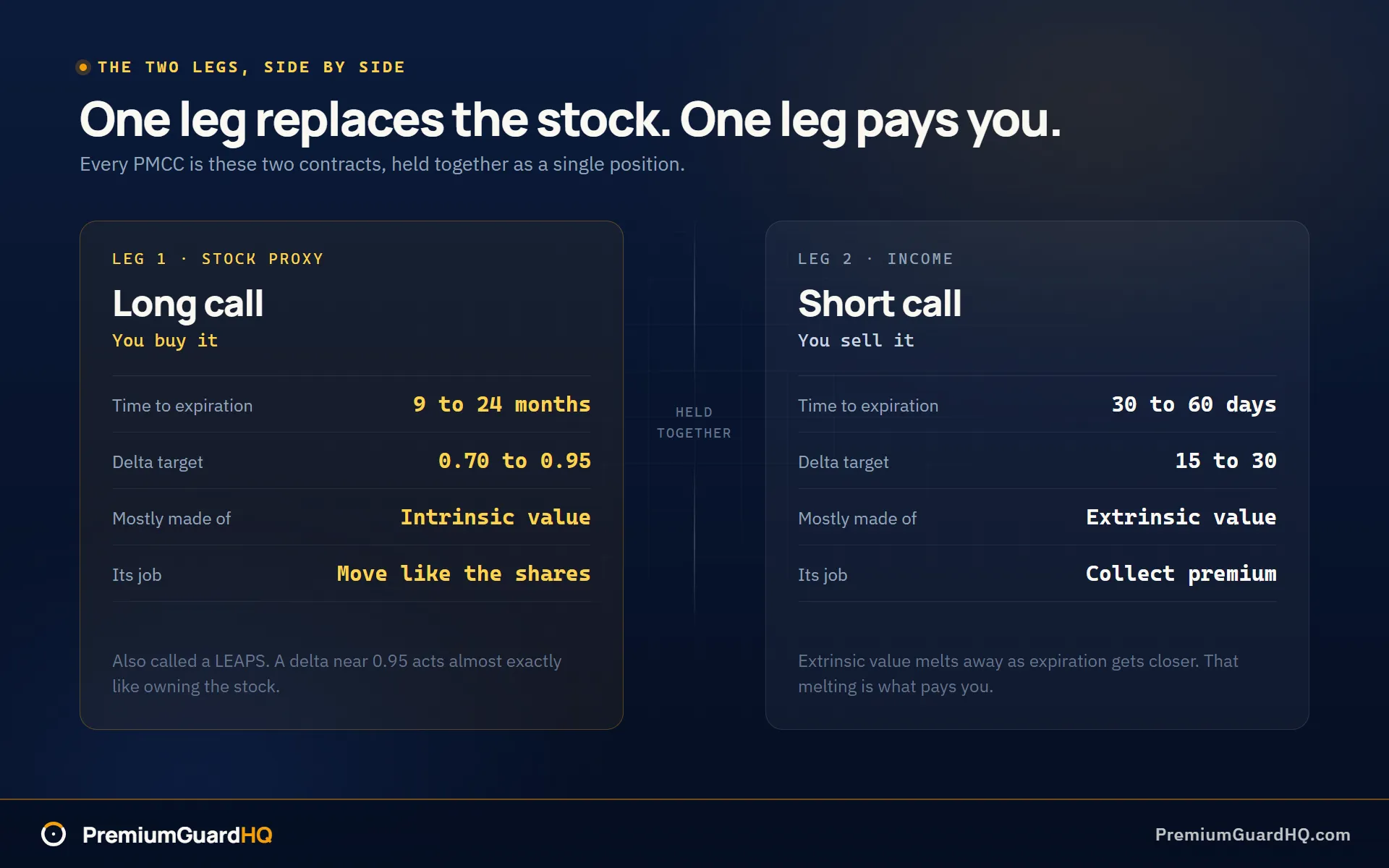
Step 2: Buy the long call. Pick one with 9 to 24 months left before it expires. Some traders go longer, up to 2.5 years. Pick a delta between 0.70 and 0.95. Delta is a number that shows how much the option’s price moves when the stock moves $1, so a delta near 0.95 acts almost exactly like owning the stock. Most of the price you pay is intrinsic value, meaning the option is already worth something today. A smaller piece is extrinsic value, the extra price tied to time and uncertainty.
Step 3: Sell the short call. This is where income shows up. Pick an option that expires in 30 to 60 days, with a delta between 15 and 30. The cash you collect comes almost entirely from extrinsic value, which melts away as expiration gets closer. That melting is what pays you.
Step 4: Watch what happens at expiration. If the stock stays below your short call’s strike price, the option expires worthless. You keep the full premium and sell another short call. If the stock climbs near or past the strike, you have choices: close the short call, roll it to a new date, or close the whole position. Nothing forces your hand here.
Step 5: Know what assignment really means. If your short call gets assigned, you owe 100 shares per contract. There are no shares waiting on hand to cover that automatically. You must either close your long call for cash, or exercise it to create real shares, depending on what your broker allows. One contract always controls 100 shares, so every assignment or exercise happens in blocks of 100.
Step 6: Close the campaign. You can close both legs together, or close one and keep the other, depending on your goal. Either way, remember this: the premium you collected is not truly yours until the cycle is closed and the final profit or loss is known.
The PMCC math operators actually track: net debit, strike width, and breakeven
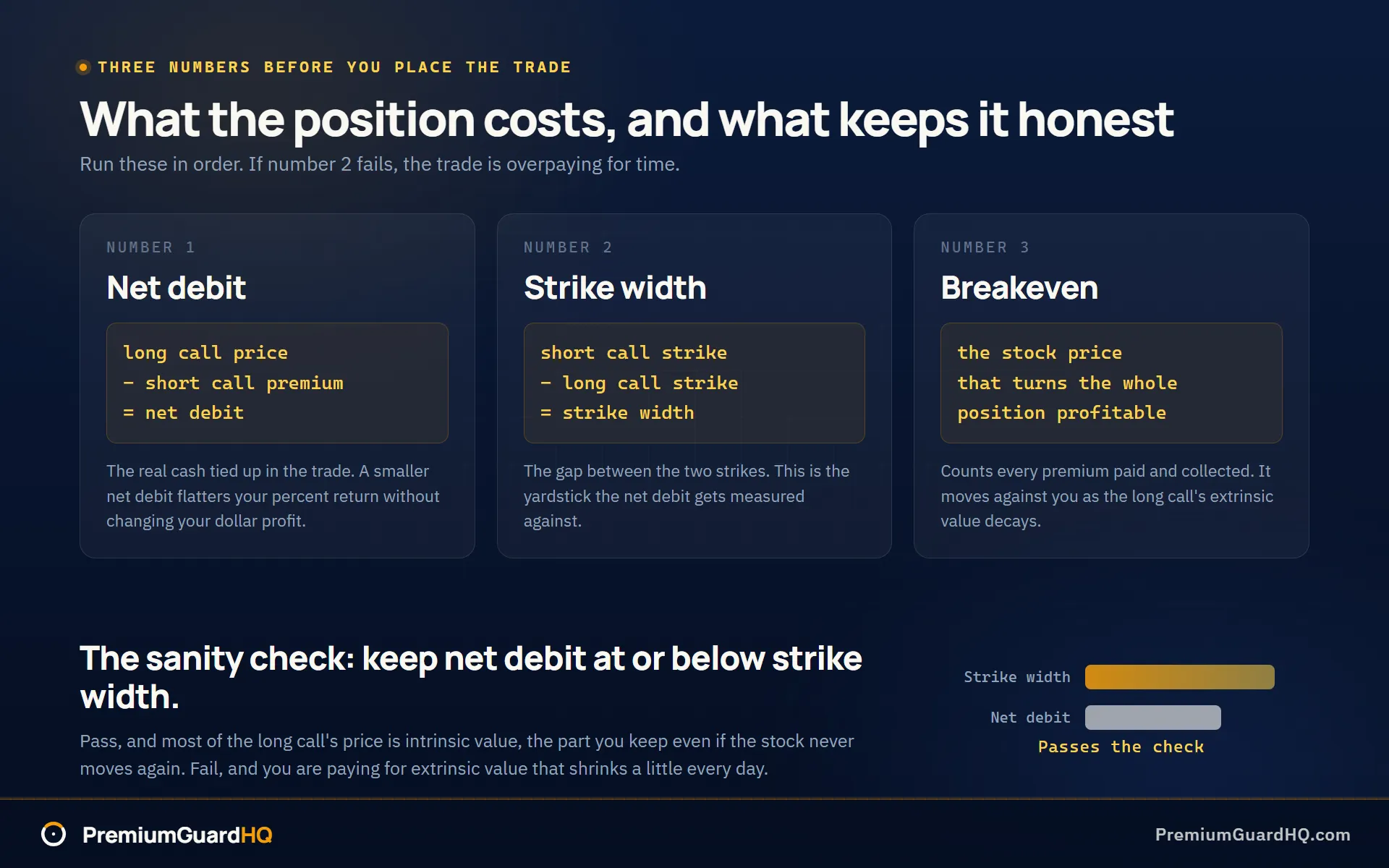
Think of the PMCC as one object made of two parts. The long call gives you stock-like movement. It is the option that goes up and down like the stock does. The short call sells time against it. It is the option you sell to collect income now, but it caps your gains above a certain price. Three numbers decide whether the whole trade makes sense before you place it.
Number 1: Net debit. This is what the position actually costs you. Take the price you paid for the long call. Subtract the premium you collected for the short call. Premium just means the price of an option. What’s left over is your net debit, the real cash you have tied up in the trade. A smaller net debit makes your percent return look bigger, even if your dollar profit is exactly the same. Don’t let that trick you. Percent returns and dollar returns tell two different stories.
Number 2: Strike width. This is your sanity check. A strike is the price written into an option contract. Subtract the long call’s strike from the short call’s strike. That gap is the strike width. Many traders follow a simple rule: keep your net debit at or below the strike width. This matters because it keeps most of your long call’s price made up of intrinsic value. Intrinsic value is the part of the price you would still have even if the stock never moved again. If your net debit is higher than the strike width, you’re overpaying for extrinsic value, the time-based part of the price that shrinks a little every day no matter what the stock does.
Number 3: Breakeven. This is the stock price you need for the whole position to turn a profit, once every premium paid and collected is counted. Here’s the mistake almost everyone makes. They treat the long call like owning the stock outright, and assume a flat stock price means they’re safe. That’s wrong. The long call’s extrinsic value keeps shrinking every day, even while the stock sits still. This quiet loss is called time decay. If time decay eats more value than your short call brings in, a flat stock can still mean a shrinking position.
Most trade logs will not treat it as one object, though. A PMCC arrives as a long call and a short call booked separately, and all three numbers above only exist once you put the two back together. PremiumGuard reads a diagonal as one position instead. Because the legs expire on different dates, its projections stop at the nearer expiration rather than drawing a payoff the trade never actually reaches.
These three numbers connect back to how you picked your long call in the first place. Delta measures how much an option’s price moves when the stock moves a dollar. A long call with 0.90 delta acts more like owning the stock than one with 0.70 delta. Higher delta means more of your cost is intrinsic value, which is safer under the strike-width rule. It also means more dollars tied up in the trade. This is the real tradeoff traders are managing when they choose between a 0.70 delta and a 0.90 delta long call. The pricing mechanics behind that choice come down to what actually moves a LEAPS call’s price.
Frequently asked questions
Is a PMCC the same thing as a diagonal spread?
Yes. “Poor man’s covered call” is just the nickname traders use. “Diagonal call spread” is the formal name for the actual structure: two call options at different strike prices and different expiration dates. The nickname stuck because the trade tries to act like a normal covered call, but ties up far less cash than buying 100 shares outright.
Those different expiration dates are also why a PMCC is harder to chart than most spreads. When the short call expires the long call is still alive and still holds time value, so there is no single expiration day to draw the position at. Structures where every leg does expire together, a covered call or a call credit spread, can be mapped exactly in a multi-leg payoff calculator.
What delta should the LEAPS be for a poor man’s covered call?
Most traders pick a long-dated call, called a LEAPS, with a delta between 0.70 and 0.95. Delta measures how much an option’s price moves when the stock moves one dollar. A delta near 0.70 costs less upfront but carries more extrinsic value, the time-based part of the price that fades over time. A delta near 0.85 to 0.95 costs more but tracks the stock more closely and holds less extrinsic value at risk.
What happens if my short call gets breached or assigned early?
“Breached” means the stock price moved above your short call’s strike price. This does not force anything to happen right away, but it raises the odds of early assignment. Assignment means the person who bought the call from you decides to exercise it, and you now owe 100 shares per contract. From here you have three paths: close the short call, roll it to a new strike and date, or close the entire position. Early assignment happens more often around ex-dividend dates, and when the option’s extrinsic value has shrunk close to zero.
How do brokers treat margin and collateral for PMCCs?
This varies by broker. It depends on your account’s approval level, and whether your broker’s system recognizes the trade as a diagonal spread rather than two separate, unrelated option trades. Some brokers require more collateral than others for the exact same position. Before you scale up your size, check the buying power effect shown in your order preview. Don’t assume it will match what you saw on a different broker or a different account.
Are there tax complications with PMCCs and rolling?
Options taxes can get complicated fast, especially with frequent rolling. Rolling a short call to a new date and strike can interact with wash sale rules, which can delay how a loss counts for tax purposes. It can also interact with straddle-style rules that defer losses when positions overlap in certain ways. The safe move is to document every close as its own finished cycle, then review your full year with a qualified tax professional who knows your specific situation.
If the math feels unclear, the fix is always the same: treat every adjustment as part of one campaign and track realized P/L when the cycle is closed.