
You pull up an options chain to sell a cash-secured put. That’s a promise to buy stock at a set price, backed by cash you set aside. You see a number like $1.21 or $0.60. It feels random, like the market just made it up.
It didn’t. Option premium is the price tag on a specific risk package you agree to take on. You are not collecting free money. You are getting paid for exposures that are named and measurable.
Soon you’ll be able to split any premium into two parts: intrinsic value and extrinsic value. You’ll know how to find intrinsic value for calls and puts. And you’ll be able to name the forces that push extrinsic value up or down. A premium quote will stop looking like a random broker number. It will look like a math problem you can solve.
Here’s the formula that makes it click.
How is option premium calculated
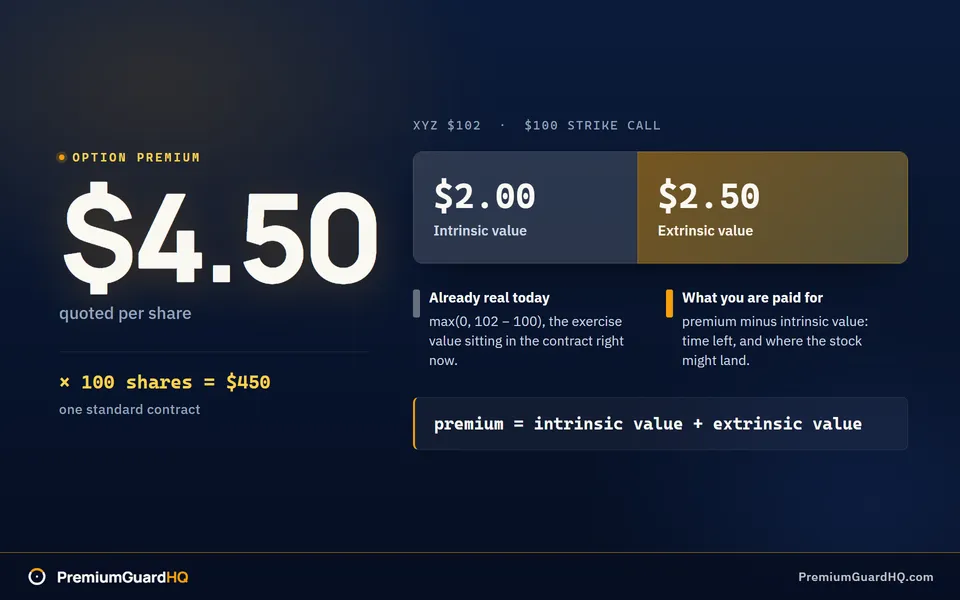
Option premium is the market price of an options contract. It splits into two parts: premium equals intrinsic value plus extrinsic value. As a seller, that price is the credit you collect for the exercise value you’d get right now, plus money for the time and risk still left before the contract ends.
Premium is quoted per share, not per contract. One standard stock option is a listed contract over 100 shares, so the actual cash you collect is close to the quoted premium times 100. A quote of $1.21 means you collect roughly $121 per contract.
Intrinsic value comes from comparing the stock price to the strike price. The strike price is the set price written into the contract. Extrinsic value is everything else in the premium. It covers the time left on the contract and the uncertainty about where the stock will go. On short-dated trades, extrinsic value is usually the bigger piece of the premium. Selling off that extrinsic value is the whole point of the wheel strategy.
If you want the full pricing model behind how extrinsic value gets calculated, read the pricing model that produces a quoted option price.
What you are actually selling when you collect premium
Here is a simple way to turn any quote into real numbers. This works on any options chain you look at.
Step 1: Pull the bid and the ask. The bid is what buyers are offering to pay. The ask is what sellers want. Both sit in the same row once you know how a chain lays out bid, ask and strike. As a seller, your order fills near the bid most of the time, not the ask.
Step 2: Pick a working number. For learning the math, use the midpoint. That is the bid and ask added together, then cut in half. Real fills move around based on how busy the market is that day.
Step 3: Find intrinsic value. This is value the contract already has, right now, if it were used today. The next section covers the exact formulas for calls and puts.
Step 4: Subtract to get extrinsic value. Extrinsic value equals premium minus intrinsic value. Whatever is left over is what you are paid for time and risk.
That is it. Four steps, every time, on any contract.
So what are you actually getting paid for? Two things only:
- Intrinsic value, if the contract has any.
- Extrinsic value: payment for the days left before the contract ends, plus payment for not knowing where the stock will land by then.
Market makers are the firms posting those bid and ask prices. They often use pricing models to set them, and that math is a deeper topic. This article sticks to what the premium is made of, not how the model builds it.
One number to anchor this: if the quote reads 1.25, your gross premium for one contract is about $125. That’s 1.25 times 100 shares, before fees and commissions come out. Mixing up the quote price with the per-contract dollar amount is one of the most common beginner mistakes, so always multiply by 100 before you do any other math.
Intrinsic value: the part of premium that is pure exercise value
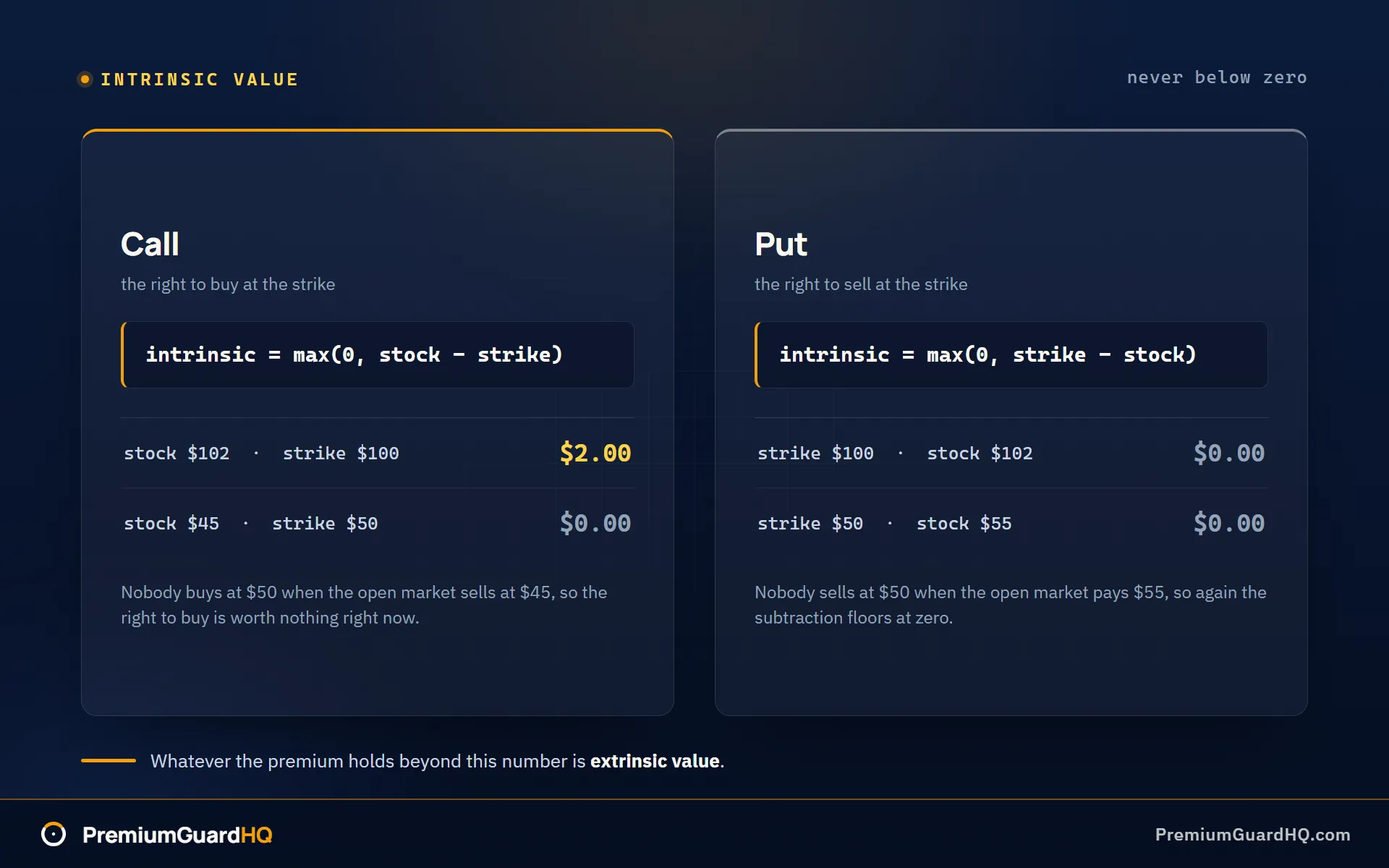
Intrinsic value is what a contract would be worth if you used it right now instead of selling it. Using a contract this way is called exercising it. Intrinsic value is not a guess about the future. It is a simple comparison between the stock price and the strike price, done today.
For a call, the math is simple. A call gives you the right to buy stock at the strike price.
Call intrinsic value = max(0, stock price − strike price)
For a put, flip it. A put gives you the right to sell stock at the strike price.
Put intrinsic value = max(0, strike price − stock price)
“Max(0, …)” means you pick whichever number is bigger: zero, or the result of the subtraction. Intrinsic value can never drop below zero. Here is why that makes sense.
Say a call has a strike price of $50, but the stock trades at $45. Nobody would use that call to buy at $50 when they could just buy the stock for $45 on the open market. So the right to buy is worth nothing right now, and intrinsic value is 0, not negative. The same logic applies to puts. If the strike is $50 and the stock is at $55, nobody would use the put to sell at $50 when they could sell for $55 instead. Intrinsic value is 0 again.
This matters to you as a seller because it tells you what kind of payment you are actually collecting. If most of your premium is intrinsic, you are not getting paid much for risk or time. You are mostly collecting built-in exercise value. This usually happens on contracts deep in the money, meaning the stock price has moved far past the strike in the buyer’s favor. If intrinsic value is 0, every dollar of premium you collect is extrinsic. Extrinsic value is the part that pays you for time and uncertainty, which the next section covers.
One quick check: in a normal, liquid market, premium should never sit below intrinsic value. If you ever see that, something is off with the quote, not with the math.
Extrinsic value: what moves the part of premium you actually earn or give back
Extrinsic value is what’s left after you subtract intrinsic value from premium. Premium equals intrinsic value plus extrinsic value, so extrinsic value equals premium minus intrinsic value. As a seller, this is the part you’re actually paid for. It’s the fee for carrying risk between now and expiration, the date the contract ends. You will also see it called time value, the part of a premium tied to the days still remaining.
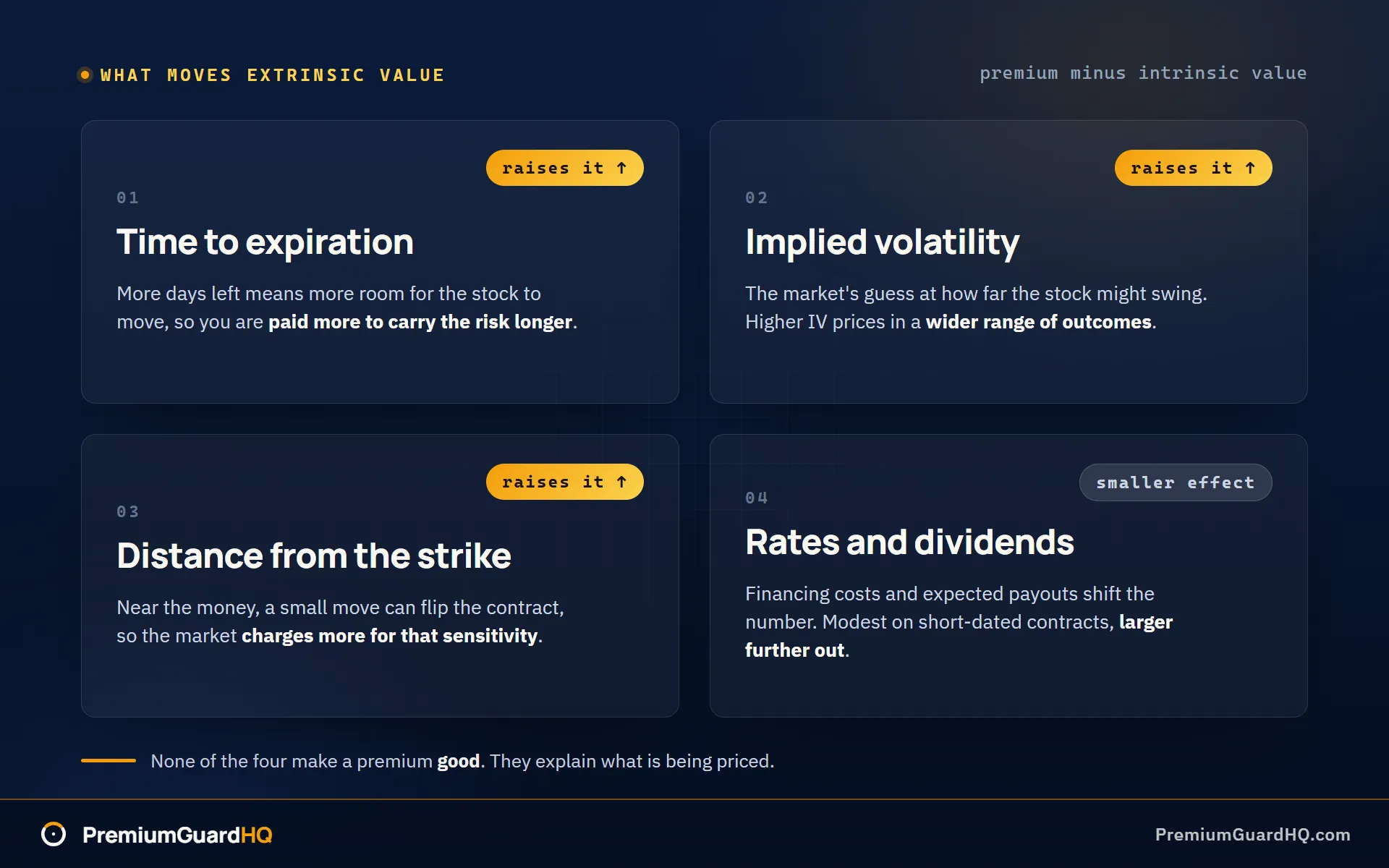
Four things move it. Learn these four and a premium quote stops being a mystery.
1. Time to expiration. More days left on a contract usually means more extrinsic value, because there’s more room for the stock to move around before the contract ends. As a seller, more time means you’re holding risk for longer. You get paid more to do it.
2. Implied volatility. This is the market’s guess at how much the stock might swing before expiration. Higher implied volatility usually means higher extrinsic value, because the market expects bigger moves. A high premium from high implied volatility is payment for carrying more risk. The market is pricing in a wider range of outcomes, and you’re the one holding the exposure if the stock lands on the bad side of that range.
3. Distance from the strike. This means how close the stock price sits to the strike price, the price written into the contract. Contracts near the money, where the stock price sits close to the strike, tend to carry more extrinsic value. A small move in the stock can flip these contracts from worthless to valuable, so the market charges more for that sensitivity. As a seller, a strike close to the stock price means you’re selling a contract that can more easily move against you.
4. Interest rates and dividends. This effect is smaller, but it’s real. For many short-dated stock options, the impact is modest. Expected interest rates and dividend payments change the cost of holding stock versus holding an option on that stock, and that shows up in the premium. Not every price difference between contracts is about volatility. Some of it is financing costs and expected cash payouts getting baked into the number.
We’re not deriving the full pricing model here. How implied volatility and rates plug into a pricing formula is a separate question from what the premium is made of.
None of these four factors make a premium “good” or “attractive.” They just explain what’s being priced and why.
Worked example: splitting a premium into intrinsic and extrinsic value
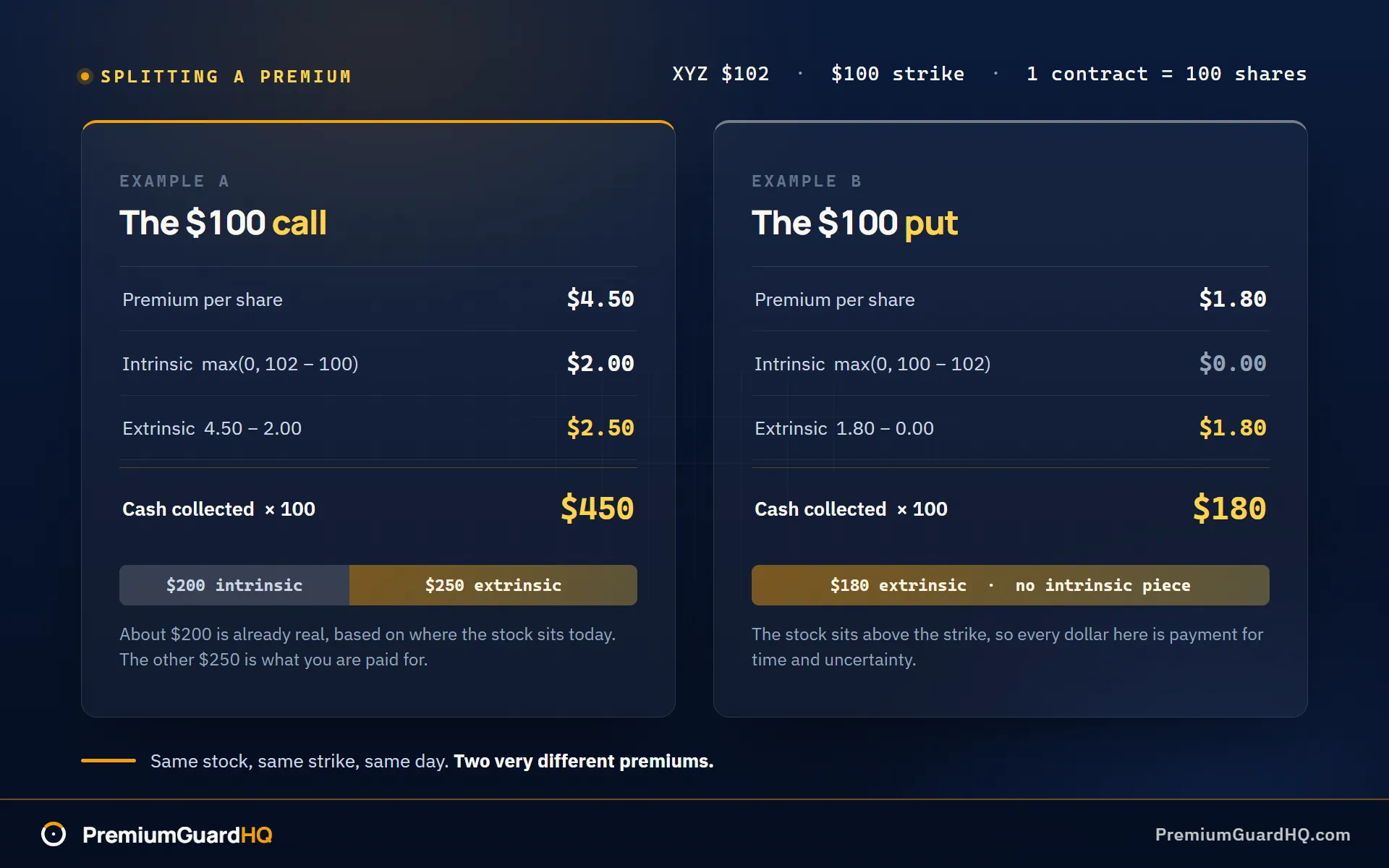
Here is the math in action. Picture a made-up stock called “XYZ” trading at $102 a share. We will look at one standard option contract, which always covers 100 shares.
Example A: a call option. A call option gives someone the right to buy the stock at a set price, called the strike price. Say the $100 strike call is trading at a premium of $4.50 per share. Premium is the price you pay or collect for the option. Plug the numbers into the intrinsic value formula:
Call intrinsic value = max(0, 102 − 100) = $2.00
That $2.00 is real value right now, because the stock is already $2 above the $100 strike. Subtract that from the premium to get extrinsic value, the part of the price not explained by current stock price alone:
Call extrinsic value = 4.50 − 2.00 = $2.50
Now translate this for a seller. One contract covers 100 shares, so your total cash collected is 4.50 × 100 = $450. About $200 of that is intrinsic value. That part is already “real,” based on where the stock sits today. The other $250 is extrinsic value. That is the part you are paid for: carrying risk while time runs out on the contract.
Example B: a put option. A put option gives someone the right to sell the stock at the strike price. Look at the $100 strike put on the same stock, trading at $1.80 per share. Plug into the same formula:
Put intrinsic value = max(0, 100 − 102) = $0.00
The stock is above the strike, so the put has zero real value right now. That makes extrinsic value simple to find:
Put extrinsic value = 1.80 − 0.00 = $1.80
As a seller, every dollar here is extrinsic. Your $180 per contract is pure payment for time and uncertainty, with no locked-in value underneath it.
Use this one test on any option premium you see: how much of what I collected is intrinsic, already real today, and how much am I being paid just to carry risk over time? You can run the same split on a contract you are actually looking at.
Frequently asked questions
If an option is out of the money, why does it still have a premium?
Because the premium is not just about value right now. An option is out of the money when its intrinsic value is 0. That means a call’s strike sits above the stock price, or a put’s strike sits below it. Even with zero intrinsic value, the contract can still carry extrinsic value as long as time is left before expiration and the market prices in some uncertainty. In fact, an out-of-the-money premium is entirely extrinsic value by definition. There’s no intrinsic piece to subtract.
Do option sellers get the premium right away?
Yes, in most cases. When your sell order fills, the premium usually lands in your account right then. But that credit is only your starting cash. The position can still move against you before it closes, you can buy it back later for more than you sold it, or it can expire worthless. Your real profit or loss depends on how the trade ends, not just on what you collected the day you opened it.
Why can two options with the same expiration date have different extrinsic values?
Mainly because of strike distance and implied volatility. A strike sitting close to the current stock price usually carries more extrinsic value than one sitting far away, since a small stock move can flip a near-the-money contract’s value. On top of that, real markets often price different implied volatility levels across different strikes on the same stock. So even with identical expiration dates, two contracts can carry very different time and risk pricing.
How do interest rates and dividends affect option premium?
They nudge the price without you needing to run a pricing model yourself. Expected interest rates and dividend payments shift the relative pricing between calls and puts and can add or subtract from extrinsic value. The effect is usually small on short-dated contracts, but it grows more noticeable on longer-dated ones. The full mechanics belong to the pricing model itself rather than to the split between intrinsic and extrinsic value.