
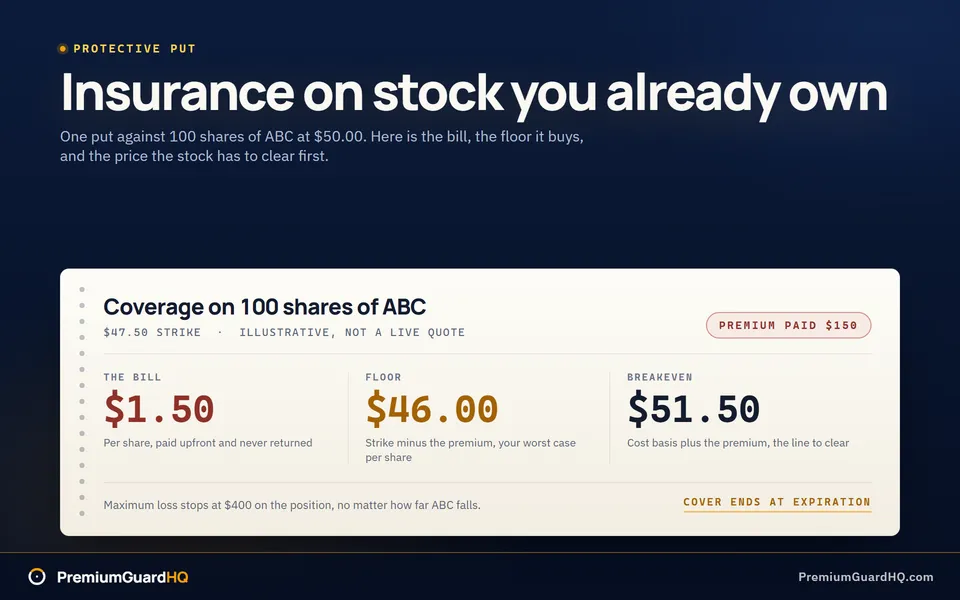
You own shares you plan to keep. A sharp drop should not erase your gains. A protective put is insurance for your stock. You pay a fee, called a premium. That fee gives you the right to sell your shares at a fixed price, no matter how low the stock falls.
By the end, you will know three numbers: what this protection costs, your worst-case loss, and your new breakeven price.
The premium is the insurance bill itself.
First, the definition.
What is a protective put?
A protective put pairs shares you already own in a stock or ETF with a put option on that same stock. The put bounds your downside for a set window. You keep all the upside the shares produce. The only cost is the put premium.
In plain terms, owning the stock plus owning the put equals crash insurance. The put gives you the right to sell shares at a fixed price, called the strike price, no matter how far the stock falls. You pay a premium upfront for that right. If the stock never declines enough for you to use it, the put expires and the premium is gone. Our guide on what is a put option covers the underlying term in more detail.
How a protective put works step by step
Step 1: Confirm what you are protecting. You need to own the shares already. A protective put only works on stock you hold now. The standard position is 100 shares for each put contract, and one contract always covers exactly 100 shares.
Step 2: Pick the put contract. Choose a strike price. That is the price you can sell at, no matter how far the stock drops. Choose an expiration date too. The protection lasts until that date, then it ends. You pay a premium to buy the put, and that premium is your insurance bill.
Step 3: Buy the put. The trade costs money upfront, so cash leaves your account immediately. Traders call this a debit.
Step 4: Watch what happens next. If the stock price rises, you keep all the gains on your shares. The put may lose value as expiration approaches, and it can expire worthless. That is normal. If the stock price falls below your strike, the put usually gains value instead. Near expiration, you have three choices. Sell the put for cash, use it to sell your shares at the strike price, or let it expire if nothing is left.
One related term worth knowing is that some traders sell a covered call alongside the put to help cover its cost. That combination is called a collar.
What the insurance costs and what it buys
Let’s put real numbers on this. The premium is the price of the put, and you cannot skip paying it.
For one put contract, the cost is:
Premium paid in dollars = premium per share × 100
One contract covers 100 shares. If the put costs $3 per share, you pay $300 in total. That cash leaves your account immediately. You do not get it back, even if the put expires unused.
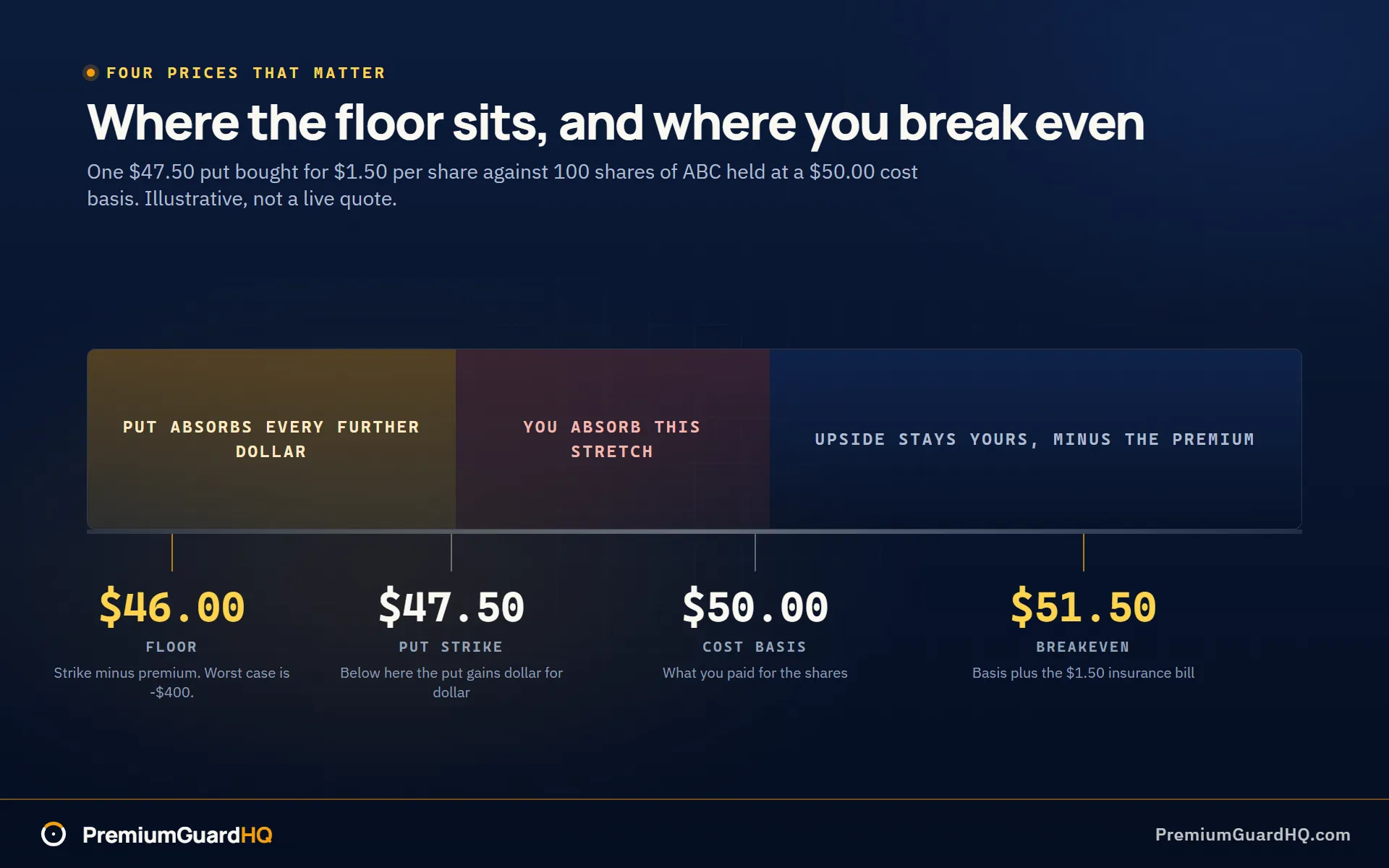
What does that $300 buy? It buys a floor for your shares. The strike price is the price you can sell at until expiration, no matter how low the stock goes. Your real floor sits a little below the strike, because the premium already came out of your pocket.
Floor price = put strike - premium paid per share
If your strike is $95 and you paid $3 per share, the true floor is $92, not $95. You absorb losses all the way down to the strike. Then you lose a little more because the insurance itself had a cost.
The put also lifts your breakeven. Breakeven is the stock price you need just to get your money back. If your original cost per share is B and you paid P per share for the put, breakeven is B + P.
Say you bought the stock at $90 and paid $3 per share for the put. The new breakeven is $93. The stock now has to climb three extra dollars just to offset the insurance.
Strike choice is a trade between cost and protection. A strike close to the current stock price costs more but sets a higher floor. A strike farther below costs less, but the stock can fall more before the put provides much help.
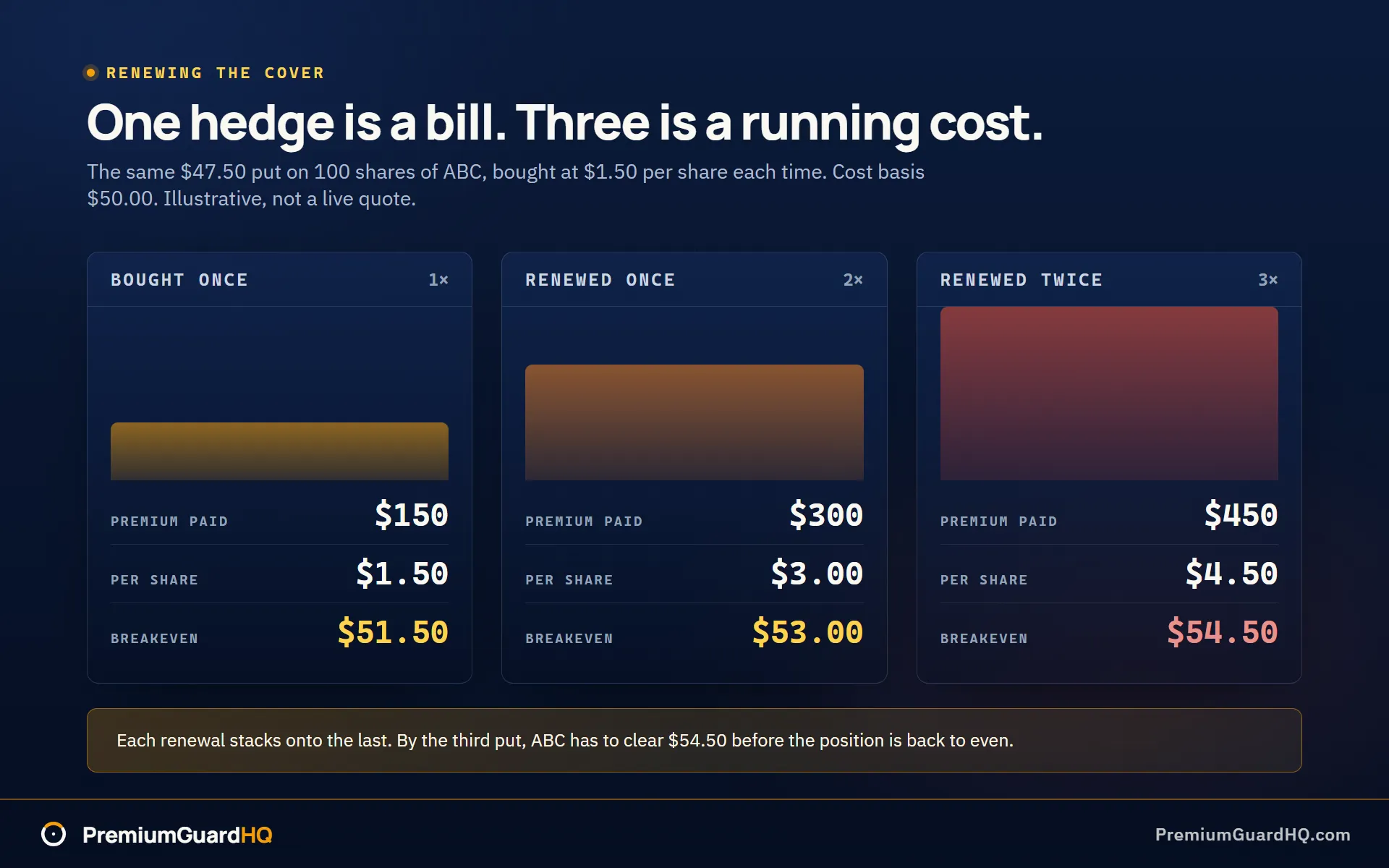
Time works the same way. A put with a longer expiration usually costs more because it protects you longer. A short-dated put looks cheaper today, but if you renew it every few weeks to stay covered, those premiums become a real recurring expense. The worked example below shows both a single put purchase and the cost of renewing it several times.
Want to check your own numbers before you commit? Put the strike, premium, and expiration into our options profit calculator to see your floor and breakeven ahead of time.
A worked example you can check line by line
Illustrative example only. Not a live quote. The numbers below use a made-up stock, ABC. None of this is live market data.
You own 100 shares of ABC. Your cost basis is $50.00 per share. ABC still trades at $50.00 today. You buy 1 put contract with a strike price of $47.50, which is the price you could sell at. The premium, the amount you pay for the put, is $1.50 per share. One contract covers 100 shares, so the cost is $1.50 times 100, or $150. Broker fees are left out to keep the math simple.
Two numbers matter most here. The breakeven is $50.00 plus $1.50, or $51.50. The stock must reach $51.50 for you to break even. The floor is $47.50 minus $1.50, or $46.00. That is your maximum loss per share, no matter how far the stock falls.
The table below shows three possible prices when the put expires and the contract ends.
| ABC ends at | Stock gain or loss | Put result | Net result |
|---|---|---|---|
| $60.00 | +$1,000 | Expires worthless, -$150 | +$850 |
| $47.50 | -$250 | Worth about $0 | -$400 |
| $40.00 | -$1,000 | Worth $750 | -$400 |
Notice that $40.00 and $47.50 both land on a -$400 net loss. That is the floor doing its job. Once the stock drops below the strike, the put’s gains cancel the stock’s losses dollar for dollar. The only leak left is the $150 premium.
Now add the renewal cost. Say you buy this protection three times, paying $1.50 per share each time. Total premium paid is $150 times 3, or $450. Spread across 100 shares, that is $4.50 per share. The stock must climb $4.50 higher just to earn back the insurance cost. One hedge is a single bill. Renewing it over and over turns into a recurring cost that compounds the drag.
Strike price, time, and market swings will move these numbers around. This example only shows the mechanics and the math.
Frequently asked questions
Is a protective put the same thing as a married put? Not quite. The mechanics match, but the timing differs.
- A protective put means you already own the shares and buy the put later.
- A married put means you buy the shares and the put on the same day, as one combined trade.
How many put contracts do I need for my shares? One contract covers 100 shares, which is the standard size for stock options.
- To cover all your shares, divide your share count by 100.
- Round down to a whole number. If you own 250 shares, 2 contracts cover 200 of them, and the other 50 shares stay unprotected.
Can I sell the put instead of exercising it? What happens at expiration? Yes. You can sell the put to someone else before expiration, as long as it still has value. That closes the option position and locks in a gain or loss without touching your shares.
- At expiration, the put is either in the money, meaning it has value because the stock is below the strike, or out of the money, meaning it expires worthless because the stock is above the strike.
- Selling early simply converts that value to cash sooner.
How is this different from a collar? A collar adds a third leg. You still own the stock and still own the put, but you also sell a call option against your shares. That is what adding a short call does to the structure.
- The cash from selling that call can offset part of the put’s cost.
- Selling a call caps your upside, though. See what capping your upside actually costs for how that trade-off works.
Want the premium math to stay clean across every position you hold? PremiumGuardHQ can track your trades from a connected broker, so your floor and breakeven update automatically as positions move.