
Ask ten traders how much money you need to trade options and you will hear ten different numbers. One person says $5,000. Another says $50,000 or stay out. Both answers are partly right and mostly useless, because neither person first asked which trade you want to place.
The wheel strategy is one way to trade options. First you sell puts to try to buy shares at a lower price. Once you own the stock, you sell calls against those shares. Each put or call is a contract linked to 100 shares of stock.
The answer changes with the trade you are placing. A cash secured put requires you to set aside cash in case you end up buying the stock. A covered call works the other way: you already own 100 shares and you sell someone the right to buy them from you. Each trade ties up a different amount of money.
There is a second hurdle most people miss. Your broker must approve your account for a particular options level before you can place either trade, regardless of how much cash is in the account.
After you finish this, you can find your own minimum in about 10 seconds flat. You need three numbers: the strike price, the share price, and your approval level. The exact math starts with the definition below.
How much money do you need to trade options
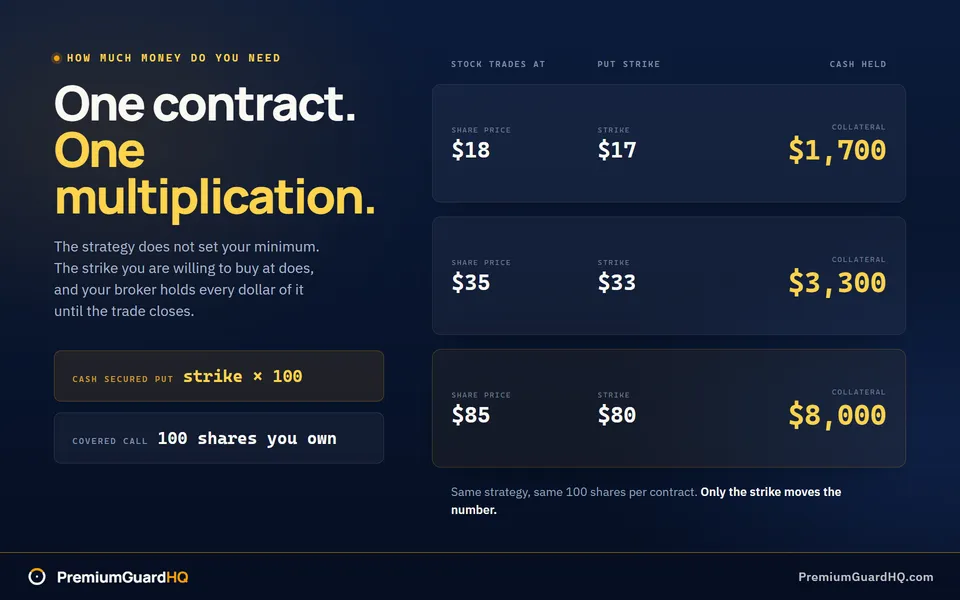
How much money you need to trade options depends on the strategy you choose. To sell one cash secured put, your broker sets aside the strike price times 100 as collateral. In practice that usually lands between about $1,700 and $8,000 per position, and the strike price you pick is what moves it.
That range is not an invented starter account number. The stock price and the strike price you choose drive it. A $25 stock and a $100 stock produce very different minimums even though the strategy stays the same.
A covered call works differently. It is a promise to sell stock you already own at a set price. To make that promise, you need 100 shares of the stock, and that share position is often the larger of the two costs.
Cash alone does not clear the second hurdle. Your broker still has to approve your account for the strategy you want to run. That approval is a permission level tied to your experience and account size. Covered calls and cash secured puts usually require a lower approval level. Spreads and uncovered options require a higher one, even if the account holds a lot of cash.
How the money requirement shows up at your broker: cash, buying power and approvals
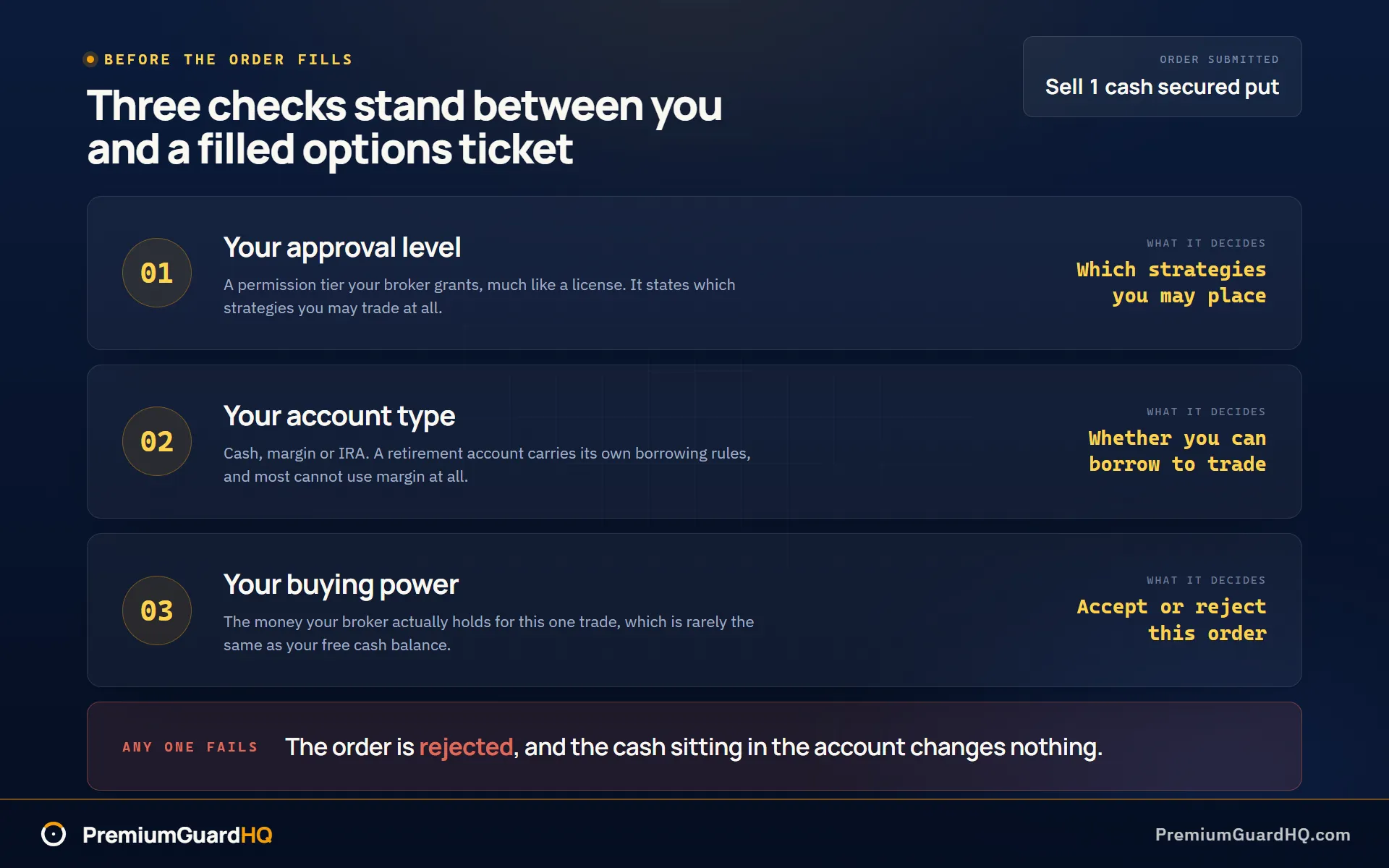
Before your broker accepts an options trade, it runs through three checks.
Check one: your approval level. Your broker grants this permission tier, much like a license, and it states which strategies you may trade. Covered calls and cash secured puts normally sit in a lower tier. A covered call gives someone else the right to buy stock you already own. A cash secured put sets aside cash to buy shares at a set price if you are assigned. Spreads and naked options, which can risk more than the account can comfortably cover, require a higher tier.
Check two: your account type. A cash account operates differently from a margin account, where you may borrow money to trade. A regular taxable account also differs from an IRA, a retirement account with its own borrowing rules.
Check three: your buying power. Buying power is the amount of money your broker will actually hold for that one trade. The broker accepts or rejects your order based on that number.
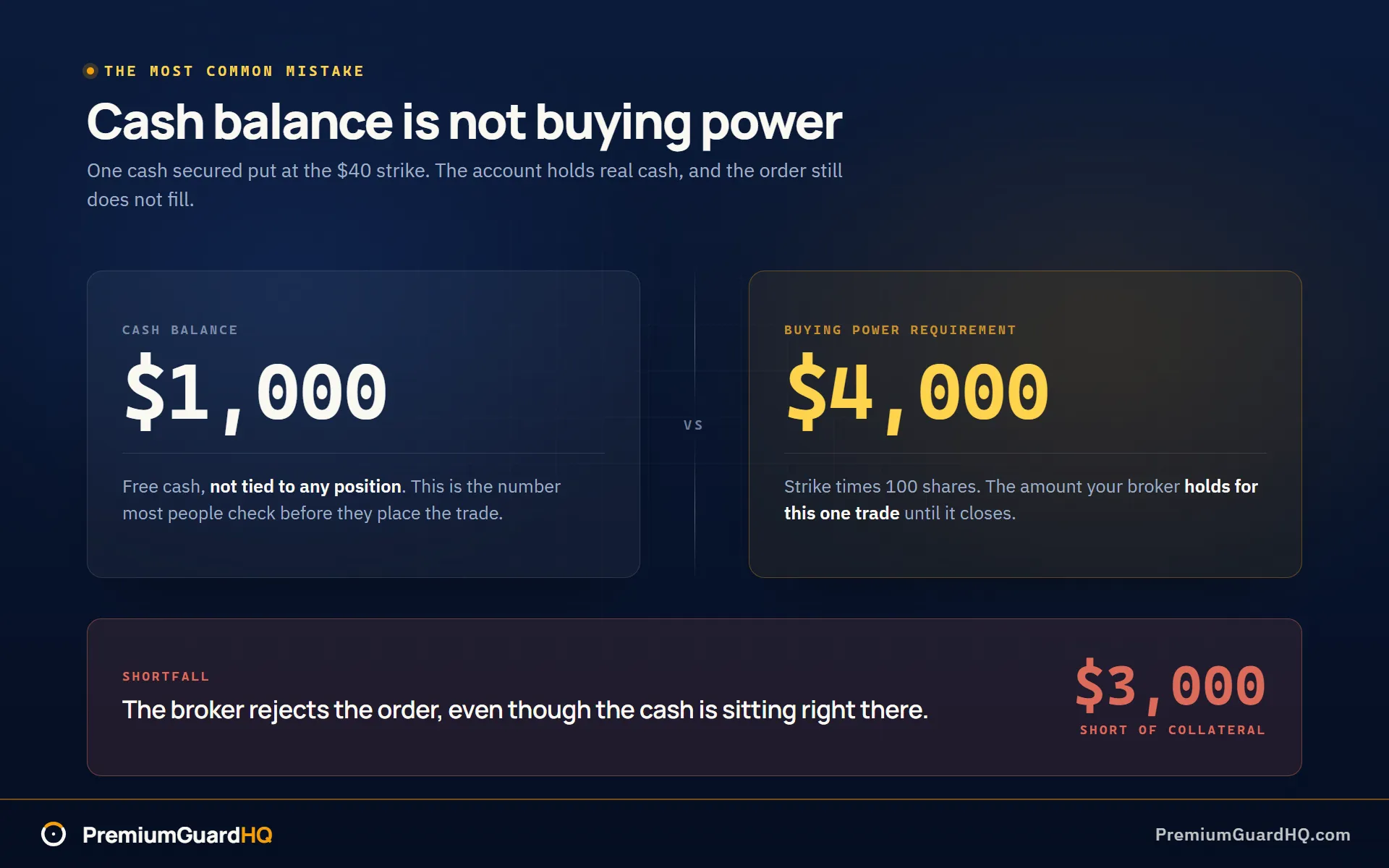
This is where two balances get confused. Your cash balance is free cash that is not tied to any position. Your buying power requirement is the amount held for one specific trade. Those two numbers often differ, and confusing them is the most common mistake new traders make.
These amounts get held on common first trades:
- Buying a call or put: You pay the premium, the price of the option, up front. Your maximum loss is that premium.
- Selling a cash secured put: Your broker holds the strike price times 100 shares. If you have $1,000 in cash but the strike times 100 equals $4,000, the broker rejects the order even though cash is sitting in the account.
- Selling a covered call: Your broker first checks that you already own 100 shares of the stock. If you do not own the shares, there is no trade.
One more wrinkle: most IRAs cannot use margin to borrow money. Your approval level may stay limited even when the account has plenty of cash.
The only calculation that matters: contract size, collateral and approval levels
One fact makes the rest of this math simple. In the US, the fixed 100-share unit behind every stock option never changes, and every dollar figure that follows comes from it.
Case A: you buy options. When you buy a call or a put, your cost is the premium times 100. The premium is the price tag on the option and is quoted per share. A $2.00 premium therefore costs $200 for one contract, plus a small broker fee. That $200 is your entire risk. This is the same math behind any stock options calculator: premium times 100, then multiplied by the number of contracts. Our free tool for pricing one contract at a given premium runs it both ways, for options you bought and options you sold.
Case B: you sell a cash secured put. Your broker holds the strike price times 100 per contract. The strike price is the price at which you agree to buy the stock if you are assigned. Cash secured means the broker locks up that cash so you can pay for the shares if assignment happens. Assigned means you must buy the shares at the strike price. The locked cash is not just sitting there for display. It stays unavailable for any other use until the trade closes. To see the exact cash a given strike ties up, put the strike and the premium side by side before you place the order.
Case C: you sell a covered call. Before you can sell the call, you need to already own 100 shares per contract. In dollars, the real capital requirement is the share price times 100, because that is what the shares cost you in the first place.
Bringing it together for the wheel. If you run the wheel strategy described above, the true starting cost is the cost of owning 100 shares of a stock you would be glad to hold, rather than the premium you collect. Your per-position minimum is roughly the strike or share price you choose, times 100.
The approval requirement. None of this math matters if your broker has not cleared you to trade it. Brokers assign traders to tiers. Firm names differ, but the shape is the same everywhere.
- Covered calls and cash secured puts usually sit in the lowest seller tier.
- Spreads, which pair two options together to limit risk, usually need a margin account and a higher tier.
- Naked options, where your risk is not capped by shares or cash, sit in the most restricted tier of all.
Brokers are not only counting your dollars here. They also review the trading experience you report and your account goals. If you want to see how the big brokers handle options approval before you open an account, the tiers and the paperwork differ more than the pricing does.
One quick note on margin calculators. An options margin calculator estimates the same buying power math before you submit your order, and it will show how that number shifts when you adjust the trade. Before sending any order, look at your broker’s own preview screen. That screen gives the most accurate number you will get.
Worked example: the wheel minimum is the stock price times 100
Assume you want to run the wheel with one contract on a stock you would be glad to own. In the loop that runs from a short put into covered calls, you sell a put to collect cash. If you are assigned the stock, you sell calls on it until the shares are sold, and then you repeat. The real cash requirement at three price points looks like this.
A cheaper stock. The stock trades at $18 a share. You sell a cash secured put at the $17 strike, which means you have promised to buy 100 shares at the strike price. Your broker holds the cash behind that promise. Strike times 100 shares equals $1,700 held back. If the stock falls and you must buy, that event is called assignment. You now own 100 shares, paid for with the cash that was already held. The next step, selling a covered call, uses those same 100 shares. The real minimum was the $1,700 locked up the whole time, not the $0.30 premium you collected from the put.
A mid-priced stock. The stock trades at $35. You sell a cash secured put at the $33 strike. That holds back $33 times 100, or $3,300. If you are assigned, you own 100 shares and move straight into selling a covered call. The share count stays fixed at 100 shares per contract, whatever the stock price.
A higher-priced stock. The stock trades at $85. A cash secured put at the $80 strike holds back $80 times 100, or $8,000. The steps and share count stay the same; only the locked-up number grows.
All three scenarios point to the same rule. For one contract, the wheel cash requirement is roughly the strike price you are willing to buy at, times 100. Choose the least expensive stock you would actually be comfortable owning, then multiply that price by 100. That gives your starting requirement for one position, before you spread money across multiple stocks.
Frequently asked questions
Do you still need $25,000 to trade options or day trade in 2026? No. For years, traders repeated a $25,000 rule as if it covered all options trading. That number came from an old pattern day trader rule, and it applied only to frequent stock and option day traders, not to the wheel or ordinary options sellers. As of June 4, 2026, FINRA rule changes removed that old day trading label and its $25,000 minimum entirely, replacing them with the intraday margin standard that took its place. Brokers still monitor account equity against your positions through the trading day and apply their own margin rules. Losing the $25,000 minimum does not mean there are no rules.
Why did my broker reject the order even though I have enough cash? Most rejections come from one of two causes. First, your account may not have the right approval level for that trade. An approval level is a permission tier your broker sets from your experience and goals, and it controls which strategies you may place. Second, you may have cash but not the right kind of collateral. A covered call order will be rejected if you do not already own 100 shares, even with plenty of cash in the account. Each broker uses its own label for these tiers, but the gate works the same way everywhere.
Can I trade options inside an IRA or Roth IRA? Often, yes, for defined-risk strategies such as cash secured puts and covered calls. An IRA is a retirement account with its own tax rules. Most brokers limit what you can do inside one because IRAs usually cannot borrow on margin the way a regular brokerage account can. That rules out uncovered, or naked, option trades in most cases. The actual limit comes from the strategies your broker allows inside that specific account type, not from your cash balance.
What is an options margin calculator and what should I look at before placing a trade? It is a tool that estimates how much buying power or collateral your broker will hold for a trade, using that broker’s own rules. Before you submit an order, check three things on the preview screen: the required buying power, your maximum possible loss if the trade has one, and whether the trade adds to or reduces your available buying power. Your broker’s own preview always beats any outside calculator, because it reflects that broker’s exact rules.