
Quick note before we start: this is general education, not tax advice. Your own situation has details only a CPA can check. Talk to one before you file.
Here’s the problem. You pull up your broker history and see two covered call tax treatment cases that look the same. A covered call is a promise to sell stock you already own at a set price. You get paid up front for making that promise, and that upfront payment is called the premium. Both trades show the same ticker, the same premium, and roughly the same timing.
But one gets taxed as a short-term gain, meaning profit taxed at your regular income rate because you held the stock a year or less. The other flips your stock’s entire holding period, even the months you owned it before you sold the call. A third case quietly blocks a loss you were counting on. That happens because of the wash-sale rule, a rule that disallows a loss if you buy a similar position too soon before or after selling at a loss. Same-looking trades, three different outcomes.
By the end, you’ll be able to spot these three outcomes on sight. You’ll know what “qualified” and “unqualified” mean for your holding period, and you’ll catch the wash-sale trap before it costs you a deduction. Everything below reflects the rules in IRS Publication 550 and the Form 8949 instructions, read from the most recent revisions the IRS has published.
What is covered call tax treatment?
Covered call tax treatment is how the IRS taxes the premium you collect and the stock you may sell when you write a call against shares you own. You owe tax only when the position resolves, not when you collect the premium, and the result is usually a capital gain or loss.
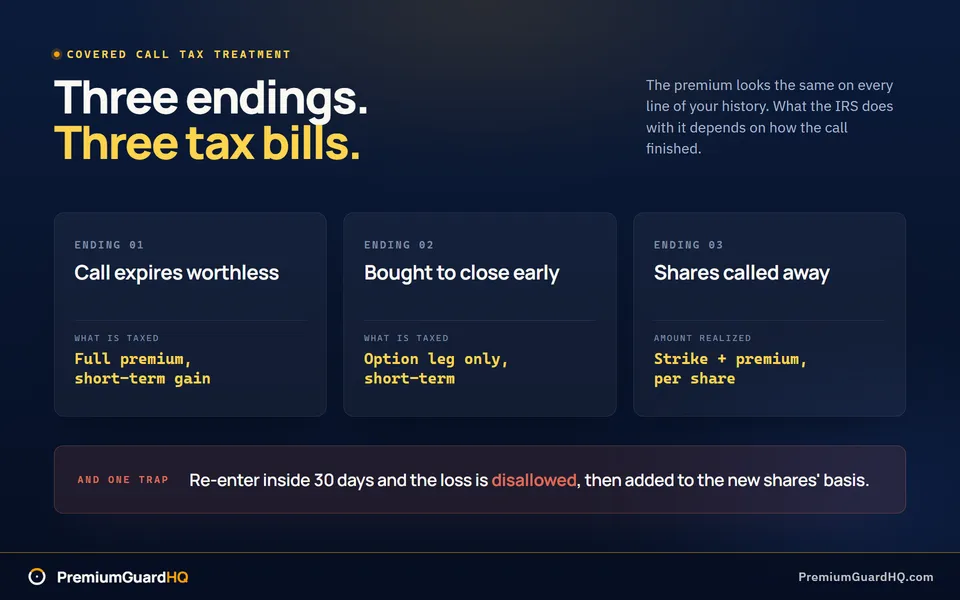
That resolution happens in one of three ways. The call expires worthless, you buy it back early, or your stock gets sold out from under you at the strike price. This last outcome is called assignment. It means the person who bought your call used their right to buy your shares. Each path has its own tax result, which the next section walks through in detail.
How covered call taxes work in a taxable account: the three outcomes
This section covers regular U.S. investors trading in a taxable brokerage account, meaning a normal account and not a retirement account like an IRA. It does not cover employee stock options. It also does not cover broad-based index options, which fall under special Section 1256 rules.
A short call, meaning the call option you sold, can only end three ways. Here is what each one does to your taxes.
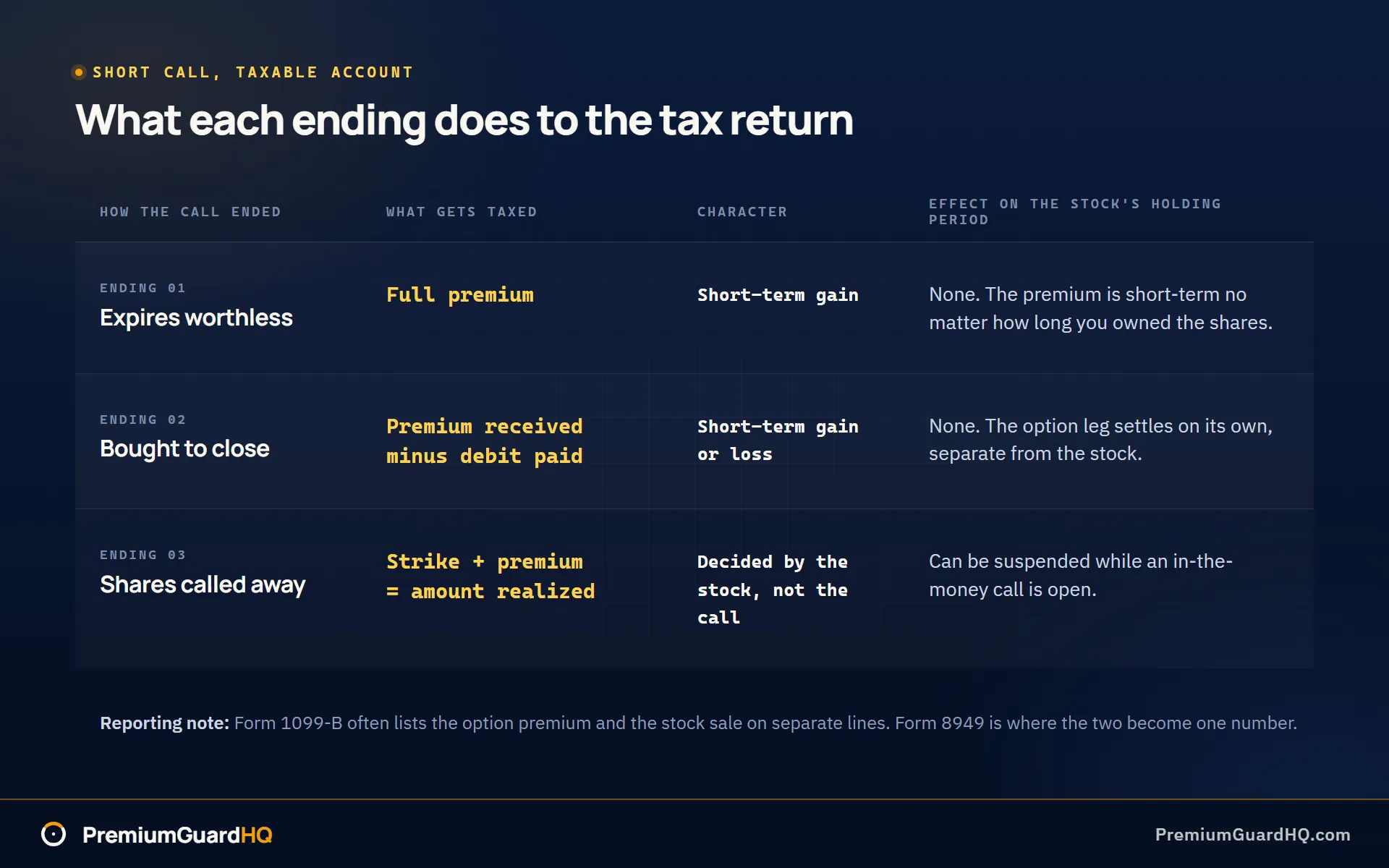
Outcome 1: The call expires worthless. The stock stayed below your strike price, the price at which the buyer could purchase your shares. The buyer never used their right to buy, so you keep the whole premium, the payment you collected upfront for selling the call. The IRS treats this premium as a short-term capital gain no matter how long you owned the stock underneath it. Short-term gains get taxed at your regular income rate, not the lower long-term rate.
Outcome 2: You buy the call back early. This is called “buying to close.” Whatever you paid, compared to what you collected when you sold it, is a short-term gain or loss on the option itself. This is separate from anything happening with your stock.
Outcome 3: Your shares get called away. This means the buyer used their right to buy, and your stock gets sold at the strike price. FINRA describes the seller’s obligation once a call is assigned as delivering the shares at the exercise price. The premium you collected gets added to that sale price. Your amount realized, the total counted as your sale proceeds, equals the strike price plus the premium, per share.
Whether that stock sale counts as short-term or long-term depends on how long you held the shares, not on the option. If the mechanics of that third ending are new to you, start with how a short call actually gets assigned. There is also an exception to this rule involving qualified versus unqualified covered calls, which a later section covers in full.
The rule you cannot blur. If you sell a cash-secured put, meaning you promise to buy shares at a set price and set aside the cash to do it, and that put gets exercised, the premium you collected lowers your cost basis in the new shares. Cost basis is the number used to figure your gain or loss later. But if that same put simply expires worthless, no shares change hands, so there is no basis to adjust. The premium just becomes a short-term gain on its own.
One practical note: your broker’s Form 1099-B often reports the stock sale and the option premium as two separate lines. You may need to adjust this yourself on Form 8949 to show the true combined result.
Qualified vs unqualified covered calls: the holding period pause that changes your tax rate
Here’s a wrinkle that trips up a lot of traders. Your stock sale isn’t always taxed based on the simple answer to “how long did I hold the shares.” The IRS has a rule that can pause, or even wipe out, that clock. Which one happens depends on the option you sold against your stock.
This comes from straddle rules. These are IRS rules built to stop people from faking a loss by holding two positions that cancel each other out. A normal covered call would get caught in those rules. So the IRS made an exception for calls that meet certain conditions. A call that meets those conditions is a qualified covered call, or QCC, and the straddle rules leave it alone. A call that fails the test is an unqualified covered call, and the harsher straddle rules can apply. Publication 550 sets out the straddle rules and the qualified covered call exception in full.
What decides qualified versus unqualified? A big factor is how deep in the money your call is. In the money means the strike price, the price you agreed to sell your stock at, is below the stock’s current trading price. The IRS doesn’t use one simple percentage to define “too deep.” It uses a benchmark tied to the stock price and the time left on the option. This is called the qualified benchmark, or in some cases the lowest qualified benchmark. For a definitive answer on a specific trade, check IRS Publication 550 and the regulation itself, 26 CFR 1.1092(c)-1, instead of guessing.
Here’s what happens to your holding period in each case:
- At-the-money or out-of-the-money qualified call: Your stock’s holding period keeps running normally the whole time the call is open.
- In-the-money qualified call: Your holding period can be suspended while the call is open. The days the call is alive don’t count toward your one-year mark. The clock pauses, then starts again later.
- Unqualified call: The straddle rules can hit harder. Depending on your exact position, your holding period can be suspended or in some cases treated as starting over completely.
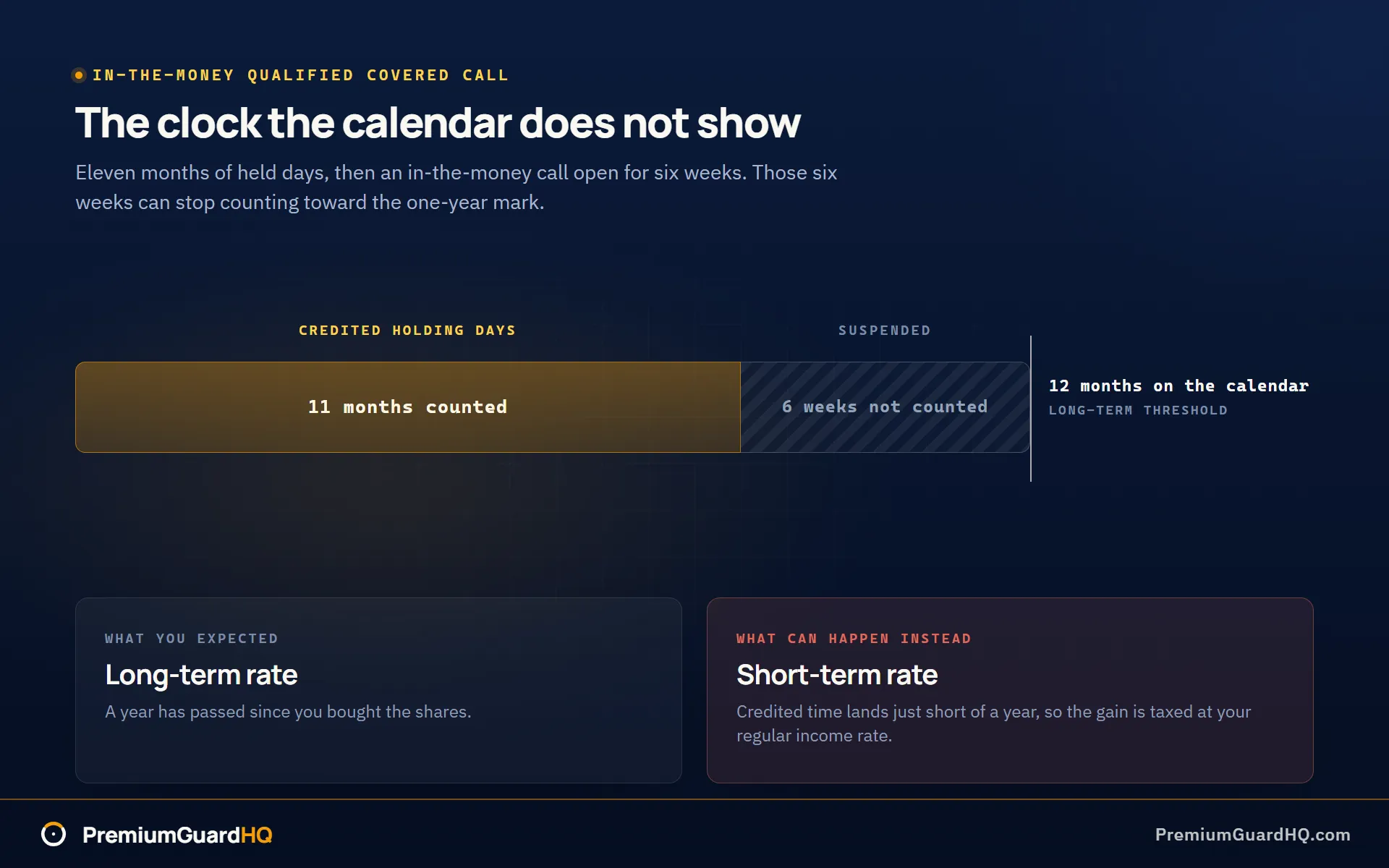
This matters because it can turn a sale you expected to be long-term into a short-term sale, just from paused days. Say you owned a stock for 11 months. Then you sold an in-the-money call that stayed open for 6 weeks before your stock got assigned, meaning the option buyer forced the sale. If those 6 weeks don’t count, your real credited holding time might land just short of one year, even though a full year has passed on the calendar. That difference matters a lot. Short-term gains are taxed at your regular income rate, which is often much higher than the long-term rate. Qualified dividends have their own holding-period rule too, and the same suspension logic can affect those, though that’s a separate topic.
Wash sales and covered calls: how a loss gets deferred when you re-enter too fast
Most traders know the wash-sale rule for plain stock trades. A wash sale is when you sell a stock at a loss and buy it back too soon. Far fewer know this rule can reach into your covered-call routine too.
Here’s the plain test. You sell a stock at a loss. Then, within 30 days before or after that sale, you buy the same stock again, or something the IRS calls “substantially identical.” If you do, the loss doesn’t count right now. Instead, that lost amount gets added to the cost basis of your new shares. Cost basis is the number used later to figure your real gain or loss. The loss is deferred.
Here’s what stock-only traders miss. The rule doesn’t stop at shares. It also counts buying a contract or option to acquire that same stock. An options trade can trigger the same 30-day trap a stock trade would.
One mix-up to clear up. Selling, or writing, a covered call is not the same as buying an option to acquire stock. Writing a call is a promise to sell, not a purchase. But wash-sale trouble still shows up in covered-call routines, because traders often rebuild their stock position, or use related options, inside that 30-day window.
Two patterns show up most often:
- Pattern A: You sell shares at a loss, then buy the same ticker back within 30 days to start writing covered calls on it again. Your earlier loss gets folded into the new shares’ cost basis instead of counting right away.
- Pattern B: You take a loss on one leg of a trade, either the stock or certain option positions, then reopen a very similar position inside that same window. This doesn’t happen every time. It’s a risk worth checking for.
That basis adjustment changes your numbers later. A higher cost basis means a smaller gain, or a bigger loss, whenever you sell the replacement shares or they get called away. Called away means your stock gets sold because someone exercised the call option against you. This is one reason cost-basis numbers on your broker’s screen can look inconsistent across lots after a busy stretch of options trading, and why keeping a running cost basis per lot is worth the effort before tax season arrives.
One guardrail. What counts as “substantially identical” isn’t always a clean line. It depends on the facts of your specific trades. When you’re not sure, IRS Publication 550 has worked examples, and a tax professional can walk through your actual positions with you.
Worked example: called away, then a wash sale eats your loss
These numbers are simplified to show the math clearly. Your real tax forms and what your broker reports can look messier.
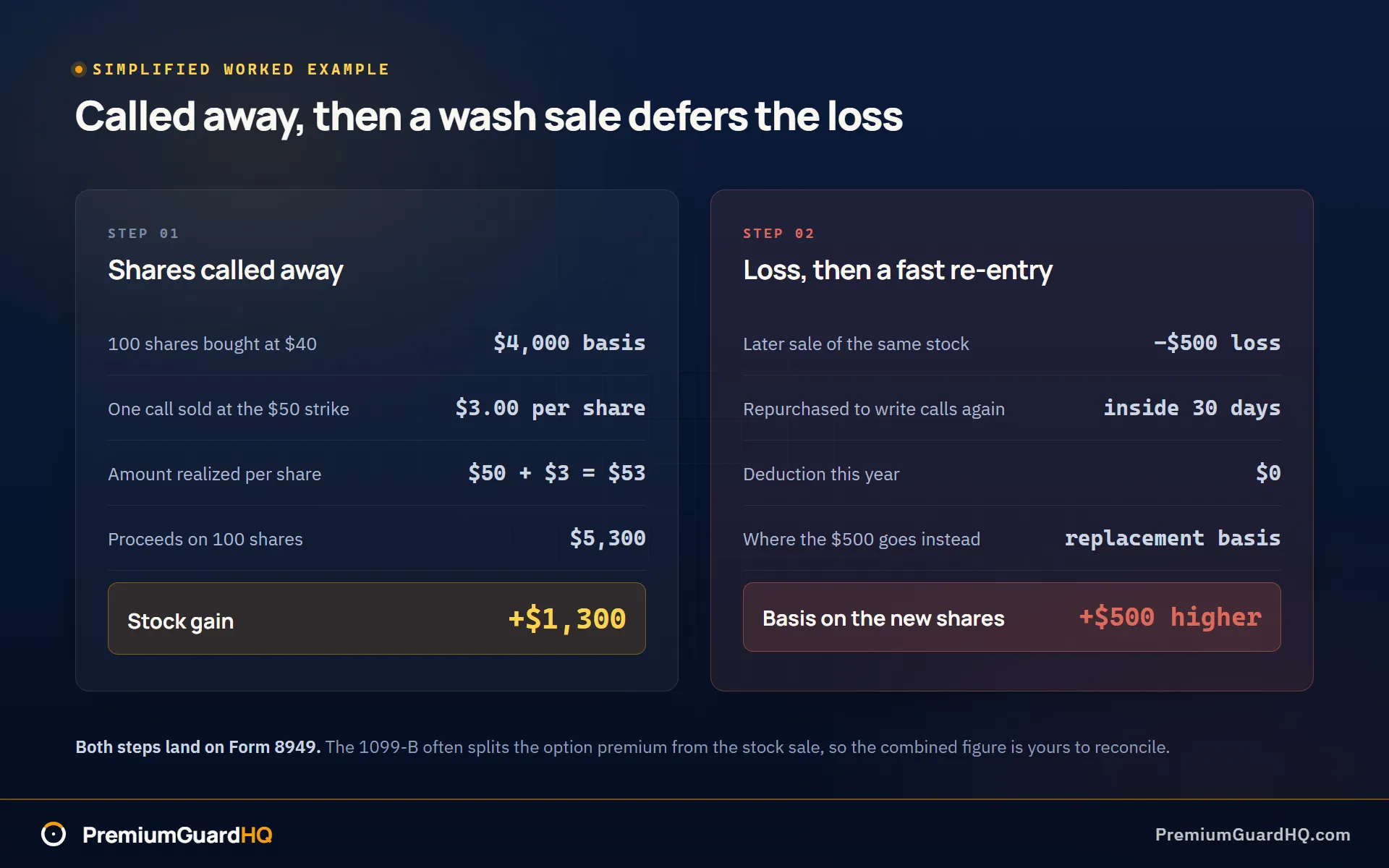
The setup. You buy 100 shares at $40 each. That’s $4,000 total, called your cost basis. Cost basis is what you paid. You’ll compare it against your sale price later to find your gain or loss. You sell one covered call, which covers 100 shares, at a $50 strike price. A strike price is the price you agree to sell at if the option gets exercised. You collect $3.00 per share upfront, or $300 total. This upfront payment is called the premium. Later, the stock gets called away, meaning your shares get sold at the strike price because the option buyer used their right to buy.
Step 1: your proceeds. When shares get called away, your amount realized per share equals the strike price plus the premium: $50 plus $3, or $53. Across 100 shares, that’s $5,300 total. Subtract your $4,000 cost basis and your stock gain is $1,300. If you would rather not do this by hand, you can run the called-away price and the premium through one calculation instead.
Whether that $1,300 is taxed as short-term or long-term depends on how long you actually held the stock. If you sold an in-the-money call, some of those holding days may not count, as covered earlier. That detail decides which tax rate applies to your $1,300.
Step 2: a wash sale. Later, you sell shares of the same stock at a $500 loss. Within 30 days, you buy the stock back to start writing covered calls on it again. That $500 loss gets disallowed right now, meaning you can’t deduct it this year. Instead, it gets added to the cost basis of your new shares. Your replacement shares now have a basis $500 higher than what you actually paid for them.
One reporting note: your broker’s 1099-B often splits the option premium and the stock sale onto separate lines. Form 8949 is where you reconcile the two into one accurate number.
Frequently asked questions about covered call taxes
Is covered call premium taxed the moment I sell the call?
No. You don’t owe tax the moment the premium hits your account. The IRS waits until the position resolves, meaning the call expires, you buy it back, or your stock gets called away. See “How covered call taxes work” above for what happens in each of those three cases.
If my covered call expires or I buy it back early, is that short-term or long-term?
For the option itself, it’s generally short-term. This holds true whether the call expires worthless or you buy it back before expiration. That’s the case even if you’ve owned the stock underneath for years. The option premium and the stock’s holding period are two separate things, and the option leg gets short-term treatment on its own.
When my shares get called away, do I report the premium as income or fold it into the stock sale?
You fold it into the stock sale. Your amount realized equals the strike price plus the premium you collected, per share. This becomes your total sale proceeds for that stock. Note that your broker’s Form 1099-B often reports the premium and the stock sale as two separate lines, so you may need to combine them yourself on Form 8949 to get the correct total. See the worked example above for the exact math.
How do wash sales mess up my cost basis when I keep wheeling the same stock?
If you trigger a wash sale, meaning you sell at a loss and buy the same or a substantially identical position back within 30 days, that loss gets disallowed for right now. Instead, it gets added to the cost basis of your replacement shares. This is why your broker’s displayed cost basis can look wrong if you’re not tracking each lot carefully. Traders who repeatedly sell and rebuy the same ticker to keep writing calls run into this often.
This article is general education, not tax advice. Confirm the details against your own trade history and broker tax forms with a qualified tax professional before you file.